Hygiene Adhesives Market Synopsis:
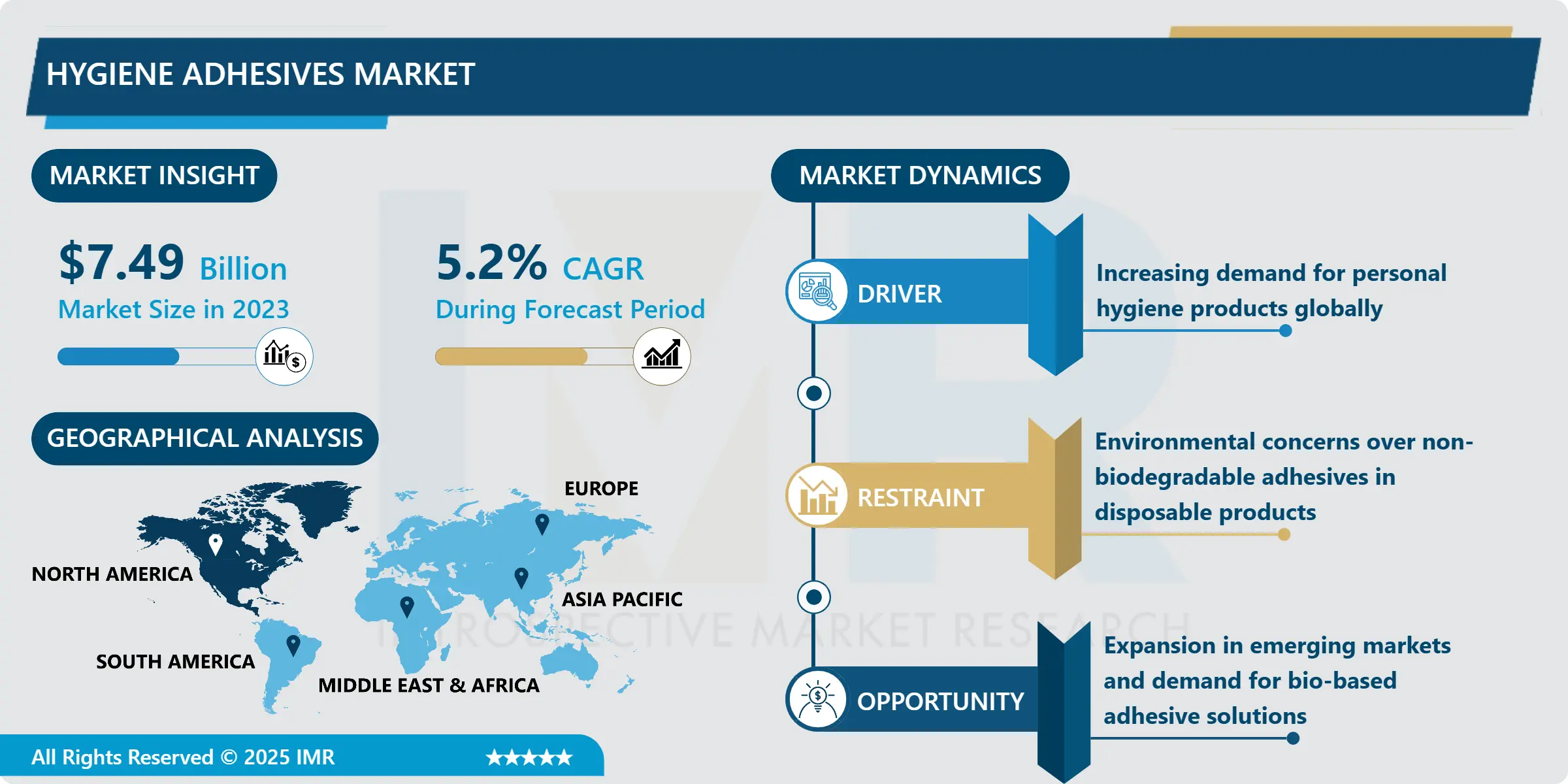
Hygiene Adhesives Market Size Was Valued at USD 7.49 Billion in 2023, and is Projected to Reach USD 11.76 Billion by 2032, Growing at a CAGR of 5.2% From 2024-2032.
The hygiene adhesives market therefore covers all adhesive products meant and developed for use on hygienic products like diapers, sanitary pads, incontinence products for adults, and medical bandages. They are being employed in processes where absorbent cores, elastic parts and other parts of the product need to be fastened for the product to remain comfortable to wear, secure and efficient in its fluid retaining purpose. They include commodity and health-care sectors and are manufactured to bear the comfort, safety and adhesion necessary in several important applications.
The global hygiene adhesives market has gained significant growth due to increasing concern of hygiene products across the developed and developing countries. A populous, overemphasized focus on personal health and hygiene in addition to demographic variations that are rapidly shifting due to aging has led to a high demand of enhanced hygiene goods; enhanced in this context refers to diapers for adults. Furthermore, the baby care segment remains a major contributor of the baby diaper requirements; more so in areas of the world that record high birth rates. The manufacturers within the market are nowadays more dedicated to improving the adhesive properties of these products to increase performance, minimize skin irritation preferences, and meet the green culture’s requirements. Consequently, novelties in structure of adhesive technologies are observed today, for example, hot melt adhesives, water adhesives.
Additional support to the growth of the market is the increase in disposable income among consumers and trend to urbanization which allows consumers to buy goods and services that fall under this market category. Hygiene adhesives are especially critical to making the products friendly for use and effective to support the ever-increasing population that desires and needs high-quality, comfortable, and convenience. Moreover, the growth of this market has found support from the recent advancements in the electronic commerce sector that has increased stock availability as well as the general knowledge about such products in even the most rural and remote corners of the country. However, new concerns of the environment and health impacts associated with their use have made firms to research for more eco-friendly, biodegradable adhesives and coatings for the forecast years.
Hygiene Adhesives Market Trend Analysis:
Growing Demand for Sustainable and Bio-Based Adhesives
- There is a degree of focus on green and bio- based adhesives in hygiene adhesives market as customers and industries turn to more environmentally friendly products. This change seems to have been prompted mainly by concerns of the environment, specifically the problems of pollution by plastics, and long-term effects of utilization of non-biodegradable resources linked to disposable hygienic products. To reduce the number of eco-failures bio-based adhesive that uses renewable sources instead of a synthetic chemical base is an improvement that makes the diapers, sanitary pads, and incontinence products less taxing on the environment. In particular, the plastics and coatings industry seem to find these bio-based adhesives appealing because such products do not only meet performance requirements but also resolve the growing market demand for environmentally friendly materials.
- This shift towards utilizing more sustainable materials is particularly closely linked with other overall industry and business sustainability strategies. Increasing numbers of firms are interested in decreasing the amount of carbon produced and adhering to the higher standard of environmental legislation in different areas. Hence through using bio based and biodegradable adhesive solutions, companies will be at a vantage in case of changes in the regulatory laws. This trend is indicative of a major development in the hygiene adhesives market in which environmentally responsible measures aren’t merely desirable but necessary for continued growth and to stand out from the competition. The use of these sustainable adhesives goes further in achieving the aims of enterprises and complies with consumers’ demand for products with less negative impact on the environment.
Opportunity
- The increasing demand of Green Products in the market has been perceived alternatively, especially with the use of Hygiene Adhesives market. This move is informed by consumer awareness campaigns on environmentalism, for instance, effective eradication of plastics and effects of non-degradable waste of Bio-syndicates linked to disposable absorbent hygiene products. Developing adhesive preparations derived from biological sources instead of petrochemicals allows minimizing the negative impact of such micro-demand items as diapers, sanitary towels, and incontinence products on the environment. The benefits of these bio-based adhesives are that they not only perform well enough to meet and satisfy the intended application requirements but are also eco-friendly solutions, which respond to current trends in consumer preference for sustainable products.
- It is therefore same with other industry and corporate sustainability trends, moving towards the utilization of sustainable raw materials. There is a lot of pressure from multiple firms looking to mitigate their carbon footprint and meet higher environmental standards in different areas. Bio and biodegradable adhesives can help companies reduce their environmental footprint and avoid problems associated with shifting legal requirements. This trend is one of the most significant factors considered in the transformation of the hygiene adhesives market, making sustainable production mandating for future development of brands. The use of these increase sustainable adhesives fulfills company goals and objectives for environmental conscious products while at the same time satisfying customers’ demand of sustainable products and services.
Hygiene Adhesives Market Segment Analysis:
Hygiene Adhesives Market is Segmented on the basis of Product type, application, end user, and region
By Product Type, hot melt adhesives segment is expected to dominate the market during the forecast period
- The hygiene adhesives market is primarily categorized by product type into three key categories: Hot melt adhesive, aqueous adhesive and solvent adhesive bonding technique. Hot melt adhesives are preferred in the hygiene goods industry because they set quickly and offer good holding power. These are blocky adhesives which are sold at room temperature though they are utilized in their molten state and are therefore suitable for high-speed converting lines in the manufacture of diapers, SNs and other encapsulated hygiene products. Due to their capacity to equally set and form a long-lasting mold without further curing procedures, these products are popular among hygiene segment producers.
- This report also states that the water based adhesive market is expected to grow in the hygiene adhesives market by 2020 as it is biodegradable. This adhesive is produced from natural or synthetic material which are water soluble polymers as opposed to solvents-based adhesives. That is why water-based adhesives are less toxic and have lower VOCs emissions, which in turn creates the backyard to the increasing green demand. Epoxy based adhesives, though now have limitations regarding their application due to environmental issues are still used in certain hygienic products. It has been appreciated for the great adhesion properties and high compatibility with different substrates. Still, because of the regulations on volatile organic compounds and a transition to more environmentally friendly products, solvent-based adhesive consumption is shrinking in comparison with water-borne and hot melt adhesives.
By Application, baby diaper segment expected to held the largest share
- By application, the hygiene adhesives market can be classified into baby diapers, adult incontinence products, sanitary napkins, wound care products and other hygiene products. Baby diapers, which has been the biggest category, continues to enjoy tremendous growth especially in the A-Pac, Latin America and some African countries due to high birth rates. In diapers their function is to hold absorbent cores, to integrate elastic parts and give a baby both comfort and protection against wetness. This category remains an expanding one, as improvement in diaper technology centers around boosting the existing features of comfort, protection, and absorbency for the skin.
- Besides baby diapers, one of the fastest-growing segments of the market is the adult incontinence products since population all over the world is getting older day by day. This is why products like adult diapers or protective underwear for example need v effective skin adhesive properties. Hygiene adhesives are also widely applied in sanitary napkins, in which adhesives used for bonding absorbent layers and avoiding leakage. Conversely the wound care products segment is relatively small but expanding because of the growing health consciousness and need for medical grade adhesive tapes and dressings. Finally, there are others like wet wipes, feminine hygiene products and medical pads, among others that help to complete the market, while adhesives make important contributions towards product’s performance and stability. This probably just goes back to the fact that the industries that use hygiene adhesives are very diverse which means that the market is very broad in terms of the areas where it is used.
Hygiene Adhesives Market Regional Insights:
North America is Expected to Dominate the Market Over the Forecast period
- The Asia-Pacific has emerged as a leading market for hygiene adhesives due to its population and its consistent growth, urbanization and rising disposable income. According to our projections, it contributed less than a quarter of the market size in the year 2023, which could be approximately 45 per cent. In Asia, China, India and Japan have the biggest populations and a high birth rate means that there is always a high demand for baby diapers. However, demand for adult incontinence products has increased due to an increasing population of the aging people of Japan and south Korea. In addition to this, there is increased adoption of hygiene adhesives in the region due to increased working women, especially in the urban region creating a need for the sanitary products they use.
- Industry production ability and cost leadership advantage are also attributable to Asia-Pacific’s manufacturing power in maintaining its market dominance. The region has been able to manufacture these hygiene products at affordable cost attracting multinational companies to establish production facilities and hence increasing access to the products in the region. Higher consumer volume, well-built production facilities, and growing demand for hygiene products have made Asia-Pacific as strategic for both production and consumption of hygiene adhesives; due to increased consumer need, different companies are investing in these regions.
Active Key Players in the Hygiene Adhesives Market:
- 3M Company (United States)
- Arkema Group (France)
- Ashland Inc. (United States)
- Avery Dennison Corporation (United States)
- BASF SE (Germany)
- Beardow Adams Ltd. (United Kingdom)
- Dow Chemical Company (United States)
- Eastman Chemical Company (United States)
- H.B. Fuller Company (United States)
- Henkel AG & Co. KGaA (Germany)
- Jowat SE (Germany)
- Lohmann-Koester GmbH & Co. KG (Germany)
- Nordson Corporation (United States)
- Sika AG (Switzerland)
- Toyobo Co., Ltd. (Japan)
- Other Active Players
|
Hygiene Adhesives Market |
|||
|
Base Year: |
2023 |
Forecast Period: |
2024-2032 |
|
Historical Data: |
2017 to 2023 |
Market Size in 2023: |
USD 7.49 Billion |
|
Forecast Period 2024-32 CAGR: |
5.2% |
Market Size in 2032: |
USD 11.76 Billion |
|
Segments Covered: |
By Product Type |
|
|
|
By Application |
|
||
|
By End-User |
|
||
|
By Region |
|
||
|
Key Market Drivers: |
|
||
|
Key Market Restraints: |
|
||
|
Key Opportunities: |
|
||
|
Companies Covered in the report: |
|
||
Chapter 1: Introduction
1.1 Scope and Coverage
Chapter 2:Executive Summary
Chapter 3: Market Landscape
3.1 Market Dynamics
3.1.1 Drivers
3.1.2 Restraints
3.1.3 Opportunities
3.1.4 Challenges
3.2 Market Trend Analysis
3.3 PESTLE Analysis
3.4 Porter's Five Forces Analysis
3.5 Industry Value Chain Analysis
3.6 Ecosystem
3.7 Regulatory Landscape
3.8 Price Trend Analysis
3.9 Patent Analysis
3.10 Technology Evolution
3.11 Investment Pockets
3.12 Import-Export Analysis
Chapter 4: Hygiene Adhesives Market by Product Type
4.1 Hygiene Adhesives Market Snapshot and Growth Engine
4.2 Hygiene Adhesives Market Overview
4.3 Hot Melt Adhesives
4.3.1 Introduction and Market Overview
4.3.2 Historic and Forecasted Market Size in Value USD and Volume Units (2017-2032F)
4.3.3 Key Market Trends, Growth Factors and Opportunities
4.3.4 Hot Melt Adhesives: Geographic Segmentation Analysis
4.4 Water-based Adhesives
4.4.1 Introduction and Market Overview
4.4.2 Historic and Forecasted Market Size in Value USD and Volume Units (2017-2032F)
4.4.3 Key Market Trends, Growth Factors and Opportunities
4.4.4 Water-based Adhesives: Geographic Segmentation Analysis
4.5 Solvent-based Adhesives
4.5.1 Introduction and Market Overview
4.5.2 Historic and Forecasted Market Size in Value USD and Volume Units (2017-2032F)
4.5.3 Key Market Trends, Growth Factors and Opportunities
4.5.4 Solvent-based Adhesives: Geographic Segmentation Analysis
Chapter 5: Hygiene Adhesives Market by Application
5.1 Hygiene Adhesives Market Snapshot and Growth Engine
5.2 Hygiene Adhesives Market Overview
5.3 BaDiapers
5.3.1 Introduction and Market Overview
5.3.2 Historic and Forecasted Market Size in Value USD and Volume Units (2017-2032F)
5.3.3 Key Market Trends, Growth Factors and Opportunities
5.3.4 BaDiapers: Geographic Segmentation Analysis
5.4 Adult Incontinence Products
5.4.1 Introduction and Market Overview
5.4.2 Historic and Forecasted Market Size in Value USD and Volume Units (2017-2032F)
5.4.3 Key Market Trends, Growth Factors and Opportunities
5.4.4 Adult Incontinence Products: Geographic Segmentation Analysis
5.5 Sanitary Napkins
5.5.1 Introduction and Market Overview
5.5.2 Historic and Forecasted Market Size in Value USD and Volume Units (2017-2032F)
5.5.3 Key Market Trends, Growth Factors and Opportunities
5.5.4 Sanitary Napkins: Geographic Segmentation Analysis
5.6 Wound Care Products
5.6.1 Introduction and Market Overview
5.6.2 Historic and Forecasted Market Size in Value USD and Volume Units (2017-2032F)
5.6.3 Key Market Trends, Growth Factors and Opportunities
5.6.4 Wound Care Products: Geographic Segmentation Analysis
5.7 Other Hygiene Products
5.7.1 Introduction and Market Overview
5.7.2 Historic and Forecasted Market Size in Value USD and Volume Units (2017-2032F)
5.7.3 Key Market Trends, Growth Factors and Opportunities
5.7.4 Other Hygiene Products: Geographic Segmentation Analysis
Chapter 6: Hygiene Adhesives Market by End User
6.1 Hygiene Adhesives Market Snapshot and Growth Engine
6.2 Hygiene Adhesives Market Overview
6.3 Personal Care Industry
6.3.1 Introduction and Market Overview
6.3.2 Historic and Forecasted Market Size in Value USD and Volume Units (2017-2032F)
6.3.3 Key Market Trends, Growth Factors and Opportunities
6.3.4 Personal Care Industry: Geographic Segmentation Analysis
6.4 Healthcare Industry
6.4.1 Introduction and Market Overview
6.4.2 Historic and Forecasted Market Size in Value USD and Volume Units (2017-2032F)
6.4.3 Key Market Trends, Growth Factors and Opportunities
6.4.4 Healthcare Industry: Geographic Segmentation Analysis
Chapter 7: Company Profiles and Competitive Analysis
7.1 Competitive Landscape
7.1.1 Competitive Benchmarking
7.1.2 Hygiene Adhesives Market Share by Manufacturer (2023)
7.1.3 Industry BCG Matrix
7.1.4 Heat Map Analysis
7.1.5 Mergers and Acquisitions
7.2 3M COMPANY (UNITED STATES)
7.2.1 Company Overview
7.2.2 Key Executives
7.2.3 Company Snapshot
7.2.4 Role of the Company in the Market
7.2.5 Sustainability and Social Responsibility
7.2.6 Operating Business Segments
7.2.7 Product Portfolio
7.2.8 Business Performance
7.2.9 Key Strategic Moves and Recent Developments
7.2.10 SWOT Analysis
7.3 ARKEMA GROUP (FRANCE)
7.4 ASHLAND INC. (UNITED STATES)
7.5 AVERY DENNISON CORPORATION (UNITED STATES)
7.6 BASF SE (GERMANY)
7.7 BEARDOW ADAMS LTD. (UNITED KINGDOM)
7.8 DOW CHEMICAL COMPANY (UNITED STATES)
7.9 EASTMAN CHEMICAL COMPANY (UNITED STATES)
7.10 H.B. FULLER COMPANY (UNITED STATES)
7.11 HENKEL AG & CO. KGAA (GERMANY)
7.12 JOWAT SE (GERMANY)
7.13 LOHMANN-KOESTER GMBH & CO. KG (GERMANY)
7.14 NORDSON CORPORATION (UNITED STATES)
7.15 SIKA AG (SWITZERLAND)
7.16 TOYOBO CO. LTD. (JAPAN).OTHER ACTIVE PLAYERS
Chapter 8: Global Hygiene Adhesives Market By Region
8.1 Overview
8.2. North America Hygiene Adhesives Market
8.2.1 Key Market Trends, Growth Factors and Opportunities
8.2.2 Top Key Companies
8.2.3 Historic and Forecasted Market Size by Segments
8.2.4 Historic and Forecasted Market Size By Product Type
8.2.4.1 Hot Melt Adhesives
8.2.4.2 Water-based Adhesives
8.2.4.3 Solvent-based Adhesives
8.2.5 Historic and Forecasted Market Size By Application
8.2.5.1 BaDiapers
8.2.5.2 Adult Incontinence Products
8.2.5.3 Sanitary Napkins
8.2.5.4 Wound Care Products
8.2.5.5 Other Hygiene Products
8.2.6 Historic and Forecasted Market Size By End User
8.2.6.1 Personal Care Industry
8.2.6.2 Healthcare Industry
8.2.7 Historic and Forecast Market Size by Country
8.2.7.1 US
8.2.7.2 Canada
8.2.7.3 Mexico
8.3. Eastern Europe Hygiene Adhesives Market
8.3.1 Key Market Trends, Growth Factors and Opportunities
8.3.2 Top Key Companies
8.3.3 Historic and Forecasted Market Size by Segments
8.3.4 Historic and Forecasted Market Size By Product Type
8.3.4.1 Hot Melt Adhesives
8.3.4.2 Water-based Adhesives
8.3.4.3 Solvent-based Adhesives
8.3.5 Historic and Forecasted Market Size By Application
8.3.5.1 BaDiapers
8.3.5.2 Adult Incontinence Products
8.3.5.3 Sanitary Napkins
8.3.5.4 Wound Care Products
8.3.5.5 Other Hygiene Products
8.3.6 Historic and Forecasted Market Size By End User
8.3.6.1 Personal Care Industry
8.3.6.2 Healthcare Industry
8.3.7 Historic and Forecast Market Size by Country
8.3.7.1 Russia
8.3.7.2 Bulgaria
8.3.7.3 The Czech Republic
8.3.7.4 Hungary
8.3.7.5 Poland
8.3.7.6 Romania
8.3.7.7 Rest of Eastern Europe
8.4. Western Europe Hygiene Adhesives Market
8.4.1 Key Market Trends, Growth Factors and Opportunities
8.4.2 Top Key Companies
8.4.3 Historic and Forecasted Market Size by Segments
8.4.4 Historic and Forecasted Market Size By Product Type
8.4.4.1 Hot Melt Adhesives
8.4.4.2 Water-based Adhesives
8.4.4.3 Solvent-based Adhesives
8.4.5 Historic and Forecasted Market Size By Application
8.4.5.1 BaDiapers
8.4.5.2 Adult Incontinence Products
8.4.5.3 Sanitary Napkins
8.4.5.4 Wound Care Products
8.4.5.5 Other Hygiene Products
8.4.6 Historic and Forecasted Market Size By End User
8.4.6.1 Personal Care Industry
8.4.6.2 Healthcare Industry
8.4.7 Historic and Forecast Market Size by Country
8.4.7.1 Germany
8.4.7.2 UK
8.4.7.3 France
8.4.7.4 The Netherlands
8.4.7.5 Italy
8.4.7.6 Spain
8.4.7.7 Rest of Western Europe
8.5. Asia Pacific Hygiene Adhesives Market
8.5.1 Key Market Trends, Growth Factors and Opportunities
8.5.2 Top Key Companies
8.5.3 Historic and Forecasted Market Size by Segments
8.5.4 Historic and Forecasted Market Size By Product Type
8.5.4.1 Hot Melt Adhesives
8.5.4.2 Water-based Adhesives
8.5.4.3 Solvent-based Adhesives
8.5.5 Historic and Forecasted Market Size By Application
8.5.5.1 BaDiapers
8.5.5.2 Adult Incontinence Products
8.5.5.3 Sanitary Napkins
8.5.5.4 Wound Care Products
8.5.5.5 Other Hygiene Products
8.5.6 Historic and Forecasted Market Size By End User
8.5.6.1 Personal Care Industry
8.5.6.2 Healthcare Industry
8.5.7 Historic and Forecast Market Size by Country
8.5.7.1 China
8.5.7.2 India
8.5.7.3 Japan
8.5.7.4 South Korea
8.5.7.5 Malaysia
8.5.7.6 Thailand
8.5.7.7 Vietnam
8.5.7.8 The Philippines
8.5.7.9 Australia
8.5.7.10 New Zealand
8.5.7.11 Rest of APAC
8.6. Middle East & Africa Hygiene Adhesives Market
8.6.1 Key Market Trends, Growth Factors and Opportunities
8.6.2 Top Key Companies
8.6.3 Historic and Forecasted Market Size by Segments
8.6.4 Historic and Forecasted Market Size By Product Type
8.6.4.1 Hot Melt Adhesives
8.6.4.2 Water-based Adhesives
8.6.4.3 Solvent-based Adhesives
8.6.5 Historic and Forecasted Market Size By Application
8.6.5.1 BaDiapers
8.6.5.2 Adult Incontinence Products
8.6.5.3 Sanitary Napkins
8.6.5.4 Wound Care Products
8.6.5.5 Other Hygiene Products
8.6.6 Historic and Forecasted Market Size By End User
8.6.6.1 Personal Care Industry
8.6.6.2 Healthcare Industry
8.6.7 Historic and Forecast Market Size by Country
8.6.7.1 Turkiye
8.6.7.2 Bahrain
8.6.7.3 Kuwait
8.6.7.4 Saudi Arabia
8.6.7.5 Qatar
8.6.7.6 UAE
8.6.7.7 Israel
8.6.7.8 South Africa
8.7. South America Hygiene Adhesives Market
8.7.1 Key Market Trends, Growth Factors and Opportunities
8.7.2 Top Key Companies
8.7.3 Historic and Forecasted Market Size by Segments
8.7.4 Historic and Forecasted Market Size By Product Type
8.7.4.1 Hot Melt Adhesives
8.7.4.2 Water-based Adhesives
8.7.4.3 Solvent-based Adhesives
8.7.5 Historic and Forecasted Market Size By Application
8.7.5.1 BaDiapers
8.7.5.2 Adult Incontinence Products
8.7.5.3 Sanitary Napkins
8.7.5.4 Wound Care Products
8.7.5.5 Other Hygiene Products
8.7.6 Historic and Forecasted Market Size By End User
8.7.6.1 Personal Care Industry
8.7.6.2 Healthcare Industry
8.7.7 Historic and Forecast Market Size by Country
8.7.7.1 Brazil
8.7.7.2 Argentina
8.7.7.3 Rest of SA
Chapter 9 Analyst Viewpoint and Conclusion
9.1 Recommendations and Concluding Analysis
9.2 Potential Market Strategies
Chapter 10 Research Methodology
10.1 Research Process
10.2 Primary Research
10.3 Secondary Research
|
Hygiene Adhesives Market |
|||
|
Base Year: |
2023 |
Forecast Period: |
2024-2032 |
|
Historical Data: |
2017 to 2023 |
Market Size in 2023: |
USD 7.49 Billion |
|
Forecast Period 2024-32 CAGR: |
5.2% |
Market Size in 2032: |
USD 11.76 Billion |
|
Segments Covered: |
By Product Type |
|
|
|
By Application |
|
||
|
By End-User |
|
||
|
By Region |
|
||
|
Key Market Drivers: |
|
||
|
Key Market Restraints: |
|
||
|
Key Opportunities: |
|
||
|
Companies Covered in the report: |
|
||