




Healthcare Chatbots Market Synopsis:
Healthcare Chatbots Market Size Was Valued at USD 249.94 Million in 2023, and is Projected to Reach USD 1368.09 Million by 2032, Growing at a CAGR of 20.79 % From 2024-2032.
The Healthcare chatbot market can be defined as the capacity that is in an AI-automated system, to enable communication between patients and all clinicians. These chatbots include activities such as; triage of concerning symptoms, scheduling of appointments, prescribing medications as well as providing information on diseases and treatments. A new demand for healthcare chatbots has arisen because in near and prompt time accurate information is required where needed. Automated conversational chatbots in health care show a cost-effective approach to engagement with patients and help to discharge the burden to caregivers.
The market size of Healthcare Chatbots has grown greatly, largely because the healthcare institutions and individual practitioners employ artificial intelligence technologies to fit the public’s demand for appropriate information in healthcare domains. As the dependency on technology increases daily, both patient and healthcare professionals value the practicability that comes with the use of chatbot solutions with will being the first line of advice given. To choose between two medications, discuss before surgery, or make a distinction between two distinct kinds of chronic diseases — that’s what a healthcare chatbot is made for. They point out some of the put-off load from common questions that require no physical visit and help the doctors to focus on complicated issues.
However, one of the cushioning factors in the market advancement is that natural language processing (NLP) and machine learning (ML) are used together to guarantee that the chatbot answers the correct information the patient asks. In addition, the use of healthcare chatbots increased during COVID-19 as clinics and hospitals employ chatbots for body temperature checks and broadcasting the latest updates on the virus. Regarding communication, it has pointed out the use of chatbots as a way of conveying information in emergencies concerning public health. Integrating with EHR systems expands the advantages of such systems, which makes the health information more compliant with the needs of the user, which further promotes the expansion of the healthcare chatbots market.
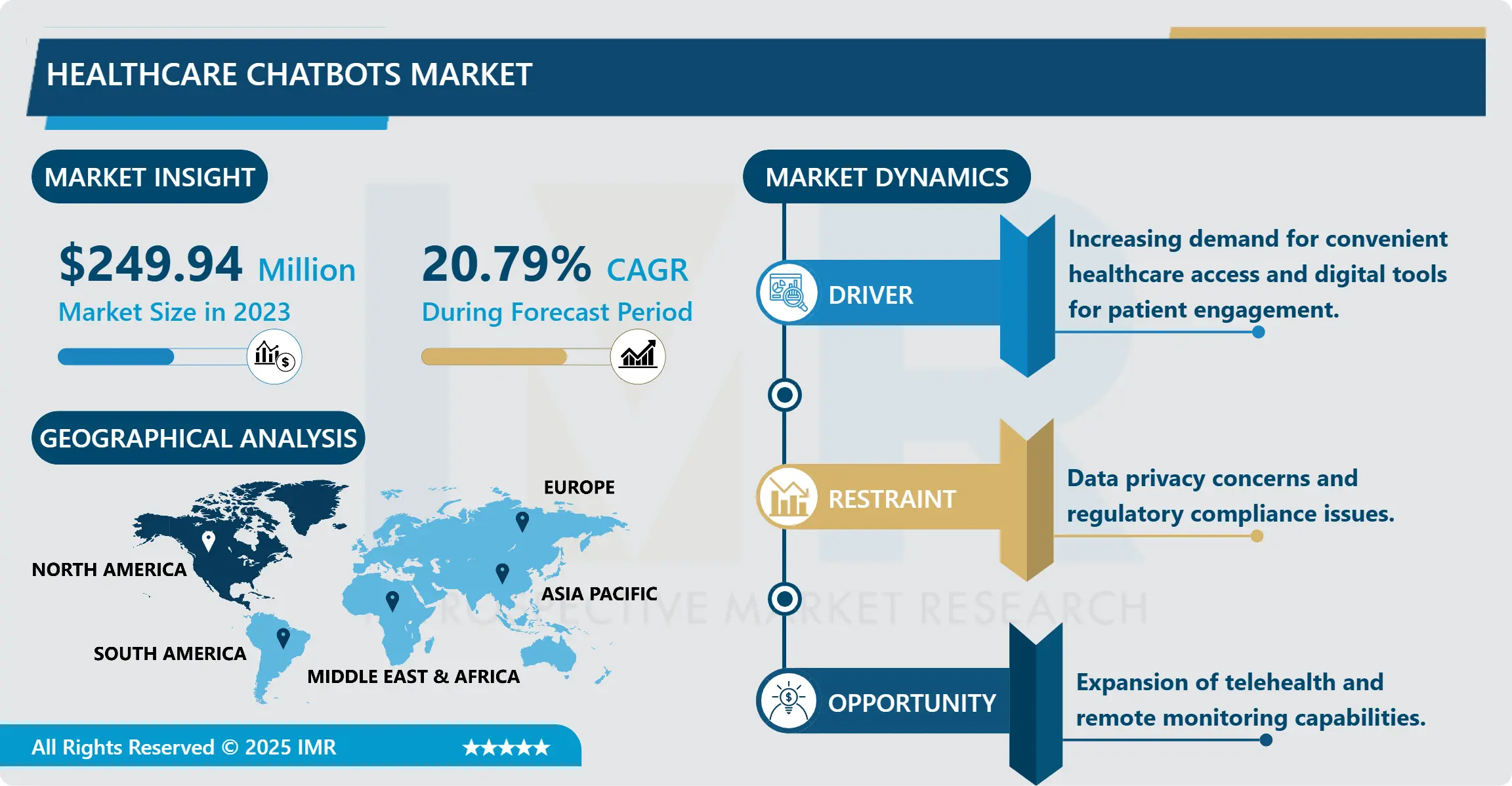
Healthcare Chatbots Market Trend Analysis:
Growing Integration of AI and NLP in Chatbots
-
One of the s that are rapidly developing in the application of Healthcare Chatbots is the attempts to use other AI approaches like NLP and ML to improve the way Chatbots imitate human speech and communication. These technologies make it possible for the chatbots to understand the meaning of medical terms, the possibility of giving appropriate answers that should correspond to the questions being asked and for the chatbots to gain from previous interactions. The newer chatbots are bidirectional or multilingual, as well as they work across the health continuum from triage to mental health support, significantly improving clinical utility. This trend is as a result of efforts to bring conversation to human like and empathetic hence patients feel free using these tools in accessing health information. Besides, effective patient interactions are made possible through chatbots that are reinforced with artificial intelligence while conversational data is shared with the providers to explain enumeration of various patients and their needs.
Rising Demand for Remote Healthcare Solutions
-
Another major chance that may stamps the growth of the healthcare chatbots market is the increasing imperative to interact with patients from a distance. Because the patient often turns to non-hospital based first point of contact consultation and advice, chatbots are effectively used for the sorting and primary health signs. This has been supported by the pandemic which has ordered things like distance and the requirement for not to congest the healthcare frameworks, telehealth and virtual care. Self, a chatbot is used in healthcare organizations to reach more patients and take more time to assist those in rural or low-income areas. The two major sources of demand are; enhancing the efficiency of chatbots and expansion of services hence, this establishes that companies that get involved in such areas stand to benefit a lot from this demand.
Healthcare Chatbots Market Segment Analysis:
Healthcare Chatbots Market is Segmented on the basis of Application, Deployment, End User, and Region
By Application, the Symptoms check segment is expected to dominate the market during the forecast period
-
Out of all these segments, the Symptoms Check segment is expected to dominate the market for healthcare chatbots because of the increasing acceptance of chatbots for preliminary health assessment. This segment has seen demand increase in ophthalmic diagnostic equipment that is not ophthalmoscopes and will serve to assist patients in keeping an eye on their conditions without a doctor. Chatbots can help, and if implemented, can ask questions, analyse answers and then guide to the next course of action – emergency visit or an appointment – something that medical practitioners would find important as well. In particular, during the current pandemic associated with COVID-19, the symptom-checking chatbots operate to identify the symptoms, assess the risk level and many other things, including the provision of safety measures. These bots have been proved useful for reducing patient anxiety and managing the traffic in facilities, so the Symptoms Check segment is expected to lead the market for the forecast period.
By Deployment, the Cloud-based segment expected to held the largest share
-
Of the two, the Cloud-Based segment is estimated to secure the most extensive market share in the global healthcare chatbots market because it has flexibility in operation besides being scalable and easy to implement. Cloud-based chatbots imply that you possess the discretion to obtain genuine-time data and is very connected with telehealth services hence you can use it on any device depending on the internet. The cloud structure allows for easy update and management of the communications happening with the patient’s data in a secure fashion in healthcare organizations. This is especially beneficial for the healthcare sector as data privacy laws get a tighten globally, cloud systems are a dependable way of data security and standards. That is why web-based services in relation to the demand fluctuations, the lower cost, and the decrease in the demands on the I.T. architecture make cloud-based solutions a priority in the healthcare chatbots market.
Healthcare Chatbots Market Regional Insights:
North America is Expected to Dominate the Market Over the Forecast period
-
North America is projected to hold the largest share for the healthcare chatbots market throughout the mentioned forecast period, mainly due to its well-developed healthcare facilities, increasing demand for chatbot solutions, and patient education in this region. The US is one of the world leading countries in the adoption of healthcare AI technology, and there has been substantial funding both federally and at the corporate level. North American countries use of Chatbots through government enlightenment on digital health solutions coupled with funding on research and Development on AI-based healthcare applications. Several healthcare facilities, such as hospitals, clinics, and healthcare canters within this region use chatbots for improved care while providing services to patients and reducing the general workload for medical workers to focus on vital patient requirements.
- Third, North American ownership of both smartphones and the internet enables the accessibility of chatbot services in the delivery of patient-cantered health care self-management support. To the credit of ambitious practicing care providers, aiming at creating a patient-centric system, chatbots have the potential to be a connector in relation to time-saving, doubling up the density of the patients’ interaction. The rise of other telehealth services also benefits the healthcare chatbot conveniently, as the patient turns to distant healthcare services.
Active Key Players in the Healthcare Chatbots Market:
-
Ada Health (Germany)
- Babylon Health (UK)
- Buoy Health (USA)
- GYANT (USA)
- HealthTap (USA)
- Infermedica (Poland)
- Kore.ai (USA)
- Microsoft (USA)
- Next IT (USA)
- Nuance Communications (USA)
- Sensely (USA)
- Tencent (China)
- Wysa (India)
- X2AI (USA)
- Your.MD (UK)
- Other Active Players
|
Healthcare Chatbots Market |
|||
|
Base Year: |
2023 |
Forecast Period: |
2024-2032 |
|
Historical Data: |
2017 to 2023 |
Market Size in 2023: |
USD 249.94 Million |
|
Forecast Period 2024-32 CAGR: |
20.79 % |
Market Size in 2032: |
USD 1,368.09 Million |
|
Segments Covered: |
By Application |
|
|
|
By Deployment |
|
||
|
By End User |
|
||
|
By Region |
|
||
|
Key Market Drivers: |
|
||
|
Key Market Restraints: |
|
||
|
Key Opportunities: |
|
||
|
Companies Covered in the report: |
|
||
Chapter 1: Introduction
1.1 Scope and Coverage
Chapter 2:Executive Summary
Chapter 3: Market Landscape
3.1 Market Dynamics
3.1.1 Drivers
3.1.2 Restraints
3.1.3 Opportunities
3.1.4 Challenges
3.2 Market Trend Analysis
3.3 PESTLE Analysis
3.4 Porter's Five Forces Analysis
3.5 Industry Value Chain Analysis
3.6 Ecosystem
3.7 Regulatory Landscape
3.8 Price Trend Analysis
3.9 Patent Analysis
3.10 Technology Evolution
3.11 Investment Pockets
3.12 Import-Export Analysis
Chapter 4: Healthcare Chatbots Market by Application
4.1 Healthcare Chatbots Market Snapshot and Growth Engine
4.2 Healthcare Chatbots Market Overview
4.3 Symptoms Check Medical and Drug Information Assistance Appointment Scheduling and Monitoring Other Application
4.3.1 Introduction and Market Overview
4.3.2 Historic and Forecasted Market Size in Value USD and Volume Units (2017-2032F)
4.3.3 Key Market Trends, Growth Factors and Opportunities
4.3.4 Symptoms Check Medical and Drug Information Assistance Appointment Scheduling and Monitoring Other Application: Geographic Segmentation Analysis
Chapter 5: Healthcare Chatbots Market by Deployment
5.1 Healthcare Chatbots Market Snapshot and Growth Engine
5.2 Healthcare Chatbots Market Overview
5.3 Cloud-based On-premise
5.3.1 Introduction and Market Overview
5.3.2 Historic and Forecasted Market Size in Value USD and Volume Units (2017-2032F)
5.3.3 Key Market Trends, Growth Factors and Opportunities
5.3.4 Cloud-based On-premise: Geographic Segmentation Analysis
Chapter 6: Healthcare Chatbots Market by End User
6.1 Healthcare Chatbots Market Snapshot and Growth Engine
6.2 Healthcare Chatbots Market Overview
6.3 Healthcare Providers Healthcare Payers Patients Other
6.3.1 Introduction and Market Overview
6.3.2 Historic and Forecasted Market Size in Value USD and Volume Units (2017-2032F)
6.3.3 Key Market Trends, Growth Factors and Opportunities
6.3.4 Healthcare Providers Healthcare Payers Patients Other: Geographic Segmentation Analysis
Chapter 7: Company Profiles and Competitive Analysis
7.1 Competitive Landscape
7.1.1 Competitive Benchmarking
7.1.2 Healthcare Chatbots Market Share by Manufacturer (2023)
7.1.3 Industry BCG Matrix
7.1.4 Heat Map Analysis
7.1.5 Mergers and Acquisitions
7.2 ADA HEALTH (GERMANY)
7.2.1 Company Overview
7.2.2 Key Executives
7.2.3 Company Snapshot
7.2.4 Role of the Company in the Market
7.2.5 Sustainability and Social Responsibility
7.2.6 Operating Business Segments
7.2.7 Product Portfolio
7.2.8 Business Performance
7.2.9 Key Strategic Moves and Recent Developments
7.2.10 SWOT Analysis
7.3 BABYLON HEALTH (UK)
7.4 BUOY HEALTH (USA)
7.5 GYANT (USA)
7.6 HEALTHTAP (USA)
7.7 INFERMEDICA (POLAND)
7.8 KORE.AI (USA)
7.9 MICROSOFT (USA)
7.10 NEXT IT (USA)
7.11 NUANCE COMMUNICATIONS (USA)
7.12 SENSELY (USA)
7.13 TENCENT (CHINA)
7.14 WYSA (INDIA)
7.15 X2AI (USA)
7.16 YOUR.MD (UK)
7.17 ...
7.18 OTHER ACTIVE PLAYERS
Chapter 8: Global Healthcare Chatbots Market By Region
8.1 Overview
8.2. North America Healthcare Chatbots Market
8.2.1 Key Market Trends, Growth Factors and Opportunities
8.2.2 Top Key Companies
8.2.3 Historic and Forecasted Market Size by Segments
8.2.4 Historic and Forecasted Market Size By Application
8.2.4.1 Symptoms Check Medical and Drug Information Assistance Appointment Scheduling and Monitoring Other Application
8.2.5 Historic and Forecasted Market Size By Deployment
8.2.5.1 Cloud-based On-premise
8.2.6 Historic and Forecasted Market Size By End User
8.2.6.1 Healthcare Providers Healthcare Payers Patients Other
8.2.7 Historic and Forecast Market Size by Country
8.2.7.1 US
8.2.7.2 Canada
8.2.7.3 Mexico
8.3. Eastern Europe Healthcare Chatbots Market
8.3.1 Key Market Trends, Growth Factors and Opportunities
8.3.2 Top Key Companies
8.3.3 Historic and Forecasted Market Size by Segments
8.3.4 Historic and Forecasted Market Size By Application
8.3.4.1 Symptoms Check Medical and Drug Information Assistance Appointment Scheduling and Monitoring Other Application
8.3.5 Historic and Forecasted Market Size By Deployment
8.3.5.1 Cloud-based On-premise
8.3.6 Historic and Forecasted Market Size By End User
8.3.6.1 Healthcare Providers Healthcare Payers Patients Other
8.3.7 Historic and Forecast Market Size by Country
8.3.7.1 Russia
8.3.7.2 Bulgaria
8.3.7.3 The Czech Republic
8.3.7.4 Hungary
8.3.7.5 Poland
8.3.7.6 Romania
8.3.7.7 Rest of Eastern Europe
8.4. Western Europe Healthcare Chatbots Market
8.4.1 Key Market Trends, Growth Factors and Opportunities
8.4.2 Top Key Companies
8.4.3 Historic and Forecasted Market Size by Segments
8.4.4 Historic and Forecasted Market Size By Application
8.4.4.1 Symptoms Check Medical and Drug Information Assistance Appointment Scheduling and Monitoring Other Application
8.4.5 Historic and Forecasted Market Size By Deployment
8.4.5.1 Cloud-based On-premise
8.4.6 Historic and Forecasted Market Size By End User
8.4.6.1 Healthcare Providers Healthcare Payers Patients Other
8.4.7 Historic and Forecast Market Size by Country
8.4.7.1 Germany
8.4.7.2 UK
8.4.7.3 France
8.4.7.4 The Netherlands
8.4.7.5 Italy
8.4.7.6 Spain
8.4.7.7 Rest of Western Europe
8.5. Asia Pacific Healthcare Chatbots Market
8.5.1 Key Market Trends, Growth Factors and Opportunities
8.5.2 Top Key Companies
8.5.3 Historic and Forecasted Market Size by Segments
8.5.4 Historic and Forecasted Market Size By Application
8.5.4.1 Symptoms Check Medical and Drug Information Assistance Appointment Scheduling and Monitoring Other Application
8.5.5 Historic and Forecasted Market Size By Deployment
8.5.5.1 Cloud-based On-premise
8.5.6 Historic and Forecasted Market Size By End User
8.5.6.1 Healthcare Providers Healthcare Payers Patients Other
8.5.7 Historic and Forecast Market Size by Country
8.5.7.1 China
8.5.7.2 India
8.5.7.3 Japan
8.5.7.4 South Korea
8.5.7.5 Malaysia
8.5.7.6 Thailand
8.5.7.7 Vietnam
8.5.7.8 The Philippines
8.5.7.9 Australia
8.5.7.10 New Zealand
8.5.7.11 Rest of APAC
8.6. Middle East & Africa Healthcare Chatbots Market
8.6.1 Key Market Trends, Growth Factors and Opportunities
8.6.2 Top Key Companies
8.6.3 Historic and Forecasted Market Size by Segments
8.6.4 Historic and Forecasted Market Size By Application
8.6.4.1 Symptoms Check Medical and Drug Information Assistance Appointment Scheduling and Monitoring Other Application
8.6.5 Historic and Forecasted Market Size By Deployment
8.6.5.1 Cloud-based On-premise
8.6.6 Historic and Forecasted Market Size By End User
8.6.6.1 Healthcare Providers Healthcare Payers Patients Other
8.6.7 Historic and Forecast Market Size by Country
8.6.7.1 Turkiye
8.6.7.2 Bahrain
8.6.7.3 Kuwait
8.6.7.4 Saudi Arabia
8.6.7.5 Qatar
8.6.7.6 UAE
8.6.7.7 Israel
8.6.7.8 South Africa
8.7. South America Healthcare Chatbots Market
8.7.1 Key Market Trends, Growth Factors and Opportunities
8.7.2 Top Key Companies
8.7.3 Historic and Forecasted Market Size by Segments
8.7.4 Historic and Forecasted Market Size By Application
8.7.4.1 Symptoms Check Medical and Drug Information Assistance Appointment Scheduling and Monitoring Other Application
8.7.5 Historic and Forecasted Market Size By Deployment
8.7.5.1 Cloud-based On-premise
8.7.6 Historic and Forecasted Market Size By End User
8.7.6.1 Healthcare Providers Healthcare Payers Patients Other
8.7.7 Historic and Forecast Market Size by Country
8.7.7.1 Brazil
8.7.7.2 Argentina
8.7.7.3 Rest of SA
Chapter 9 Analyst Viewpoint and Conclusion
9.1 Recommendations and Concluding Analysis
9.2 Potential Market Strategies
Chapter 10 Research Methodology
10.1 Research Process
10.2 Primary Research
10.3 Secondary Research
|
Healthcare Chatbots Market |
|||
|
Base Year: |
2023 |
Forecast Period: |
2024-2032 |
|
Historical Data: |
2017 to 2023 |
Market Size in 2023: |
USD 249.94 Million |
|
Forecast Period 2024-32 CAGR: |
20.79 % |
Market Size in 2032: |
USD 1,368.09 Million |
|
Segments Covered: |
By Application |
|
|
|
By Deployment |
|
||
|
By End User |
|
||
|
By Region |
|
||
|
Key Market Drivers: |
|
||
|
Key Market Restraints: |
|
||
|
Key Opportunities: |
|
||
|
Companies Covered in the report: |
|
||


