




H2 Receptor Antagonist Market Synopsis:
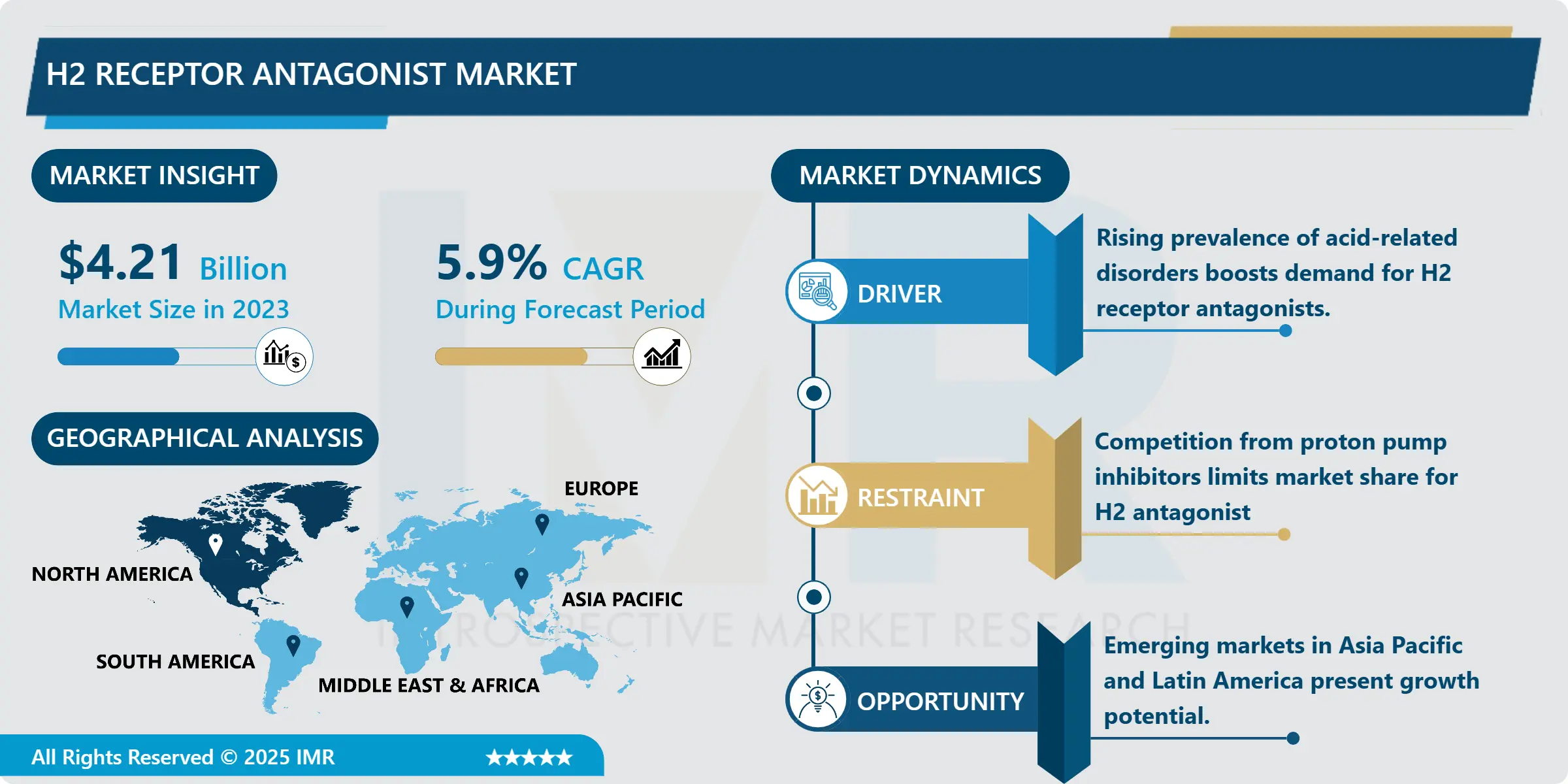
H2 Receptor Antagonist Market Size Was Valued at USD 4.21 Billion in 2023, and is Projected to Reach USD 6.30 Billion by 2032, Growing at a CAGR of 5.9 % From 2024-2032.
The H2 receptor antagonist market encompasses a range of medications designed to inhibit the action of histamine at the H2 receptors in the stomach, thereby reducing gastric acid secretion. These drugs are primarily utilized to treat conditions such as gastroesophageal reflux disease (GERD), peptic ulcers, and Zollinger-Ellison syndrome, providing significant relief to patients suffering from acid-related disorders. Key players in this market include established pharmaceutical companies that produce well-known agents like ranitidine, famotidine, cimetidine, and nizatidine. As the prevalence of acid-related conditions continues to rise globally, influenced by factors such as unhealthy diets, obesity, and increased stress levels, the demand for H2 receptor antagonists is expected to grow. The market is further shaped by trends such as the rising popularity of over-the-counter formulations, the emergence of safety concerns leading to the withdrawal of certain products, and ongoing research into alternative therapies. Collectively, these dynamics position the H2 receptor antagonist market for continued expansion as healthcare providers seek effective treatments to enhance patient quality of life.
The H2 receptor antagonist market plays a crucial role in the management of gastric acid-related disorders, offering effective treatment options for conditions such as gastroesophageal reflux disease (GERD), peptic ulcers, and Zollinger-Ellison syndrome. These medications work by blocking histamine at the H2 receptors in the stomach, leading to a decrease in gastric acid production. Key players in this market include established pharmaceutical companies that manufacture widely recognized H2 antagonists such as ranitidine, famotidine, cimetidine, and nizatidine. As awareness of acid-related disorders increases, alongside lifestyle factors contributing to their prevalence, the demand for these treatments is anticipated to rise significantly.
Recent trends indicate a shift towards over-the-counter (OTC) availability of H2 receptor antagonists, allowing patients to manage milder symptoms without the need for a prescription. This transition has broadened market accessibility and empowered consumers to take charge of their gastrointestinal health. However, the market has also faced challenges, including the withdrawal of certain H2 antagonists due to safety concerns, which has prompted a re-evaluation of treatment options and increased interest in alternative therapies. Ongoing research into the long-term efficacy and potential new applications of H2 antagonists is likely to influence market dynamics, offering opportunities for innovation and expansion.
As healthcare providers continue to seek effective solutions for managing acid-related disorders, the H2 receptor antagonist market is expected to thrive. The combination of rising prevalence rates, evolving consumer preferences, and advancements in pharmaceutical research positions this market for sustained growth. With a focus on enhancing patient outcomes and quality of life, H2 receptor antagonists will remain a vital component of gastrointestinal therapeutics in the years to come.
H2 Receptor Antagonist Market Trend Analysis:
Over-the-Counter Availability Expands Access
- The trend of increasing over-the-counter (OTC) availability of H2 receptor antagonists is significantly expanding access to these vital medications for patients suffering from acid-related disorders. With the shift toward self-care and proactive health management, patients can now purchase these medications without a prescription, making it easier for them to address mild to moderate symptoms such as heartburn, indigestion, and acid reflux. This accessibility is particularly beneficial in a healthcare landscape where many individuals may hesitate to consult a physician for less severe symptoms. By enabling consumers to manage their gastrointestinal health independently, OTC availability empowers patients to seek timely relief and potentially avoid the progression of more serious conditions.
- Moreover, the rise in OTC H2 receptor antagonists is supported by increasing consumer awareness of gastrointestinal health and the importance of early intervention. Educational campaigns and marketing efforts by pharmaceutical companies are helping to inform the public about the availability and effectiveness of these medications. As patients become more knowledgeable about their treatment options, they are more likely to self-manage their symptoms, leading to a greater overall market demand. This trend not only fosters increased sales for manufacturers but also aligns with the broader movement towards patient-centered healthcare, where individuals take a more active role in their treatment journeys. As a result, the OTC availability of H2 receptor antagonists is poised to play a crucial role in shaping the future of the gastrointestinal therapeutics market.
New Formulations Boost Efficacy in Treatment
- The H2 receptor antagonist market is witnessing a wave of innovation with the development of new formulations aimed at enhancing the efficacy and safety profiles of these medications. Traditional H2 antagonists, while effective, often face challenges related to solubility and the onset of action. Recent advancements in pharmaceutical technology have led to the creation of novel formulations, such as extended-release versions and those utilizing alternative delivery systems. These innovations are designed to improve drug absorption and prolong therapeutic effects, offering patients more consistent relief from symptoms associated with acid-related disorders. By optimizing the pharmacokinetics of these drugs, manufacturers can provide enhanced treatment options that meet the evolving needs of patients.
- Moreover, the integration of combination therapies involving H2 receptor antagonists and proton pump inhibitors (PPIs) is becoming increasingly common. This approach allows healthcare providers to leverage the strengths of both medication classes, addressing a wider range of symptoms and providing a more comprehensive treatment strategy for conditions like gastroesophageal reflux disease (GERD) and peptic ulcers. Research is also focused on formulating H2 antagonists with adjunctive therapies that target the underlying causes of acid secretion. As these new formulations enter the market, they not only promise improved patient outcomes but also position pharmaceutical companies at the forefront of innovation in gastrointestinal therapeutics, ultimately reshaping the treatment landscape for acid-related disorders.
H2 Receptor Antagonist Market Segment Analysis:
H2 Receptor Antagonist Market is Segmented on the basis of Type, Application, End User, and Region
By Type, Famotidine segment is expected to dominate the market during the forecast period
- The Famotidine segment is poised to lead the H2 receptor antagonist market during the forecast period, primarily due to its remarkable efficacy and safety profile. Famotidine has gained prominence for its ability to effectively reduce gastric acid secretion, providing rapid relief for conditions such as gastroesophageal reflux disease (GERD) and peptic ulcers. Its potent action, combined with a lower incidence of side effects compared to other H2 antagonists, makes it a favored choice among healthcare providers. Moreover, Famotidine’s versatility in being available both as a prescription medication and over-the-counter product enhances its accessibility, allowing a broader range of patients to utilize it for self-management of their symptoms. This dual availability aligns with the growing trend of patients seeking convenient and effective treatment options without needing frequent physician consultations.
- Additionally, the growing awareness of gastrointestinal health and the importance of early intervention in acid-related disorders contribute to the increased demand for Famotidine. As more individuals are diagnosed with conditions that require acid suppression, the recognition of Famotidine as a first-line treatment option solidifies its market position. Furthermore, the drug’s strong track record in clinical practice, coupled with ongoing research into its effectiveness in various patient populations, bolsters confidence in its continued use. With lifestyle factors such as dietary habits and obesity contributing to rising rates of GERD and related conditions, the Famotidine segment is strategically positioned to capture a significant share of the market, driving growth and innovation in the H2 receptor antagonist landscape.
By Application, Gastroesophageal Reflux Disease segment expected to held the largest share
- The Gastroesophageal Reflux Disease (GERD) segment is projected to hold the largest share of the H2 receptor antagonist market, primarily driven by the increasing prevalence of this condition worldwide. GERD affects a substantial portion of the population, often leading to symptoms such as persistent heartburn, acid regurgitation, and discomfort. The growing awareness of the impact of GERD on quality of life has prompted many patients to seek effective treatments, further fueling demand for medications that can provide relief. H2 receptor antagonists, particularly Famotidine, are recognized for their ability to effectively reduce gastric acid secretion and manage GERD symptoms, making them a go-to option for both healthcare providers and patients.
- Moreover, the segment’s dominance is supported by a range of factors, including lifestyle changes that contribute to an increase in GERD cases. Factors such as unhealthy diets, obesity, and high-stress levels are significant contributors to the rise in acid-related disorders. As healthcare providers emphasize the importance of timely and effective management of GERD to prevent complications such as esophagitis or Barrett's esophagus, the demand for H2 receptor antagonists will continue to grow. Educational campaigns aimed at informing patients about the availability and efficacy of these treatments further enhance patient engagement, leading to increased usage. As a result, the GERD segment is well-positioned for sustained growth, highlighting the critical role that H2 receptor antagonists play in managing one of the most common gastrointestinal disorders today.
H2 Receptor Antagonist Market Regional Insights:
North America is Expected to Dominate the Market Over the Forecast period
- North America is projected to dominate the H2 receptor antagonist market over the forecast period, driven by several key factors. The region exhibits a high prevalence of acid-related disorders such as gastroesophageal reflux disease (GERD) and peptic ulcers, which significantly boosts the demand for effective treatment options. The presence of well-established healthcare infrastructure and advanced medical practices further facilitates patient access to these medications. Moreover, increasing consumer awareness regarding gastrointestinal health and the availability of both prescription and over-the-counter formulations of H2 receptor antagonists have contributed to heightened usage among patients seeking relief from acid-related symptoms.
- Additionally, the North American market benefits from substantial investment in pharmaceutical research and development, leading to innovations in drug formulations and delivery methods. The growing trend of personalized medicine and combination therapies is also gaining traction, enhancing treatment options for patients. Furthermore, regulatory support and a competitive landscape featuring prominent pharmaceutical companies help drive market growth. As healthcare providers increasingly prioritize effective management strategies for acid-related disorders, North America is well-positioned to maintain its dominance in the H2 receptor antagonist market throughout the forecast period, ultimately improving patient outcomes and quality of life in the region.
Active Key Players in the H2 Receptor Antagonist Market:
- AbbVie (USA)
- Amgen (USA)
- AstraZeneca (UK)
- Aurobindo Pharma (India)
- Bayer (Germany)
- Dr. Reddy's Laboratories (India)
- Eisai Co., Ltd. (Japan)
- GlaxoSmithKline (UK)
- Hikma Pharmaceuticals (UK/Jordan)
- Johnson & Johnson (USA)
- Merck & Co. (USA)
- Mylan (USA)
- Novartis (Switzerland)
- Pfizer (USA)
- Sandoz (Germany)
- Sanofi (France)
- Takeda Pharmaceuticals (Japan)
- Teva Pharmaceutical Industries (Israel)
- Other Active Players
|
H2 Receptor Antagonist Market |
|||
|
Base Year: |
2023 |
Forecast Period: |
2024-2032 |
|
Historical Data: |
2017 to 2023 |
Market Size in 2023: |
USD 4.21 Billion |
|
Forecast Period 2024-32 CAGR: |
5.9 % |
Market Size in 2032: |
USD 6.30 Billion |
|
Segments Covered: |
By Type |
|
|
|
By Application |
|
||
|
By End User |
|
||
|
By Region |
|
||
|
Key Market Drivers: |
|
||
|
Key Market Restraints: |
|
||
|
Key Opportunities: |
|
||
|
Companies Covered in the report: |
|
||
Chapter 1: Introduction
1.1 Scope and Coverage
Chapter 2:Executive Summary
Chapter 3: Market Landscape
3.1 Market Dynamics
3.1.1 Drivers
3.1.2 Restraints
3.1.3 Opportunities
3.1.4 Challenges
3.2 Market Trend Analysis
3.3 PESTLE Analysis
3.4 Porter's Five Forces Analysis
3.5 Industry Value Chain Analysis
3.6 Ecosystem
3.7 Regulatory Landscape
3.8 Price Trend Analysis
3.9 Patent Analysis
3.10 Technology Evolution
3.11 Investment Pockets
3.12 Import-Export Analysis
Chapter 4: H2 Receptor Antagonist Market by Type
4.1 H2 Receptor Antagonist Market Snapshot and Growth Engine
4.2 H2 Receptor Antagonist Market Overview
4.3 Ranitidine
4.3.1 Introduction and Market Overview
4.3.2 Historic and Forecasted Market Size in Value USD and Volume Units (2017-2032F)
4.3.3 Key Market Trends, Growth Factors and Opportunities
4.3.4 Ranitidine: Geographic Segmentation Analysis
4.4 Famotidine
4.4.1 Introduction and Market Overview
4.4.2 Historic and Forecasted Market Size in Value USD and Volume Units (2017-2032F)
4.4.3 Key Market Trends, Growth Factors and Opportunities
4.4.4 Famotidine: Geographic Segmentation Analysis
4.5 Cimetidine
4.5.1 Introduction and Market Overview
4.5.2 Historic and Forecasted Market Size in Value USD and Volume Units (2017-2032F)
4.5.3 Key Market Trends, Growth Factors and Opportunities
4.5.4 Cimetidine: Geographic Segmentation Analysis
4.6 Nizatidine
4.6.1 Introduction and Market Overview
4.6.2 Historic and Forecasted Market Size in Value USD and Volume Units (2017-2032F)
4.6.3 Key Market Trends, Growth Factors and Opportunities
4.6.4 Nizatidine: Geographic Segmentation Analysis
Chapter 5: H2 Receptor Antagonist Market by Application
5.1 H2 Receptor Antagonist Market Snapshot and Growth Engine
5.2 H2 Receptor Antagonist Market Overview
5.3 Gastroesophageal Reflux Disease (GERD)
5.3.1 Introduction and Market Overview
5.3.2 Historic and Forecasted Market Size in Value USD and Volume Units (2017-2032F)
5.3.3 Key Market Trends, Growth Factors and Opportunities
5.3.4 Gastroesophageal Reflux Disease (GERD): Geographic Segmentation Analysis
5.4 Peptic Ulcers
5.4.1 Introduction and Market Overview
5.4.2 Historic and Forecasted Market Size in Value USD and Volume Units (2017-2032F)
5.4.3 Key Market Trends, Growth Factors and Opportunities
5.4.4 Peptic Ulcers: Geographic Segmentation Analysis
5.5 Zollinger-Ellison Syndrome
5.5.1 Introduction and Market Overview
5.5.2 Historic and Forecasted Market Size in Value USD and Volume Units (2017-2032F)
5.5.3 Key Market Trends, Growth Factors and Opportunities
5.5.4 Zollinger-Ellison Syndrome: Geographic Segmentation Analysis
5.6 Other Acid-Related Disorders
5.6.1 Introduction and Market Overview
5.6.2 Historic and Forecasted Market Size in Value USD and Volume Units (2017-2032F)
5.6.3 Key Market Trends, Growth Factors and Opportunities
5.6.4 Other Acid-Related Disorders: Geographic Segmentation Analysis
Chapter 6: H2 Receptor Antagonist Market by End User
6.1 H2 Receptor Antagonist Market Snapshot and Growth Engine
6.2 H2 Receptor Antagonist Market Overview
6.3 Hospitals
6.3.1 Introduction and Market Overview
6.3.2 Historic and Forecasted Market Size in Value USD and Volume Units (2017-2032F)
6.3.3 Key Market Trends, Growth Factors and Opportunities
6.3.4 Hospitals: Geographic Segmentation Analysis
6.4 Pharmacies
6.4.1 Introduction and Market Overview
6.4.2 Historic and Forecasted Market Size in Value USD and Volume Units (2017-2032F)
6.4.3 Key Market Trends, Growth Factors and Opportunities
6.4.4 Pharmacies: Geographic Segmentation Analysis
6.5 Online Pharmacies
6.5.1 Introduction and Market Overview
6.5.2 Historic and Forecasted Market Size in Value USD and Volume Units (2017-2032F)
6.5.3 Key Market Trends, Growth Factors and Opportunities
6.5.4 Online Pharmacies: Geographic Segmentation Analysis
6.6 Clinics
6.6.1 Introduction and Market Overview
6.6.2 Historic and Forecasted Market Size in Value USD and Volume Units (2017-2032F)
6.6.3 Key Market Trends, Growth Factors and Opportunities
6.6.4 Clinics: Geographic Segmentation Analysis
Chapter 7: Company Profiles and Competitive Analysis
7.1 Competitive Landscape
7.1.1 Competitive Benchmarking
7.1.2 H2 Receptor Antagonist Market Share by Manufacturer (2023)
7.1.3 Industry BCG Matrix
7.1.4 Heat Map Analysis
7.1.5 Mergers and Acquisitions
7.2 ABBVIE (USA)
7.2.1 Company Overview
7.2.2 Key Executives
7.2.3 Company Snapshot
7.2.4 Role of the Company in the Market
7.2.5 Sustainability and Social Responsibility
7.2.6 Operating Business Segments
7.2.7 Product Portfolio
7.2.8 Business Performance
7.2.9 Key Strategic Moves and Recent Developments
7.2.10 SWOT Analysis
7.3 AMGEN (USA)
7.4 ASTRAZENECA (UK)
7.5 AUROBINDO PHARMA (INDIA)
7.6 BAYER (GERMANY)
7.7 DR. REDDY'S LABORATORIES (INDIA)
7.8 EISAI CO. LTD. (JAPAN)
7.9 GLAXOSMITHKLINE (UK)
7.10 OTHER ACTIVE PLAYERS
Chapter 8: Global H2 Receptor Antagonist Market By Region
8.1 Overview
8.2. North America H2 Receptor Antagonist Market
8.2.1 Key Market Trends, Growth Factors and Opportunities
8.2.2 Top Key Companies
8.2.3 Historic and Forecasted Market Size by Segments
8.2.4 Historic and Forecasted Market Size By Type
8.2.4.1 Ranitidine
8.2.4.2 Famotidine
8.2.4.3 Cimetidine
8.2.4.4 Nizatidine
8.2.5 Historic and Forecasted Market Size By Application
8.2.5.1 Gastroesophageal Reflux Disease (GERD)
8.2.5.2 Peptic Ulcers
8.2.5.3 Zollinger-Ellison Syndrome
8.2.5.4 Other Acid-Related Disorders
8.2.6 Historic and Forecasted Market Size By End User
8.2.6.1 Hospitals
8.2.6.2 Pharmacies
8.2.6.3 Online Pharmacies
8.2.6.4 Clinics
8.2.7 Historic and Forecast Market Size by Country
8.2.7.1 US
8.2.7.2 Canada
8.2.7.3 Mexico
8.3. Eastern Europe H2 Receptor Antagonist Market
8.3.1 Key Market Trends, Growth Factors and Opportunities
8.3.2 Top Key Companies
8.3.3 Historic and Forecasted Market Size by Segments
8.3.4 Historic and Forecasted Market Size By Type
8.3.4.1 Ranitidine
8.3.4.2 Famotidine
8.3.4.3 Cimetidine
8.3.4.4 Nizatidine
8.3.5 Historic and Forecasted Market Size By Application
8.3.5.1 Gastroesophageal Reflux Disease (GERD)
8.3.5.2 Peptic Ulcers
8.3.5.3 Zollinger-Ellison Syndrome
8.3.5.4 Other Acid-Related Disorders
8.3.6 Historic and Forecasted Market Size By End User
8.3.6.1 Hospitals
8.3.6.2 Pharmacies
8.3.6.3 Online Pharmacies
8.3.6.4 Clinics
8.3.7 Historic and Forecast Market Size by Country
8.3.7.1 Russia
8.3.7.2 Bulgaria
8.3.7.3 The Czech Republic
8.3.7.4 Hungary
8.3.7.5 Poland
8.3.7.6 Romania
8.3.7.7 Rest of Eastern Europe
8.4. Western Europe H2 Receptor Antagonist Market
8.4.1 Key Market Trends, Growth Factors and Opportunities
8.4.2 Top Key Companies
8.4.3 Historic and Forecasted Market Size by Segments
8.4.4 Historic and Forecasted Market Size By Type
8.4.4.1 Ranitidine
8.4.4.2 Famotidine
8.4.4.3 Cimetidine
8.4.4.4 Nizatidine
8.4.5 Historic and Forecasted Market Size By Application
8.4.5.1 Gastroesophageal Reflux Disease (GERD)
8.4.5.2 Peptic Ulcers
8.4.5.3 Zollinger-Ellison Syndrome
8.4.5.4 Other Acid-Related Disorders
8.4.6 Historic and Forecasted Market Size By End User
8.4.6.1 Hospitals
8.4.6.2 Pharmacies
8.4.6.3 Online Pharmacies
8.4.6.4 Clinics
8.4.7 Historic and Forecast Market Size by Country
8.4.7.1 Germany
8.4.7.2 UK
8.4.7.3 France
8.4.7.4 The Netherlands
8.4.7.5 Italy
8.4.7.6 Spain
8.4.7.7 Rest of Western Europe
8.5. Asia Pacific H2 Receptor Antagonist Market
8.5.1 Key Market Trends, Growth Factors and Opportunities
8.5.2 Top Key Companies
8.5.3 Historic and Forecasted Market Size by Segments
8.5.4 Historic and Forecasted Market Size By Type
8.5.4.1 Ranitidine
8.5.4.2 Famotidine
8.5.4.3 Cimetidine
8.5.4.4 Nizatidine
8.5.5 Historic and Forecasted Market Size By Application
8.5.5.1 Gastroesophageal Reflux Disease (GERD)
8.5.5.2 Peptic Ulcers
8.5.5.3 Zollinger-Ellison Syndrome
8.5.5.4 Other Acid-Related Disorders
8.5.6 Historic and Forecasted Market Size By End User
8.5.6.1 Hospitals
8.5.6.2 Pharmacies
8.5.6.3 Online Pharmacies
8.5.6.4 Clinics
8.5.7 Historic and Forecast Market Size by Country
8.5.7.1 China
8.5.7.2 India
8.5.7.3 Japan
8.5.7.4 South Korea
8.5.7.5 Malaysia
8.5.7.6 Thailand
8.5.7.7 Vietnam
8.5.7.8 The Philippines
8.5.7.9 Australia
8.5.7.10 New Zealand
8.5.7.11 Rest of APAC
8.6. Middle East & Africa H2 Receptor Antagonist Market
8.6.1 Key Market Trends, Growth Factors and Opportunities
8.6.2 Top Key Companies
8.6.3 Historic and Forecasted Market Size by Segments
8.6.4 Historic and Forecasted Market Size By Type
8.6.4.1 Ranitidine
8.6.4.2 Famotidine
8.6.4.3 Cimetidine
8.6.4.4 Nizatidine
8.6.5 Historic and Forecasted Market Size By Application
8.6.5.1 Gastroesophageal Reflux Disease (GERD)
8.6.5.2 Peptic Ulcers
8.6.5.3 Zollinger-Ellison Syndrome
8.6.5.4 Other Acid-Related Disorders
8.6.6 Historic and Forecasted Market Size By End User
8.6.6.1 Hospitals
8.6.6.2 Pharmacies
8.6.6.3 Online Pharmacies
8.6.6.4 Clinics
8.6.7 Historic and Forecast Market Size by Country
8.6.7.1 Turkiye
8.6.7.2 Bahrain
8.6.7.3 Kuwait
8.6.7.4 Saudi Arabia
8.6.7.5 Qatar
8.6.7.6 UAE
8.6.7.7 Israel
8.6.7.8 South Africa
8.7. South America H2 Receptor Antagonist Market
8.7.1 Key Market Trends, Growth Factors and Opportunities
8.7.2 Top Key Companies
8.7.3 Historic and Forecasted Market Size by Segments
8.7.4 Historic and Forecasted Market Size By Type
8.7.4.1 Ranitidine
8.7.4.2 Famotidine
8.7.4.3 Cimetidine
8.7.4.4 Nizatidine
8.7.5 Historic and Forecasted Market Size By Application
8.7.5.1 Gastroesophageal Reflux Disease (GERD)
8.7.5.2 Peptic Ulcers
8.7.5.3 Zollinger-Ellison Syndrome
8.7.5.4 Other Acid-Related Disorders
8.7.6 Historic and Forecasted Market Size By End User
8.7.6.1 Hospitals
8.7.6.2 Pharmacies
8.7.6.3 Online Pharmacies
8.7.6.4 Clinics
8.7.7 Historic and Forecast Market Size by Country
8.7.7.1 Brazil
8.7.7.2 Argentina
8.7.7.3 Rest of SA
Chapter 9 Analyst Viewpoint and Conclusion
9.1 Recommendations and Concluding Analysis
9.2 Potential Market Strategies
Chapter 10 Research Methodology
10.1 Research Process
10.2 Primary Research
10.3 Secondary Research
|
H2 Receptor Antagonist Market |
|||
|
Base Year: |
2023 |
Forecast Period: |
2024-2032 |
|
Historical Data: |
2017 to 2023 |
Market Size in 2023: |
USD 4.21 Billion |
|
Forecast Period 2024-32 CAGR: |
5.9 % |
Market Size in 2032: |
USD 6.30 Billion |
|
Segments Covered: |
By Type |
|
|
|
By Application |
|
||
|
By End User |
|
||
|
By Region |
|
||
|
Key Market Drivers: |
|
||
|
Key Market Restraints: |
|
||
|
Key Opportunities: |
|
||
|
Companies Covered in the report: |
|
||


