




Green Coffee Market Synopsis
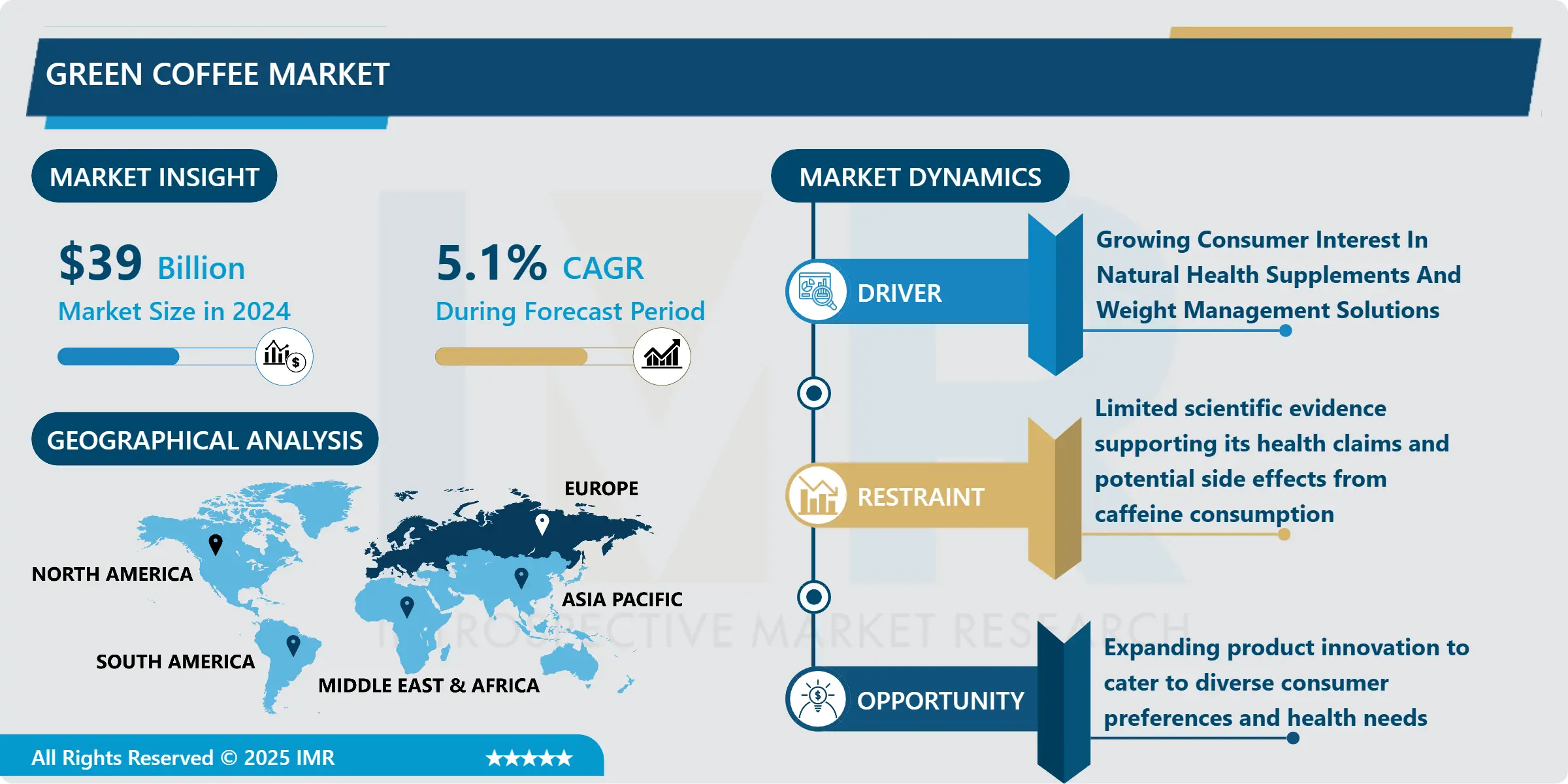
Green Coffee Market Size Was Valued at USD 39 Billion in 2024, and is Projected to Reach USD 58.07 Billion by 2032, Growing at a CAGR of 5.1% From 2025-2032.
Green coffee, unroasted beans from the Coffee plant, contain higher levels of compounds like chlorogenic acid, potentially promoting health benefits. Green coffee extract is popular for its antioxidant properties and weight loss effects. Some coffee enthusiasts roast their beans for unique flavor profiles.
Green coffee extract is a popular dietary supplement due to its high antioxidant content, particularly chlorogenic acid. It may aid in weight loss by affecting blood sugar and metabolism. It also contains caffeine, providing a temporary energy boost. Green coffee extract is also used in skin care products due to its antioxidant properties. Brewing green coffee beans produces a grassy and slightly acidic taste, and home coffee enthusiasts can experiment with roasting techniques to create unique blends.
The green coffee market is experiencing growth due to increased health consciousness, demand for natural and organic products, and weight loss trends. Green coffee extract, a natural source of antioxidants, is marketed as a healthier alternative to roasted coffee. The weight loss industry is a significant driver of demand, with studies suggesting that chlorogenic acid in green coffee extract may aid in weight loss.
The specialty coffee market, which emphasizes high-quality and unique experiences, is expanding globally, with green coffee beans offering an opportunity for coffee enthusiasts to experiment with different flavor profiles and home roasting techniques. Green coffee extract has diverse applications beyond traditional coffee consumption, including dietary supplements, skincare products, and functional beverages. Effective marketing campaigns highlighting health benefits, weight loss, antioxidant properties, and sustainability attract consumers interested in improving their health and supporting environmentally friendly products.

Green Coffee Market Trend Analysis
Green Coffee Market Drivers- Growing Consumer Interest In Natural Health Supplements And Weight Management Solutions
- The green coffee market has expanded due to the increasing demand for natural health supplements and weight management solutions. The market is driven by perceived health benefits, such as weight loss improved heart health, and weight management trends. Green coffee extract, rich in antioxidants, has gained popularity due to its potential to boost metabolism and reduce carb absorption.
- Consumers are also increasingly preferring natural and organic products due to concerns about synthetic ingredients and potential health effects. Increased internet and social media access has raised awareness about the health benefits of green coffee extract, leading to greater demand for these items. Effective marketing campaigns, celebrity endorsements, influencer marketing, and social media advertising have also contributed to consumer interest in green coffee products.
- The market offers a wide range of products, including green coffee extract supplements, home roasting beans, and functional beverages containing green coffee extract. As consumer awareness grows and preferences evolve, the green coffee market is expected to continue to thrive, driven by innovation and continued promotion of green coffee products.
Green Coffee Market Restraints- Limited scientific evidence supporting its health claims and potential side effects from caffeine consumption
- The green coffee market faces several challenges, including limited scientific evidence supporting its health claims, regulatory challenges, consumer skepticism, potential side effects from caffeine consumption, and competition from established products. While some research suggests weight loss and antioxidant properties, the scientific evidence is inconclusive, leading to skepticism among consumers and healthcare professionals.
- The regulatory landscape surrounding dietary supplements can be complex and stringent, with some jurisdictions limiting marketing claims and requiring companies to provide safety and efficacy evidence. Consumer skepticism about the effectiveness of green coffee extract can further erode consumer confidence and dampen demand. The green coffee extract contains caffeine, which can lead to side effects, especially for those sensitive to caffeine or those with certain medical conditions.
Green Coffee Market Opportunity- Expanding product innovation to cater to diverse consumer preferences and health needs
- The green coffee market is poised for significant growth by embracing product innovation to cater to diverse consumer preferences and health needs. By creating tailored offerings, companies can cater to different tastes, dietary requirements, and lifestyle choices. Green coffee is known for its health benefits, such as weight management, antioxidant support, and energy enhancement.
- By developing targeted solutions, companies can appeal to consumers seeking holistic wellness solutions. The green coffee market can also penetrate niche segments, catering to specialized dietary preferences or health conditions. For instance, plant-based and vegan products can be targeted, while athletes or individuals with specific nutritional requirements can be targeted.
- Beyond beverages, green coffee can be incorporated into functional foods like snacks, bars, and desserts, and skincare products like creams, serums, and masks. This differentiation can help brands stand out from competitors, attracting consumer attention and fostering brand loyalty.
Green Coffee Market Challenges- Consistent quality and taste due to variability in growing conditions and processing methods
- Coffee plants grow in diverse regions with unique climates, soil compositions, and altitudes, which significantly influence the flavor profile and quality of the beans. Processing methods, such as dry or wet, fermentation, and drying, can affect the beans' acidity, sweetness, and body, leading to variations in the final cup of coffee. The green coffee supply chain is complex, involving multiple stakeholders and introducing additional factors that affect quality and taste.
- Quality control challenges, such as lack of access to modern equipment, inadequate training, and inconsistent quality assessment practices, can also contribute to variations in coffee quality and taste. Consumers expect consistency in flavor and quality, regardless of the coffee origin or variety. Roasters and coffee companies must invest in rigorous quality control protocols, sensory analysis, and blending techniques to achieve a consistent flavor profile across batches and origins.
Green Coffee Market Segment Analysis:
Green Coffee Market Segmented based on type, application, and distribution channel.
By Type, Arabica segment is expected to dominate the market during the forecast period
- Arabica coffee beans are known for their superior quality, delicate flavor profile, and aromatic characteristics, making them highly desirable among coffee enthusiasts. They are preferred by consumers worldwide due to their smoother, less bitter taste compared to Robusta coffee. Arabica beans are also a staple in the specialty coffee market, focusing on high-quality beans, sustainable sourcing practices, and unique flavor profiles.
- The global demand for Arabica coffee is expected to remain strong due to factors like urbanization, changing consumer preferences, and the expansion of coffee culture. Arabica coffee typically commands higher prices than Robusta coffee due to its perceived superior quality and flavor. It is also associated with quality, sustainability, and ethical sourcing practices, leading to many coffee companies and retailers prioritizing Arabica beans in their product offerings.
By Application, Beverage segment held the largest share in 2024
- Coffee is a popular global beverage, consumed by millions daily. The green coffee beverage segment offers various forms of coffee, catering to different tastes and occasions. Wide availability in various settings, such as cafes, restaurants, and coffee shops, makes it easily accessible to consumers. The green coffee beverage segment offers a diverse range of products, including specialty coffee drinks, flavored coffees, ready-to-drink beverages, and innovative coffee concoctions.
- Coffee has deep cultural significance, serving as a social lubricant, morning ritual, and source of comfort and pleasure. The beverage segment taps into this cultural connection, driving consumption and maintaining its market dominance. Health and wellness trends are also driving demand for green coffee-infused beverages, as consumers seek healthier alternatives to sugary sodas and energy drinks.
Green Coffee Market Regional Insights:
Western Europe is Expected to Dominate the Market Over the Forecast Period
- Europe accounted for 32% of global coffee consumption in 2021. Asia-Pacific ranks second, with a market share of 24%, followed by Latin America and North America, both with market shares of 19%
- Western Europe, despite its strong coffee culture and high consumption rates. This dominance is attributed to factors such as the rich coffee consumption culture in countries like Italy, France, and Germany, the coffee roasting industry in Western Europe, the rise of specialty coffee markets, the vibrant café culture in Western European cities, and well-established trade and distribution networks. Consumers are increasingly drinking high-quality coffees. This is largely led by the strong growth of consumption at specialized coffee shops in Western Europe, where mainly high-quality coffees are served.
- The networks facilitate the importation and distribution of green coffee beans from coffee-producing regions to local markets, ensuring a steady supply to meet European consumers' demand. The coffee industry in Western Europe is a significant contributor to the global green coffee market. However, another country in the region, the United Kingdom, also has sizable coffee markets and contributes to the overall consumption and trade of green coffee beans.
Green Coffee Market Top Key Players:
- Sustainable Harvest (US)
- Mercon Coffee Corporation (US)
- InterAmerican Coffee (US)
- Atlantic Specialty Coffee, Inc. (US)
- Volcafe USA (US)
- Kona Coffee & Tea Company (US)
- Neumann Kaffee Gruppe (Germany)
- Taylors of Harrogate (UK)
- Armajaro Trading Limited (UK)
- Volcafe Specialty Coffee (UK)
- Touton S.A. (France)
- Volcafe (Switzerland)
- Sucafina (Switzerland)
- ECOM Agroindustrial Corp. Ltd. (Switzerland)
- COFCO International (China)
- ITOCHU Corporation (Japan)
- Mitsui & Co., Ltd. (Japan)
- Minas Hill Coffee (Australia)
- Indokemikal Komoditi International (Indonesia)
- Kafecel (Turkey)
- Expocaccer (Brazil), and other active players
Key Industry Developments in the Green Coffee Market:
- In February 2023, Neumann Kaffee Gruppe announced the launch of its integrated warehouse, cupping lab, and import office in Jakarta in March 2024. It will be the second company based in Indonesia of the green coffee service group Neumann Kaffee Gruppe (NKG). The climate-controlled warehouse will be used to store imported green coffees of all qualities. As Indonesia is both a producing and an ever-increasing consuming country, NKG Indonesia Imports will be incorporated in the most ideal period where the demand for green coffee will exceed the domestic grown availability.
- In January 2021, Sucafina announced an agreement to take a majority interest in Complete Coffee Limited alongside the Breminer family, which will retain participation in the company. The new partnership will provide added value for CCL’s customers, expanding coffee offerings in soluble, specialty, and mainstream green coffees. CCL will have immediate access to Sucafina’s extensive global network of coffee supply chains and expertise.
|
Global Green Coffee Market |
|||
|
Base Year: |
2024 |
Forecast Period: |
2025-2032 |
|
Historical Data: |
2018 to 2023 |
Market Size in 2024: |
39 Bn |
|
Forecast Period 2024-32 CAGR: |
5.1 % |
Market Size in 2032: |
58.07 Bn |
|
Segments Covered: |
By Type |
|
|
|
By Application |
|
||
|
By Distribution Channel |
|
||
|
By Region |
|
||
|
Key Market Drivers: |
|
||
|
Key Market Restraints: |
|
||
|
Key Opportunities: |
|
||
|
Companies Covered in the report: |
|
||
Chapter 1: Introduction
1.1 Scope and Coverage
Chapter 2:Executive Summary
Chapter 3: Market Landscape
3.1 Market Dynamics
3.1.1 Drivers
3.1.2 Restraints
3.1.3 Opportunities
3.1.4 Challenges
3.2 Market Trend Analysis
3.3 PESTLE Analysis
3.4 Porter's Five Forces Analysis
3.5 Industry Value Chain Analysis
3.6 Ecosystem
3.7 Regulatory Landscape
3.8 Price Trend Analysis
3.9 Patent Analysis
3.10 Technology Evolution
3.11 Investment Pockets
3.12 Import-Export Analysis
Chapter 4: Green Coffee Market by Type (2018-2032)
4.1 Green Coffee Market Snapshot and Growth Engine
4.2 Market Overview
4.3 Arabica
4.3.1 Introduction and Market Overview
4.3.2 Historic and Forecasted Market Size in Value USD and Volume Units
4.3.3 Key Market Trends, Growth Factors, and Opportunities
4.3.4 Geographic Segmentation Analysis
4.4 Robusta
Chapter 5: Green Coffee Market by Application (2018-2032)
5.1 Green Coffee Market Snapshot and Growth Engine
5.2 Market Overview
5.3 Beverage
5.3.1 Introduction and Market Overview
5.3.2 Historic and Forecasted Market Size in Value USD and Volume Units
5.3.3 Key Market Trends, Growth Factors, and Opportunities
5.3.4 Geographic Segmentation Analysis
5.4 Dietary Supplements
5.5 Others
Chapter 6: Green Coffee Market by Distribution Channel (2018-2032)
6.1 Green Coffee Market Snapshot and Growth Engine
6.2 Market Overview
6.3 Direct Sales
6.3.1 Introduction and Market Overview
6.3.2 Historic and Forecasted Market Size in Value USD and Volume Units
6.3.3 Key Market Trends, Growth Factors, and Opportunities
6.3.4 Geographic Segmentation Analysis
6.4 Indirect Sales
Chapter 7: Company Profiles and Competitive Analysis
7.1 Competitive Landscape
7.1.1 Competitive Benchmarking
7.1.2 Green Coffee Market Share by Manufacturer (2024)
7.1.3 Industry BCG Matrix
7.1.4 Heat Map Analysis
7.1.5 Mergers and Acquisitions
7.2 CARGILL (US)
7.2.1 Company Overview
7.2.2 Key Executives
7.2.3 Company Snapshot
7.2.4 Role of the Company in the Market
7.2.5 Sustainability and Social Responsibility
7.2.6 Operating Business Segments
7.2.7 Product Portfolio
7.2.8 Business Performance
7.2.9 Key Strategic Moves and Recent Developments
7.2.10 SWOT Analysis
7.3 DUPONT (US)
7.4 ARCHER DANIELS MIDLAND (ADM) (US)
7.5 INGREDION (US)
7.6 KEMIN INDUSTRIES (US)
7.7 INTERNATIONAL FLAVORS & FRAGRANCES INC. (IFF) (US)
7.8 SENSIENT TECHNOLOGIES CORPORATION (US)
7.9 DÖHLER GROUP (GERMANY)
7.10 BASF (GERMANY)
7.11 SYMRISE AG (GERMANY)
7.12 TATE & LYLE (UK)
7.13 NATUREX (FRANCE)
7.14 GROUPE LIMAGRAIN HOLDING SA (FRANCE)
7.15 KONINKLIJKE DSM N.V. (DSM) (NETHERLANDS)
7.16 CORBION (NETHERLANDS)
7.17 ROYAL COSUN (DUYNIE GROUP) (NETHERLANDS)
7.18 SVZ INTERNATIONAL BV (NETHERLANDS)
7.19 CHR. HANSEN HOLDING A/S (DENMARK)
7.20 NOVOZYMES A/S (DENMARK)
7.21 FIRMENICH INTERNATIONAL SA (SWITZERLAND)
7.22 AJINOMOTO COINC. (JAPAN)
7.23 TAURA NATURAL INGREDIENTS LIMITED (NEW ZEALAND)
7.24 KERRY GROUP (IRELAND)
7.25 FRUTAROM INDUSTRIES LTD. (ISRAEL)
7.26 AND OTHER MAJOR PLAYER
Chapter 8: Global Green Coffee Market By Region
8.1 Overview
8.2. North America Green Coffee Market
8.2.1 Key Market Trends, Growth Factors and Opportunities
8.2.2 Top Key Companies
8.2.3 Historic and Forecasted Market Size by Segments
8.2.4 Historic and Forecasted Market Size by Type
8.2.4.1 Arabica
8.2.4.2 Robusta
8.2.5 Historic and Forecasted Market Size by Application
8.2.5.1 Beverage
8.2.5.2 Dietary Supplements
8.2.5.3 Others
8.2.6 Historic and Forecasted Market Size by Distribution Channel
8.2.6.1 Direct Sales
8.2.6.2 Indirect Sales
8.2.7 Historic and Forecast Market Size by Country
8.2.7.1 US
8.2.7.2 Canada
8.2.7.3 Mexico
8.3. Eastern Europe Green Coffee Market
8.3.1 Key Market Trends, Growth Factors and Opportunities
8.3.2 Top Key Companies
8.3.3 Historic and Forecasted Market Size by Segments
8.3.4 Historic and Forecasted Market Size by Type
8.3.4.1 Arabica
8.3.4.2 Robusta
8.3.5 Historic and Forecasted Market Size by Application
8.3.5.1 Beverage
8.3.5.2 Dietary Supplements
8.3.5.3 Others
8.3.6 Historic and Forecasted Market Size by Distribution Channel
8.3.6.1 Direct Sales
8.3.6.2 Indirect Sales
8.3.7 Historic and Forecast Market Size by Country
8.3.7.1 Russia
8.3.7.2 Bulgaria
8.3.7.3 The Czech Republic
8.3.7.4 Hungary
8.3.7.5 Poland
8.3.7.6 Romania
8.3.7.7 Rest of Eastern Europe
8.4. Western Europe Green Coffee Market
8.4.1 Key Market Trends, Growth Factors and Opportunities
8.4.2 Top Key Companies
8.4.3 Historic and Forecasted Market Size by Segments
8.4.4 Historic and Forecasted Market Size by Type
8.4.4.1 Arabica
8.4.4.2 Robusta
8.4.5 Historic and Forecasted Market Size by Application
8.4.5.1 Beverage
8.4.5.2 Dietary Supplements
8.4.5.3 Others
8.4.6 Historic and Forecasted Market Size by Distribution Channel
8.4.6.1 Direct Sales
8.4.6.2 Indirect Sales
8.4.7 Historic and Forecast Market Size by Country
8.4.7.1 Germany
8.4.7.2 UK
8.4.7.3 France
8.4.7.4 The Netherlands
8.4.7.5 Italy
8.4.7.6 Spain
8.4.7.7 Rest of Western Europe
8.5. Asia Pacific Green Coffee Market
8.5.1 Key Market Trends, Growth Factors and Opportunities
8.5.2 Top Key Companies
8.5.3 Historic and Forecasted Market Size by Segments
8.5.4 Historic and Forecasted Market Size by Type
8.5.4.1 Arabica
8.5.4.2 Robusta
8.5.5 Historic and Forecasted Market Size by Application
8.5.5.1 Beverage
8.5.5.2 Dietary Supplements
8.5.5.3 Others
8.5.6 Historic and Forecasted Market Size by Distribution Channel
8.5.6.1 Direct Sales
8.5.6.2 Indirect Sales
8.5.7 Historic and Forecast Market Size by Country
8.5.7.1 China
8.5.7.2 India
8.5.7.3 Japan
8.5.7.4 South Korea
8.5.7.5 Malaysia
8.5.7.6 Thailand
8.5.7.7 Vietnam
8.5.7.8 The Philippines
8.5.7.9 Australia
8.5.7.10 New Zealand
8.5.7.11 Rest of APAC
8.6. Middle East & Africa Green Coffee Market
8.6.1 Key Market Trends, Growth Factors and Opportunities
8.6.2 Top Key Companies
8.6.3 Historic and Forecasted Market Size by Segments
8.6.4 Historic and Forecasted Market Size by Type
8.6.4.1 Arabica
8.6.4.2 Robusta
8.6.5 Historic and Forecasted Market Size by Application
8.6.5.1 Beverage
8.6.5.2 Dietary Supplements
8.6.5.3 Others
8.6.6 Historic and Forecasted Market Size by Distribution Channel
8.6.6.1 Direct Sales
8.6.6.2 Indirect Sales
8.6.7 Historic and Forecast Market Size by Country
8.6.7.1 Turkiye
8.6.7.2 Bahrain
8.6.7.3 Kuwait
8.6.7.4 Saudi Arabia
8.6.7.5 Qatar
8.6.7.6 UAE
8.6.7.7 Israel
8.6.7.8 South Africa
8.7. South America Green Coffee Market
8.7.1 Key Market Trends, Growth Factors and Opportunities
8.7.2 Top Key Companies
8.7.3 Historic and Forecasted Market Size by Segments
8.7.4 Historic and Forecasted Market Size by Type
8.7.4.1 Arabica
8.7.4.2 Robusta
8.7.5 Historic and Forecasted Market Size by Application
8.7.5.1 Beverage
8.7.5.2 Dietary Supplements
8.7.5.3 Others
8.7.6 Historic and Forecasted Market Size by Distribution Channel
8.7.6.1 Direct Sales
8.7.6.2 Indirect Sales
8.7.7 Historic and Forecast Market Size by Country
8.7.7.1 Brazil
8.7.7.2 Argentina
8.7.7.3 Rest of SA
Chapter 9 Analyst Viewpoint and Conclusion
9.1 Recommendations and Concluding Analysis
9.2 Potential Market Strategies
Chapter 10 Research Methodology
10.1 Research Process
10.2 Primary Research
10.3 Secondary Research
|
Global Green Coffee Market |
|||
|
Base Year: |
2024 |
Forecast Period: |
2025-2032 |
|
Historical Data: |
2018 to 2023 |
Market Size in 2024: |
39 Bn |
|
Forecast Period 2024-32 CAGR: |
5.1 % |
Market Size in 2032: |
58.07 Bn |
|
Segments Covered: |
By Type |
|
|
|
By Application |
|
||
|
By Distribution Channel |
|
||
|
By Region |
|
||
|
Key Market Drivers: |
|
||
|
Key Market Restraints: |
|
||
|
Key Opportunities: |
|
||
|
Companies Covered in the report: |
|
||


