




Floating Connector Market Synopsis:
Floating Connector Market Size Was Valued at USD 1.2 Billion in 2024, and is Projected to Reach USD 3.13 Billion by 2035, Growing at a CAGR of 9.1% from 2025-2035.
Floating connectors are special types of connectors used in electronic devices. Unlike regular connectors, floating connectors can move slightly when connecting two parts. This movement helps prevent damage caused by vibration, misalignment, or movement during use. Because of this, floating connectors are widely used in devices that need strong and reliable connections such as smartphones, laptops, automotive systems, industrial machines, and medical devices.
The floating connector market is growing quickly due to the rising use of compact and advanced electronics. As more industries switch to smaller, faster, and smarter devices, the need for reliable connectors increases. Floating connectors are becoming essential in making sure these complex devices work properly and last longer. Many electronics manufacturers are choosing floating connectors to reduce problems during assembly and to improve performance in harsh conditions. These connectors help in handling shock, heat, and other mechanical stresses, which is important in sectors like automotive, aerospace, and telecommunications.
Overall, the floating connector market is expected to continue growing, driven by innovation, rising electronics production, and the need for better durability and performance in modern devices.
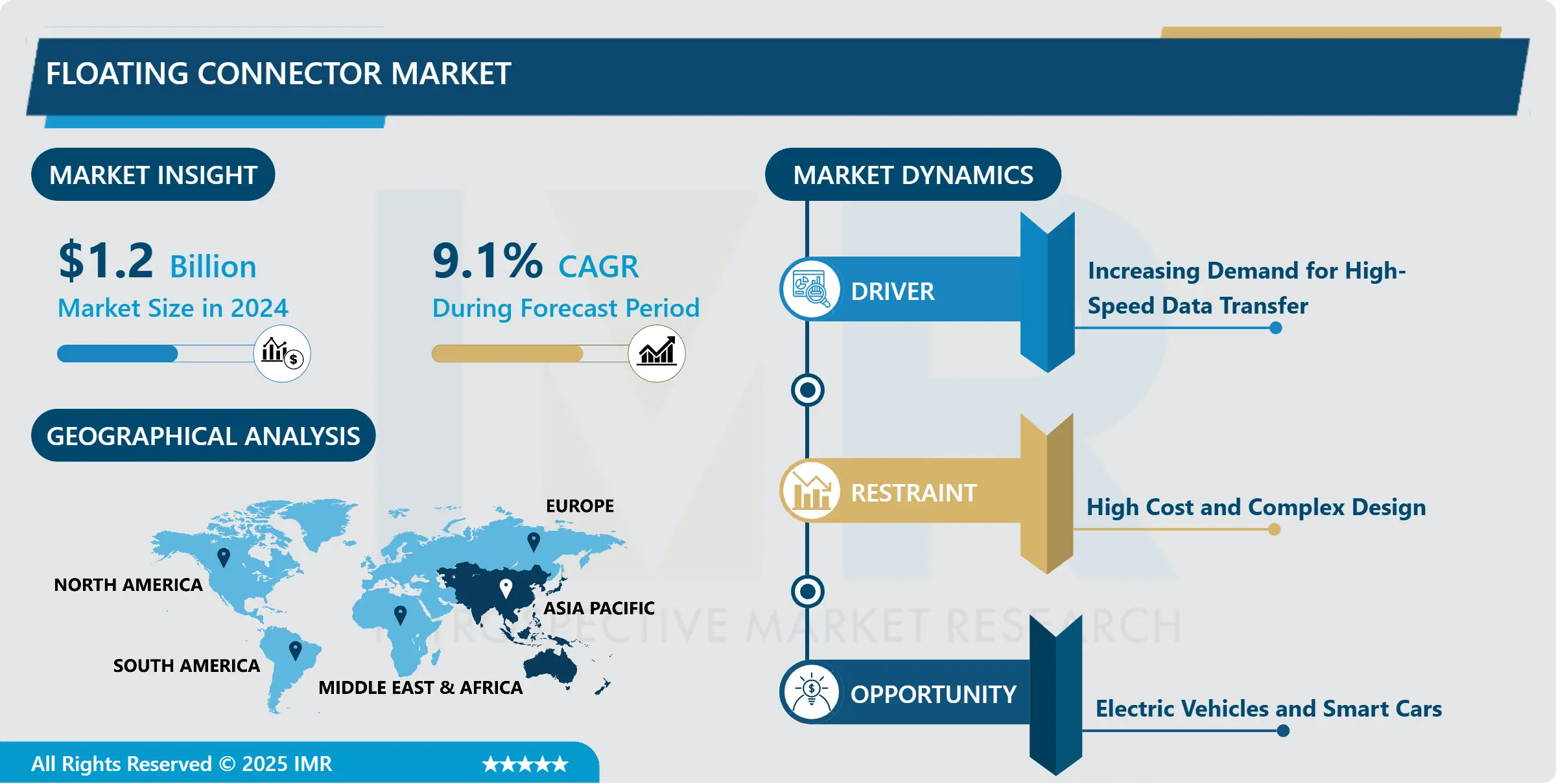
Floating Connector Market Growth and Trend Analysis:
Floating Connector Market Growth Driver - Increasing Demand for High-Speed Data Transfer
-
One of the main reasons the floating connector market is growing is the rising demand for fast and stable data transfer. In today’s world, more devices are being connected through technologies like 5G, cloud computing, and artificial intelligence (AI). These technologies require large amounts of data to move quickly and without errors. This is where floating connectors play an important role.
- Floating connectors are designed to handle high-speed data transmission while also dealing with physical movement, vibration, or slight misalignment between parts. This makes them perfect for modern devices such as smartphones, servers, routers, smart home systems, and even vehicles with advanced infotainment and navigation features.
- As 5G networks spread globally, more electronic devices are being made to support higher internet speeds. These devices need connectors that can support fast communication between components. Floating connectors help make sure this data moves smoothly and reliably, even in small or moving devices.
- Also, with cloud services and AI being used in homes, factories, hospitals, and offices, the demand for fast and stable connections is only increasing. Floating connectors help keep these systems running without delay or failure. In short, as our world becomes more digital and connected, floating connectors are becoming more important for high-speed, reliable performance.
Floating Connector Market Limiting Factor - High Cost and Complex Design
-
One major factor limiting the growth of the floating connector market is the high cost and complex design. Unlike regular connectors, floating connectors are made to move slightly and still keep a strong connection. This requires special materials and careful manufacturing. As a result, floating connectors are more expensive to produce.
- This becomes a problem for companies making low-cost products or large volumes of simple devices. For example, budget smartphones or household gadgets may not need the advanced features of a floating connector. In these cases, companies often choose cheaper, standard connectors.
- Also, floating connectors are harder to design into products. Engineers have to make sure the connector fits well and works properly with the rest of the device. This takes more time and effort, which increases the overall development cost.
- So, while floating connectors are great for high-performance devices, their high price and design complexity limit their use in everyday or low-cost electronics. This slows down their adoption in the broader market.
Floating Connector Market Expansion Opportunity - Electric Vehicles and Smart Cars
-
One of the biggest growth opportunities for the floating connector market is in the electric vehicle (EV) and smart car industries. As more people around the world switch to EVs and cars with advanced features like self-driving, in-car entertainment, and smart navigation, the need for strong, reliable connections increases.
- Cars go through a lot of shaking, heat, and movement while driving. Floating connectors are perfect for these conditions because they can handle vibration and small movements without losing connection. They help the car’s electronic systems stay connected and work properly, even on bumpy roads or in extreme temperatures.
- In EVs, floating connectors are used in battery systems, control units, and charging equipment. These parts need to share data quickly and safely, and floating connectors help make that possible.
- As governments and companies push for greener transportation, more electric and smart vehicles are being made. This creates a big chance for connector companies to grow by supplying floating connectors to car manufacturers. In short, the shift to EVs and smart cars is a strong opportunity for the floating connector market, especially as vehicles become more dependent on reliable electronic connections.
Floating Connector Market Challenge and Risk - Compatibility and Lack of Standards
-
A major challenge in the floating connector market is the lack of standard sizes and designs. Different companies often make connectors in different ways, and there is no single standard that all manufacturers follow. This can cause problems when trying to use floating connectors in different types of devices or systems.
- If a floating connector doesn’t fit properly or work with other parts, engineers may need to redesign parts of the product. This adds time, cost, and effort to the development process. It can also delay product launches or lead to performance issues.
- Another risk is fast-changing technology. As electronics get smaller and more advanced, connector designs must change quickly too. Companies that can’t keep up with these changes may fall behind or struggle to meet customer needs.
- Lastly, there’s a supply chain risk. Some key materials or parts for floating connectors might be hard to get or may become more expensive, especially during global supply disruptions. These challenges can slow down market growth or make companies think twice before choosing floating connectors. Solving these issues through better standards and supply management is important for the market to grow smoothly.
Floating Connector Market Segment Analysis:
Floating Connector Market is segmented based on Type, Application, End-Users, and Region
By Type, Floating Connector Segment is Expected to Dominate the Market During the Forecast Period
-
Standard floating connectors are pre-designed connectors that come in fixed shapes, sizes, and configurations. They are widely used in many electronic devices where the design does not require any special adjustments. These connectors are often available from manufacturers as ready-made parts, which makes them easy to find and use.
- One of the biggest advantages of standard floating connectors is that they help reduce the time and cost of designing a product. Since they are already made and tested, engineers do not have to spend extra time creating or customizing them. This speeds up the development process, especially in industries that need to bring products to market quickly. These connectors are also more affordable compared to custom connectors because they are produced in large quantities. This makes them a popular choice for consumer electronics, home appliances, office equipment, and other general-purpose machines.
- Despite being “standard,” these connectors still offer key benefits like shock absorption, vibration resistance, and the ability to handle slight misalignment features that are important for devices that move or vibrate during use. Overall, standard floating connectors are a practical and cost-effective solution for many companies. They offer good performance, are easy to work with, and help manufacturers save time and money without sacrificing reliability.
By Application, Floating Connector Segment Held the Largest Share in 2024
-
In the marine and boating industry, electronic systems are often exposed to rough conditions like saltwater, humidity, vibration, and movement. Because of this, the components used in boats and ships must be strong, reliable, and resistant to harsh environments. This is where floating connectors play an important role.
- Floating connectors are used in many parts of a boat’s electronic system, including control panels, GPS units, sonar systems, radio communication devices, engine monitoring systems, and navigation tools. These systems are vital for safety, communication, and operation at sea.
- One of the biggest challenges on boats is constant motion caused by waves, wind, and engine vibration. Standard connectors can get loose or damaged over time in such conditions. Floating connectors, however, are designed to allow a small amount of movement between parts without breaking the connection. This makes them ideal for marine use, where constant motion is unavoidable.
- Additionally, floating connectors can be designed to resist corrosion from saltwater and moisture damage, which helps extend the life of electronic equipment. As boats and ships become more high-tech and automated, the need for durable, flexible, and high-performance connectors will continue to grow. Floating connectors offer a smart solution for keeping marine electronics working smoothly and safely, even in tough ocean environments.
Floating Connector Market Regional Insights:
Asia Pacific is Expected to Dominate the Market Over the Forecast Period
-
The Asia-Pacific (APAC) region is the largest and fastest-growing market for floating connectors. This region includes countries like China, Japan, South Korea, and Taiwan, which are known for their strong electronics manufacturing industries. These countries produce millions of devices such as smartphones, tablets, laptops, TVs, cars, and industrial machines, all of which use connectors to function properly.
- Floating connectors are especially useful in devices that require reliable, high-speed connections and can handle small movements or vibrations. Since APAC produces a high volume of such electronics, the demand for floating connectors is very strong here.
- The growing use of electric vehicles (EVs) and smart factories in countries like China and South Korea is also increasing demand. EVs need strong and stable connectors for battery systems, sensors, and control units. Similarly, automated factories need floating connectors that can handle machine vibrations.
- As more people in Asia use electronic gadgets and as industries grow rapidly, the need for floating connectors is expected to rise even more. This makes Asia-Pacific the top region driving the global floating connector market forward.
Floating Connector Market Active Players:
- 3M Electronics (North America)
- Amphenol Corporation (North America)
- Bel Fuse Inc. (North America)
- BizLink Technology Inc. (Asia-Pacific)
- CUI Devices (North America)
- Dai-ichi Seiko Co., Ltd. (Asia-Pacific)
- ERNI Electronics (Part of TE Connectivity) (Europe)
- Fujitsu Components Ltd. (Asia-Pacific)
- HARTING Technology Group (Europe)
- Hirose Electric Co., Ltd. (Asia-Pacific)
- Hon Hai Precision Industry Co., Ltd. (Foxconn) (Asia-Pacific)
- I-PEX (Dai-ichi Seiko Group) (Asia-Pacific)
- ITT Inc. (North America)
- Japan Aviation Electronics Industry, Ltd. (JAE) (Asia-Pacific)
- JST Mfg. Co., Ltd. (Asia-Pacific)
- Kang Yang Hardware Enterprises Co., Ltd. (Asia-Pacific)
- KEL Corporation (Asia-Pacific)
- Kyocera AVX Components Corporation (Asia-Pacific)
- Luxshare Precision Industry Co., Ltd. (Asia-Pacific)
- Molex (a Koch Company) (North America)
- Panasonic Corporation (Asia-Pacific)
- Phoenix Contact (Europe)
- Radiall (Europe)
- Samtec Inc. (North America)
- Shenzhen ACON Technologies Co., Ltd. (Asia-Pacific)
- Shenzhen Deren Electronic Co., Ltd. (Asia-Pacific)
- Shenzhen Greenconn Technology Co., Ltd. (Asia-Pacific)
- TE Connectivity (North America)
- Würth Elektronik (Europe)
- Yamaichi Electronics Co., Ltd. (Asia-Pacific)
- Other Active Players
Key Industry Developments in the Floating Connector Market:
- In March 2024 – Harwin Launches “Flecto” Series has developed the Harwin introduced its new Flecto floating connector series, designed to support automated high-speed manufacturing with strong resistance to shock and vibration. And its purpose is Improves reliability and alignment tolerance in industrial and automation environments.
- In January 2024 Amphenol Expands Automotive Floating Connector Range has Developed the Amphenol released a new line of floating connectors specifically for electric vehicles (EVs) and ADAS systems. And the purpose is To improve data transmission stability under thermal and mechanical stress in automotive applications.
|
Floating Connector Market |
|||
|
Base Year: |
2024 |
Forecast Period: |
2025-2035 |
|
Historical Data: |
2018 to 2024 |
Market Size in 2024: |
USD 1.2 Billion |
|
Forecast Period 2025-35 CAGR: |
9.1 % |
Market Size in 2035: |
USD 3.13 Billion |
|
Segments Covered: |
By Type |
|
|
|
By Material |
|
||
|
By Application |
|
||
|
By Connector Size |
|
||
|
By End User |
|
||
|
By Region |
|
||
|
Growth Driver: |
|
||
|
Limiting Factor |
|
||
|
Expansion Opportunity |
|
||
|
Challenge and Risk |
|
||
|
Companies Covered in the Report: |
|
||
Chapter 1: Introduction
1.1 Scope and Coverage
Chapter 2:Executive Summary
Chapter 3: Market Landscape
3.1 Market Dynamics and Opportunity Analysis
3.1.1 Growth Drivers
3.1.2 Limiting Factors
3.1.3 Growth Opportunities
3.1.4 Challenges and Risks
3.2 Market Trend Analysis
3.3 Industry Ecosystem
3.4 Industry Value Chain Mapping
3.5 Strategic PESTLE Overview
3.6 Porter's Five Forces Framework
3.7 Regulatory Framework
3.8 Pricing Trend Analysis
3.9 Intellectual Property Review
3.10 Technology Evolution
3.11 Import-Export Analysis
3.12 Consumer Behavior Analysis
3.13 Investment Pocket Analysis
3.14 Go-To Market Strategy
Chapter 4: Floating Connector Market by Screen Type (2018-2035)
4.1 Floating Connector Market Snapshot and Growth Engine
4.2 Market Overview
4.3 Standard Floating Connectors
4.3.1 Introduction and Market Overview
4.3.2 Historic and Forecasted Market Size in Value USD and Volume Units
4.3.3 Key Market Trends, Growth Factors, and Opportunities
4.3.4 Geographic Segmentation Analysis
4.4 Custom Floating Connectors
Chapter 5: Floating Connector Market by Material (2018-2035)
5.1 Floating Connector Market Snapshot and Growth Engine
5.2 Market Overview
5.3 Plastic
5.3.1 Introduction and Market Overview
5.3.2 Historic and Forecasted Market Size in Value USD and Volume Units
5.3.3 Key Market Trends, Growth Factors, and Opportunities
5.3.4 Geographic Segmentation Analysis
5.4 Metal
Chapter 6: Floating Connector Market by Application (2018-2035)
6.1 Floating Connector Market Snapshot and Growth Engine
6.2 Market Overview
6.3 Marine and Boating
6.3.1 Introduction and Market Overview
6.3.2 Historic and Forecasted Market Size in Value USD and Volume Units
6.3.3 Key Market Trends, Growth Factors, and Opportunities
6.3.4 Geographic Segmentation Analysis
6.4 Aerospace
Chapter 7: Floating Connector Market by Connector Size (2018-2035)
7.1 Floating Connector Market Snapshot and Growth Engine
7.2 Market Overview
7.3 Miniature Floating Connectors
7.3.1 Introduction and Market Overview
7.3.2 Historic and Forecasted Market Size in Value USD and Volume Units
7.3.3 Key Market Trends, Growth Factors, and Opportunities
7.3.4 Geographic Segmentation Analysis
7.4 Standard Floating Connectors
Chapter 8: Floating Connector Market by End-user (2018-2035)
8.1 Floating Connector Market Snapshot and Growth Engine
8.2 Market Overview
8.3 Schools
8.3.1 Introduction and Market Overview
8.3.2 Historic and Forecasted Market Size in Value USD and Volume Units
8.3.3 Key Market Trends, Growth Factors, and Opportunities
8.3.4 Geographic Segmentation Analysis
8.4 Colleges and Universities
Chapter 9: Company Profiles and Competitive Analysis
9.1 Competitive Landscape
9.1.1 Competitive Benchmarking
9.1.2 Floating Connector Market Share by Manufacturer/Service Provider(2024)
9.1.3 Industry BCG Matrix
9.1.4 PArtnerships, Mergers & Acquisitions
9.2 3M ELECTRONICS (NORTH AMERICA)
9.2.1 Company Overview
9.2.2 Key Executives
9.2.3 Company Snapshot
9.2.4 Role of the Company in the Market
9.2.5 Sustainability and Social Responsibility
9.2.6 Operating Business Segments
9.2.7 Product Portfolio
9.2.8 Business Performance
9.2.9 Recent News & Developments
9.2.10 SWOT Analysis
9.3 AMPHENOL CORPORATION (NORTH AMERICA)
9.4 BEL FUSE INC. (NORTH AMERICA)
9.5 BIZLINK TECHNOLOGY INC. (ASIA-PACIFIC)
9.6 CUI DEVICES (NORTH AMERICA)
9.7 DAI-ICHI SEIKO CO.
9.8 LTD. (ASIA-PACIFIC)
9.9 ERNI ELECTRONICS (PART OF TE CONNECTIVITY) (EUROPE)
9.10 FUJITSU COMPONENTS LTD. (ASIA-PACIFIC)
9.11 HARTING TECHNOLOGY GROUP (EUROPE)
9.12 HIROSE ELECTRIC CO.
9.13 LTD. (ASIA-PACIFIC)
9.14 HON HAI PRECISION INDUSTRY CO.
9.15 LTD. (FOXCONN) (ASIA-PACIFIC)
9.16 I-PEX (DAI-ICHI SEIKO GROUP) (ASIA-PACIFIC)
9.17 ITT INC. (NORTH AMERICA)
9.18 JAPAN AVIATION ELECTRONICS INDUSTRY
9.19 LTD. (JAE) (ASIA-PACIFIC)
9.20 JST MFG. CO.
9.21 LTD. (ASIA-PACIFIC)
9.22 KANG YANG HARDWARE ENTERPRISES CO.
9.23 LTD. (ASIA-PACIFIC)
9.24 KEL CORPORATION (ASIA-PACIFIC)
9.25 KYOCERA AVX COMPONENTS CORPORATION (ASIA-PACIFIC)
9.26 LUXSHARE PRECISION INDUSTRY CO.
9.27 LTD. (ASIA-PACIFIC)
9.28 MOLEX (A KOCH COMPANY) (NORTH AMERICA)
9.29 PANASONIC CORPORATION (ASIA-PACIFIC)
9.30 PHOENIX CONTACT (EUROPE)
9.31 RADIALL (EUROPE)
9.32 SAMTEC INC. (NORTH AMERICA)
9.33 SHENZHEN ACON TECHNOLOGIES CO.
9.34 LTD. (ASIA-PACIFIC)
9.35 SHENZHEN DEREN ELECTRONIC CO.
9.36 LTD. (ASIA-PACIFIC)
9.37 SHENZHEN GREENCONN TECHNOLOGY CO.
9.38 LTD. (ASIA-PACIFIC)
9.39 TE CONNECTIVITY (NORTH AMERICA)
9.40 WÜRTH ELEKTRONIK (EUROPE)
9.41 YAMAICHI ELECTRONICS CO.
9.42 LTD. (ASIA-PACIFIC)
9.43 AND OTHER ACTIVE PLAYERS.
Chapter 10: Global Floating Connector Market By Region
10.1 Overview
10.2. North America Floating Connector Market
10.2.1 Key Market Trends, Growth Factors and Opportunities
10.2.2 Top Key Companies
10.2.3 Historic and Forecasted Market Size by Segments
10.2.4 Historic and Forecast Market Size by Country
10.2.4.1 US
10.2.4.2 Canada
10.2.4.3 Mexico
10.3. Eastern Europe Floating Connector Market
10.3.1 Key Market Trends, Growth Factors and Opportunities
10.3.2 Top Key Companies
10.3.3 Historic and Forecasted Market Size by Segments
10.3.4 Historic and Forecast Market Size by Country
10.3.4.1 Russia
10.3.4.2 Bulgaria
10.3.4.3 The Czech Republic
10.3.4.4 Hungary
10.3.4.5 Poland
10.3.4.6 Romania
10.3.4.7 Rest of Eastern Europe
10.4. Western Europe Floating Connector Market
10.4.1 Key Market Trends, Growth Factors and Opportunities
10.4.2 Top Key Companies
10.4.3 Historic and Forecasted Market Size by Segments
10.4.4 Historic and Forecast Market Size by Country
10.4.4.1 Germany
10.4.4.2 UK
10.4.4.3 France
10.4.4.4 The Netherlands
10.4.4.5 Italy
10.4.4.6 Spain
10.4.4.7 Rest of Western Europe
10.5. Asia Pacific Floating Connector Market
10.5.1 Key Market Trends, Growth Factors and Opportunities
10.5.2 Top Key Companies
10.5.3 Historic and Forecasted Market Size by Segments
10.5.4 Historic and Forecast Market Size by Country
10.5.4.1 China
10.5.4.2 India
10.5.4.3 Japan
10.5.4.4 South Korea
10.5.4.5 Malaysia
10.5.4.6 Thailand
10.5.4.7 Vietnam
10.5.4.8 The Philippines
10.5.4.9 Australia
10.5.4.10 New Zealand
10.5.4.11 Rest of APAC
10.6. Middle East & Africa Floating Connector Market
10.6.1 Key Market Trends, Growth Factors and Opportunities
10.6.2 Top Key Companies
10.6.3 Historic and Forecasted Market Size by Segments
10.6.4 Historic and Forecast Market Size by Country
10.6.4.1 Turkiye
10.6.4.2 Bahrain
10.6.4.3 Kuwait
10.6.4.4 Saudi Arabia
10.6.4.5 Qatar
10.6.4.6 UAE
10.6.4.7 Israel
10.6.4.8 South Africa
10.7. South America Floating Connector Market
10.7.1 Key Market Trends, Growth Factors and Opportunities
10.7.2 Top Key Companies
10.7.3 Historic and Forecasted Market Size by Segments
10.7.4 Historic and Forecast Market Size by Country
10.7.4.1 Brazil
10.7.4.2 Argentina
10.7.4.3 Rest of SA
Chapter 11 Analyst Viewpoint and Conclusion
Chapter 12 Our Thematic Research Methodology
12.1 Research Process
12.2 Primary Research
12.3 Secondary Research
Chapter 13 Case Study
Chapter 14 Appendix
14.1 Sources
14.2 List of Tables and figures
14.3 Short Forms and Citations
14.4 Assumption and Conversion
14.5 Disclaimer
|
Floating Connector Market |
|||
|
Base Year: |
2024 |
Forecast Period: |
2025-2035 |
|
Historical Data: |
2018 to 2024 |
Market Size in 2024: |
USD 1.2 Billion |
|
Forecast Period 2025-35 CAGR: |
9.1 % |
Market Size in 2035: |
USD 3.13 Billion |
|
Segments Covered: |
By Type |
|
|
|
By Material |
|
||
|
By Application |
|
||
|
By Connector Size |
|
||
|
By End User |
|
||
|
By Region |
|
||
|
Growth Driver: |
|
||
|
Limiting Factor |
|
||
|
Expansion Opportunity |
|
||
|
Challenge and Risk |
|
||
|
Companies Covered in the Report: |
|
||


