




Electronic Ceramic Market Synopsis:
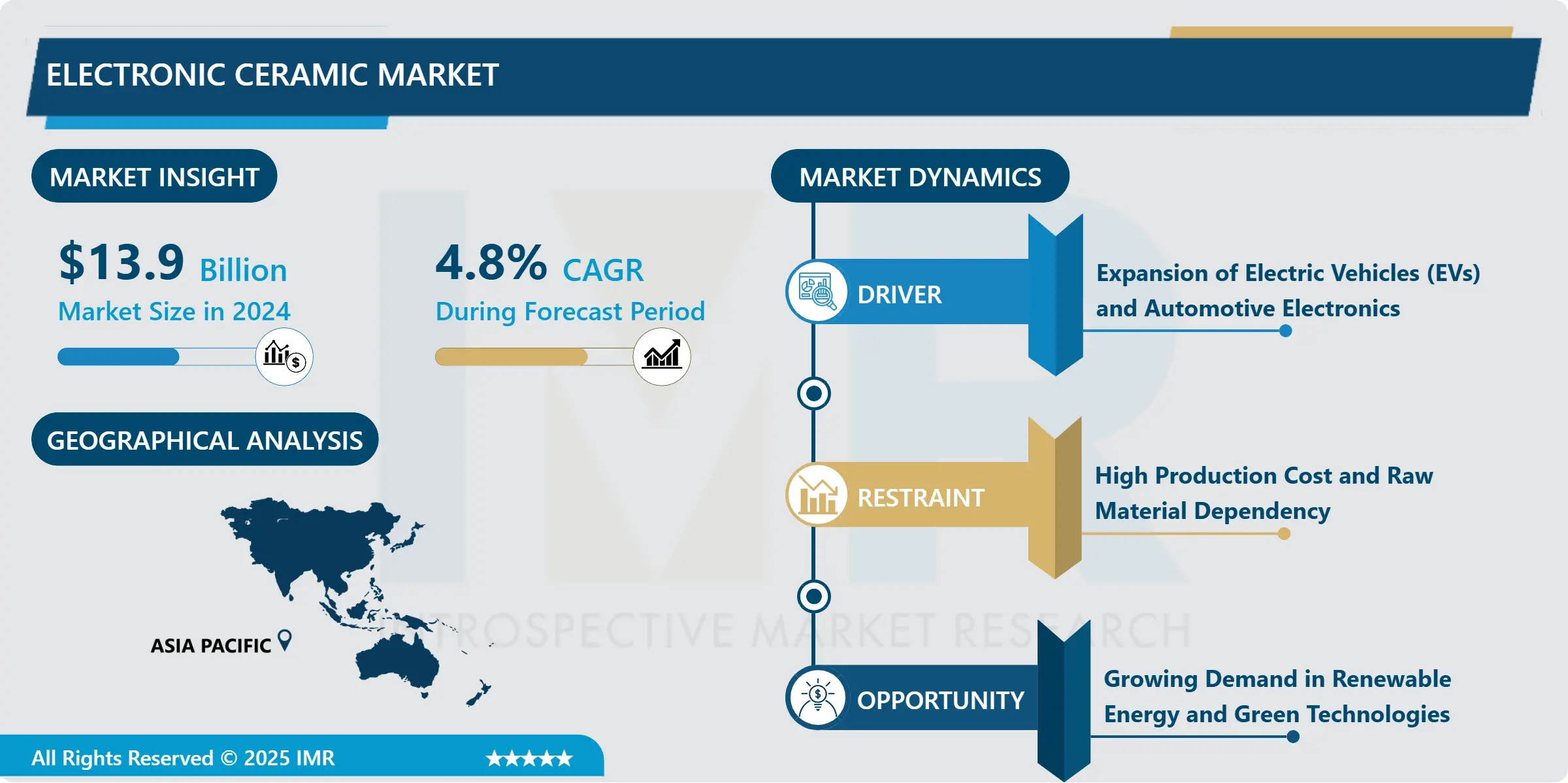
Electronic Ceramic Market Size Was Valued at USD?13.9?billion in 2024, and is Projected to Reach USD?23.28?billion by 2035, Growing at a CAGR of 4.8% from 2025-2035.
The Electronic Ceramic Market is experiencing steady growth, driven by rising demand across consumer electronics, electric vehicles (EVs), telecommunications, and healthcare sectors. These ceramics are specialized inorganic materials known for their excellent electrical insulation, thermal resistance, and unique properties like piezoelectricity and ferroelectricity.
Electronic ceramics are used in key components such as capacitors (especially MLCCs), sensors, actuators, power devices, and memory storage systems. Among these, piezoelectric ceramics and dielectric ceramics dominate due to their widespread application in smartphones, medical devices, automotive sensors, and 5G-enabled systems
However, the market faces challenges such as high production costs, material availability, and environmental concerns related to lead-based ceramics. Despite this, ongoing innovation in lead-free ceramics and sustainable manufacturing is expected to support long-term growth. Overall, the electronic ceramics market is a vital part of the modern electronics ecosystem, with strong prospects ahead.
Electronic Ceramic Market Growth and Trend Analysis:
Electronic Ceramic Market Growth Driver- Expansion of Electric Vehicles (EVs) and Automotive Electronics
- The rapid growth of electric vehicles (EVs) and hybrid cars is one of the main reasons for the increasing demand for electronic ceramics. As the world moves toward cleaner and more energy-efficient transportation, more EVs are being produced each year. These vehicles rely heavily on advanced electronic systems to work safely and efficiently. Ceramic materials play a key role in many of these systems because of their excellent ability to handle high temperatures, resist electricity, and last a long time.
- In EVs, ceramics are used in important parts such as battery management systems, power inverters, and charging systems. They help control and protect the battery by ensuring that it operates within safe temperature and voltage limits. Ceramics are also used in advanced driver-assistance systems (ADAS) like automatic braking and parking sensors, where they support fast and accurate responses.
- One of the biggest advantages of electronic ceramics is their ability to remain stable even in extreme conditions, such as high heat or strong electric currents. This makes them ideal for use in vehicles, which often face tough driving environments. As the number of EVs continues to grow and automotive technology becomes more advanced, the need for reliable and durable ceramic components will also increase. This trend is expected to drive strong growth in the electronic ceramic market over the coming years.
Electronic Ceramic Market Limiting Factor- High Production Cost and Raw Material Dependency
- One major factor limiting the growth of the electronic ceramic market is the high cost of production and dependence on rare and expensive raw materials. Manufacturing electronic ceramics requires high-purity materials like alumina, zirconia, and rare earth elements, which are not only costly but also limited in global supply. Additionally, the production process involves energy-intensive steps such as high-temperature sintering and precision engineering, which further increases manufacturing costs. These high expenses can reduce profit margins and make it difficult for smaller manufacturers to compete, ultimately slowing down the overall growth of the market.
Electronic Ceramic Market Expansion Opportunity- Growing Demand in Renewable Energy and Green Technologies
- One of the biggest expansion opportunities for the Electronic Ceramic Market lies in the renewable energy sector and green technologies. As the world shifts toward clean and sustainable energy sources such as solar power, wind energy, and electric vehicles the need for advanced electronic components is rapidly increasing. Electronic ceramics play a vital role in these technologies due to their excellent thermal resistance, electrical insulation, and long-term durability.
- For example, in solar power systems, ceramic substrates and insulators are used in inverters and power control modules to ensure safe and efficient energy conversion. In wind turbines, electronic ceramics help control and monitor high-voltage systems. Additionally, as electric vehicles (EVs) continue to grow in popularity, electronic ceramics are in high demand for use in battery management systems, charging stations, and power electronics.
- Governments around the world are also offering strong support for renewable energy projects through funding and environmental regulations, which is encouraging more companies to invest in clean tech solutions. This trend creates a massive opportunity for electronic ceramic manufacturers to supply the necessary components.
- By developing cost-effective, eco-friendly, and high-performance ceramic materials, companies in this market can expand their reach and play a key role in the global transition to a greener, more energy-efficient future.
Electronic Ceramic Market Challenge and Risk - Key Challenges and Risks Hindering the Growth of the Electronic Ceramic Market
- The Electronic Ceramic Market faces several key challenges and risks that can impact its growth and stability. One major challenge is the high cost and limited availability of raw materials such as alumina, zirconia, and rare earth elements. These materials are often sourced from specific regions, making the supply chain vulnerable to disruptions caused by political tensions, export restrictions, or market instability. Any shortage or price hike can significantly raise manufacturing costs.
- Another important risk is the strict environmental regulations, especially concerning lead-based ceramics like PZT (lead zirconate titanate), which are commonly used for their excellent piezoelectric properties. However, because lead is toxic and harmful to the environment, many countries are enforcing bans or limits on its use. This pushes manufacturers to develop lead-free alternatives, which may be more expensive, less efficient, or harder to produce at scale.
- The complex and costly manufacturing process is also a barrier. Producing high-performance electronic ceramics requires advanced technology, high temperatures, skilled workers, and tight quality control. This makes it difficult for smaller or new companies to enter the market.
- Lastly, rapid technological changes in electronics and evolving customer needs require continuous innovation. Companies must invest heavily in R&D to stay competitive, which adds to operational risks and financial pressure. These combined factors present significant risks to the growth and sustainability of the electronic ceramic market.
Electronic Ceramic Market Segment Analysis:
Electronic Ceramic Market is segmented based on Type, Application, End-Users, and Region
By Type, Electronic Ceramic Segment is Expected to Dominate the Market During the Forecast Period
- Among the various product types, Monolithic Ceramics currently lead the market and are expected to remain dominant during the forecast period. Monolithic ceramics are single-phase, dense materials with high mechanical strength, excellent thermal resistance, and superior electrical insulating properties. They are widely used in consumer electronics, medical devices, automotive components, and industrial equipment. Their cost-effectiveness and versatility make them the most preferred choice compared to Ceramic Matrix Composites and Ceramic Coatings, which are typically used in more specialized, high-performance applications like aerospace or defence.
By Application, Electronic Ceramic Segment Held the Largest Share in 2024
- In terms of application, Capacitors especially Multilayer Ceramic Capacitors (MLCCs) represent the top market trend and hold the largest market share. MLCCs are essential in nearly every electronic device, from smartphones and laptops to electric vehicles and renewable energy systems. They are valued for their high capacitance, small size, and long-life span. The ongoing expansion of consumer electronics, the rollout of 5G, and the rise of electric vehicles are all fuelling the demand for capacitors made from electronic ceramics.
- Together, the dominance of Monolithic Ceramics as the leading product type and Capacitors as the top application area highlight the strong market trend toward miniaturized, high-performance components that are essential in next-generation technologies.
Electronic Ceramic Market Regional Insights:
Asia Pacific is Expected to Dominate the Market Over the Forecast Period
- The Asia-Pacific region is emerging as the dominant player in the global electronic ceramic market, both in terms of market share and growth rate. This strong position is largely attributed to the presence of major electronics and semiconductor manufacturers in countries such as China, Japan, South Korea, and Taiwan. These nations are global hubs for the production of consumer electronics, smartphones, laptops, semiconductors, and automotive electronics all of which heavily depend on electronic ceramic components like capacitors, insulators, and sensors.
- Favourable government policies, such as subsidies and support for high-tech manufacturing, are further boosting industry growth. Additionally, low labour costs, strong supply chain infrastructure, and increasing demand for advanced electronic devices contribute to the region’s leadership in this sector.
- Rapid industrialization and increasing adoption of technologies like 5G, electric vehicles (EVs), and IoT are also accelerating the demand for high-performance electronic ceramics. Japan and South Korea are particularly noted for their advancements in ceramic material science and innovation, while China is expanding rapidly due to its vast manufacturing capacity and growing domestic demand.
- Overall, Asia-Pacific is expected to maintain its leading role in the electronic ceramic market over the forecast period, driven by continuous innovation and strong industrial support.
Electronic Ceramic Market Active Players:
- American Technical Ceramics Corp. (ATC) (United States)
- APC International, Ltd. (United States)
- Blasch Precision Ceramics Inc. (United States)
- Central Electronics Limited (CEL) (India)
- CeramTec GmbH (Germany)
- CoorsTek KK (Japan)
- CoorsTek, Inc. (United States)
- CTS Corporation (United States)
- Elan Technology (United States)
- Electro-Science Laboratories (ESL) (United States)
- Ferro Corporation (United States)
- H.C. Starck Ceramics GmbH (Germany)
- Innovacera (China)
- KEMET Corporation (Yageo Group) (United States / Taiwan)
- Kerafol – Keramische Folien GmbH & Co. KG (Germany)
- KOA Corporation (Japan)
- Kyocera Corporation (Japan)
- Mantec Technical Ceramics Ltd. (United Kingdom)
- Morgan Advanced Materials (United Kingdom)
- Murata Manufacturing Co., Ltd. (Japan)
- NGK Spark Plug Co., Ltd. (NTK Technical Ceramics) (Japan)
- Nippon Chemical Industrial Co., Ltd. (NCI) (Japan)
- PI Ceramic GmbH (Germany)
- Saint-Gobain Ceramics (France)
- Sparkler Ceramics Pvt. Ltd. (India)
- Superior Technical Ceramics (United States)
- Surmet Corporation (United States)
- TDK Corporation (Japan)
- Vishay Intertechnology, Inc. (United States)
- Zibo Taisheng Ceramic Technology Co., Ltd. (China)
- Other Active Players
Key Industry Developments in the Electronic Ceramic Market:
- Morgan Advanced Materials launched a next-gen piezoelectric ceramic formulation in February 2024, enhancing energy harvesting for IoT sensors.
- MARUWA Co. released a low-temperature co-fired ceramic (LTCC) system for 5G applications in April 2024
|
Electronic Ceramic Market |
|||
|
Base Year: |
2024 |
Forecast Period: |
2025-2035 |
|
Historical Data: |
2018 to 2023 |
Market Size in 2024: |
USD?13.9?billion |
|
Forecast Period 2025-35 CAGR: |
4.8% |
Market Size in 2035: |
USD?23.28?billion |
|
Segments Covered: |
By Type |
|
|
|
By Application |
|
||
|
By End User |
|
||
|
By Region |
|
||
|
Growth Driver: |
|
||
|
Limiting Factor |
|
||
|
Expansion Opportunity |
|
||
|
Challenge and Risk |
|
||
|
Companies Covered in the Report: |
|
||
Chapter 1: Introduction
1.1 Scope and Coverage
Chapter 2:Executive Summary
Chapter 3: Market Landscape
3.1 Market Dynamics and Opportunity Analysis
3.1.1 Growth Drivers
3.1.2 Limiting Factors
3.1.3 Growth Opportunities
3.1.4 Challenges and Risks
3.2 Market Trend Analysis
3.3 Industry Ecosystem
3.4 Industry Value Chain Mapping
3.5 Strategic PESTLE Overview
3.6 Porter's Five Forces Framework
3.7 Regulatory Framework
3.8 Pricing Trend Analysis
3.9 Intellectual Property Review
3.10 Technology Evolution
3.11 Import-Export Analysis
3.12 Consumer Behavior Analysis
3.13 Investment Pocket Analysis
3.14 Go-To Market Strategy
Chapter 4: Electronic Ceramic Market by Product Type (2018-2035)
4.1 Electronic Ceramic Market Snapshot and Growth Engine
4.2 Market Overview
4.3 Monolithic Ceramics
4.3.1 Introduction and Market Overview
4.3.2 Historic and Forecasted Market Size in Value USD and Volume Units
4.3.3 Key Market Trends, Growth Factors, and Opportunities
4.3.4 Geographic Segmentation Analysis
4.4 Ceramic Matrix Composites
4.5 Ceramic Coatings
Chapter 5: Electronic Ceramic Market by Application (2018-2035)
5.1 Electronic Ceramic Market Snapshot and Growth Engine
5.2 Market Overview
5.3 Capacitors
5.3.1 Introduction and Market Overview
5.3.2 Historic and Forecasted Market Size in Value USD and Volume Units
5.3.3 Key Market Trends, Growth Factors, and Opportunities
5.3.4 Geographic Segmentation Analysis
5.4 Data Storage Devices
5.5 Optoelectronic Devices
5.6 Actuators & Sensors
5.7 Power Distribution Devices
Chapter 6: Electronic Ceramic Market by End User (2018-2035)
6.1 Electronic Ceramic Market Snapshot and Growth Engine
6.2 Market Overview
6.3 Electronics
6.3.1 Introduction and Market Overview
6.3.2 Historic and Forecasted Market Size in Value USD and Volume Units
6.3.3 Key Market Trends, Growth Factors, and Opportunities
6.3.4 Geographic Segmentation Analysis
6.4 Automobile
6.5 Medical
6.6 Aerospace & Defence
Chapter 7: Company Profiles and Competitive Analysis
7.1 Competitive Landscape
7.1.1 Competitive Benchmarking
7.1.2 Electronic Ceramic Market Share by Manufacturer/Service Provider(2024)
7.1.3 Industry BCG Matrix
7.1.4 PArtnerships, Mergers & Acquisitions
7.2 AMERICAN TECHNICAL CERAMICS CORP. (ATC) (UNITED STATES)
7.2.1 Company Overview
7.2.2 Key Executives
7.2.3 Company Snapshot
7.2.4 Role of the Company in the Market
7.2.5 Sustainability and Social Responsibility
7.2.6 Operating Business Segments
7.2.7 Product Portfolio
7.2.8 Business Performance
7.2.9 Recent News & Developments
7.2.10 SWOT Analysis
7.3 APC INTERNATIONAL
7.4 LTD. (UNITED STATES)
7.5 BLASCH PRECISION CERAMICS INC. (UNITED STATES)
7.6 CENTRAL ELECTRONICS LIMITED (CEL) (INDIA)
7.7 CERAMTEC GMBH (GERMANY)
7.8 COORSTEK KK (JAPAN)
7.9 COORSTEK
7.10 INC. (UNITED STATES)
7.11 CTS CORPORATION (UNITED STATES)
7.12 ELAN TECHNOLOGY (UNITED STATES)
7.13 ELECTRO-SCIENCE LABORATORIES (ESL) (UNITED STATES)
7.14 FERRO CORPORATION (UNITED STATES)
7.15 H.C. STARCK CERAMICS GMBH (GERMANY)
7.16 INNOVACERA (CHINA)
7.17 KEMET CORPORATION (YAGEO GROUP) (UNITED STATES / TAIWAN)
7.18 KERAFOL – KERAMISCHE FOLIEN GMBH & CO. KG (GERMANY)
7.19 KOA CORPORATION (JAPAN)
7.20 KYOCERA CORPORATION (JAPAN)
7.21 MANTEC TECHNICAL CERAMICS LTD. (UNITED KINGDOM)
7.22 MORGAN ADVANCED MATERIALS (UNITED KINGDOM)
7.23 MURATA MANUFACTURING CO.
7.24 LTD. (JAPAN)
7.25 NGK SPARK PLUG CO.
7.26 LTD. (NTK TECHNICAL CERAMICS) (JAPAN)
7.27 NIPPON CHEMICAL INDUSTRIAL CO.
7.28 LTD. (NCI) (JAPAN)
7.29 PI CERAMIC GMBH (GERMANY)
7.30 SAINT-GOBAIN CERAMICS (FRANCE)
7.31 SPARKLER CERAMICS PVT. LTD. (INDIA)
7.32 SUPERIOR TECHNICAL CERAMICS (UNITED STATES)
7.33 SURMET CORPORATION (UNITED STATES)
7.34 TDK CORPORATION (JAPAN)
7.35 VISHAY INTERTECHNOLOGY
7.36 INC. (UNITED STATES)
7.37 ZIBO TAISHENG CERAMIC TECHNOLOGY CO.
7.38 LTD. (CHINA)
7.39 AND OTHER ACTIVE PLAYERS
Chapter 8: Global Electronic Ceramic Market By Region
8.1 Overview
8.2. North America Electronic Ceramic Market
8.2.1 Key Market Trends, Growth Factors and Opportunities
8.2.2 Top Key Companies
8.2.3 Historic and Forecasted Market Size by Segments
8.2.4 Historic and Forecast Market Size by Country
8.2.4.1 US
8.2.4.2 Canada
8.2.4.3 Mexico
8.3. Eastern Europe Electronic Ceramic Market
8.3.1 Key Market Trends, Growth Factors and Opportunities
8.3.2 Top Key Companies
8.3.3 Historic and Forecasted Market Size by Segments
8.3.4 Historic and Forecast Market Size by Country
8.3.4.1 Russia
8.3.4.2 Bulgaria
8.3.4.3 The Czech Republic
8.3.4.4 Hungary
8.3.4.5 Poland
8.3.4.6 Romania
8.3.4.7 Rest of Eastern Europe
8.4. Western Europe Electronic Ceramic Market
8.4.1 Key Market Trends, Growth Factors and Opportunities
8.4.2 Top Key Companies
8.4.3 Historic and Forecasted Market Size by Segments
8.4.4 Historic and Forecast Market Size by Country
8.4.4.1 Germany
8.4.4.2 UK
8.4.4.3 France
8.4.4.4 The Netherlands
8.4.4.5 Italy
8.4.4.6 Spain
8.4.4.7 Rest of Western Europe
8.5. Asia Pacific Electronic Ceramic Market
8.5.1 Key Market Trends, Growth Factors and Opportunities
8.5.2 Top Key Companies
8.5.3 Historic and Forecasted Market Size by Segments
8.5.4 Historic and Forecast Market Size by Country
8.5.4.1 China
8.5.4.2 India
8.5.4.3 Japan
8.5.4.4 South Korea
8.5.4.5 Malaysia
8.5.4.6 Thailand
8.5.4.7 Vietnam
8.5.4.8 The Philippines
8.5.4.9 Australia
8.5.4.10 New Zealand
8.5.4.11 Rest of APAC
8.6. Middle East & Africa Electronic Ceramic Market
8.6.1 Key Market Trends, Growth Factors and Opportunities
8.6.2 Top Key Companies
8.6.3 Historic and Forecasted Market Size by Segments
8.6.4 Historic and Forecast Market Size by Country
8.6.4.1 Turkiye
8.6.4.2 Bahrain
8.6.4.3 Kuwait
8.6.4.4 Saudi Arabia
8.6.4.5 Qatar
8.6.4.6 UAE
8.6.4.7 Israel
8.6.4.8 South Africa
8.7. South America Electronic Ceramic Market
8.7.1 Key Market Trends, Growth Factors and Opportunities
8.7.2 Top Key Companies
8.7.3 Historic and Forecasted Market Size by Segments
8.7.4 Historic and Forecast Market Size by Country
8.7.4.1 Brazil
8.7.4.2 Argentina
8.7.4.3 Rest of SA
Chapter 9 Analyst Viewpoint and Conclusion
Chapter 10 Our Thematic Research Methodology
10.1 Research Process
10.2 Primary Research
10.3 Secondary Research
Chapter 11 Case Study
Chapter 12 Appendix
12.1 Sources
12.2 List of Tables and figures
12.3 Short Forms and Citations
12.4 Assumption and Conversion
12.5 Disclaimer
|
Electronic Ceramic Market |
|||
|
Base Year: |
2024 |
Forecast Period: |
2025-2035 |
|
Historical Data: |
2018 to 2023 |
Market Size in 2024: |
USD?13.9?billion |
|
Forecast Period 2025-35 CAGR: |
4.8% |
Market Size in 2035: |
USD?23.28?billion |
|
Segments Covered: |
By Type |
|
|
|
By Application |
|
||
|
By End User |
|
||
|
By Region |
|
||
|
Growth Driver: |
|
||
|
Limiting Factor |
|
||
|
Expansion Opportunity |
|
||
|
Challenge and Risk |
|
||
|
Companies Covered in the Report: |
|
||


