




Electrode ionization Market Synopsis:
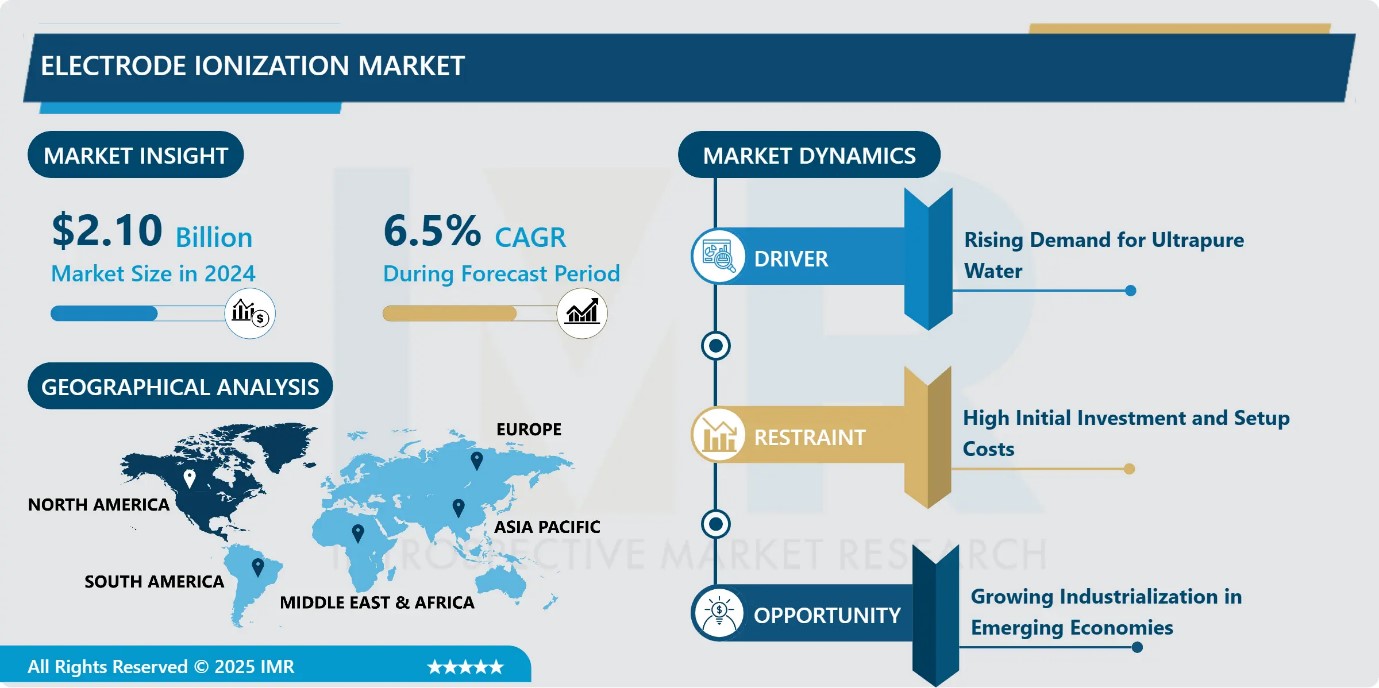
Electrode ionization Market Size Was Valued at USD 2.10 Billion in 2024, and is Projected to Reach USD 4.20 Billion by 2035, Growing at a CAGR of 6.5% from 2025-2035.
Electrode ionization (EDI) is an advanced water purification technology that combines ion exchange resins and electricity to remove ionized and ionizable species from water. Unlike traditional deionization methods, EDI does not require chemical regeneration, making it a more sustainable and cost-effective solution.
The market for EDI is being driven by the growing demand for ultrapure water in industries such as pharmaceuticals, power generation, electronics, and food & beverage. As environmental regulations become more stringent and industries seek cleaner, chemical-free water treatment solutions, EDI is gaining popularity due to its efficiency, low operating costs, and minimal environmental impact.
Increased industrialization, technological advancements in water treatment, and heightened awareness of water sustainability are key factors contributing to the growing adoption of EDI systems worldwide. Additionally, the push for green technologies and reduced dependence on hazardous chemicals is further propelling market growth.
Electrode ionization Market Growth and Trend Analysis:
Electrode ionization Market Growth Driver - Rising Demand for Ultrapure Water
- One of the main reasons behind the growth of the Electrode Ionization (EDI) market is the increasing demand for ultrapure water across various industries. Ultrapure water is water that has been purified to extremely high standards, meaning it contains almost no impurities, minerals, or dissolved salts. This type of water is critical in sectors like pharmaceuticals, semiconductors, and power generation.
- In the pharmaceutical industry, ultrapure water is used in the production of medicines and cleaning of equipment to ensure there is no contamination. Any impurity in the water could affect the quality and safety of the drugs. Similarly, in the semiconductor industry, where microchips are made, even the tiniest particle or chemical in water can damage the delicate components of a chip. Therefore, the need for absolutely clean water is extremely high. The power industry also uses ultrapure water in boilers and cooling systems to avoid damage and improve efficiency.
- EDI systems help produce this high-quality water without the use of harmful chemicals. Traditional methods often involve chemicals for cleaning or regeneration, which are expensive and harmful to the environment. EDI, on the other hand, is a chemical-free, continuous, and low-maintenance process, making it a preferred solution.
- As these industries grow and global standards for water purity become stricter, the demand for EDI systems is expected to rise, pushing the market forward in the coming years. ?
Electrode ionization Market Limiting Factor - High Initial Investment and Setup Costs
- One of the key limiting factors in the growth of the Electrode Ionization (EDI) market is the high initial cost of setting up an EDI system. Although EDI offers long-term savings and is more environmentally friendly than traditional water purification methods, the upfront costs for equipment, installation, and integration with existing systems can be quite high.
- For small and medium-sized businesses, especially in developing countries, this can be a major barrier. These companies may not have the budget or resources to invest in advanced water treatment technologies, even if they understand the long-term benefits.
- In addition, technical complexity can also slow down adoption. EDI systems require proper system design, skilled technicians for installation and operation, and regular monitoring to ensure optimal performance. This need for expertise and training adds to the overall cost and can deter companies unfamiliar with the technology.
- Furthermore, in regions where conventional deionization systems are still widely used and where regulations are less strict, industries may not feel the immediate need to shift to EDI, slowing market expansion.
- To overcome this barrier, manufacturers and solution providers are focusing on offering cost-effective, modular, and easy-to-operate EDI systems, along with training and support services to encourage broader adoption.
Electrode ionization Market Expansion Opportunity - Growing Industrialization in Emerging Economies
- A major opportunity for the expansion of the Electrode Ionization (EDI) market lies in the rapid industrial growth in emerging economies. Countries such as India, China, Brazil, and Indonesia are investing heavily in manufacturing, pharmaceuticals, electronics, and energy sectors industries that require high-purity water for critical operations.
- As these nations continue to industrialize, the demand for reliable and efficient water treatment solutions is rising. EDI systems, known for their ability to produce ultrapure water without chemicals, are becoming an attractive option for industries aiming to meet international quality standards and environmental regulations.
- Additionally, governments in these regions are beginning to enforce stricter environmental and water quality laws, encouraging industries to adopt cleaner and more sustainable water treatment technologies like EDI. International companies are also expanding their operations into these markets, further boosting demand for advanced water purification systems.
- There is also a growing awareness of water sustainability and the need to reduce industrial waste and chemical usage. This creates a strong incentive for companies in developing markets to shift from traditional deionization methods to EDI solutions. By offering cost-effective, modular, and scalable EDI systems, manufacturers have a great opportunity to tap into these emerging markets and expand their global footprint.
Electrode ionization Market Challenge and Risk- High Capital and Operational Costs in Electrode ionization (EDI) Systems
- One of the main challenges in the electrode ionization (EDI) market is the high cost of installing and operating these systems. Compared to traditional deionization methods, such as mixed-bed ion exchange, EDI systems are more expensive. This is because EDI uses advanced technology that includes special membranes, electrodes, and control systems, which are costly to produce and install.
- The initial setup of an EDI unit requires a significant investment. Companies need to buy high-quality materials and components that are designed to handle the continuous process of removing ions from water using electricity. In addition to the cost of the equipment itself, skilled professionals are needed to design, install, and maintain the system, which adds to the overall expense.
- Operational costs can also be high. Although EDI systems use less chemical input compared to older methods, they do need a consistent power supply, and the components may need regular cleaning or replacement to prevent fouling or damage. If the feed water contains impurities or minerals, additional pre-treatment systems may be required, increasing the total cost.
- Because of these high capital and operating expenses, many small or budget-conscious businesses may hesitate to adopt EDI technology, even though it offers long-term benefits like better water quality and lower chemical use. The high-cost barrier makes it harder for EDI to be used widely, especially in developing regions or industries where cost control is a priority.
Electrode ionization Market Segment Analysis:
Electrode ionization Market is segmented based on Type, Application, End-Users, and Region
By Type, Electrode ionization Segment is Expected to Dominate the Market During the Forecast Period
- The Plate & Frame design is the most widely used type of electrode ionization (EDI) system. It is popular because it is simple in structure, easy to use, and suitable for many common applications that require high-purity water.
- In this design, flat sheets of membranes are placed in layers, one after the other, like a sandwich. Between these layers, electrodes are placed to help remove unwanted ions from the water. The water flows through these layers, and as it passes, the electric current helps move the ions out, creating very pure water without the use of chemicals.
- One of the biggest advantages of the Plate & Frame design is its easy maintenance. If there is a problem or if the system needs cleaning, the flat sheets can be easily removed, inspected, or replaced. This makes the system ideal for industries that want reliable performance with minimal downtime.
- Also, this design is flexible and can be scaled up or down depending on how much water needs to be treated. That’s why it is used in many sectors such as pharmaceuticals, laboratories, and small to mid-size water treatment plants.
- Overall, the Plate & Frame design offers a good balance between performance, cost, and ease of operation, which is why it remains a preferred choice in the EDI market.
By Application, Electrode ionization Segment Held the Largest Share in 2024
- In the power generation industry, especially in nuclear and thermal power plants, producing ultrapure water is extremely important. One of the key methods used to achieve this is Electrode ionization (EDI). EDI helps remove ions and impurities from water without using chemicals, making it a clean and efficient solution.
- Power plants use a large amount of water to produce steam, which drives turbines to generate electricity. This water must be extremely pure, especially when it is used as boiler feedwater. If the water contains salts, minerals, or other impurities, it can cause scaling, corrosion, or damage to the boiler and turbine systems. Over time, this reduces the efficiency of the plant and increases maintenance costs.
- EDI helps solve this problem by providing a continuous supply of ultrapure water. It combines ion-exchange membranes and electricity to remove dissolved salts from the water. Since it does not require frequent chemical regeneration like older systems, it is safer and more environmentally friendly.
- Using EDI in power plants improves operational efficiency, reduces equipment wear, and helps meet strict water quality standards. That’s why many modern power stations choose EDI systems as a key part of their water treatment process.
Electrode ionization Market Regional Insights:
North America is Expected to Dominate the Market Over the Forecast Period
- North America, especially the United States, is one of the leading regions in the global electrode ionization (EDI) market. The demand for EDI systems in this region is driven by the strong presence of advanced industries such as pharmaceuticals, power generation, and microelectronics. These industries require ultrapure water for their processes, and EDI is a reliable and efficient method to produce it.
- In the pharmaceutical industry, high-purity water is needed for drug manufacturing, laboratory use, and cleaning. EDI helps meet strict water quality standards without the need for chemicals. In the power sector, especially in thermal and nuclear plants, EDI is used to produce clean water for boilers and steam systems, which helps improve efficiency and reduce corrosion. The electronics and semiconductor industries also require ultrapure water during the production of chips and other components.
- Another reason for EDI growth in North America is the region's strict environmental regulations. Government policies encourage industries to adopt cleaner, chemical-free water treatment solutions. EDI fits well with this approach, as it reduces chemical waste and is energy-efficient.
- Overall, North America is expected to continue leading the EDI market due to its strong industrial base, focus on sustainable technology, and commitment to high water quality standards.
Electrode ionization Market Active Players:
- Applied Membranes Inc. (USA)
- Aqua Solutions, Inc. (USA)
- Aquafine Corporation (USA)
- Aquatech International LLC (USA)
- Bio-Cell GmbH (Germany)
- Dow Water & Process Solutions (DuPont) (USA)
- Evoqua Water Technologies (Xylem Inc.) (USA)
- EWT Water Technology (Germany)
- General Electric (GE Water – now part of SUEZ) (USA)
- Genesis Water Technologies, Inc. (USA)
- Gradiant Corporation (USA)
- Hangzhou E-MEM Environmental Technology Co., Ltd. (China)
- Hydranautics (Nitto Group Company) (Japan)
- Ionpure (a part of Evoqua/Xylem) (USA)
- Koch Separation Solutions (USA)
- Lenntech B.V. (Netherlands)
- MEGA a.s. (Czech Republic)
- MilliporeSigma (Merck Group) (Germany)
- Newterra Ltd. (Canada)
- Osmonics Inc. (acquired by GE) (USA)
- Ovivo Inc. (Canada)
- Pentair plc (Ireland)
- Pure Water Group (Netherlands)
- Puretech Water Systems (UK) Ltd (United Kingdom)
- Right Water Solutions (India)
- Shenzhen Hach Water Treatment Technology Co., Ltd. (China)
- SnowPure Water Technologies (USA)
- SUEZ Water Technologies & Solutions (USA)
- Thermax Limited (India)
- Veolia Water Technologies (France)
- Other active players
Key Industry Developments in the Electrode ionization Market:
- In March 2024, Veolia Water Technologies announced a partnership with a major semiconductor manufacturer in Changshu, China, to supply EDI systems for a new chip fabrication plant highlighting the critical role of ultrapure water in semiconductor production.
- In 2023, EDI systems using the Plate & Frame design secured a dominant 68% share of global installations driven by industries like pharmaceuticals, power, and electronics due to its modularity and ease of maintenance.
|
Electrode ionization Market |
|||
|
Base Year: |
2024 |
Forecast Period: |
2025-2035 |
|
Historical Data: |
2018 to 2023 |
Market Size in 2024: |
USD 2.10 Billion |
|
Forecast Period 2025-35 CAGR: |
6.5 % |
Market Size in 2035: |
USD 4.20 Billion |
|
Segments Covered: |
By Type |
|
|
|
By End Use |
|
||
|
By Region |
|
||
|
Growth Driver: |
|
||
|
Limiting Factor |
|
||
|
Expansion Opportunity |
|
||
|
Challenge and Risk |
|
||
|
Companies Covered in the Report: |
|
||
Chapter 1: Introduction
1.1 Scope and Coverage
Chapter 2:Executive Summary
Chapter 3: Market Landscape
3.1 Market Dynamics and Opportunity Analysis
3.1.1 Growth Drivers
3.1.2 Limiting Factors
3.1.3 Growth Opportunities
3.1.4 Challenges and Risks
3.2 Market Trend Analysis
3.3 Industry Ecosystem
3.4 Industry Value Chain Mapping
3.5 Strategic PESTLE Overview
3.6 Porter's Five Forces Framework
3.7 Regulatory Framework
3.8 Pricing Trend Analysis
3.9 Intellectual Property Review
3.10 Technology Evolution
3.11 Import-Export Analysis
3.12 Consumer Behavior Analysis
3.13 Investment Pocket Analysis
3.14 Go-To Market Strategy
Chapter 4: Electrodeionization Market by Design (2018-2035)
4.1 Electrodeionization Market Snapshot and Growth Engine
4.2 Market Overview
4.3 Plate & Frame
4.3.1 Introduction and Market Overview
4.3.2 Historic and Forecasted Market Size in Value USD and Volume Units
4.3.3 Key Market Trends, Growth Factors, and Opportunities
4.3.4 Geographic Segmentation Analysis
4.4 Spiral Wound
Chapter 5: Electrodeionization Market by End Use (2018-2035)
5.1 Electrodeionization Market Snapshot and Growth Engine
5.2 Market Overview
5.3 Power Generation
5.3.1 Introduction and Market Overview
5.3.2 Historic and Forecasted Market Size in Value USD and Volume Units
5.3.3 Key Market Trends, Growth Factors, and Opportunities
5.3.4 Geographic Segmentation Analysis
5.4 Food & Beverage
5.5 Chemical
5.6 Pharmaceutical
5.7 Electronics & Semiconductor
5.8 Others
Chapter 6: Company Profiles and Competitive Analysis
6.1 Competitive Landscape
6.1.1 Competitive Benchmarking
6.1.2 Electrodeionization Market Share by Manufacturer/Service Provider(2024)
6.1.3 Industry BCG Matrix
6.1.4 PArtnerships, Mergers & Acquisitions
6.2 APPLIED MEMBRANES INC. (USA)
6.2.1 Company Overview
6.2.2 Key Executives
6.2.3 Company Snapshot
6.2.4 Role of the Company in the Market
6.2.5 Sustainability and Social Responsibility
6.2.6 Operating Business Segments
6.2.7 Product Portfolio
6.2.8 Business Performance
6.2.9 Recent News & Developments
6.2.10 SWOT Analysis
6.3 AQUAFINE CORPORATION (USA)
6.4 AQUARION GROUP (SWITZERLAND)
6.5 AQUATECH INTERNATIONAL LLC (USA)
6.6 AXEON WATER TECHNOLOGIES (USA)
6.7 BIWATER INTERNATIONAL (UNITED KINGDOM)
6.8 BWT AG (AUSTRIA)
6.9 DOW WATER & PROCESS SOLUTIONS (NOW DUPONT WATER SOLUTIONS) (USA)
6.10 ELECTROPURE EDI (USA)
6.11 EVOQUA WATER TECHNOLOGIES (USA)
6.12 GE WATER & PROCESS TECHNOLOGIES (ACQUIRED BY SUEZ) (USA/FRANCE)
6.13 GENERAL ELECTRIC (USA)
6.14 GENESIS WATER TECHNOLOGIES (USA)
6.15 GRADIANT (USA)
6.16 HAGER + ELSÄSSER (GERMANY)
6.17 HYDRANAUTICS (A NITTO GROUP COMPANY) (JAPAN/USA)
6.18 ION EXCHANGE (INDIA) LTD (INDIA)
6.19 IONPURE (A SUBSIDIARY OF EVOQUA) (USA)
6.20 KURITA WATER INDUSTRIES LTD. (JAPAN)
6.21 LENNTECH (NETHERLANDS)
6.22 MEGA A.S. (CZECH REPUBLIC)
6.23 NEWTERRA (CANADA)
6.24 OVIVO INC. (CANADA)
6.25 PENTAIR PLC (IRELAND/USA)
6.26 PURE WATER GROUP (NETHERLANDS)
6.27 SAMCO TECHNOLOGIES (USA)
6.28 SNOWPURE WATER TECHNOLOGIES (USA)
6.29 SUEZ WATER TECHNOLOGIES & SOLUTIONS (NOW PART OF VEOLIA) (FRANCE)
6.30 VEOLIA WATER TECHNOLOGIES (FRANCE)
6.31 AND XYLEM INC. (USA)
6.32 OTHER ACTIVE PLAYERS
Chapter 7: Global Electrodeionization Market By Region
7.1 Overview
7.2. North America Electrodeionization Market
7.2.1 Key Market Trends, Growth Factors and Opportunities
7.2.2 Top Key Companies
7.2.3 Historic and Forecasted Market Size by Segments
7.2.4 Historic and Forecast Market Size by Country
7.2.4.1 US
7.2.4.2 Canada
7.2.4.3 Mexico
7.3. Eastern Europe Electrodeionization Market
7.3.1 Key Market Trends, Growth Factors and Opportunities
7.3.2 Top Key Companies
7.3.3 Historic and Forecasted Market Size by Segments
7.3.4 Historic and Forecast Market Size by Country
7.3.4.1 Russia
7.3.4.2 Bulgaria
7.3.4.3 The Czech Republic
7.3.4.4 Hungary
7.3.4.5 Poland
7.3.4.6 Romania
7.3.4.7 Rest of Eastern Europe
7.4. Western Europe Electrodeionization Market
7.4.1 Key Market Trends, Growth Factors and Opportunities
7.4.2 Top Key Companies
7.4.3 Historic and Forecasted Market Size by Segments
7.4.4 Historic and Forecast Market Size by Country
7.4.4.1 Germany
7.4.4.2 UK
7.4.4.3 France
7.4.4.4 The Netherlands
7.4.4.5 Italy
7.4.4.6 Spain
7.4.4.7 Rest of Western Europe
7.5. Asia Pacific Electrodeionization Market
7.5.1 Key Market Trends, Growth Factors and Opportunities
7.5.2 Top Key Companies
7.5.3 Historic and Forecasted Market Size by Segments
7.5.4 Historic and Forecast Market Size by Country
7.5.4.1 China
7.5.4.2 India
7.5.4.3 Japan
7.5.4.4 South Korea
7.5.4.5 Malaysia
7.5.4.6 Thailand
7.5.4.7 Vietnam
7.5.4.8 The Philippines
7.5.4.9 Australia
7.5.4.10 New Zealand
7.5.4.11 Rest of APAC
7.6. Middle East & Africa Electrodeionization Market
7.6.1 Key Market Trends, Growth Factors and Opportunities
7.6.2 Top Key Companies
7.6.3 Historic and Forecasted Market Size by Segments
7.6.4 Historic and Forecast Market Size by Country
7.6.4.1 Turkiye
7.6.4.2 Bahrain
7.6.4.3 Kuwait
7.6.4.4 Saudi Arabia
7.6.4.5 Qatar
7.6.4.6 UAE
7.6.4.7 Israel
7.6.4.8 South Africa
7.7. South America Electrodeionization Market
7.7.1 Key Market Trends, Growth Factors and Opportunities
7.7.2 Top Key Companies
7.7.3 Historic and Forecasted Market Size by Segments
7.7.4 Historic and Forecast Market Size by Country
7.7.4.1 Brazil
7.7.4.2 Argentina
7.7.4.3 Rest of SA
Chapter 8 Analyst Viewpoint and Conclusion
Chapter 9 Our Thematic Research Methodology
9.1 Research Process
9.2 Primary Research
9.3 Secondary Research
Chapter 10 Case Study
Chapter 11 Appendix
11.1 Sources
11.2 List of Tables and figures
11.3 Short Forms and Citations
11.4 Assumption and Conversion
11.5 Disclaimer
|
Electrode ionization Market |
|||
|
Base Year: |
2024 |
Forecast Period: |
2025-2035 |
|
Historical Data: |
2018 to 2023 |
Market Size in 2024: |
USD 2.10 Billion |
|
Forecast Period 2025-35 CAGR: |
6.5 % |
Market Size in 2035: |
USD 4.20 Billion |
|
Segments Covered: |
By Type |
|
|
|
By End Use |
|
||
|
By Region |
|
||
|
Growth Driver: |
|
||
|
Limiting Factor |
|
||
|
Expansion Opportunity |
|
||
|
Challenge and Risk |
|
||
|
Companies Covered in the Report: |
|
||


