




Ear Infection Treatment Market Synopsis:
Ear Infection Treatment Market Size Was Valued at USD 11.47 Billion in 2023, and is Projected to Reach USD 18.30 Billion by 2032, Growing at a CAGR of 5.33% From 2024-2032.
The middle ear infection is the condition affecting the air filled cavity behind the eardrum and consists of tiny ear bones. Ear infections are cases whereby bacteria or viruses enter and settle at the eardrum forming what is known as an effusion causing pain and eardrum inflammation or protrude. Some of the treatment include Antibiotics, antiviral, pain relievers and the procedure that involves the placement of ear tubes. If bacteria are thought to be the cause of the ear infection, your doctor might prescribe antibiotics. Earaches and flues can be managed with over the counter drugs such as acetaminophen and ibuprofen. There are also pain relieving eardrops.Eardrops that relieve pain are also available. This condition is also known as acute otitis media.
The ear infection treatment market is growing year after year because of the continuously developing ear infections all over the world, which is because of the rates of respiratory diseases, allergies, and toxic substances in the environment. Otitis media specifically affecting children is as well a principal concern for health care providers over the years resulting to developmental changes of treatment techniques from antibiotic use to surgeries for recurrent cases. Another related category for which consumer demand is rising is over the counter (OTC) drugs like pain relievers and ear drops for sharp ear infections that can be bought without a medical prescription.
The market is believed to grow even more in the future as manufacturing companies of pharmaceuticals seek to create new products with better therapeutic outcomes with lower possibility of side effects. New solutions for instance targeted drug therapies, administration of good bacteria through Probiotics and natural cure methods are being embraced greatly especially in health conscious areas. Moreover, the application of sophisticated technologies, clinical and biochemical diagnostic parameters, and costly medicines in the management of healthcare patients are helping clinicians to introduce newer and more effective individual approach to patient treatments. The subsequent factors are also anticipated to present a positive push on the market in the latter years: The overall elevation in an awareness of healthcare, spending on healthcare services, facilitating telemedicine services, and products.
Region wise the Ear Infection treatment market is dominated by North America and Europe owing to reasons like their developed healthcare facilities and correctly diagnosing and treating cases of ear infection. However, the Asia-Pacific region is estimated to show the highest growth rate due to the betterment in healthcare facility and awareness about the infection and existence of many cases of ear infections. Also, Key players of the market are making efforts to capture a large market share by means of merger and acquisition along with strategic partnerships for strengthened product portfolio. All in all, the ear infection treatment market could be expected to grow globally and steadily, especially due the continuous development of the treatment methods and expanding demands from various areas across the world.
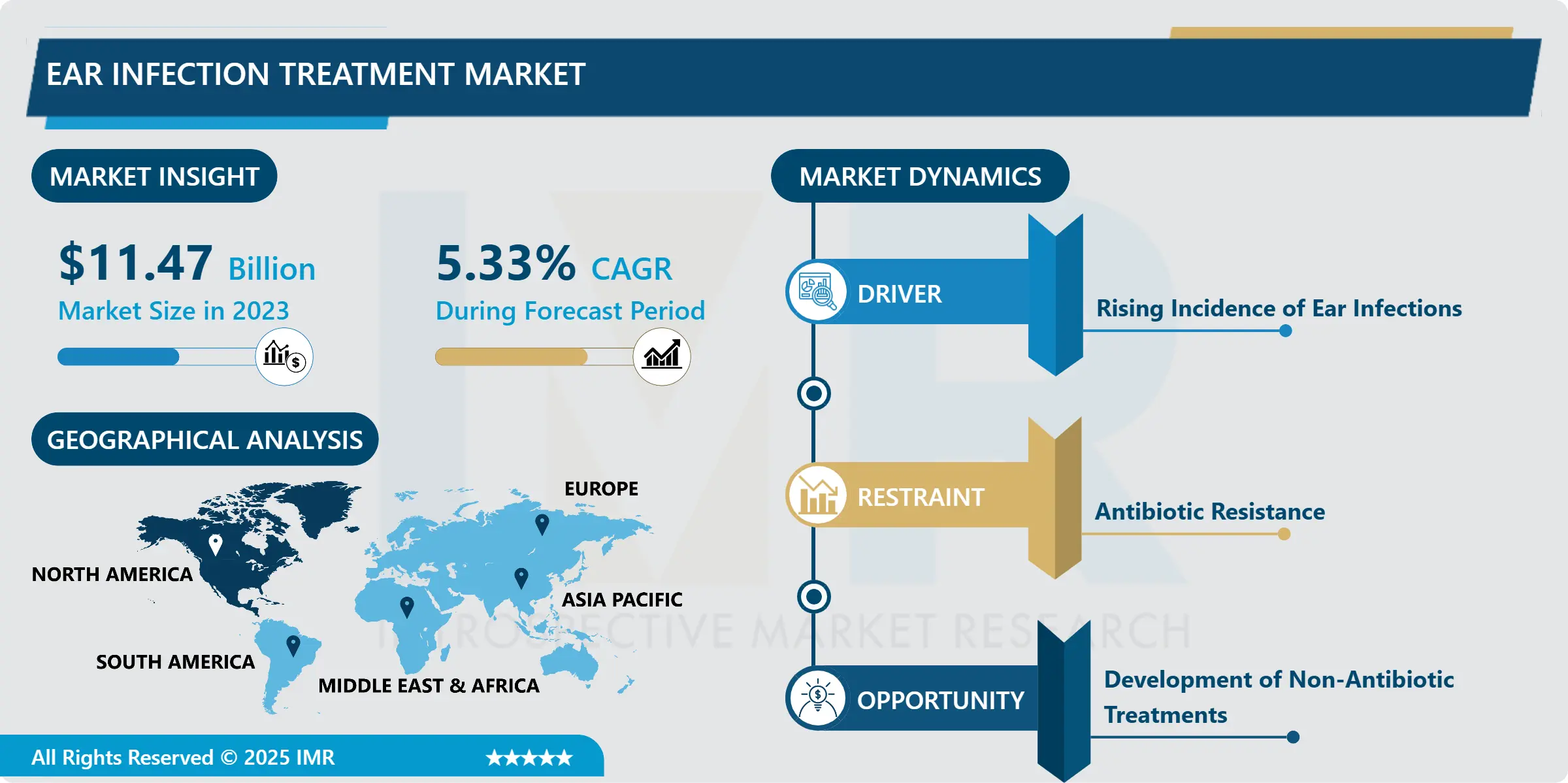
Ear Infection Treatment Market Trend Analysis:
Driving Growth in the Ear Infection Treatment Market
-
Growing consciousness about the availability of proper treatments to cure ear infections, need of over than counter ONTC products, and home-based treatment products also contribute to fuelling the market for ear infection treatment. Since individuals are becoming more enlightened on signs and treatment of the infections, there is growing demand for self-service medication with over-the-counter products. This trend is pegged on increased access to over the counter antibiotics, pain relievers and topical products. In the same way, the increase in usage of homemade remedies and natural cure is the other reason why people are using it so frequently especially in treating some ear infections, which does not have to be prescribed by a doctor.
- Increased market opportunities are also being presented as medical technologies, and treatments are being refined further. Concentrated, which means that they are designed not to contribute to resistance and are presumably more effective, targeted antibiotics continue to grow in popularity. Also, the nasal spray formulation that is used in the treatment of ear infection is becoming fashionable among individuals since it is easy to use and non invasive. Ear infection treatments have a better access to the healthcare especially in the emerging markets and this is has enhanced the greater adoption rate. Such avenues are helped by the global trends towards self-treatment of such conditions, along with more diverse treatment courses, as well as natural and holistic treatments, all of which can be seen to be defining the future of the ear infection treatment market.
Growing Opportunities in the Ear Infection Treatment Market
-
An increasing concern with the ear health, and especially among children and the geriatrics has created a demand for intervention for ear infections. Child and elder people are vulnerable to ear infections as such infections are associated with lowered immunity, or diseases such as allergies, or respiratory infections. They translate into increasing concern for foreseeing the onset and providing right treatment, which drives the need for GA and various treatment possibilities: from medications to OTC preparations. Since the focus on ear health and the need for treatments for the conditions affecting the ear increases especially in the high-risk groups, the market has a good potential and will continue to expand.
- The ear infection treatment market is also likely to gain from growth in technology within the healthcare sector. An evolution of the specific antibiotics and antifungal, new methods of surgical interventions, and staphylococcal infections treatments are also contributing to better treatment benefits and minimized side effects, which leads to the high level of patient compliance and satisfaction in the treatment process. In the same regard, more people are preferring OTC products, and applying home remedies to treat their ailments further propel market growth. An increasing number of people regard these options as helpful in saving money and efficient in treating diseases, including ear infections; this consideration also fuels the development of the market. Due to advancement of new formulations that increase the effectiveness of drugs, this outlooks offers new prospects for the development in the treatment of ear infections.
Ear Infection Treatment Market Segment Analysis:
Ear Infection Treatment Market is Segmented on the basis of Type, Pathogen, Treatment Type, Dosage form, Route of Administration, End-Users, Distribution Channel, and Region.
By Type, Middle Ear segment is expected to dominate the market during the forecast period
-
Otitis media, or middle ear infection is one of the common types of ear infections prevailing particularly in children. These infections develop when the middle ear becomes infected through bacteria or a virus. Otitis media is the most usual, could be a complication of a cold, respiratory virus infection, the bacteria involved includes Streptococcus pneumonia or Haemophilus influenzae. Those stemming from some form of viral attack such as the flu or cold, cause otitis media but are usually less severe than the bacterial ones. Etness: Inflammation allows build-up of fluid behind the eardrum and leads to pain, fever and hearing impairment. Today, otitis media ranks among the top reasons for children to consult with pediatricians across the world.
- Most cases of middle ear infections are treated with drugs that may help cure the cause of the infection and reduce the signs and symptoms. Many people often get given antibiotics for bacterial infections when the signs are not improving within two days or are worse. The usual drugs prescribed for otitis media are amoxicillin and amoxicillin-clavulanate. They do not treat viral infections, so they are not useful for such diseases; antiviral drugs are also not applicable here; one has to control symptoms with pain killers like ibuprofen or acetaminophen to reduce pain and temperature. Certain interventions may be considered only if the infection is more persistent or frequent, brisk; in such cases more invasive procedures like myringotomy (operations wherein small incisions are made on eardrums to drain out fluids) may be needed. Several factors are considered in selection of proper treatment for the child with the infection for example severity of infection, age and whether there are complications or not.
By Distribution Channel, Hospital Pharmacy segment expected to held the largest share
-
The hospital pharmacy department has a central responsibility of ordering, storing, issuing and managing medication especially for patients with severe and complicated ear infections. These infections usually need stronger medications than the pill you can buy without a prescription like an antibiotic or antiviral. For example, where bacterial infections such as otitis media become unresponsive to regular antibiotics, a hospital pharmacy may stock or order enhanced or higher power antibiotics which are most often given intravenously to enhance aufnahme. Further, in cases of viral infections or secondary bacterial infection in middle ear infections, antiviral or other appropriate medication may be used. Local hospital pharmacies also possess the capacity to prepare the compounded medicine, review dose depending on the patient’s need, and avoid drug-interaction in complicated cases that is so vital in managing diseases.
- The hospital pharmacies in most of the cases are involved in the care of all the therapeutic process of the hospitalized patients including dispensing of medication, assessment of their side effects and interactions. The need to practice such top-notch standard of practices cannot be over-emphasized especially for patient’s who are immune-compromised, those with chronic ear infection and other comorbidities that demand constant medical accompaniment. Hospital pharmacies also involve other practitioners like ENT specialist in order to make sure the right treatments required by the individual patient are provided by the health care facility. Due to the complicated nature of some infections that affect the ear, often accompanied by complications like ruptured eardrums or hearing loss, hospital pharmacies enable patients receive the correct medication at the right time.
Ear Infection Treatment Market Regional Insights:
North America is Expected to Dominate the Market Over the Forecast period
-
In North America the major driving factor for ear infection treatment market is based on the availability of developed healthcare structure and advanced pharmaceutical sector. Ear infection is significantly common in the U.S. as well as in Canada; especially in children which fuels the consumption of OTC and prescription drugs. Children’s cases entail recurrent visits to the clinics, thus involving a large use of antibiotics, ear drops, and analgesics. That fact along with an understanding of severity of ear infections and possible consequences that can follow helps to increase the demand for timely treatment. Moreover, North American consumers are offered more selection of treatment because of well-developed healthcare system and variety of insurance, which guarantees that a number of treatments may help to cope with the condition.
- Rising demand of telehealth care services is another factor attributing to the growth of ear infection treatment market in North America. Telemedicine helps give patients a possibility to get advice on circumstances they have without going to a doctor physically, which makes it easier to avail treatment for conditions such as ear infection for people in remote arias or regions with few health facilities. It is more useful in the later follow up because it eliminates the frequency of in office visits. Furthermore, there are other causes of otitis externa or media infections due to effects from the environment that include swimming frequently, allergy to seasonal changes and pollution. Thus, these factors influence the populations, and since a large number of people will require preventive as well as curative treatments, the market for North America will be inevitable.
Active Key Players in the Ear Infection Treatment Market:
- Eli Lilly and Company (U.S.)
- AstraZeneca (U.K.)
- Novartis AG (Switzerland)
- Johnson & Johnson Private Limited (U.S.)
- Teva Pharmaceutical Industries Ltd. (Ireland)
- Merck & Co., Inc. (U.S.)
- Allergan (Ireland)
- Bausch Health Companies Inc. (Canada)
- Abbott (U.S.)
- F. Hoffmann-La Roche Ltd. (Switzerland)
- Pfizer Inc. (U.S.)
- GlaxoSmithKline plc (U.K.)
- Sanofi (France)
- Merck KGaA (Germany)
- Dr. Reddy's Laboratories Ltd. (India)
- Zydus Cadila (India)
- Sun Pharmaceutical Industries Ltd. (India)
- Aurobindo Pharma (India)
- Lupin (India)
- Hikma Pharmaceuticals PLC (U.K.), and Other Active Players
|
Global Ear Infection Treatment Market |
|||
|
Base Year: |
2023 |
Forecast Period: |
2024-2032 |
|
Historical Data: |
2017 to 2023 |
Market Size in 2023: |
USD 11.47 Billion |
|
Forecast Period 2024-32 CAGR: |
5.33% |
Market Size in 2032: |
USD 18.30 Billion |
|
Segments Covered: |
By Type |
|
|
|
By Pathogen |
|
||
|
By Treatment Type |
|
||
|
By Dosage form |
|
||
|
By Route of Administration |
|
||
|
By End-Users |
|
||
|
By Distribution Channel |
|
||
|
By Region |
|
||
|
Key Market Drivers: |
|
||
|
Key Market Restraints: |
|
||
|
Key Opportunities: |
|
||
|
Companies Covered in the report: |
|
||
Chapter 1: Introduction
1.1 Scope and Coverage
Chapter 2:Executive Summary
Chapter 3: Market Landscape
3.1 Market Dynamics
3.1.1 Drivers
3.1.2 Restraints
3.1.3 Opportunities
3.1.4 Challenges
3.2 Market Trend Analysis
3.3 PESTLE Analysis
3.4 Porter's Five Forces Analysis
3.5 Industry Value Chain Analysis
3.6 Ecosystem
3.7 Regulatory Landscape
3.8 Price Trend Analysis
3.9 Patent Analysis
3.10 Technology Evolution
3.11 Investment Pockets
3.12 Import-Export Analysis
Chapter 4: Ear Infection Treatment Market by Type
4.1 Ear Infection Treatment Market Snapshot and Growth Engine
4.2 Ear Infection Treatment Market Overview
4.3 Middle Ear
4.3.1 Introduction and Market Overview
4.3.2 Historic and Forecasted Market Size in Value USD and Volume Units (2017-2032F)
4.3.3 Key Market Trends, Growth Factors and Opportunities
4.3.4 Middle Ear: Geographic Segmentation Analysis
4.4 Outer Ear
4.4.1 Introduction and Market Overview
4.4.2 Historic and Forecasted Market Size in Value USD and Volume Units (2017-2032F)
4.4.3 Key Market Trends, Growth Factors and Opportunities
4.4.4 Outer Ear: Geographic Segmentation Analysis
4.5 Inner Ear
4.5.1 Introduction and Market Overview
4.5.2 Historic and Forecasted Market Size in Value USD and Volume Units (2017-2032F)
4.5.3 Key Market Trends, Growth Factors and Opportunities
4.5.4 Inner Ear: Geographic Segmentation Analysis
Chapter 5: Ear Infection Treatment Market by Pathogen
5.1 Ear Infection Treatment Market Snapshot and Growth Engine
5.2 Ear Infection Treatment Market Overview
5.3 Bacteria
5.3.1 Introduction and Market Overview
5.3.2 Historic and Forecasted Market Size in Value USD and Volume Units (2017-2032F)
5.3.3 Key Market Trends, Growth Factors and Opportunities
5.3.4 Bacteria: Geographic Segmentation Analysis
5.4 Virus
5.4.1 Introduction and Market Overview
5.4.2 Historic and Forecasted Market Size in Value USD and Volume Units (2017-2032F)
5.4.3 Key Market Trends, Growth Factors and Opportunities
5.4.4 Virus: Geographic Segmentation Analysis
Chapter 6: Ear Infection Treatment Market by Treatment Type
6.1 Ear Infection Treatment Market Snapshot and Growth Engine
6.2 Ear Infection Treatment Market Overview
6.3 Medication
6.3.1 Introduction and Market Overview
6.3.2 Historic and Forecasted Market Size in Value USD and Volume Units (2017-2032F)
6.3.3 Key Market Trends, Growth Factors and Opportunities
6.3.4 Medication: Geographic Segmentation Analysis
6.4 Surgery
6.4.1 Introduction and Market Overview
6.4.2 Historic and Forecasted Market Size in Value USD and Volume Units (2017-2032F)
6.4.3 Key Market Trends, Growth Factors and Opportunities
6.4.4 Surgery: Geographic Segmentation Analysis
Chapter 7: Ear Infection Treatment Market by Route of Administration
7.1 Ear Infection Treatment Market Snapshot and Growth Engine
7.2 Ear Infection Treatment Market Overview
7.3 Oral
7.3.1 Introduction and Market Overview
7.3.2 Historic and Forecasted Market Size in Value USD and Volume Units (2017-2032F)
7.3.3 Key Market Trends, Growth Factors and Opportunities
7.3.4 Oral: Geographic Segmentation Analysis
7.4 Topical
7.4.1 Introduction and Market Overview
7.4.2 Historic and Forecasted Market Size in Value USD and Volume Units (2017-2032F)
7.4.3 Key Market Trends, Growth Factors and Opportunities
7.4.4 Topical: Geographic Segmentation Analysis
7.5 Others
7.5.1 Introduction and Market Overview
7.5.2 Historic and Forecasted Market Size in Value USD and Volume Units (2017-2032F)
7.5.3 Key Market Trends, Growth Factors and Opportunities
7.5.4 Others: Geographic Segmentation Analysis
Chapter 8: Ear Infection Treatment Market by Dosage form
8.1 Ear Infection Treatment Market Snapshot and Growth Engine
8.2 Ear Infection Treatment Market Overview
8.3 Solution
8.3.1 Introduction and Market Overview
8.3.2 Historic and Forecasted Market Size in Value USD and Volume Units (2017-2032F)
8.3.3 Key Market Trends, Growth Factors and Opportunities
8.3.4 Solution: Geographic Segmentation Analysis
8.4 Tablets
8.4.1 Introduction and Market Overview
8.4.2 Historic and Forecasted Market Size in Value USD and Volume Units (2017-2032F)
8.4.3 Key Market Trends, Growth Factors and Opportunities
8.4.4 Tablets: Geographic Segmentation Analysis
8.5 Others
8.5.1 Introduction and Market Overview
8.5.2 Historic and Forecasted Market Size in Value USD and Volume Units (2017-2032F)
8.5.3 Key Market Trends, Growth Factors and Opportunities
8.5.4 Others: Geographic Segmentation Analysis
Chapter 9: Ear Infection Treatment Market by End-Users
9.1 Ear Infection Treatment Market Snapshot and Growth Engine
9.2 Ear Infection Treatment Market Overview
9.3 Hospitals
9.3.1 Introduction and Market Overview
9.3.2 Historic and Forecasted Market Size in Value USD and Volume Units (2017-2032F)
9.3.3 Key Market Trends, Growth Factors and Opportunities
9.3.4 Hospitals: Geographic Segmentation Analysis
9.4 Specialty Clinics
9.4.1 Introduction and Market Overview
9.4.2 Historic and Forecasted Market Size in Value USD and Volume Units (2017-2032F)
9.4.3 Key Market Trends, Growth Factors and Opportunities
9.4.4 Specialty Clinics: Geographic Segmentation Analysis
9.5 Homecare
9.5.1 Introduction and Market Overview
9.5.2 Historic and Forecasted Market Size in Value USD and Volume Units (2017-2032F)
9.5.3 Key Market Trends, Growth Factors and Opportunities
9.5.4 Homecare: Geographic Segmentation Analysis
9.6 Others
9.6.1 Introduction and Market Overview
9.6.2 Historic and Forecasted Market Size in Value USD and Volume Units (2017-2032F)
9.6.3 Key Market Trends, Growth Factors and Opportunities
9.6.4 Others: Geographic Segmentation Analysis
Chapter 10: Ear Infection Treatment Market by Distribution Channel
10.1 Ear Infection Treatment Market Snapshot and Growth Engine
10.2 Ear Infection Treatment Market Overview
10.3 Hospital Pharmacy
10.3.1 Introduction and Market Overview
10.3.2 Historic and Forecasted Market Size in Value USD and Volume Units (2017-2032F)
10.3.3 Key Market Trends, Growth Factors and Opportunities
10.3.4 Hospital Pharmacy: Geographic Segmentation Analysis
10.4 Retail Pharmacy
10.4.1 Introduction and Market Overview
10.4.2 Historic and Forecasted Market Size in Value USD and Volume Units (2017-2032F)
10.4.3 Key Market Trends, Growth Factors and Opportunities
10.4.4 Retail Pharmacy: Geographic Segmentation Analysis
10.5 Online Pharmacy
10.5.1 Introduction and Market Overview
10.5.2 Historic and Forecasted Market Size in Value USD and Volume Units (2017-2032F)
10.5.3 Key Market Trends, Growth Factors and Opportunities
10.5.4 Online Pharmacy: Geographic Segmentation Analysis
10.6 Others
10.6.1 Introduction and Market Overview
10.6.2 Historic and Forecasted Market Size in Value USD and Volume Units (2017-2032F)
10.6.3 Key Market Trends, Growth Factors and Opportunities
10.6.4 Others: Geographic Segmentation Analysis
Chapter 11: Company Profiles and Competitive Analysis
11.1 Competitive Landscape
11.1.1 Competitive Benchmarking
11.1.2 Ear Infection Treatment Market Share by Manufacturer (2023)
11.1.3 Industry BCG Matrix
11.1.4 Heat Map Analysis
11.1.5 Mergers and Acquisitions
11.2 ELI LILLY AND COMPANY (U.S.)
11.2.1 Company Overview
11.2.2 Key Executives
11.2.3 Company Snapshot
11.2.4 Role of the Company in the Market
11.2.5 Sustainability and Social Responsibility
11.2.6 Operating Business Segments
11.2.7 Product Portfolio
11.2.8 Business Performance
11.2.9 Key Strategic Moves and Recent Developments
11.2.10 SWOT Analysis
11.3 ASTRAZENECA (U.K.)
11.4 NOVARTIS AG (SWITZERLAND)
11.5 JOHNSON & JOHNSON PRIVATE LIMITED (U.S.)
11.6 TEVA PHARMACEUTICAL INDUSTRIES LTD. (IRELAND)
11.7 MERCK & CO. INC. (U.S.)
11.8 ALLERGAN (IRELAND)
11.9 BAUSCH HEALTH COMPANIES INC. (CANADA)
11.10 ABBOTT (U.S.)
11.11 F. HOFFMANN-LA ROCHE LTD. (SWITZERLAND)
11.12 PFIZER INC. (U.S.)
11.13 GLAXOSMITHKLINE PLC (U.K.)
11.14 SANOFI (FRANCE)
11.15 MERCK KGAA (GERMANY)
11.16 DR. REDDY'S LABORATORIES LTD. (INDIA)
11.17 ZYDUS CADILA (INDIA)
11.18 SUN PHARMACEUTICAL INDUSTRIES LTD. (INDIA)
11.19 AUROBINDO PHARMA (INDIA)
11.20 LUPIN (INDIA)
11.21 HIKMA PHARMACEUTICALS PLC (U.K.)
11.22 OTHER ACTIVE PLAYERS
Chapter 12: Global Ear Infection Treatment Market By Region
12.1 Overview
12.2. North America Ear Infection Treatment Market
12.2.1 Key Market Trends, Growth Factors and Opportunities
12.2.2 Top Key Companies
12.2.3 Historic and Forecasted Market Size by Segments
12.2.4 Historic and Forecasted Market Size By Type
12.2.4.1 Middle Ear
12.2.4.2 Outer Ear
12.2.4.3 Inner Ear
12.2.5 Historic and Forecasted Market Size By Pathogen
12.2.5.1 Bacteria
12.2.5.2 Virus
12.2.6 Historic and Forecasted Market Size By Treatment Type
12.2.6.1 Medication
12.2.6.2 Surgery
12.2.7 Historic and Forecasted Market Size By Route of Administration
12.2.7.1 Oral
12.2.7.2 Topical
12.2.7.3 Others
12.2.8 Historic and Forecasted Market Size By Dosage form
12.2.8.1 Solution
12.2.8.2 Tablets
12.2.8.3 Others
12.2.9 Historic and Forecasted Market Size By End-Users
12.2.9.1 Hospitals
12.2.9.2 Specialty Clinics
12.2.9.3 Homecare
12.2.9.4 Others
12.2.10 Historic and Forecasted Market Size By Distribution Channel
12.2.10.1 Hospital Pharmacy
12.2.10.2 Retail Pharmacy
12.2.10.3 Online Pharmacy
12.2.10.4 Others
12.2.11 Historic and Forecast Market Size by Country
12.2.11.1 US
12.2.11.2 Canada
12.2.11.3 Mexico
12.3. Eastern Europe Ear Infection Treatment Market
12.3.1 Key Market Trends, Growth Factors and Opportunities
12.3.2 Top Key Companies
12.3.3 Historic and Forecasted Market Size by Segments
12.3.4 Historic and Forecasted Market Size By Type
12.3.4.1 Middle Ear
12.3.4.2 Outer Ear
12.3.4.3 Inner Ear
12.3.5 Historic and Forecasted Market Size By Pathogen
12.3.5.1 Bacteria
12.3.5.2 Virus
12.3.6 Historic and Forecasted Market Size By Treatment Type
12.3.6.1 Medication
12.3.6.2 Surgery
12.3.7 Historic and Forecasted Market Size By Route of Administration
12.3.7.1 Oral
12.3.7.2 Topical
12.3.7.3 Others
12.3.8 Historic and Forecasted Market Size By Dosage form
12.3.8.1 Solution
12.3.8.2 Tablets
12.3.8.3 Others
12.3.9 Historic and Forecasted Market Size By End-Users
12.3.9.1 Hospitals
12.3.9.2 Specialty Clinics
12.3.9.3 Homecare
12.3.9.4 Others
12.3.10 Historic and Forecasted Market Size By Distribution Channel
12.3.10.1 Hospital Pharmacy
12.3.10.2 Retail Pharmacy
12.3.10.3 Online Pharmacy
12.3.10.4 Others
12.3.11 Historic and Forecast Market Size by Country
12.3.11.1 Russia
12.3.11.2 Bulgaria
12.3.11.3 The Czech Republic
12.3.11.4 Hungary
12.3.11.5 Poland
12.3.11.6 Romania
12.3.11.7 Rest of Eastern Europe
12.4. Western Europe Ear Infection Treatment Market
12.4.1 Key Market Trends, Growth Factors and Opportunities
12.4.2 Top Key Companies
12.4.3 Historic and Forecasted Market Size by Segments
12.4.4 Historic and Forecasted Market Size By Type
12.4.4.1 Middle Ear
12.4.4.2 Outer Ear
12.4.4.3 Inner Ear
12.4.5 Historic and Forecasted Market Size By Pathogen
12.4.5.1 Bacteria
12.4.5.2 Virus
12.4.6 Historic and Forecasted Market Size By Treatment Type
12.4.6.1 Medication
12.4.6.2 Surgery
12.4.7 Historic and Forecasted Market Size By Route of Administration
12.4.7.1 Oral
12.4.7.2 Topical
12.4.7.3 Others
12.4.8 Historic and Forecasted Market Size By Dosage form
12.4.8.1 Solution
12.4.8.2 Tablets
12.4.8.3 Others
12.4.9 Historic and Forecasted Market Size By End-Users
12.4.9.1 Hospitals
12.4.9.2 Specialty Clinics
12.4.9.3 Homecare
12.4.9.4 Others
12.4.10 Historic and Forecasted Market Size By Distribution Channel
12.4.10.1 Hospital Pharmacy
12.4.10.2 Retail Pharmacy
12.4.10.3 Online Pharmacy
12.4.10.4 Others
12.4.11 Historic and Forecast Market Size by Country
12.4.11.1 Germany
12.4.11.2 UK
12.4.11.3 France
12.4.11.4 The Netherlands
12.4.11.5 Italy
12.4.11.6 Spain
12.4.11.7 Rest of Western Europe
12.5. Asia Pacific Ear Infection Treatment Market
12.5.1 Key Market Trends, Growth Factors and Opportunities
12.5.2 Top Key Companies
12.5.3 Historic and Forecasted Market Size by Segments
12.5.4 Historic and Forecasted Market Size By Type
12.5.4.1 Middle Ear
12.5.4.2 Outer Ear
12.5.4.3 Inner Ear
12.5.5 Historic and Forecasted Market Size By Pathogen
12.5.5.1 Bacteria
12.5.5.2 Virus
12.5.6 Historic and Forecasted Market Size By Treatment Type
12.5.6.1 Medication
12.5.6.2 Surgery
12.5.7 Historic and Forecasted Market Size By Route of Administration
12.5.7.1 Oral
12.5.7.2 Topical
12.5.7.3 Others
12.5.8 Historic and Forecasted Market Size By Dosage form
12.5.8.1 Solution
12.5.8.2 Tablets
12.5.8.3 Others
12.5.9 Historic and Forecasted Market Size By End-Users
12.5.9.1 Hospitals
12.5.9.2 Specialty Clinics
12.5.9.3 Homecare
12.5.9.4 Others
12.5.10 Historic and Forecasted Market Size By Distribution Channel
12.5.10.1 Hospital Pharmacy
12.5.10.2 Retail Pharmacy
12.5.10.3 Online Pharmacy
12.5.10.4 Others
12.5.11 Historic and Forecast Market Size by Country
12.5.11.1 China
12.5.11.2 India
12.5.11.3 Japan
12.5.11.4 South Korea
12.5.11.5 Malaysia
12.5.11.6 Thailand
12.5.11.7 Vietnam
12.5.11.8 The Philippines
12.5.11.9 Australia
12.5.11.10 New Zealand
12.5.11.11 Rest of APAC
12.6. Middle East & Africa Ear Infection Treatment Market
12.6.1 Key Market Trends, Growth Factors and Opportunities
12.6.2 Top Key Companies
12.6.3 Historic and Forecasted Market Size by Segments
12.6.4 Historic and Forecasted Market Size By Type
12.6.4.1 Middle Ear
12.6.4.2 Outer Ear
12.6.4.3 Inner Ear
12.6.5 Historic and Forecasted Market Size By Pathogen
12.6.5.1 Bacteria
12.6.5.2 Virus
12.6.6 Historic and Forecasted Market Size By Treatment Type
12.6.6.1 Medication
12.6.6.2 Surgery
12.6.7 Historic and Forecasted Market Size By Route of Administration
12.6.7.1 Oral
12.6.7.2 Topical
12.6.7.3 Others
12.6.8 Historic and Forecasted Market Size By Dosage form
12.6.8.1 Solution
12.6.8.2 Tablets
12.6.8.3 Others
12.6.9 Historic and Forecasted Market Size By End-Users
12.6.9.1 Hospitals
12.6.9.2 Specialty Clinics
12.6.9.3 Homecare
12.6.9.4 Others
12.6.10 Historic and Forecasted Market Size By Distribution Channel
12.6.10.1 Hospital Pharmacy
12.6.10.2 Retail Pharmacy
12.6.10.3 Online Pharmacy
12.6.10.4 Others
12.6.11 Historic and Forecast Market Size by Country
12.6.11.1 Turkiye
12.6.11.2 Bahrain
12.6.11.3 Kuwait
12.6.11.4 Saudi Arabia
12.6.11.5 Qatar
12.6.11.6 UAE
12.6.11.7 Israel
12.6.11.8 South Africa
12.7. South America Ear Infection Treatment Market
12.7.1 Key Market Trends, Growth Factors and Opportunities
12.7.2 Top Key Companies
12.7.3 Historic and Forecasted Market Size by Segments
12.7.4 Historic and Forecasted Market Size By Type
12.7.4.1 Middle Ear
12.7.4.2 Outer Ear
12.7.4.3 Inner Ear
12.7.5 Historic and Forecasted Market Size By Pathogen
12.7.5.1 Bacteria
12.7.5.2 Virus
12.7.6 Historic and Forecasted Market Size By Treatment Type
12.7.6.1 Medication
12.7.6.2 Surgery
12.7.7 Historic and Forecasted Market Size By Route of Administration
12.7.7.1 Oral
12.7.7.2 Topical
12.7.7.3 Others
12.7.8 Historic and Forecasted Market Size By Dosage form
12.7.8.1 Solution
12.7.8.2 Tablets
12.7.8.3 Others
12.7.9 Historic and Forecasted Market Size By End-Users
12.7.9.1 Hospitals
12.7.9.2 Specialty Clinics
12.7.9.3 Homecare
12.7.9.4 Others
12.7.10 Historic and Forecasted Market Size By Distribution Channel
12.7.10.1 Hospital Pharmacy
12.7.10.2 Retail Pharmacy
12.7.10.3 Online Pharmacy
12.7.10.4 Others
12.7.11 Historic and Forecast Market Size by Country
12.7.11.1 Brazil
12.7.11.2 Argentina
12.7.11.3 Rest of SA
Chapter 13 Analyst Viewpoint and Conclusion
13.1 Recommendations and Concluding Analysis
13.2 Potential Market Strategies
Chapter 14 Research Methodology
14.1 Research Process
14.2 Primary Research
14.3 Secondary Research
|
Global Ear Infection Treatment Market |
|||
|
Base Year: |
2023 |
Forecast Period: |
2024-2032 |
|
Historical Data: |
2017 to 2023 |
Market Size in 2023: |
USD 11.47 Billion |
|
Forecast Period 2024-32 CAGR: |
5.33% |
Market Size in 2032: |
USD 18.30 Billion |
|
Segments Covered: |
By Type |
|
|
|
By Pathogen |
|
||
|
By Treatment Type |
|
||
|
By Dosage form |
|
||
|
By Route of Administration |
|
||
|
By End-Users |
|
||
|
By Distribution Channel |
|
||
|
By Region |
|
||
|
Key Market Drivers: |
|
||
|
Key Market Restraints: |
|
||
|
Key Opportunities: |
|
||
|
Companies Covered in the report: |
|
||


