




Dog Food Market Synopsis
Dog Food Market Size Was Valued at USD 51.79 billion in 2023 and is Projected to Reach USD 92.99 Million by 2032, Growing at a CAGR of 6.72% From 2024-2032.
Dog food is specially formulated food designed to meet the nutritional needs of domestic dogs. It typically consists of a balanced blend of proteins, carbohydrates, fats, vitamins, and minerals to support a dog's overall health. The primary ingredients in dog food often include meat, grains, and vegetables.
There are various types of dog food available, including dry kibble, canned wet food, and semi-moist options. Dry kibble is a popular and convenient choice, offering a longer shelf life and aiding in dental health by promoting chewing. Canned wet food, on the other hand, can be more palatable for some dogs due to its moisture content and may be preferable for those with dental issues.
Many commercial dog foods are developed based on the specific life stage (puppy, adult, senior) and size of the dog (small, medium, large). Additionally, some brands focus on special dietary needs, such as grain-free or hypoallergenic formulas for dogs with specific sensitivities.
Nowadays, there has been a notable trend toward humanization of pet food, with pet owners treating their dogs as family members and seeking pet food that mirrors human food trends, such as grain-free, organic, and natural options. Additionally, the e-commerce boom has played a crucial role in the expansion of the dog food market, providing consumers with convenient access to a wide range of products and brands.
The market is also witnessing innovations in product formulations, including the development of functional and specialized dog food for different life stages, breeds, and health conditions. Sustainability and eco-friendly packaging have become important considerations for both consumers and manufacturers in the pet food industry.

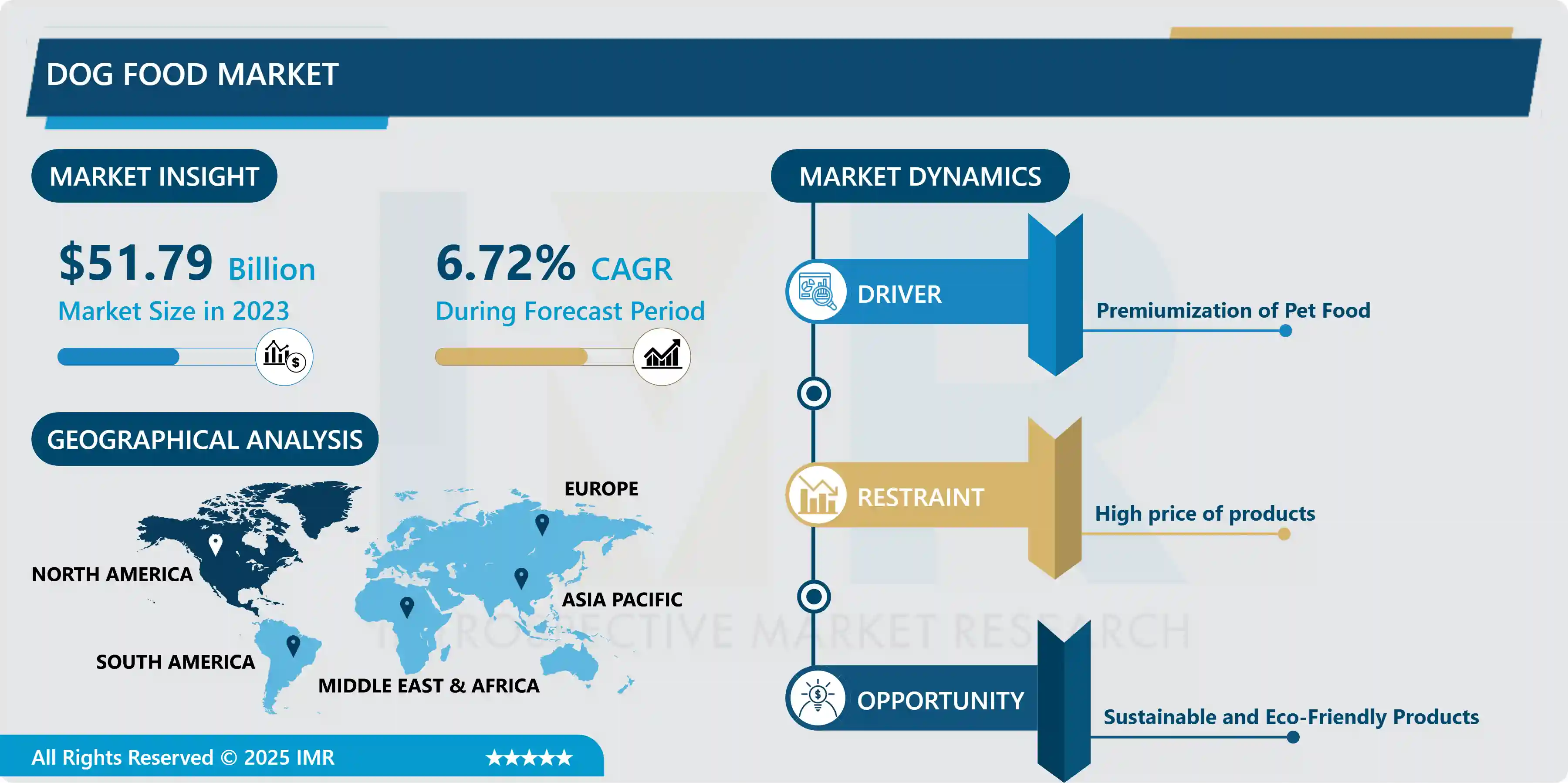
Dog Food Market Trend Analysis
Premiumization of Pet Food
- The premiumization of pet food has emerged as a pivotal driving force in the dynamic growth of the dog food market. Pet owners increasingly view their dogs as integral members of the family, leading to a shift in consumer preferences towards high-quality, nutritious, and specialized pet food options.
- The demand for premium dog food has surged due to a growing awareness of the direct impact of nutrition on canine health and well-being. Pet owners are willing to invest more in superior ingredients, advanced formulations, and specialized diets that cater to specific health needs or preferences of their furry companions. Premium dog food often includes features such as natural and organic ingredients, novel proteins, and customized formulations that contribute to optimal canine health.
- Moreover, the rising trend of humanization of pets has elevated expectations for pet food to mirror human food standards. This has led to an influx of innovative and gourmet dog food products in the market, further driving the premiumization trend.
Sustainable and Eco-Friendly Products create an Opportunity for Dog Food Market
- The dog food market has a promising opportunity to thrive by embracing sustainable and eco-friendly products. As awareness of environmental issues grows, pet owners are increasingly seeking products that align with their values of responsible consumption. Sustainable dog food options, made from ethically sourced ingredients and utilizing eco-friendly packaging, appeal to environmentally conscious consumers.
- Manufacturers incorporating organic, locally sourced, and human-grade ingredients not only contribute to the well-being of pets but also address concerns about the ecological footprint of traditional pet foods. By adopting sustainable practices, the dog food market can reduce its environmental impact, appealing to a growing segment of environmentally conscious pet owners.
- Innovations such as plant-based or insect protein alternatives offer sustainable protein sources while reducing reliance on traditional animal agriculture. Additionally, biodegradable packaging and waste reduction initiatives contribute to a greener supply chain.
Dog Food Market Segment Analysis:
Dog Food Market Segmented on the basis of Type, Source, Nature, Pet Type, and Distribution channels.
By Type, Dry Dog Food segment is expected to dominate the market during the forecast period
- The Dry Dog Food segment is poised to assert its dominance in the rapidly expanding Dog Food Market. This projection is underpinned by several key factors that contribute to its pre-eminence. Dry dog food offers unparalleled convenience for pet owners, characterized by longer shelf life and ease of storage compared to other types of dog food. The segment aligns with the modern pet owner's lifestyle, providing a hassle-free and cost-effective solution without compromising on nutritional value.
- Moreover, the Dry Dog Food segment addresses the growing emphasis on pet health and wellness, as it often incorporates balanced formulations to meet the specific dietary needs of different breeds and life stages. The convenience of measuring and serving precise portions aids in weight management, contributing to the overall well-being of canine companions.
By Nature, Organic segment held the largest share of 48% in 2022
- The organic segment is poised to assert its dominance in the dog food market, driven by a growing consumer preference for natural and health-conscious pet nutrition. As awareness of the correlation between diet and pet well-being rises, more pet owners are seeking high-quality, organic alternatives for their furry companions. Organic dog food is crafted from ingredients free of synthetic pesticides, hormones, and genetically modified organisms, aligning with the broader trend of clean and sustainable living.
- The emphasis on transparency in the sourcing and production of pet food further amplifies the appeal of organic options. Pet owners are increasingly scrutinizing labels, opting for products that prioritize animal welfare, ethical farming practices, and environmental sustainability. This shift is notably pronounced in developed markets where pet humanization trends are strong.
Dog Food Market Regional Insights:
North America is Expected to Dominate the Market Over the Forecast period
- North America is poised to assert its dominance in the dog food market, showcasing a robust and thriving industry. The region's dog food market is expected to soar, driven by factors such as heightened pet ownership, increased awareness of pet nutrition, and a growing emphasis on premium and specialized pet food products. Consumers in North America are displaying a strong inclination towards prioritizing their pets' health and well-being, leading to a surge in demand for high-quality, nutritious dog food.
- The market is witnessing a notable shift towards premium and organic dog food options, as pet owners become more discerning about the ingredients and nutritional value of the products they provide for their furry companions. Additionally, innovative product offerings, including specialized diets catering to various health needs, are gaining popularity.
- With a sophisticated pet care infrastructure, a robust economy, and a pet-loving culture, North America is emerging as a key player in the global dog food market. As the trend towards humanization of pets continues to grow, the region is expected to maintain its dominant position, fostering further innovation and expansion within the dog food industry.
- North America has many pets, with a significant number of households owning dogs. According to the American Pet Products Association, nearly 68% of households in the United States alone own a pet, and approximately 50% of those households’ own dogs. The large pet population creates significant demand for dog food, making North America a lucrative market for dog food. For instance, according to Statista, in the US the number of pet owners that said they have a dog is 74% and is the highest among all countries thus driving the growth of dog food in the North American region.

Dog Food Market Top Key Players:
- The Farmers Dog, Inc. (U.S.)
- Canidae (U.S.)
- The J.M. Smucker Company (U.S.)
- Colgate-Palmolive Company (U.S.)
- WellPet, LLC (U.S.)
- Diamond Pet Foods (U.S.)
- Simmon Pet Food, Inc. (U.S.)
- JustFoodForDogs, LLC (U.S.)
- Ollie Pets Inc. (U.S.),
- Royal Canin (France)
- Natural Dog food company (U.K.)
- Farmina Pet Foods Holding B.V. (Netherlands)
- Nestlé S.A. (Switzerland)
- Mars Petcare Inc. (Switzerland) and Other Major Players
Key Industry Developments in the Dog Food Market:
- In January 2024, The Farmer’s Dog, the pet food company offering fresh, vet-developed, science-backed, human-grade dog food, and the World Small Animal Veterinary Association (WSAVA), the global association for companion animal veterinary professionals, announced a joint partnership to advance the well-being of companion animals and the professionals who care for them. As a WSAVA Diamond Partner and the organization’s first-ever fresh-food company partner, The Farmer’s Dog will support WSAVA’s goals by advancing veterinary research and furthering professional growth and well-being for veterinary professionals and their practices.
- In April 2024, Nestlé Purina PetCare Company announced expansion, Governor Tony Evers announced that Nestlé Purina PetCare Company, which feeds more than 46 million dogs and 68 million cats every year, was expanded its production facility in Jefferson–a $195 million project expected to bring an additional 100 jobs to the community it had called home since 1910.
- In December 2022, Mankind Pharma announced its foray into the Pet care segment with the launch of its pet food brand, PetStar Dog Food, the company. Under PetStar, the company will sell dry food, treats, and gravy products.
- In September 2021, Freshpet (FRPT) announced the launch of its first-ever fresh, vegetarian dog food, Spring & Sprout. Developed by Freshpet's veterinarian nutritionist, Spring & Sprout combines healthy plant-based proteins with cage-free eggs, fruits and vegetables for balanced nutrition for dogs.
|
Global Dog Food Market |
|||
|
Base Year: |
2023 |
Forecast Period: |
2024-2032 |
|
Historical Data: |
2017 to 2023 |
Market Size in 2023: |
USD 51.79 Bn. |
|
Forecast Period 2024-32 CAGR: |
6.72% |
Market Size in 2032: |
USD 92.99 Bn. |
|
Segments Covered: |
By Product Type |
|
|
|
By Source |
|
||
|
By Nature |
|
||
|
By Pet Type |
|
||
|
By Distribution Channel |
|
||
|
By Region |
|
||
|
Key Market Drivers: |
|
||
|
Key Market Restraints: |
|
||
|
Key Opportunities: |
|
||
|
Companies Covered in the report: |
|
||
1.1 Scope and Coverage
Chapter 2:Executive Summary
Chapter 3: Market Landscape
3.1 Market Dynamics
3.1.1 Drivers
3.1.2 Restraints
3.1.3 Opportunities
3.1.4 Challenges
3.2 Market Trend Analysis
3.3 PESTLE Analysis
3.4 Porter's Five Forces Analysis
3.5 Industry Value Chain Analysis
3.6 Ecosystem
3.7 Regulatory Landscape
3.8 Price Trend Analysis
3.9 Patent Analysis
3.10 Technology Evolution
3.11 Investment Pockets
3.12 Import-Export Analysis
Chapter 4: Dog Food Market by Product Type (2018-2032)
4.1 Dog Food Market Snapshot and Growth Engine
4.2 Market Overview
4.3 Dry Dog Food
4.3.1 Introduction and Market Overview
4.3.2 Historic and Forecasted Market Size in Value USD and Volume Units
4.3.3 Key Market Trends, Growth Factors, and Opportunities
4.3.4 Geographic Segmentation Analysis
4.4 Dog Treats
4.5 Wet Dog Food
Chapter 5: Dog Food Market by Source (2018-2032)
5.1 Dog Food Market Snapshot and Growth Engine
5.2 Market Overview
5.3 Animal Derived
5.3.1 Introduction and Market Overview
5.3.2 Historic and Forecasted Market Size in Value USD and Volume Units
5.3.3 Key Market Trends, Growth Factors, and Opportunities
5.3.4 Geographic Segmentation Analysis
5.4 Plant-Derived
5.5 Insect-Derived
Chapter 6: Dog Food Market by Nature (2018-2032)
6.1 Dog Food Market Snapshot and Growth Engine
6.2 Market Overview
6.3 Organic
6.3.1 Introduction and Market Overview
6.3.2 Historic and Forecasted Market Size in Value USD and Volume Units
6.3.3 Key Market Trends, Growth Factors, and Opportunities
6.3.4 Geographic Segmentation Analysis
6.4 Monoprotein
6.5 Conventional
Chapter 7: Dog Food Market by Pet Type (2018-2032)
7.1 Dog Food Market Snapshot and Growth Engine
7.2 Market Overview
7.3 Puppy
7.3.1 Introduction and Market Overview
7.3.2 Historic and Forecasted Market Size in Value USD and Volume Units
7.3.3 Key Market Trends, Growth Factors, and Opportunities
7.3.4 Geographic Segmentation Analysis
7.4 Adult
7.5 Senior
Chapter 8: Dog Food Market by Distribution Channel (2018-2032)
8.1 Dog Food Market Snapshot and Growth Engine
8.2 Market Overview
8.3 Supermarkets and Hypermarkets
8.3.1 Introduction and Market Overview
8.3.2 Historic and Forecasted Market Size in Value USD and Volume Units
8.3.3 Key Market Trends, Growth Factors, and Opportunities
8.3.4 Geographic Segmentation Analysis
8.4 Specialty Stores
8.5 E-Commerce
Chapter 9: Company Profiles and Competitive Analysis
9.1 Competitive Landscape
9.1.1 Competitive Benchmarking
9.1.2 Dog Food Market Share by Manufacturer (2024)
9.1.3 Industry BCG Matrix
9.1.4 Heat Map Analysis
9.1.5 Mergers and Acquisitions
9.2 KD FASTENERS INC. (U.S.)
9.2.1 Company Overview
9.2.2 Key Executives
9.2.3 Company Snapshot
9.2.4 Role of the Company in the Market
9.2.5 Sustainability and Social Responsibility
9.2.6 Operating Business Segments
9.2.7 Product Portfolio
9.2.8 Business Performance
9.2.9 Key Strategic Moves and Recent Developments
9.2.10 SWOT Analysis
9.3 FASTENAL COMPANY (U.S.)
9.4 BRUNNER MANUFACTURING CO. INC. (U.S.)
9.5 ROCKFORD FASTENER INC. (U.S.)
9.6 AB STEEL INC. (CANADA)
9.7 WÜRTH INDUSTRIES SERVICE GMBH & CO. KG (GERMANY)
9.8 REYHER (GERMANY)
9.9 KELLER & KALMBACH GMBH (GERMANY)
9.10 FABORY (NETHERLANDS)
9.11 BIG BOLT NUT (INDIA)
9.12 VIHA STEEL & FORGING (INDIA)
9.13 JIGNESH STEEL (INDIA)
Chapter 10: Global Dog Food Market By Region
10.1 Overview
10.2. North America Dog Food Market
10.2.1 Key Market Trends, Growth Factors and Opportunities
10.2.2 Top Key Companies
10.2.3 Historic and Forecasted Market Size by Segments
10.2.4 Historic and Forecasted Market Size by Product Type
10.2.4.1 Dry Dog Food
10.2.4.2 Dog Treats
10.2.4.3 Wet Dog Food
10.2.5 Historic and Forecasted Market Size by Source
10.2.5.1 Animal Derived
10.2.5.2 Plant-Derived
10.2.5.3 Insect-Derived
10.2.6 Historic and Forecasted Market Size by Nature
10.2.6.1 Organic
10.2.6.2 Monoprotein
10.2.6.3 Conventional
10.2.7 Historic and Forecasted Market Size by Pet Type
10.2.7.1 Puppy
10.2.7.2 Adult
10.2.7.3 Senior
10.2.8 Historic and Forecasted Market Size by Distribution Channel
10.2.8.1 Supermarkets and Hypermarkets
10.2.8.2 Specialty Stores
10.2.8.3 E-Commerce
10.2.9 Historic and Forecast Market Size by Country
10.2.9.1 US
10.2.9.2 Canada
10.2.9.3 Mexico
10.3. Eastern Europe Dog Food Market
10.3.1 Key Market Trends, Growth Factors and Opportunities
10.3.2 Top Key Companies
10.3.3 Historic and Forecasted Market Size by Segments
10.3.4 Historic and Forecasted Market Size by Product Type
10.3.4.1 Dry Dog Food
10.3.4.2 Dog Treats
10.3.4.3 Wet Dog Food
10.3.5 Historic and Forecasted Market Size by Source
10.3.5.1 Animal Derived
10.3.5.2 Plant-Derived
10.3.5.3 Insect-Derived
10.3.6 Historic and Forecasted Market Size by Nature
10.3.6.1 Organic
10.3.6.2 Monoprotein
10.3.6.3 Conventional
10.3.7 Historic and Forecasted Market Size by Pet Type
10.3.7.1 Puppy
10.3.7.2 Adult
10.3.7.3 Senior
10.3.8 Historic and Forecasted Market Size by Distribution Channel
10.3.8.1 Supermarkets and Hypermarkets
10.3.8.2 Specialty Stores
10.3.8.3 E-Commerce
10.3.9 Historic and Forecast Market Size by Country
10.3.9.1 Russia
10.3.9.2 Bulgaria
10.3.9.3 The Czech Republic
10.3.9.4 Hungary
10.3.9.5 Poland
10.3.9.6 Romania
10.3.9.7 Rest of Eastern Europe
10.4. Western Europe Dog Food Market
10.4.1 Key Market Trends, Growth Factors and Opportunities
10.4.2 Top Key Companies
10.4.3 Historic and Forecasted Market Size by Segments
10.4.4 Historic and Forecasted Market Size by Product Type
10.4.4.1 Dry Dog Food
10.4.4.2 Dog Treats
10.4.4.3 Wet Dog Food
10.4.5 Historic and Forecasted Market Size by Source
10.4.5.1 Animal Derived
10.4.5.2 Plant-Derived
10.4.5.3 Insect-Derived
10.4.6 Historic and Forecasted Market Size by Nature
10.4.6.1 Organic
10.4.6.2 Monoprotein
10.4.6.3 Conventional
10.4.7 Historic and Forecasted Market Size by Pet Type
10.4.7.1 Puppy
10.4.7.2 Adult
10.4.7.3 Senior
10.4.8 Historic and Forecasted Market Size by Distribution Channel
10.4.8.1 Supermarkets and Hypermarkets
10.4.8.2 Specialty Stores
10.4.8.3 E-Commerce
10.4.9 Historic and Forecast Market Size by Country
10.4.9.1 Germany
10.4.9.2 UK
10.4.9.3 France
10.4.9.4 The Netherlands
10.4.9.5 Italy
10.4.9.6 Spain
10.4.9.7 Rest of Western Europe
10.5. Asia Pacific Dog Food Market
10.5.1 Key Market Trends, Growth Factors and Opportunities
10.5.2 Top Key Companies
10.5.3 Historic and Forecasted Market Size by Segments
10.5.4 Historic and Forecasted Market Size by Product Type
10.5.4.1 Dry Dog Food
10.5.4.2 Dog Treats
10.5.4.3 Wet Dog Food
10.5.5 Historic and Forecasted Market Size by Source
10.5.5.1 Animal Derived
10.5.5.2 Plant-Derived
10.5.5.3 Insect-Derived
10.5.6 Historic and Forecasted Market Size by Nature
10.5.6.1 Organic
10.5.6.2 Monoprotein
10.5.6.3 Conventional
10.5.7 Historic and Forecasted Market Size by Pet Type
10.5.7.1 Puppy
10.5.7.2 Adult
10.5.7.3 Senior
10.5.8 Historic and Forecasted Market Size by Distribution Channel
10.5.8.1 Supermarkets and Hypermarkets
10.5.8.2 Specialty Stores
10.5.8.3 E-Commerce
10.5.9 Historic and Forecast Market Size by Country
10.5.9.1 China
10.5.9.2 India
10.5.9.3 Japan
10.5.9.4 South Korea
10.5.9.5 Malaysia
10.5.9.6 Thailand
10.5.9.7 Vietnam
10.5.9.8 The Philippines
10.5.9.9 Australia
10.5.9.10 New Zealand
10.5.9.11 Rest of APAC
10.6. Middle East & Africa Dog Food Market
10.6.1 Key Market Trends, Growth Factors and Opportunities
10.6.2 Top Key Companies
10.6.3 Historic and Forecasted Market Size by Segments
10.6.4 Historic and Forecasted Market Size by Product Type
10.6.4.1 Dry Dog Food
10.6.4.2 Dog Treats
10.6.4.3 Wet Dog Food
10.6.5 Historic and Forecasted Market Size by Source
10.6.5.1 Animal Derived
10.6.5.2 Plant-Derived
10.6.5.3 Insect-Derived
10.6.6 Historic and Forecasted Market Size by Nature
10.6.6.1 Organic
10.6.6.2 Monoprotein
10.6.6.3 Conventional
10.6.7 Historic and Forecasted Market Size by Pet Type
10.6.7.1 Puppy
10.6.7.2 Adult
10.6.7.3 Senior
10.6.8 Historic and Forecasted Market Size by Distribution Channel
10.6.8.1 Supermarkets and Hypermarkets
10.6.8.2 Specialty Stores
10.6.8.3 E-Commerce
10.6.9 Historic and Forecast Market Size by Country
10.6.9.1 Turkiye
10.6.9.2 Bahrain
10.6.9.3 Kuwait
10.6.9.4 Saudi Arabia
10.6.9.5 Qatar
10.6.9.6 UAE
10.6.9.7 Israel
10.6.9.8 South Africa
10.7. South America Dog Food Market
10.7.1 Key Market Trends, Growth Factors and Opportunities
10.7.2 Top Key Companies
10.7.3 Historic and Forecasted Market Size by Segments
10.7.4 Historic and Forecasted Market Size by Product Type
10.7.4.1 Dry Dog Food
10.7.4.2 Dog Treats
10.7.4.3 Wet Dog Food
10.7.5 Historic and Forecasted Market Size by Source
10.7.5.1 Animal Derived
10.7.5.2 Plant-Derived
10.7.5.3 Insect-Derived
10.7.6 Historic and Forecasted Market Size by Nature
10.7.6.1 Organic
10.7.6.2 Monoprotein
10.7.6.3 Conventional
10.7.7 Historic and Forecasted Market Size by Pet Type
10.7.7.1 Puppy
10.7.7.2 Adult
10.7.7.3 Senior
10.7.8 Historic and Forecasted Market Size by Distribution Channel
10.7.8.1 Supermarkets and Hypermarkets
10.7.8.2 Specialty Stores
10.7.8.3 E-Commerce
10.7.9 Historic and Forecast Market Size by Country
10.7.9.1 Brazil
10.7.9.2 Argentina
10.7.9.3 Rest of SA
Chapter 11 Analyst Viewpoint and Conclusion
11.1 Recommendations and Concluding Analysis
11.2 Potential Market Strategies
Chapter 12 Research Methodology
12.1 Research Process
12.2 Primary Research
12.3 Secondary Research
|
Global Dog Food Market |
|||
|
Base Year: |
2023 |
Forecast Period: |
2024-2032 |
|
Historical Data: |
2017 to 2023 |
Market Size in 2023: |
USD 51.79 Bn. |
|
Forecast Period 2024-32 CAGR: |
6.72% |
Market Size in 2032: |
USD 92.99 Bn. |
|
Segments Covered: |
By Product Type |
|
|
|
By Source |
|
||
|
By Nature |
|
||
|
By Pet Type |
|
||
|
By Distribution Channel |
|
||
|
By Region |
|
||
|
Key Market Drivers: |
|
||
|
Key Market Restraints: |
|
||
|
Key Opportunities: |
|
||
|
Companies Covered in the report: |
|
||


