




Commercial Aircraft Market Synopsis:
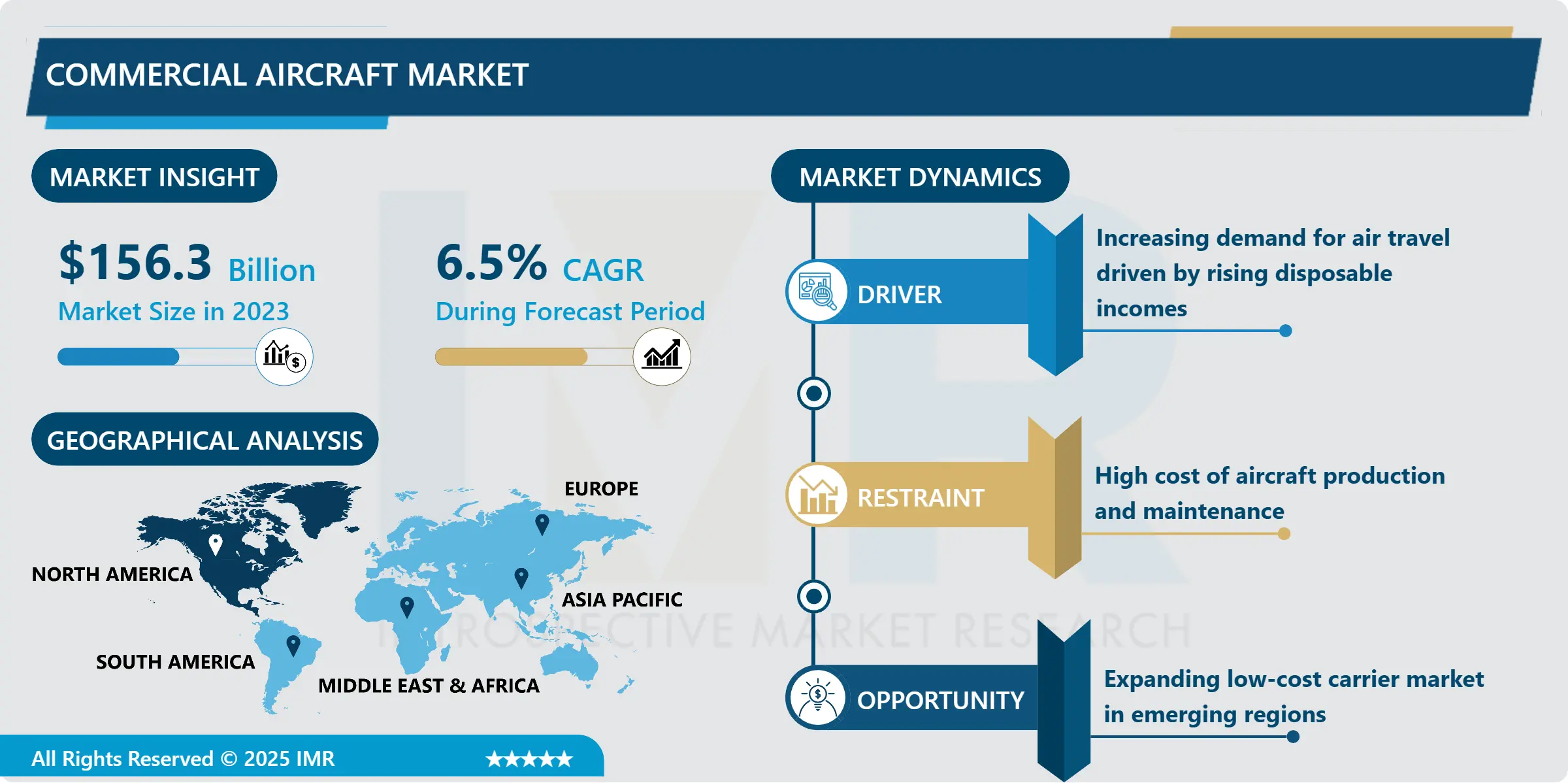
Commercial Aircraft Market Size Was Valued at USD 156.3 Billion in 2023, and is Projected to Reach USD 275.49 Billion by 2032, Growing at a CAGR of 6.5% From 2024-2032.
The commercial aircraft market refers to the business of designing, manufacturing and servicing airplanes used for carrying people or goods. This market covers the range of airplanes on the narrow body, wide body airplanes which are used in the short haul and the long haul flights respectively. Market is therefore buoyed by stakeholders HexString in the air transport and growth of technology used in flights as a means of transport. Some of the key elements of the space that are considered are manufacturing of brand new airplanes alongside the servicing and retrofitting of Numerous of already existing fleets comes into play that greatly help the market growth. The commercial aircraft business is influenced by factors such as the economic conditions of the world, the prices of fuels, the existing and other relevant regulations, and the remaining consumer preference for air transport.
The global commercial aircraft market is expanding rapidly due to the rising demand and size of air transport across the world at large. Currently the operators are increasing their fleet size to accommodate the growing number of passengers globally especially in the growing region like Asia-Pacific and Middle East. Technological advancement and improved fuels and engines and lighter materials of aircrafts are also some of the drivers that have enhanced the growth of air transport industry through enhancing its affordability. The market is also quite intense within leading market players such as Boeing and Airbus that are actively investing in product upgrades in response to consumers’ and regulatory requirements. Secondly, the increasing concern of energy conservation and emission reduction, the development of aircraft manufacturers to achieve better fuel efficiency of aircraft has prompted the development of green-energy-based substitutes for conventional jet fuel.
Nevertheless, there some intrigues that challenges the market, some of which include; high costs involved in the production of aircrafts, volatility of fuel prices, political and economic instabilities that offends the uptake of air transport services. For instance, political risk, such as political instability, invasions, or breakout of epidemics, or a shift in regulatory policies may greatly affect airlines’ financial viability, hence the procurement strategies for aircraft. However, the market has not lost hope in the development areas through which flight activities are slowly penetrating due to increased disposable income and urbanization.
Commercial Aircraft Market Trend Analysis
Growing focus on sustainability and fuel efficiency
- Carriers are now indicating to more efficient planes, fiscally friendly and less polluting planes like Boeing’s 787 dream liner, Airbus 350s. These aircrafts are designed from composite fibers and is installed with new generation engines which yields higher efficiency in fuel usage than previous models. Furthermore, bio fuels and hybrid electric power are also on the increase in the aviation industry as airlines manufacturers seek to provide adequate solution to global demand for environment friendly form of transport. Environmentalism is not just a legal concept in today’s world but also contribute to the choice einige passengers. As the aviations pressure to lessen its effect on the environment rises, new technologies in both aerodynamics and powerplant design should remain a commercial aviation trend for the foreseen future.
Expansion of low-cost carriers (LCCs) in emerging markets
- A promising trend in commercial aircraft is the growth of LCCs in new regions of the world with a constantly increasing middle class, and subsequently a human demand for transportation. The requirement for cheap commercial aircraft is also expected to climb as people begin to travel by air in areas like Asia-Pacific, Latin America, and Africa. These regions in particular are expected to register high economic growth thus expanding the size of consumers with higher disposable incomes. Airline industries in these regions are acquiring additional small, efficient, non-wide-bodied aircraft to meet the growing demand in the domestic and short-haul markets. This trend is by far a good chance for aircraft makers to design and deliver cheap, efficient aircraft types suitable for those markets. In addition, the major airlines are purchasing smaller planes to reach out to many underutilized local airports adding to the uses of the airplane. This opportunity is particularly important to those electronics manufacturers that are interested in emerging markets for aircraft for cost-efficient airplanes that are sustainable.
Commercial Aircraft Market Segment Analysis:
Commercial Aircraft Market is Segmented on the basis of Size, Application, and Region.
By Size, Narrow Body segment is expected to dominate the market during the forecast period
- The growth of the segment regarding the commercial aircraft market will be dominated by the narrow-body aircraft during the forecast period because of the growing demand for short-haul and mid-range flights. Single aisle aircrafts also known as narrow body aircrafts are preferred in commercial use because of it manoeuvrability, lower cost and ability to operate in small airports. Narrow-body jets are being preferred over these wide-body ones because they consume less fuel, and therefore viable for short routes where traffic is usually not very high. However, the growing trend of LCCs offering only affordable fares with more regional network is favoring the growth of NBACs. These models are rather suitable for operation by LCCs because of the two reasons in terms of demand and cost-effectiveness.
- Today’s LCCs are also enjoying benefits from new generation and advanced technologies that have provided them with efficient and cheap fuel consumption on their narrow-body aircraft. Types of PAX such as the Boeing 737 MAX and Aircraft Airbus A320neo segment relfects narrow body the technological advanced and lighter engine technologies increase fuel efficiency hence reducing operating costs. This process of modernization within the narrow-body segment is providing them with even more competitive advantages that attracts more airlines that try to optimize their fleet. With the increase in the need for affordable travel, the narrow body aircraft segment is expected to sustain its growth rate especially in the new economy where air travel is rapidly emerging.
By Application, Passenger segment expected to held the largest share
- This research work further projected that the passenger segment of the commercial aircraft market would continue to grow and dominate the market during the forecast period of this study. With air travel experiencing a continuing rise across the world, passenger aircrafts are seen to be in high demand especially for the new economies with the rising middle income earners who require cheaper mode of transport. With more and more airline operators seeking to offer an increased number of available seats to its customers, the commercial airplane market has experienced high demand for new passenger aircraft. Also, increase in demand for air transport instead of other modes of conveyance such as railways and road transport across global Continue, especially in the continents with large land area such as North America and Asia-Pacific will sustain the global demand for passenger aircrafts.
Commercial Aircraft Market Regional Insights:
North America is Expected to Dominate the Market Over the Forecast period
- The commercial aircraft market was also significantly led by North America in 2023. It can be partly explained by the fact more established manufacturers are from this region for instance Boeing in United States that enjoys more than a quarter mercado share lift in the worldwide market. for instance, the United States has one of the biggest numbers of commercial aircraft, and its airlines remain orderinging new aircraft to addressing the increasing air transportation.
- Also, there is a high request for business airplane principally because the region boasts of many big airports and a broad flight network. This is also supported by high traffic volume in North American and the general appreciation of modernizing the fleet through replacing old planes with newer, fuel efficient, green machines. As the investments in the field of air travel and manufacturing of aircrafts are on the rise North America is likely to retain its market presence in the future years for certain.
Active Key Players in the Commercial Aircraft Market
- Airbus (France)
- ATR Aircraft (France)
- Boeing (USA)
- Bombardier (Canada)
- COMAC (China)
- Dassault Aviation (France)
- Embraer (Brazil)
- GE Aviation (USA)
- Lockheed Martin (USA)
- Mitsubishi Aircraft Corporation (Japan)
- Northrop Grumman (USA)
- Rolls-Royce Holdings (UK)
- Saab AB (Sweden)
- Textron Aviation (USA)
- United Aircraft Corporation (Russia)
- Other Active Players.
|
Global Commercial Aircraft Market |
|||
|
Base Year: |
2023 |
Forecast Period: |
2024-2032 |
|
Historical Data: |
2017 to 2023 |
Market Size in 2023: |
USD 156.3 Billion |
|
Forecast Period 2024-32 CAGR: |
6.5% |
Market Size in 2032: |
USD 275.49 Billion |
|
Segments Covered: |
By Size |
|
|
|
By Application |
|
||
|
By Region |
|
||
|
Key Market Drivers: |
|
||
|
Key Market Restraints: |
|
||
|
Key Opportunities: |
|
||
|
Companies Covered in the report: |
|
||
Chapter 1: Introduction
1.1 Scope and Coverage
Chapter 2:Executive Summary
Chapter 3: Market Landscape
3.1 Market Dynamics
3.1.1 Drivers
3.1.2 Restraints
3.1.3 Opportunities
3.1.4 Challenges
3.2 Market Trend Analysis
3.3 PESTLE Analysis
3.4 Porter's Five Forces Analysis
3.5 Industry Value Chain Analysis
3.6 Ecosystem
3.7 Regulatory Landscape
3.8 Price Trend Analysis
3.9 Patent Analysis
3.10 Technology Evolution
3.11 Investment Pockets
3.12 Import-Export Analysis
Chapter 4: Commercial Aircraft Market by Size
4.1 Commercial Aircraft Market Snapshot and Growth Engine
4.2 Commercial Aircraft Market Overview
4.3 Narrow Body
4.3.1 Introduction and Market Overview
4.3.2 Historic and Forecasted Market Size in Value USD and Volume Units (2017-2032F)
4.3.3 Key Market Trends, Growth Factors and Opportunities
4.3.4 Narrow Body: Geographic Segmentation Analysis
4.4 Wide Body
4.4.1 Introduction and Market Overview
4.4.2 Historic and Forecasted Market Size in Value USD and Volume Units (2017-2032F)
4.4.3 Key Market Trends, Growth Factors and Opportunities
4.4.4 Wide Body: Geographic Segmentation Analysis
4.5 Regional & Business Jet
4.5.1 Introduction and Market Overview
4.5.2 Historic and Forecasted Market Size in Value USD and Volume Units (2017-2032F)
4.5.3 Key Market Trends, Growth Factors and Opportunities
4.5.4 Regional & Business Jet: Geographic Segmentation Analysis
4.6 Freighter
4.6.1 Introduction and Market Overview
4.6.2 Historic and Forecasted Market Size in Value USD and Volume Units (2017-2032F)
4.6.3 Key Market Trends, Growth Factors and Opportunities
4.6.4 Freighter: Geographic Segmentation Analysis
Chapter 5: Commercial Aircraft Market by Application
5.1 Commercial Aircraft Market Snapshot and Growth Engine
5.2 Commercial Aircraft Market Overview
5.3 Passenger
5.3.1 Introduction and Market Overview
5.3.2 Historic and Forecasted Market Size in Value USD and Volume Units (2017-2032F)
5.3.3 Key Market Trends, Growth Factors and Opportunities
5.3.4 Passenger: Geographic Segmentation Analysis
5.4 Cargo
5.4.1 Introduction and Market Overview
5.4.2 Historic and Forecasted Market Size in Value USD and Volume Units (2017-2032F)
5.4.3 Key Market Trends, Growth Factors and Opportunities
5.4.4 Cargo: Geographic Segmentation Analysis
Chapter 6: Company Profiles and Competitive Analysis
6.1 Competitive Landscape
6.1.1 Competitive Benchmarking
6.1.2 Commercial Aircraft Market Share by Manufacturer (2023)
6.1.3 Industry BCG Matrix
6.1.4 Heat Map Analysis
6.1.5 Mergers and Acquisitions
6.2 AIRBUS (FRANCE)
6.2.1 Company Overview
6.2.2 Key Executives
6.2.3 Company Snapshot
6.2.4 Role of the Company in the Market
6.2.5 Sustainability and Social Responsibility
6.2.6 Operating Business Segments
6.2.7 Product Portfolio
6.2.8 Business Performance
6.2.9 Key Strategic Moves and Recent Developments
6.2.10 SWOT Analysis
6.3 BOEING (USA)
6.4 BOMBARDIER (CANADA)
6.5 EMBRAER (BRAZIL)
6.6 LOCKHEED MARTIN (USA)
6.7 NORTHROP GRUMMAN (USA)
6.8 MITSUBISHI AIRCRAFT CORPORATION (JAPAN)
6.9 COMAC (CHINA)
6.10 TEXTRON AVIATION (USA)
6.11 UNITED AIRCRAFT CORPORATION (RUSSIA)
6.12 DASSAULT AVIATION (FRANCE)
6.13 SAAB AB (SWEDEN)
6.14 ATR AIRCRAFT (FRANCE)
6.15 GE AVIATION (USA)
6.16 ROLLS-ROYCE HOLDINGS (UK)
6.17 OTHER ACTIVE PLAYERS
Chapter 7: Global Commercial Aircraft Market By Region
7.1 Overview
7.2. North America Commercial Aircraft Market
7.2.1 Key Market Trends, Growth Factors and Opportunities
7.2.2 Top Key Companies
7.2.3 Historic and Forecasted Market Size by Segments
7.2.4 Historic and Forecasted Market Size By Size
7.2.4.1 Narrow Body
7.2.4.2 Wide Body
7.2.4.3 Regional & Business Jet
7.2.4.4 Freighter
7.2.5 Historic and Forecasted Market Size By Application
7.2.5.1 Passenger
7.2.5.2 Cargo
7.2.6 Historic and Forecast Market Size by Country
7.2.6.1 US
7.2.6.2 Canada
7.2.6.3 Mexico
7.3. Eastern Europe Commercial Aircraft Market
7.3.1 Key Market Trends, Growth Factors and Opportunities
7.3.2 Top Key Companies
7.3.3 Historic and Forecasted Market Size by Segments
7.3.4 Historic and Forecasted Market Size By Size
7.3.4.1 Narrow Body
7.3.4.2 Wide Body
7.3.4.3 Regional & Business Jet
7.3.4.4 Freighter
7.3.5 Historic and Forecasted Market Size By Application
7.3.5.1 Passenger
7.3.5.2 Cargo
7.3.6 Historic and Forecast Market Size by Country
7.3.6.1 Russia
7.3.6.2 Bulgaria
7.3.6.3 The Czech Republic
7.3.6.4 Hungary
7.3.6.5 Poland
7.3.6.6 Romania
7.3.6.7 Rest of Eastern Europe
7.4. Western Europe Commercial Aircraft Market
7.4.1 Key Market Trends, Growth Factors and Opportunities
7.4.2 Top Key Companies
7.4.3 Historic and Forecasted Market Size by Segments
7.4.4 Historic and Forecasted Market Size By Size
7.4.4.1 Narrow Body
7.4.4.2 Wide Body
7.4.4.3 Regional & Business Jet
7.4.4.4 Freighter
7.4.5 Historic and Forecasted Market Size By Application
7.4.5.1 Passenger
7.4.5.2 Cargo
7.4.6 Historic and Forecast Market Size by Country
7.4.6.1 Germany
7.4.6.2 UK
7.4.6.3 France
7.4.6.4 The Netherlands
7.4.6.5 Italy
7.4.6.6 Spain
7.4.6.7 Rest of Western Europe
7.5. Asia Pacific Commercial Aircraft Market
7.5.1 Key Market Trends, Growth Factors and Opportunities
7.5.2 Top Key Companies
7.5.3 Historic and Forecasted Market Size by Segments
7.5.4 Historic and Forecasted Market Size By Size
7.5.4.1 Narrow Body
7.5.4.2 Wide Body
7.5.4.3 Regional & Business Jet
7.5.4.4 Freighter
7.5.5 Historic and Forecasted Market Size By Application
7.5.5.1 Passenger
7.5.5.2 Cargo
7.5.6 Historic and Forecast Market Size by Country
7.5.6.1 China
7.5.6.2 India
7.5.6.3 Japan
7.5.6.4 South Korea
7.5.6.5 Malaysia
7.5.6.6 Thailand
7.5.6.7 Vietnam
7.5.6.8 The Philippines
7.5.6.9 Australia
7.5.6.10 New Zealand
7.5.6.11 Rest of APAC
7.6. Middle East & Africa Commercial Aircraft Market
7.6.1 Key Market Trends, Growth Factors and Opportunities
7.6.2 Top Key Companies
7.6.3 Historic and Forecasted Market Size by Segments
7.6.4 Historic and Forecasted Market Size By Size
7.6.4.1 Narrow Body
7.6.4.2 Wide Body
7.6.4.3 Regional & Business Jet
7.6.4.4 Freighter
7.6.5 Historic and Forecasted Market Size By Application
7.6.5.1 Passenger
7.6.5.2 Cargo
7.6.6 Historic and Forecast Market Size by Country
7.6.6.1 Turkiye
7.6.6.2 Bahrain
7.6.6.3 Kuwait
7.6.6.4 Saudi Arabia
7.6.6.5 Qatar
7.6.6.6 UAE
7.6.6.7 Israel
7.6.6.8 South Africa
7.7. South America Commercial Aircraft Market
7.7.1 Key Market Trends, Growth Factors and Opportunities
7.7.2 Top Key Companies
7.7.3 Historic and Forecasted Market Size by Segments
7.7.4 Historic and Forecasted Market Size By Size
7.7.4.1 Narrow Body
7.7.4.2 Wide Body
7.7.4.3 Regional & Business Jet
7.7.4.4 Freighter
7.7.5 Historic and Forecasted Market Size By Application
7.7.5.1 Passenger
7.7.5.2 Cargo
7.7.6 Historic and Forecast Market Size by Country
7.7.6.1 Brazil
7.7.6.2 Argentina
7.7.6.3 Rest of SA
Chapter 8 Analyst Viewpoint and Conclusion
8.1 Recommendations and Concluding Analysis
8.2 Potential Market Strategies
Chapter 9 Research Methodology
9.1 Research Process
9.2 Primary Research
9.3 Secondary Research
|
Global Commercial Aircraft Market |
|||
|
Base Year: |
2023 |
Forecast Period: |
2024-2032 |
|
Historical Data: |
2017 to 2023 |
Market Size in 2023: |
USD 156.3 Billion |
|
Forecast Period 2024-32 CAGR: |
6.5% |
Market Size in 2032: |
USD 275.49 Billion |
|
Segments Covered: |
By Size |
|
|
|
By Application |
|
||
|
By Region |
|
||
|
Key Market Drivers: |
|
||
|
Key Market Restraints: |
|
||
|
Key Opportunities: |
|
||
|
Companies Covered in the report: |
|
||


