




Central Nervous System Disorders Therapeutics Market Synopsis:
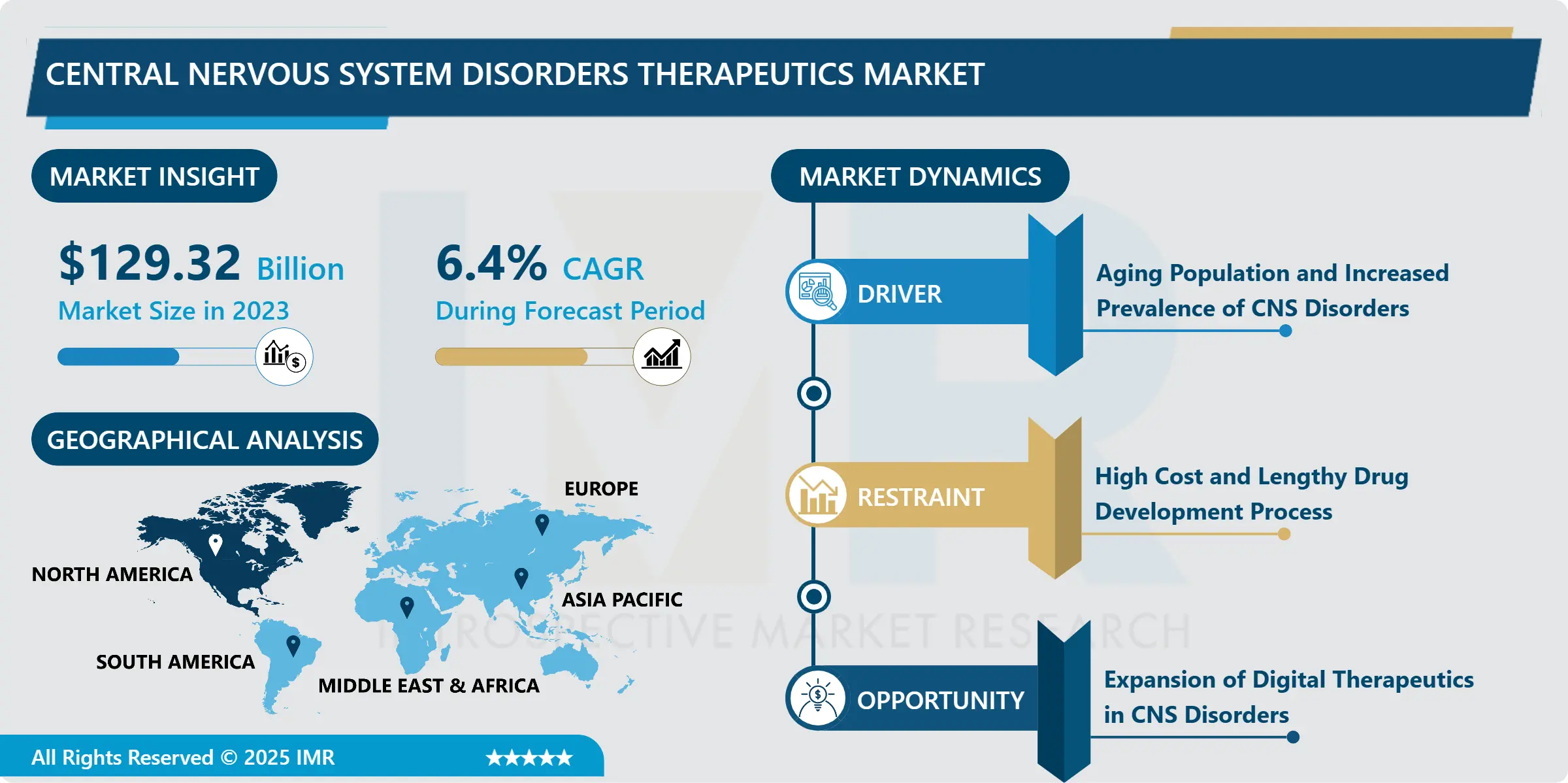
Central Nervous System Disorders Therapeutics Market Size Was Valued at USD 129.32 Billion in 2023, and is Projected to Reach USD 226.02 Billion by 2032, Growing at a CAGR of 6.40% From 2024-2032.
The Central Nervous System (CNS) Disorders Therapeutics Market refers to the pharmaceutical sector focused on the development, manufacturing, and commercialization of treatments for disorders that affect the brain, spinal cord, and nerves. These include diseases like Alzheimer’s, Parkinson’s, epilepsy, multiple sclerosis, schizophrenia, and depression, among others. The market encompasses a range of drugs, therapies, and treatments aimed at alleviating the symptoms and slowing the progression of these chronic conditions.
The CNS disorder therapeutic market is one of the fastest growing segments the global pharmaceutical market due to increasing global population, enhancing acceptance of mental health disorders, and development of innovative drugs. Alzheimer’s disease, Parkinson’s disease, depression, schizophrenia, epilepsy and other CNS disorders are common in the societies, meaning that there is a high market demand for solutions to these ailments. With these disorders needing more treatment options today, there may be more pressure towards developing new treatments.
A major issue within the CNS therapeutics market is the intricate nature of the brain and nervous system which increases the difficulties of the development of useful therapeutic medicine. Some of the CNS disorders remain only partially characterized, and many available treatments are not curative at best, they can only ameliorate the symptoms and/or halt the progression of the disease. This has led to sustained funding of research and efforts to locate optimal treatments, including development of even higher understanding of the biological based diseases that cause these diseases.
High-technology medicine over the years has brought new products including gene therapy, stem cell therapy and discoveries of Organ of transplantation basically stem cell. The targeting also provides hope to treat diseases such as Alzheimer and Parkinson through the launch of biologics and targeted therapies. Also, there is a growing interest in non-pharmacological approaches like digital therapeutics and neurostimulation devices targeted to be an addition or the outright substitute to pharmacological interventions.
The growth is also boosted by rising governmental expenditures and efforts that have been embraced to enhance the management of CNS diseases. Governmental and non-governmental agencies such as FDA and EMA are enabling approval of new treatments and many pharmaceutical firms are engaging research institutions in effort to fast-track novel treatments. Nonetheless, the competitors like high treatment costs, long developed time of new drugs, and tough administrative polices still restricted the growth of the market.
Central Nervous System Disorders Therapeutics Market Trend Analysis:
Rise in Personalized Medicine for CNS Disorders
-
This current trend of CNS disorders therapeutics indicates personalized drugs for the respective diseases and disorders. The use of genomics and biomarkers in research means that patients are now getting treatments based on their genetic predisposition, extent of the illness, as well as their reaction to medications. Targeted therapies can be helpful since the current approaches for treating illnesses such as Alzheimer’s and Parkinson’s are not very productive since not all people can respond to the same treatment. This trend is exciting the drug development process and altering the treatment patterns of CNS disorders.
- It is thematic for CNS therapeutics market that more and more biotech companies are setting up in this field to develop genetic testing, gene therapies and companion diagnosis. These improvements have enabled clinicians to give more target treatments and this has a potentiality of decreasing on the side effects of patients with CNS disorders. However, as it has been stated, several factors, including the high price of realizing genetic tests, and the lack of enough clinical information that would make the tests the ultimate, remain a hurdle towards the extensive utilization of the test. Nevertheless, personalized medicine should become one of the primary focus areas in the further CNS therapeutic development.
Expansion of Digital Therapeutics in CNS Disorders
-
One new trend in the CNS disorders therapeutics market is digital therapeutics which can involve the utilization of software-based interventions to treat CNS diseases including depression, anxiety, or Attention Deficit Hyperactivity Disorder. These personal health solutions, which are mostly presented in form of mobile applications, virtual programmes and gadgets, provide patients with a non-pharmacological support to their conditions. It is also more useful in mental health disorders because there has been growing need for non-drug approaches to health challenges.
- The addition of technology for the augmentation of traditional therapy type forms a comprehensive solution in the treatment of CNS disorders since they include the psychological as well as the physiological angle of the ailments. These pes Federal-State partnerships, integrated as these digital solutions demonstrate their effectiveness in clinical trials, present a distinctive chance to act as an addition, or in some cases a remedy, for specific medications, mostly in the sphere of medicine connected to disorders such as for example depression and anxiety. It offers firms the possibility of a new market to expand their risky portfolios and develop new products that can enhance the quality of care, and contain expenses at the same time.
Central Nervous System Disorders Therapeutics Market Segment Analysis:
Central Nervous System Disorders Therapeutics Market is Segmented on the basis of Disorder Type, Drug Class, Route of Administration, Distribution Channel, End User, and Region.
By Type, Alzheimer's Disease segment is expected to dominate the market during the forecast period
-
The CNS disorders therapeutics market according to the nature of the various disorders that are available in the market and majorly comprises of Alzheimer disorder, Parkinson disorder, multiple sclerosis, epilepsy, migraine, depression, schizophrenia and other disorders. Alzheimer’s disease has a large market share, commonly due to the raising incidence rates especially among the elderly. Given the target populations and the conditions involved which include attempts at attacking the very cores of cognitive impairments and memory loss the demand for the treatments remains massive although the current treatments are available the need is however still critical for more effective drugs that would reduce or halt the disease early progress.
- Parkinson’s disease and multiple sclerosis are also significant for this market because of severe disease symptoms and long-term treatment. Research efforts to find disease-modifying interventions in these territories are ongoing, and current primary interests include neuroprotectants and genetic treatments. Depression being a mental health disorder is another big segment another key segment, with increased awareness and acceptability of newer antidepressant drugs especially ones showing faster onset of action and less side effects. These are all different diseases which make it difficult in the market and as a pharma company to make more effective therapies.
By End User, Hospitals segment expected to held the largest share
-
Based on application, CNS disorders therapeutics market is segmented into hospitals, clinic and home care. Hospitals are slated to hold the largest market share because these are the major centres for diagnosing and managing complex CNS diseases. This is because hospitals already carry all the necessary resources and staff to deal with symptoms and treatment of chronic diseases such as Alzheimer’s, Parkinson’s, multiple sclerosis, among others. Furthermore, hospitals provide treatment through clinical trials, which also attributes to them being the key players in that market.
- Specialty clinics and home health care are also emerging as important sub segments within the CNS therapeutics market, as treatments are becoming available outside of hospitals. Outpatient care services are common for patient with chronic illness who need be checked and supervised frequently, but do not need to be hospitalize. Another side, clinics offer more individual and regional solutions, especially regarding further treatment and control. Thanks to the trends in telemedicine and mobile health solutions, both of these segments will experience growth in the future.
Central Nervous System Disorders Therapeutics Market Regional Insights:
North America is Expected to Dominate the Market Over the Forecast period
-
North America is the market leader in the CNS disorders therapeutics market due to factors such as good infrastructure in healthcare, higher expenditure on healthcare, and a developed pharmaceutical company. The U.S. dominates this market given the high incidence of CNS disorders such as Alzheimer’s disease and Parkinson’s disease in the aging population in that country. Healthcare systems in the region are also supportive for research and development and there are many biotech firms, universities as well as hospitals that play a significant role towards the advancement of CNS therapeutic sector.
- The other advantage of North America is that the region possesses a valid enabling environment that facilitates readily approval of new CNS drugs. The FDA has approved new therapies for neurodegenerative diseases hence enhancing innovation of new treatments, inadequate funding from the government for the research of treatments of diseases supports steady innovation. These factors coupled with an enhancement in consciousness level of psychiatric and neurological diseases will help North America maintain its leading position in the global CNS disorders therapeutics market.
Active Key Players in the Central Nervous System Disorders Therapeutics Market:
- Eli Lilly and Co. (USA)
- Johnson & Johnson (USA)
- Pfizer Inc. (USA)
- Novartis AG (Switzerland)
- Sanofi S.A. (France)
- Roche Holding AG (Switzerland)
- AstraZeneca PLC (UK)
- Merck & Co., Inc. (USA)
- Bristol Myers Squibb (USA)
- GlaxoSmithKline (UK)
- AbbVie Inc. (USA)
- Teva Pharmaceutical Industries Ltd. (Israel),
- Other Active Players
|
Global Central Nervous System Disorders Therapeutics Market |
|||
|
Base Year: |
2023 |
Forecast Period: |
2024-2032 |
|
Historical Data: |
2017 to 2023 |
Market Size in 2023: |
USD 129.32 Billion |
|
Forecast Period 2024-32 CAGR: |
6.40% |
Market Size in 2032: |
USD 226.02 Billion |
|
Segments Covered: |
By Disorder Type |
|
|
|
By Application |
|
||
|
By Region |
|
||
|
Key Market Drivers: |
|
||
|
Key Market Restraints: |
|
||
|
Key Opportunities: |
|
||
|
Companies Covered in the report: |
|
||
Chapter 1: Introduction
1.1 Scope and Coverage
Chapter 2:Executive Summary
Chapter 3: Market Landscape
3.1 Market Dynamics
3.1.1 Drivers
3.1.2 Restraints
3.1.3 Opportunities
3.1.4 Challenges
3.2 Market Trend Analysis
3.3 PESTLE Analysis
3.4 Porter's Five Forces Analysis
3.5 Industry Value Chain Analysis
3.6 Ecosystem
3.7 Regulatory Landscape
3.8 Price Trend Analysis
3.9 Patent Analysis
3.10 Technology Evolution
3.11 Investment Pockets
3.12 Import-Export Analysis
Chapter 4: Central Nervous System Disorders Therapeutics Market by Disorder Type
4.1 Central Nervous System Disorders Therapeutics Market Snapshot and Growth Engine
4.2 Central Nervous System Disorders Therapeutics Market Overview
4.3 Alzheimer's Disease
4.3.1 Introduction and Market Overview
4.3.2 Historic and Forecasted Market Size in Value USD and Volume Units (2017-2032F)
4.3.3 Key Market Trends, Growth Factors and Opportunities
4.3.4 Alzheimer's Disease: Geographic Segmentation Analysis
4.4 Parkinson's Disease
4.4.1 Introduction and Market Overview
4.4.2 Historic and Forecasted Market Size in Value USD and Volume Units (2017-2032F)
4.4.3 Key Market Trends, Growth Factors and Opportunities
4.4.4 Parkinson's Disease: Geographic Segmentation Analysis
4.5 Multiple Sclerosis
4.5.1 Introduction and Market Overview
4.5.2 Historic and Forecasted Market Size in Value USD and Volume Units (2017-2032F)
4.5.3 Key Market Trends, Growth Factors and Opportunities
4.5.4 Multiple Sclerosis: Geographic Segmentation Analysis
4.6 Epilepsy
4.6.1 Introduction and Market Overview
4.6.2 Historic and Forecasted Market Size in Value USD and Volume Units (2017-2032F)
4.6.3 Key Market Trends, Growth Factors and Opportunities
4.6.4 Epilepsy: Geographic Segmentation Analysis
4.7 Migraine
4.7.1 Introduction and Market Overview
4.7.2 Historic and Forecasted Market Size in Value USD and Volume Units (2017-2032F)
4.7.3 Key Market Trends, Growth Factors and Opportunities
4.7.4 Migraine: Geographic Segmentation Analysis
4.8 Depression
4.8.1 Introduction and Market Overview
4.8.2 Historic and Forecasted Market Size in Value USD and Volume Units (2017-2032F)
4.8.3 Key Market Trends, Growth Factors and Opportunities
4.8.4 Depression: Geographic Segmentation Analysis
4.9 Schizophrenia
4.9.1 Introduction and Market Overview
4.9.2 Historic and Forecasted Market Size in Value USD and Volume Units (2017-2032F)
4.9.3 Key Market Trends, Growth Factors and Opportunities
4.9.4 Schizophrenia: Geographic Segmentation Analysis
4.10 Other
4.10.1 Introduction and Market Overview
4.10.2 Historic and Forecasted Market Size in Value USD and Volume Units (2017-2032F)
4.10.3 Key Market Trends, Growth Factors and Opportunities
4.10.4 Other: Geographic Segmentation Analysis
Chapter 5: Central Nervous System Disorders Therapeutics Market by Drug Class
5.1 Central Nervous System Disorders Therapeutics Market Snapshot and Growth Engine
5.2 Central Nervous System Disorders Therapeutics Market Overview
5.3 Antidepressants
5.3.1 Introduction and Market Overview
5.3.2 Historic and Forecasted Market Size in Value USD and Volume Units (2017-2032F)
5.3.3 Key Market Trends, Growth Factors and Opportunities
5.3.4 Antidepressants: Geographic Segmentation Analysis
5.4 Antipsychotics
5.4.1 Introduction and Market Overview
5.4.2 Historic and Forecasted Market Size in Value USD and Volume Units (2017-2032F)
5.4.3 Key Market Trends, Growth Factors and Opportunities
5.4.4 Antipsychotics: Geographic Segmentation Analysis
5.5 Antiepileptics
5.5.1 Introduction and Market Overview
5.5.2 Historic and Forecasted Market Size in Value USD and Volume Units (2017-2032F)
5.5.3 Key Market Trends, Growth Factors and Opportunities
5.5.4 Antiepileptics: Geographic Segmentation Analysis
5.6 Dopamine Agonists
5.6.1 Introduction and Market Overview
5.6.2 Historic and Forecasted Market Size in Value USD and Volume Units (2017-2032F)
5.6.3 Key Market Trends, Growth Factors and Opportunities
5.6.4 Dopamine Agonists: Geographic Segmentation Analysis
5.7 CNS Stimulants
5.7.1 Introduction and Market Overview
5.7.2 Historic and Forecasted Market Size in Value USD and Volume Units (2017-2032F)
5.7.3 Key Market Trends, Growth Factors and Opportunities
5.7.4 CNS Stimulants: Geographic Segmentation Analysis
5.8 Muscle Relaxants
5.8.1 Introduction and Market Overview
5.8.2 Historic and Forecasted Market Size in Value USD and Volume Units (2017-2032F)
5.8.3 Key Market Trends, Growth Factors and Opportunities
5.8.4 Muscle Relaxants: Geographic Segmentation Analysis
5.9 Analgesics
5.9.1 Introduction and Market Overview
5.9.2 Historic and Forecasted Market Size in Value USD and Volume Units (2017-2032F)
5.9.3 Key Market Trends, Growth Factors and Opportunities
5.9.4 Analgesics: Geographic Segmentation Analysis
5.10 Others
5.10.1 Introduction and Market Overview
5.10.2 Historic and Forecasted Market Size in Value USD and Volume Units (2017-2032F)
5.10.3 Key Market Trends, Growth Factors and Opportunities
5.10.4 Others: Geographic Segmentation Analysis
Chapter 6: Central Nervous System Disorders Therapeutics Market by Route of Administration
6.1 Central Nervous System Disorders Therapeutics Market Snapshot and Growth Engine
6.2 Central Nervous System Disorders Therapeutics Market Overview
6.3 Oral
6.3.1 Introduction and Market Overview
6.3.2 Historic and Forecasted Market Size in Value USD and Volume Units (2017-2032F)
6.3.3 Key Market Trends, Growth Factors and Opportunities
6.3.4 Oral: Geographic Segmentation Analysis
6.4 Injectable
6.4.1 Introduction and Market Overview
6.4.2 Historic and Forecasted Market Size in Value USD and Volume Units (2017-2032F)
6.4.3 Key Market Trends, Growth Factors and Opportunities
6.4.4 Injectable: Geographic Segmentation Analysis
6.5 Transdermal
6.5.1 Introduction and Market Overview
6.5.2 Historic and Forecasted Market Size in Value USD and Volume Units (2017-2032F)
6.5.3 Key Market Trends, Growth Factors and Opportunities
6.5.4 Transdermal: Geographic Segmentation Analysis
Chapter 7: Central Nervous System Disorders Therapeutics Market by Distribution Channel
7.1 Central Nervous System Disorders Therapeutics Market Snapshot and Growth Engine
7.2 Central Nervous System Disorders Therapeutics Market Overview
7.3 Hospitals
7.3.1 Introduction and Market Overview
7.3.2 Historic and Forecasted Market Size in Value USD and Volume Units (2017-2032F)
7.3.3 Key Market Trends, Growth Factors and Opportunities
7.3.4 Hospitals: Geographic Segmentation Analysis
7.4 Retail Pharmacies
7.4.1 Introduction and Market Overview
7.4.2 Historic and Forecasted Market Size in Value USD and Volume Units (2017-2032F)
7.4.3 Key Market Trends, Growth Factors and Opportunities
7.4.4 Retail Pharmacies: Geographic Segmentation Analysis
7.5 Online Pharmacies
7.5.1 Introduction and Market Overview
7.5.2 Historic and Forecasted Market Size in Value USD and Volume Units (2017-2032F)
7.5.3 Key Market Trends, Growth Factors and Opportunities
7.5.4 Online Pharmacies: Geographic Segmentation Analysis
Chapter 8: Central Nervous System Disorders Therapeutics Market by End User
8.1 Central Nervous System Disorders Therapeutics Market Snapshot and Growth Engine
8.2 Central Nervous System Disorders Therapeutics Market Overview
8.3 Hospitals
8.3.1 Introduction and Market Overview
8.3.2 Historic and Forecasted Market Size in Value USD and Volume Units (2017-2032F)
8.3.3 Key Market Trends, Growth Factors and Opportunities
8.3.4 Hospitals: Geographic Segmentation Analysis
8.4 Clinics
8.4.1 Introduction and Market Overview
8.4.2 Historic and Forecasted Market Size in Value USD and Volume Units (2017-2032F)
8.4.3 Key Market Trends, Growth Factors and Opportunities
8.4.4 Clinics: Geographic Segmentation Analysis
8.5 Home Care
8.5.1 Introduction and Market Overview
8.5.2 Historic and Forecasted Market Size in Value USD and Volume Units (2017-2032F)
8.5.3 Key Market Trends, Growth Factors and Opportunities
8.5.4 Home Care: Geographic Segmentation Analysis
Chapter 9: Company Profiles and Competitive Analysis
9.1 Competitive Landscape
9.1.1 Competitive Benchmarking
9.1.2 Central Nervous System Disorders Therapeutics Market Share by Manufacturer (2023)
9.1.3 Industry BCG Matrix
9.1.4 Heat Map Analysis
9.1.5 Mergers and Acquisitions
9.2 ELI LILLY AND CO. - (USA).JOHNSON & JOHNSON - (USA).PFIZER INC. - (USA)
9.2.1 Company Overview
9.2.2 Key Executives
9.2.3 Company Snapshot
9.2.4 Role of the Company in the Market
9.2.5 Sustainability and Social Responsibility
9.2.6 Operating Business Segments
9.2.7 Product Portfolio
9.2.8 Business Performance
9.2.9 Key Strategic Moves and Recent Developments
9.2.10 SWOT Analysis
9.3 NOVARTIS AG - (SWITZERLAND)
9.4 SANOFI S.A. - (FRANCE)
9.5 ROCHE HOLDING AG - (SWITZERLAND)
9.6 ASTRAZENECA PLC - (UK)
9.7 MERCK & CO. INC. - (USA)
9.8 BRISTOL MYERS SQUIBB - (USA)
9.9 GLAXOSMITHKLINE - (UK)
9.10 ABBVIE INC. - (USA)
9.11 TEVA PHARMACEUTICAL INDUSTRIES LTD. - (ISRAEL)
9.12 OTHER ACTIVE PLAYERS
Chapter 10: Global Central Nervous System Disorders Therapeutics Market By Region
10.1 Overview
10.2. North America Central Nervous System Disorders Therapeutics Market
10.2.1 Key Market Trends, Growth Factors and Opportunities
10.2.2 Top Key Companies
10.2.3 Historic and Forecasted Market Size by Segments
10.2.4 Historic and Forecasted Market Size By Disorder Type
10.2.4.1 Alzheimer's Disease
10.2.4.2 Parkinson's Disease
10.2.4.3 Multiple Sclerosis
10.2.4.4 Epilepsy
10.2.4.5 Migraine
10.2.4.6 Depression
10.2.4.7 Schizophrenia
10.2.4.8 Other
10.2.5 Historic and Forecasted Market Size By Drug Class
10.2.5.1 Antidepressants
10.2.5.2 Antipsychotics
10.2.5.3 Antiepileptics
10.2.5.4 Dopamine Agonists
10.2.5.5 CNS Stimulants
10.2.5.6 Muscle Relaxants
10.2.5.7 Analgesics
10.2.5.8 Others
10.2.6 Historic and Forecasted Market Size By Route of Administration
10.2.6.1 Oral
10.2.6.2 Injectable
10.2.6.3 Transdermal
10.2.7 Historic and Forecasted Market Size By Distribution Channel
10.2.7.1 Hospitals
10.2.7.2 Retail Pharmacies
10.2.7.3 Online Pharmacies
10.2.8 Historic and Forecasted Market Size By End User
10.2.8.1 Hospitals
10.2.8.2 Clinics
10.2.8.3 Home Care
10.2.9 Historic and Forecast Market Size by Country
10.2.9.1 US
10.2.9.2 Canada
10.2.9.3 Mexico
10.3. Eastern Europe Central Nervous System Disorders Therapeutics Market
10.3.1 Key Market Trends, Growth Factors and Opportunities
10.3.2 Top Key Companies
10.3.3 Historic and Forecasted Market Size by Segments
10.3.4 Historic and Forecasted Market Size By Disorder Type
10.3.4.1 Alzheimer's Disease
10.3.4.2 Parkinson's Disease
10.3.4.3 Multiple Sclerosis
10.3.4.4 Epilepsy
10.3.4.5 Migraine
10.3.4.6 Depression
10.3.4.7 Schizophrenia
10.3.4.8 Other
10.3.5 Historic and Forecasted Market Size By Drug Class
10.3.5.1 Antidepressants
10.3.5.2 Antipsychotics
10.3.5.3 Antiepileptics
10.3.5.4 Dopamine Agonists
10.3.5.5 CNS Stimulants
10.3.5.6 Muscle Relaxants
10.3.5.7 Analgesics
10.3.5.8 Others
10.3.6 Historic and Forecasted Market Size By Route of Administration
10.3.6.1 Oral
10.3.6.2 Injectable
10.3.6.3 Transdermal
10.3.7 Historic and Forecasted Market Size By Distribution Channel
10.3.7.1 Hospitals
10.3.7.2 Retail Pharmacies
10.3.7.3 Online Pharmacies
10.3.8 Historic and Forecasted Market Size By End User
10.3.8.1 Hospitals
10.3.8.2 Clinics
10.3.8.3 Home Care
10.3.9 Historic and Forecast Market Size by Country
10.3.9.1 Russia
10.3.9.2 Bulgaria
10.3.9.3 The Czech Republic
10.3.9.4 Hungary
10.3.9.5 Poland
10.3.9.6 Romania
10.3.9.7 Rest of Eastern Europe
10.4. Western Europe Central Nervous System Disorders Therapeutics Market
10.4.1 Key Market Trends, Growth Factors and Opportunities
10.4.2 Top Key Companies
10.4.3 Historic and Forecasted Market Size by Segments
10.4.4 Historic and Forecasted Market Size By Disorder Type
10.4.4.1 Alzheimer's Disease
10.4.4.2 Parkinson's Disease
10.4.4.3 Multiple Sclerosis
10.4.4.4 Epilepsy
10.4.4.5 Migraine
10.4.4.6 Depression
10.4.4.7 Schizophrenia
10.4.4.8 Other
10.4.5 Historic and Forecasted Market Size By Drug Class
10.4.5.1 Antidepressants
10.4.5.2 Antipsychotics
10.4.5.3 Antiepileptics
10.4.5.4 Dopamine Agonists
10.4.5.5 CNS Stimulants
10.4.5.6 Muscle Relaxants
10.4.5.7 Analgesics
10.4.5.8 Others
10.4.6 Historic and Forecasted Market Size By Route of Administration
10.4.6.1 Oral
10.4.6.2 Injectable
10.4.6.3 Transdermal
10.4.7 Historic and Forecasted Market Size By Distribution Channel
10.4.7.1 Hospitals
10.4.7.2 Retail Pharmacies
10.4.7.3 Online Pharmacies
10.4.8 Historic and Forecasted Market Size By End User
10.4.8.1 Hospitals
10.4.8.2 Clinics
10.4.8.3 Home Care
10.4.9 Historic and Forecast Market Size by Country
10.4.9.1 Germany
10.4.9.2 UK
10.4.9.3 France
10.4.9.4 The Netherlands
10.4.9.5 Italy
10.4.9.6 Spain
10.4.9.7 Rest of Western Europe
10.5. Asia Pacific Central Nervous System Disorders Therapeutics Market
10.5.1 Key Market Trends, Growth Factors and Opportunities
10.5.2 Top Key Companies
10.5.3 Historic and Forecasted Market Size by Segments
10.5.4 Historic and Forecasted Market Size By Disorder Type
10.5.4.1 Alzheimer's Disease
10.5.4.2 Parkinson's Disease
10.5.4.3 Multiple Sclerosis
10.5.4.4 Epilepsy
10.5.4.5 Migraine
10.5.4.6 Depression
10.5.4.7 Schizophrenia
10.5.4.8 Other
10.5.5 Historic and Forecasted Market Size By Drug Class
10.5.5.1 Antidepressants
10.5.5.2 Antipsychotics
10.5.5.3 Antiepileptics
10.5.5.4 Dopamine Agonists
10.5.5.5 CNS Stimulants
10.5.5.6 Muscle Relaxants
10.5.5.7 Analgesics
10.5.5.8 Others
10.5.6 Historic and Forecasted Market Size By Route of Administration
10.5.6.1 Oral
10.5.6.2 Injectable
10.5.6.3 Transdermal
10.5.7 Historic and Forecasted Market Size By Distribution Channel
10.5.7.1 Hospitals
10.5.7.2 Retail Pharmacies
10.5.7.3 Online Pharmacies
10.5.8 Historic and Forecasted Market Size By End User
10.5.8.1 Hospitals
10.5.8.2 Clinics
10.5.8.3 Home Care
10.5.9 Historic and Forecast Market Size by Country
10.5.9.1 China
10.5.9.2 India
10.5.9.3 Japan
10.5.9.4 South Korea
10.5.9.5 Malaysia
10.5.9.6 Thailand
10.5.9.7 Vietnam
10.5.9.8 The Philippines
10.5.9.9 Australia
10.5.9.10 New Zealand
10.5.9.11 Rest of APAC
10.6. Middle East & Africa Central Nervous System Disorders Therapeutics Market
10.6.1 Key Market Trends, Growth Factors and Opportunities
10.6.2 Top Key Companies
10.6.3 Historic and Forecasted Market Size by Segments
10.6.4 Historic and Forecasted Market Size By Disorder Type
10.6.4.1 Alzheimer's Disease
10.6.4.2 Parkinson's Disease
10.6.4.3 Multiple Sclerosis
10.6.4.4 Epilepsy
10.6.4.5 Migraine
10.6.4.6 Depression
10.6.4.7 Schizophrenia
10.6.4.8 Other
10.6.5 Historic and Forecasted Market Size By Drug Class
10.6.5.1 Antidepressants
10.6.5.2 Antipsychotics
10.6.5.3 Antiepileptics
10.6.5.4 Dopamine Agonists
10.6.5.5 CNS Stimulants
10.6.5.6 Muscle Relaxants
10.6.5.7 Analgesics
10.6.5.8 Others
10.6.6 Historic and Forecasted Market Size By Route of Administration
10.6.6.1 Oral
10.6.6.2 Injectable
10.6.6.3 Transdermal
10.6.7 Historic and Forecasted Market Size By Distribution Channel
10.6.7.1 Hospitals
10.6.7.2 Retail Pharmacies
10.6.7.3 Online Pharmacies
10.6.8 Historic and Forecasted Market Size By End User
10.6.8.1 Hospitals
10.6.8.2 Clinics
10.6.8.3 Home Care
10.6.9 Historic and Forecast Market Size by Country
10.6.9.1 Turkiye
10.6.9.2 Bahrain
10.6.9.3 Kuwait
10.6.9.4 Saudi Arabia
10.6.9.5 Qatar
10.6.9.6 UAE
10.6.9.7 Israel
10.6.9.8 South Africa
10.7. South America Central Nervous System Disorders Therapeutics Market
10.7.1 Key Market Trends, Growth Factors and Opportunities
10.7.2 Top Key Companies
10.7.3 Historic and Forecasted Market Size by Segments
10.7.4 Historic and Forecasted Market Size By Disorder Type
10.7.4.1 Alzheimer's Disease
10.7.4.2 Parkinson's Disease
10.7.4.3 Multiple Sclerosis
10.7.4.4 Epilepsy
10.7.4.5 Migraine
10.7.4.6 Depression
10.7.4.7 Schizophrenia
10.7.4.8 Other
10.7.5 Historic and Forecasted Market Size By Drug Class
10.7.5.1 Antidepressants
10.7.5.2 Antipsychotics
10.7.5.3 Antiepileptics
10.7.5.4 Dopamine Agonists
10.7.5.5 CNS Stimulants
10.7.5.6 Muscle Relaxants
10.7.5.7 Analgesics
10.7.5.8 Others
10.7.6 Historic and Forecasted Market Size By Route of Administration
10.7.6.1 Oral
10.7.6.2 Injectable
10.7.6.3 Transdermal
10.7.7 Historic and Forecasted Market Size By Distribution Channel
10.7.7.1 Hospitals
10.7.7.2 Retail Pharmacies
10.7.7.3 Online Pharmacies
10.7.8 Historic and Forecasted Market Size By End User
10.7.8.1 Hospitals
10.7.8.2 Clinics
10.7.8.3 Home Care
10.7.9 Historic and Forecast Market Size by Country
10.7.9.1 Brazil
10.7.9.2 Argentina
10.7.9.3 Rest of SA
Chapter 11 Analyst Viewpoint and Conclusion
11.1 Recommendations and Concluding Analysis
11.2 Potential Market Strategies
Chapter 12 Research Methodology
12.1 Research Process
12.2 Primary Research
12.3 Secondary Research
|
Global Central Nervous System Disorders Therapeutics Market |
|||
|
Base Year: |
2023 |
Forecast Period: |
2024-2032 |
|
Historical Data: |
2017 to 2023 |
Market Size in 2023: |
USD 129.32 Billion |
|
Forecast Period 2024-32 CAGR: |
6.40% |
Market Size in 2032: |
USD 226.02 Billion |
|
Segments Covered: |
By Disorder Type |
|
|
|
By Application |
|
||
|
By Region |
|
||
|
Key Market Drivers: |
|
||
|
Key Market Restraints: |
|
||
|
Key Opportunities: |
|
||
|
Companies Covered in the report: |
|
||


