




Key Market Highlights
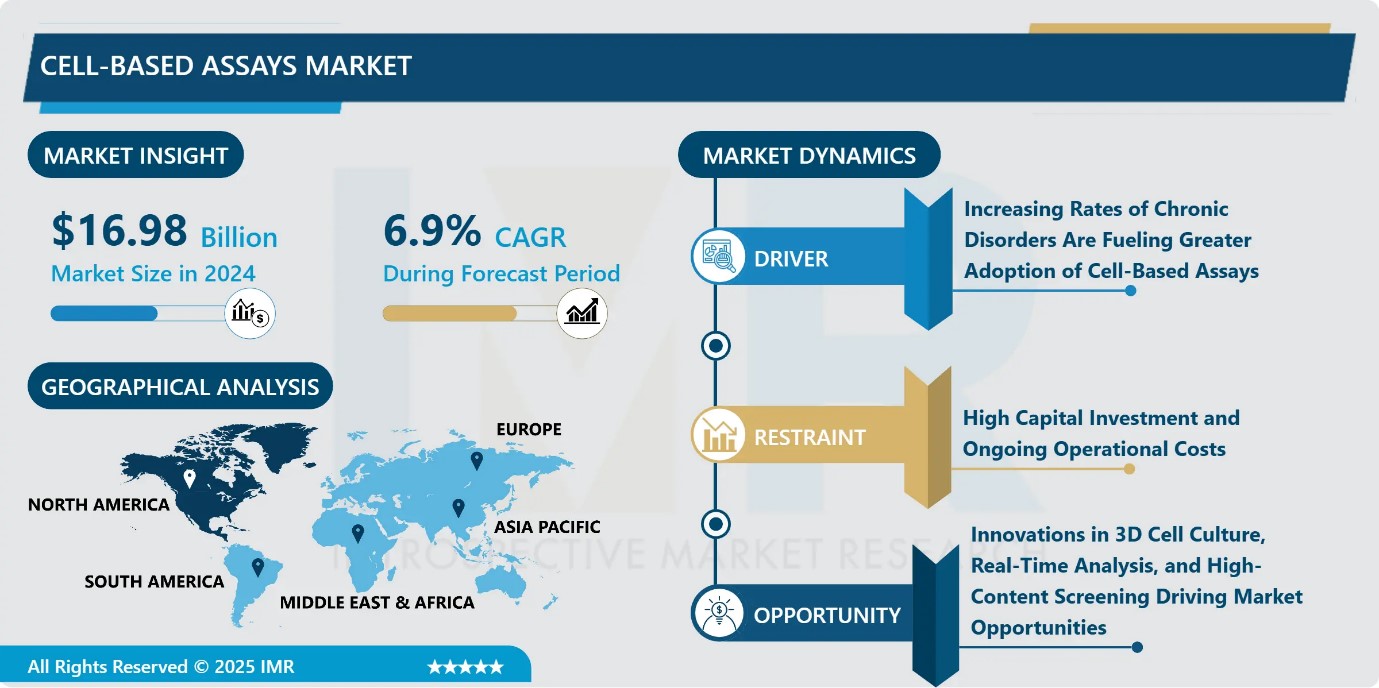
Cell-Based Assays Market Size Was Valued at USD 16.98 Billion in 2024, and is Projected to Reach USD 35.37 Billion by 2035, Growing at a CAGR of 6.9% from 2025-2035.
- Market Size in 2024: USD 16.98 Billion
- Projected Market Size by 2035: USD 35.37 Billion
- CAGR (2025–2035): 6.9%
- Leading Market in 2024: North America
- Fastest-Growing Market: Asia-Pacific
- By Application: The Drug Discovery segment is anticipated to lead the market by accounting for 33.87% of the market share throughout the forecast period.
- By End-User: The Pharmaceutical & Biotechnology Companies segment is expected to capture 30.56% of the market share, thereby maintaining its dominance over the forecast period.
- By Region: North America region is projected to hold 32.11% of the market share during the forecast period.
- Active Players: Abcam plc (United Kingdom), Agilent Technologies, Inc. (United States), Becton, Dickinson and Company (BD) (United States), Bio-Rad Laboratories, Inc. (United States), Charles River Laboratories International, Inc. (United States), and Other Active Players.
Cell-Based Assays Market Synopsis:
Cell-based assays are techniques that analyze living cells to measure cellular functions, such as proliferation, motility, toxicity, morphology, and biomarker production. Widely used in drug discovery, diagnostics, and disease modeling, these assays provide critical insights into drug efficacy, mechanism of action, and toxicity. The market is driven by the growing demand for personalized medicine, high-throughput screening, and biologically relevant in vitro models. Advancements like 3D cell cultures, microfluidic systems, and live-cell imaging are enhancing assay sensitivity and scalability. Increasing applications in cancer research, stem cell studies, neurodegenerative disease modeling, and toxicology, coupled with adoption by pharmaceutical companies, biotechnology firms, academic institutes, and CROs, are fueling market growth, projected to reach significant global valuation by 2035.
Cell-Based Assays Market Dynamics and Trend Analysis:
Cell-Based Assays Market Growth Driver-Increasing Rates of Chronic Disorders Are Fueling Greater Adoption of Cell-Based Assays
- The rising burden of chronic and lifestyle-related diseases is strongly influencing the growth of the cell-based assays market. Diseases such as cancer, diabetes, cardiovascular conditions, and neurodegenerative disorders require a better understanding of how they develop and progress at the cellular level. Cell-based assays help researchers recreate disease conditions in the laboratory, making it easier to study cellular responses and identify meaningful therapeutic targets. These assays are widely used in drug discovery to screen compounds and evaluate their effectiveness and safety. Growing investments in cancer and metabolic disease research, along with an aging global population, are further driving the adoption of advanced cell-based assay technologies, supporting sustained market expansion.
Cell-Based Assays Market Limiting Factor-High Capital Investment and Ongoing Operational Costs
- High capital and maintenance costs remain a major restraint in the global cell-based assays market. Advanced platforms such as high-throughput screening systems, spectral flow cytometers, and high-content imaging instruments often require investments exceeding several hundred thousand dollars, with annual service and maintenance contracts adding significant recurring expenses. For example, spectral flow cytometry systems can cost over USD 500,000, limiting adoption among academic laboratories and price-sensitive markets.
- In addition, specialized assay kits for applications such as 3D cell culture, stem cell analysis, and organ-on-chip models are often proprietary and costly. Expenses related to skilled personnel, infrastructure, regulatory compliance, and assay validation further increase operational burdens, restricting broader market penetration, particularly for smaller research institutions and emerging biotech companies.
Cell-Based Assays Market Expansion Opportunity-Innovations in 3D Cell Culture, Real-Time Analysis, and High-Content Screening Driving Market Opportunities
- Rapid innovation in cell culture technologies is creating strong growth opportunities in the cell-based assays market. The shift from traditional 2D cultures to advanced 3D models, organoids, and organ-on-chip systems enables researchers to better replicate human physiology, improving the predictive accuracy of drug screening and toxicity studies. Integration of high-content screening (HCS), microfluidics, and label-free, real-time technologies is further enhancing assay efficiency and data quality. For example, Nanolive’s 2025 launch of a label-free, AI-enabled mitochondrial assay allows continuous monitoring of live-cell dynamics without dyes. Additionally, tools such as Agilent’s real-time cell analysis platforms and Corning’s 3D culture products are supporting broader adoption. These advancements are opening new opportunities in personalized medicine, oncology research, and complex disease modelling.
Cell-Based Assays Market Challenge and Risk-Shortage of Skilled Talent and Lack of Assay Standardization
- The cell-based assays market faces a significant challenge due to the shortage of skilled, multidisciplinary professionals required to design, execute, and interpret complex assays. Expertise spanning cell biology, assay development, automation, and data analytics remains limited, particularly in emerging markets. For instance, Singapore projects a notable increase in assay-development talent gaps despite ongoing training initiatives, highlighting a broader global issue. This skills shortage often delays custom assay development and increases reliance on contract research organizations (CROs).
- Additionally, the lack of standardized protocols across laboratories leads to variability in results, driven by differences in cell lines, reagents, and experimental handling. These reproducibility concerns complicate regulatory validation, increase development costs, and slow the translation of preclinical findings into clinical outcomes, restraining overall market progress.
Cell-Based Assays Market Trend-Expansion of Personalized Medicine and Biomarker-Driven Drug Development Reshaping the Cell-Based Assays Landscape
- The increasing shift toward personalized and precision medicine is emerging as a key trend shaping the cell-based assays market. Healthcare providers and pharmaceutical companies are moving away from standardized treatments toward therapies tailored to individual genetic, molecular, and cellular profiles. Cell-based assays play a critical role in this transition by enabling the testing of drug responses using patient-derived cells, helping to predict efficacy and reduce adverse effects.
- Their growing use in drug discovery and development supports more physiologically relevant preclinical data while reducing dependence on animal models. For example, Thermo Fisher Scientific’s Gibco CTS Rotea system enhances cell therapy workflows, while the 2025 partnership between Precision for Medicine and SOPHiA GENETICS highlights rising investments in biomarker-driven precision medicine. This trend is accelerating adoption across clinical and research settings.
Cell-Based Assays Market Segment Analysis:
Cell-Based Assays Market is segmented based on Product, Technology, Application, End-User and Region
By Application, Drug Discovery segment is expected to dominate the market with around 33.87% share during the forecast period.
- The drug discovery segment dominated the cell-based assays market, accounting for approximately 33.87% of total revenue in 2024, due to its critical role in early-stage drug development. Cell-based assays are widely used for lead identification, target validation, cytotoxicity assessment, and high-throughput screening, enabling accurate evaluation of drug efficacy, toxicity, and mechanisms of action in physiologically relevant models.
- This dominance is driven by rising global R&D spending, increasing prevalence of chronic diseases such as cancer and neurodegenerative disorders, and the need to reduce late-stage clinical failures. Advancements in 3D cell culture, organ-on-chip technologies, and automated screening platforms further enhance assay relevance. Additionally, regulatory encouragement from the FDA and EMA to adopt in vitro models has strengthened reliance on cell-based assays in drug discovery workflows.
By End-User, Pharmaceutical and Biotechnology is expected to dominate with close to 30.56% market share during the forecast period.
- Pharmaceutical and biotechnology companies dominated the cell-based assays market, accounting for over 30.56% of total revenue in 2024, due to their extensive use of these assays across drug discovery, toxicity testing, and high-throughput screening. This dominance is driven by rising global R&D investments, expanding pipelines of biologics and targeted therapies, and the growing emphasis on personalized medicine.
- Cell-based assays enable accurate evaluation of drug efficacy, safety, and mechanisms of action at early development stages, helping reduce clinical failure rates and development costs. Additionally, regulatory encouragement to minimize animal testing and accelerate drug approval processes has increased reliance on physiologically relevant in-vitro models. As pharmaceutical and biotechnology companies continue to prioritize efficiency, automation, and innovation, this segment is expected to maintain its leading position throughout the forecast period.
Cell-Based Assays Market Regional Insights:
North America region is estimated to lead the market with around 32.11% share during the forecast period.
- North America dominated the global cell-based assays market with a 32.11% revenue share in 2024, led by the U.S., due to the presence of well-established pharmaceutical and biotechnology sectors, advanced research infrastructure, and strong regulatory support. The market thrives because of rising R&D investments, high prevalence of chronic diseases such as cancer, diabetes, and cardiovascular disorders, and growing adoption of precision medicine, which drive demand for target validation, drug discovery, and toxicity testing.
- Collaborations between academic institutes, pharmaceutical companies, and CROs, including ThermoFisher, Charles River, and Lonza, foster innovation. For example, in June 2025, Illumina acquired SomaLogic to expand its proteomics capabilities, reflecting strategic investments aimed at enhancing advanced cell-based assay applications.
Cell-Based Assays Market Active Players:
- Abcam plc (United Kingdom)
- Agilent Technologies, Inc. (United States)
- Becton, Dickinson and Company (BD) (United States)
- Bio-Rad Laboratories, Inc. (United States)
- Charles River Laboratories International, Inc. (United States)
- Corning Incorporated (United States)
- Danaher Corporation (United States)
- F. Hoffmann-La Roche Ltd. (Roche Holding AG) (Switzerland)
- Lonza Group AG (Switzerland)
- Merck KGaA (Germany)
- PerkinElmer, Inc. (United States)
- Promega Corporation (United States
- ThermoFisher Scientific Inc. (United States)
- Cell Signalling Technology, Inc. (United States)
- GE Healthcare (United Kingdom)
- Other Active Players
Key Industry Developments in the Cell-Based Assays Market:
- In May 2025, BD launched the FACSDiscover A8 Cell Analyzer, the first commercial platform combining spectral flow cytometry with real-time cell imaging, enabling analysis of up to 50 cellular characteristics for advanced biomarker discovery.
- In January 2025, Merck KGaA acquired HUB Organoids Holding B.V. to strengthen its expertise in 3D cell cultures and organoid-based assays, supporting more efficient drug discovery and development.
Core Technologies and Technical Capabilities Defining the Global Cell-Based Assays Market
- Cell-based assays are in vitro analytical methods used to measure cellular responses to biological or chemical stimuli, providing physiologically relevant data for drug discovery, toxicology, and disease research. These assays evaluate parameters such as cell viability, proliferation, apoptosis, signal transduction, gene expression, and receptor binding. Technologies commonly employed include reporter gene assays, high-content screening (HCS), flow cytometry, and label-free real-time analysis platforms.
- The market is increasingly shifting from conventional two-dimensional (2D) cultures toward advanced three-dimensional (3D) cell models, organoids, and organ-on-chip systems to improve translational accuracy. Integration of automation, microfluidics, and artificial intelligence–based image analysis has enhanced throughput, data quality, and reproducibility. Additionally, genome-editing tools such as CRISPR/Cas9 enable precise manipulation of cellular pathways, supporting the development of complex disease-relevant assays. These technological advancements are expanding applications across pharmaceutical R&D, precision medicine, and stem cell research.
|
Cell-Based Assays Market |
|||
|
Base Year: |
2024 |
Forecast Period: |
2025-2035 |
|
Historical Data: |
2018 to 2023 |
Market Size in 2024: |
USD 16.98 Bn. |
|
Forecast Period 2025-32 CAGR: |
6.9 % |
Market Size in 2035: |
USD 35.37 Bn. |
|
Segments Covered: |
By Product |
|
|
|
By Technology |
|
||
|
By Application
|
|
||
|
By End-User |
|
||
|
By Region |
|
||
|
Growth Driver: |
|
||
|
Limiting Factor |
|
||
|
Expansion Opportunity |
|
||
|
Challenge and Risk |
|
||
|
Companies Covered in the Report: |
|
||
Chapter 1: Introduction
1.1 Scope and Coverage
Chapter 2:Executive Summary
Chapter 3: Market Landscape
3.1 Market Dynamics and Opportunity Analysis
3.1.1 Growth Drivers
3.1.2 Limiting Factors
3.1.3 Growth Opportunities
3.1.4 Challenges and Risks
3.2 Market Trend Analysis
3.3 Industry Ecosystem
3.4 Industry Value Chain Mapping
3.5 Strategic PESTLE Overview
3.6 Porter's Five Forces Framework
3.7 Regulatory Framework
3.8 Pricing Trend Analysis
3.9 Intellectual Property Review
3.10 Technology Evolution
3.11 Import-Export Analysis
3.12 Consumer Behavior Analysis
3.13 Investment Pocket Analysis
3.14 Go-To Market Strategy
Chapter 4: Cell-Based Assays Market by Product (2018-2035)
4.1 Cell-Based Assays Market Snapshot and Growth Engine
4.2 Market Overview
4.3 Reagents
4.3.1 Introduction and Market Overview
4.3.2 Historic and Forecasted Market Size in Value USD and Volume Units
4.3.3 Key Market Trends, Growth Factors, and Opportunities
4.3.4 Geographic Segmentation Analysis
4.4 Assay Kits
4.5 Probes & Labels
4.6 Microplates
4.7 Instruments & Software
4.8 Cell Lines
Chapter 5: Cell-Based Assays Market by Technology (2018-2035)
5.1 Cell-Based Assays Market Snapshot and Growth Engine
5.2 Market Overview
5.3 Flow Cytometry
5.3.1 Introduction and Market Overview
5.3.2 Historic and Forecasted Market Size in Value USD and Volume Units
5.3.3 Key Market Trends, Growth Factors, and Opportunities
5.3.4 Geographic Segmentation Analysis
5.4 High-Throughput Screening
5.5 High-Content Screening
5.6 Label-Free Detection
5.7 Automated Handling
Chapter 6: Cell-Based Assays Market by Application (2018-2035)
6.1 Cell-Based Assays Market Snapshot and Growth Engine
6.2 Market Overview
6.3 Drug Discovery
6.3.1 Introduction and Market Overview
6.3.2 Historic and Forecasted Market Size in Value USD and Volume Units
6.3.3 Key Market Trends, Growth Factors, and Opportunities
6.3.4 Geographic Segmentation Analysis
6.4 Basic Research
6.5 ADME Studies
6.6 Predictive Toxicology
Chapter 7: Cell-Based Assays Market by End-User (2018-2035)
7.1 Cell-Based Assays Market Snapshot and Growth Engine
7.2 Market Overview
7.3 Pharmaceutical & Biotechnology Companies
7.3.1 Introduction and Market Overview
7.3.2 Historic and Forecasted Market Size in Value USD and Volume Units
7.3.3 Key Market Trends, Growth Factors, and Opportunities
7.3.4 Geographic Segmentation Analysis
7.4 CROs
7.5 Academic & Research Institutes
7.6 Government Organizations
Chapter 8: Company Profiles and Competitive Analysis
8.1 Competitive Landscape
8.1.1 Competitive Benchmarking
8.1.2 Cell-Based Assays Market Share by Manufacturer/Service Provider(2024)
8.1.3 Industry BCG Matrix
8.1.4 PArtnerships, Mergers & Acquisitions
8.2 ABCAM PLC (UNITED KINGDOM)
8.2.1 Company Overview
8.2.2 Key Executives
8.2.3 Company Snapshot
8.2.4 Role of the Company in the Market
8.2.5 Sustainability and Social Responsibility
8.2.6 Operating Business Segments
8.2.7 Product Portfolio
8.2.8 Business Performance
8.2.9 Recent News & Developments
8.2.10 SWOT Analysis
8.3 AGILENT TECHNOLOGIES
8.4 INC. (USA)
8.5 BECTON
8.6 DICKINSON AND COMPANY (BD) (USA)
8.7 BIO-RAD LABORATORIES
8.8 INC. (USA)
8.9 CHARLES RIVER LABORATORIES INTERNATIONAL
8.10 INC. (USA)
8.11 CORNING INCORPORATED (USA)
8.12 DANAHER CORPORATION (USA)
8.13 F. HOFFMANN-LA ROCHE LTD. (ROCHE HOLDING AG) (SWITZERLAND)
8.14 LONZA GROUP AG (SWITZERLAND)
8.15 MERCK KGAA (GERMANY)
8.16 PERKINELMER
8.17 INC. (USA)
8.18 PROMEGA CORPORATION (USA)
8.19 THERMOFISHER SCIENTIFIC INC. (USA)
8.20 CELL SIGNALLING TECHNOLOGY
8.21 INC. (USA)
8.22 GE HEALTHCARE (UNITED KINGDOM) AND OTHER ACTIVE PLAYERS
Chapter 9: Global Cell-Based Assays Market By Region
9.1 Overview
9.2. North America Cell-Based Assays Market
9.2.1 Key Market Trends, Growth Factors and Opportunities
9.2.2 Top Key Companies
9.2.3 Historic and Forecasted Market Size by Segments
9.2.4 Historic and Forecast Market Size by Country
9.2.4.1 US
9.2.4.2 Canada
9.2.4.3 Mexico
9.3. Eastern Europe Cell-Based Assays Market
9.3.1 Key Market Trends, Growth Factors and Opportunities
9.3.2 Top Key Companies
9.3.3 Historic and Forecasted Market Size by Segments
9.3.4 Historic and Forecast Market Size by Country
9.3.4.1 Russia
9.3.4.2 Bulgaria
9.3.4.3 The Czech Republic
9.3.4.4 Hungary
9.3.4.5 Poland
9.3.4.6 Romania
9.3.4.7 Rest of Eastern Europe
9.4. Western Europe Cell-Based Assays Market
9.4.1 Key Market Trends, Growth Factors and Opportunities
9.4.2 Top Key Companies
9.4.3 Historic and Forecasted Market Size by Segments
9.4.4 Historic and Forecast Market Size by Country
9.4.4.1 Germany
9.4.4.2 UK
9.4.4.3 France
9.4.4.4 The Netherlands
9.4.4.5 Italy
9.4.4.6 Spain
9.4.4.7 Rest of Western Europe
9.5. Asia Pacific Cell-Based Assays Market
9.5.1 Key Market Trends, Growth Factors and Opportunities
9.5.2 Top Key Companies
9.5.3 Historic and Forecasted Market Size by Segments
9.5.4 Historic and Forecast Market Size by Country
9.5.4.1 China
9.5.4.2 India
9.5.4.3 Japan
9.5.4.4 South Korea
9.5.4.5 Malaysia
9.5.4.6 Thailand
9.5.4.7 Vietnam
9.5.4.8 The Philippines
9.5.4.9 Australia
9.5.4.10 New Zealand
9.5.4.11 Rest of APAC
9.6. Middle East & Africa Cell-Based Assays Market
9.6.1 Key Market Trends, Growth Factors and Opportunities
9.6.2 Top Key Companies
9.6.3 Historic and Forecasted Market Size by Segments
9.6.4 Historic and Forecast Market Size by Country
9.6.4.1 Turkiye
9.6.4.2 Bahrain
9.6.4.3 Kuwait
9.6.4.4 Saudi Arabia
9.6.4.5 Qatar
9.6.4.6 UAE
9.6.4.7 Israel
9.6.4.8 South Africa
9.7. South America Cell-Based Assays Market
9.7.1 Key Market Trends, Growth Factors and Opportunities
9.7.2 Top Key Companies
9.7.3 Historic and Forecasted Market Size by Segments
9.7.4 Historic and Forecast Market Size by Country
9.7.4.1 Brazil
9.7.4.2 Argentina
9.7.4.3 Rest of SA
Chapter 10 Analyst Viewpoint and Conclusion
Chapter 11 Our Thematic Research Methodology
11.1 Research Process
11.2 Primary Research
11.3 Secondary Research
Chapter 12 Case Study
Chapter 13 Appendix
13.1 Sources
13.2 List of Tables and figures
13.3 Short Forms and Citations
13.4 Assumption and Conversion
13.5 Disclaimer
|
Cell-Based Assays Market |
|||
|
Base Year: |
2024 |
Forecast Period: |
2025-2035 |
|
Historical Data: |
2018 to 2023 |
Market Size in 2024: |
USD 16.98 Bn. |
|
Forecast Period 2025-32 CAGR: |
6.9 % |
Market Size in 2035: |
USD 35.37 Bn. |
|
Segments Covered: |
By Product |
|
|
|
By Technology |
|
||
|
By Application
|
|
||
|
By End-User |
|
||
|
By Region |
|
||
|
Growth Driver: |
|
||
|
Limiting Factor |
|
||
|
Expansion Opportunity |
|
||
|
Challenge and Risk |
|
||
|
Companies Covered in the Report: |
|
||


