




Cardiac Assist Devices Market Synopsis:
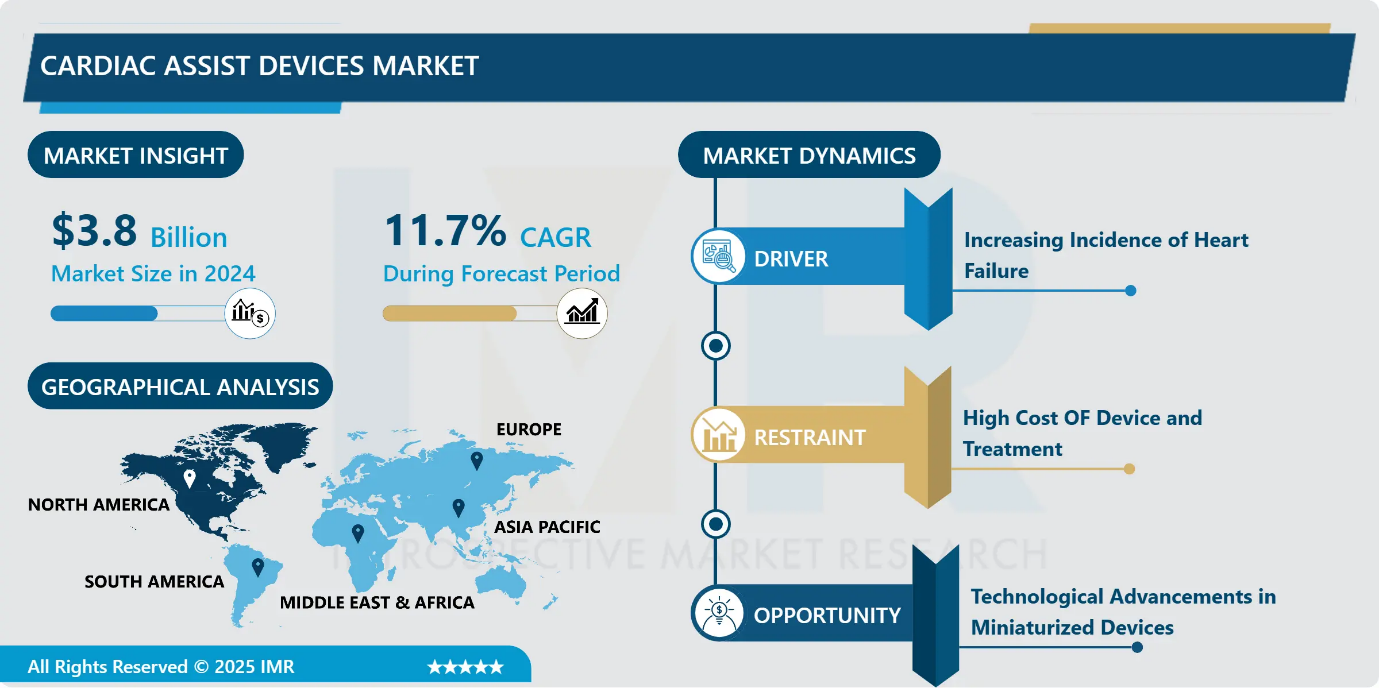
Global Cardiac Assist Devices Market Size Was Valued at USD 3.8 Billion in 2024 and is Projected to Reach USD 12.83 Billion by 2035, Growing at a CAGR of 11.7% From 2025–2035
Cardiac assist devices are mechanical devices used to support or take over the function of a failing heart. These devices have become increasingly important in treating patients with severe heart failure, especially those waiting for a heart transplant or those not eligible for one.
One of the most commonly used devices is the left ventricular assist device (LVAD), which helps the heart pump blood from the left ventricle to the rest of the body. These devices are being adopted by hospitals around the world due to their ability to improve patient survival rates and quality of life.
The growing number of people with heart diseases, especially in aging populations is driving the demand for cardiac assist devices. In addition, technological improvements have made these devices smaller more durable, and easier to implant further supporting market growth.
Hospitals and cardiac centres are key users of these devices but there is also growing interest from home-care providers especially for long-term heart failure patients.
Cardiac Assist Devices Market Growth and Trend Analysis:
Cardiac Assist Devices Market Growth Driver- Increasing Incidence of Heart Failure
-
The rising number of people suffering from heart failure and other serious cardiac conditions. Heart failure is a condition where the heart cannot pump enough blood to meet the body’s needs, and it has become a major health concern across the world. The risk factors leading to heart failure such as diabetes, obesity, high blood pressure, and smoking are also on the rise, especially in urban populations.
- Cardiac assist devices especially Left Ventricular Assist Devices (LVADs) are being widely used to help patients survive until they receive a heart transplant. Some devices are even used as destination therapy for patients who are not candidates for a transplant. The devices help to improve blood circulation, reduce hospital readmissions, and increase survival rates. Medical professionals are increasingly recommending them due to their effectiveness. The growing awareness about the benefits of these devices, combined with a rise in specialist cardiac centre’s offering such treatments, is significantly contributing to market growth.
Cardiac Assist Devices Market Limiting Factor - High Cost OF Device and Treatment
-
One of the biggest restraints in the cardiac assist device market is the high cost of both the device and the treatment process. The price of an advanced cardiac assist device can range from tens of thousands to even hundreds of thousands of dollars, depending on the brand and type. Besides the cost of the device itself, patients and hospitals must also bear the costs related to the surgery, hospitalisation, post-operative care, and long-term follow-ups. The expenses make the treatment unaffordable for many patients, particularly in developing countries or regions with limited health insurance coverage.
- In countries where health insurance systems do not cover cardiac implants or advanced cardiac care, the adoption of these devices is very low. Additionally, hospitals may hesitate to invest in such expensive equipment due to budget constraints, which affects market penetration in smaller or rural healthcare centres. Cost factor remains a significant barrier to the widespread use of cardiac assist devices worldwide.
Cardiac Assist Devices Market Expansion Opportunity - Technological Advancements in Miniaturized Devices
-
Growing opportunity in the development of smaller, smarter, and more efficient cardiac assist devices. Manufacturers are focusing on reducing the size of these devices while enhancing their functionality and durability. Miniaturized devices are easier to implant, cause fewer complications, and improve patient comfort. Some of the newer models are designed for partial assistance, which means they provide support only when the heart needs it, leading to more natural heart function and longer device life. Moreover, wireless and battery-operated devices are being developed to allow more freedom and mobility for patients, significantly improving their quality of life.
- Innovations such as magnetically levitated pumps, reduced noise levels, and longer battery backup are making these devices more patient-friendly. The improvements can attract both patients and healthcare providers, especially in developed countries where people are looking for high-quality, technologically advanced treatments. As companies continue to invest in research and development, the market is expected to benefit from new product launches and better device adoption.
Cardiac Assist Devices Market Challenge and Risk - Risk of Device-Related Complications
-
Cardiac assist devices offer life-saving support their use comes with several medical challenges. Patients implanted with these devices face risks such as infection at the surgical site, internal bleeding, and the formation of blood clots that can lead to stroke or organ damage. In some cases, there may also be issues with device malfunction or mechanical failure, which can be life-threatening if not managed promptly. The complications require close monitoring, regular check-ups, and immediate medical attention, which can be difficult in areas with limited access to healthcare facilities.
- Infections can also result from long-term device use and may require removal or replacement, adding to the patient’s burden. Doctors and patients must carefully weigh the benefits and risks before proceeding with implantation. Furthermore, not all healthcare providers are trained to manage such devices, which can impact patient outcomes. If risk is not managed properly, may lead to low confidence in cardiac assist therapies and hinder market growth, especially in resource-poor settings.
Cardiac Assist Devices Market Segment Analysis:
Cardiac Assist Devices Market is segmented based on Technology, Type, Distribution Channel, End-Users, and Region
By Type, Cardiac Assist Devices Market Segment is Expected to Dominate the Market During the Forecast Period
-
The heart uses LVADs, which are popular mechanical devices, to pump blood from the left ventricle to the body's other organs. Due to the fact that heart failure typically affects the left side of the heart first, this market segment is dominant. These devices have been shown to increase patient survival and decrease the return to hospitals.
- Patients who are waiting for heart transplants or who are unable to have transplant surgery (destination therapy) frequently utilise LVADs. Large corporations are making major investments in LVAD research and product development, including Abbott and Medtronic. Patients are finding LVADs more comfortable and accessible thanks to innovations like wireless systems and miniaturisation.
By Application, Cardiac Assist Devices Market Segment Held the Largest Share in 2024
-
The market is dominated by hospitals since so many cases of severe heart failure are treated there. These institutions are equipped with cardiac teams that are trained to monitor and implant cardiac assist devices. The patients with these devices need long-term monitoring and post-operative care, which makes hospitals the preferable option.
- New technologies such as the HeartMate 3 and Impeller heart pumps are being quickly adopted by large hospital systems and cardiac speciality centres. The use of hospital-based cardiac devices is increasing in industrialised nations due to increased government support and healthcare resources. Hospitals frequently work with device manufacturers to conduct clinical trials, giving patients access to modern technology.
Cardiac Assist Devices Market Regional Insights:
North America is Expected to Dominate the Market Over the Forecast Period
-
North America is currently the leading region in the cardiac assist devices market. This is mainly because of the high number of people suffering from heart-related conditions, such as heart failure and coronary artery disease. These health problems are common in the region due to factors like aging populations, sedentary lifestyles, unhealthy diets, and high rates of diabetes and obesity. As a result, there is a growing demand for devices that help support heart function, such as ventricular assist devices (VADs) and intra-aortic balloon pumps (IABPs).
- The region also benefits from a well-developed healthcare system, with access to advanced medical technology, experienced healthcare professionals, and high-quality hospitals. Many hospitals in North America are early adopters of new cardiac technologies and offer specialized heart care programs. The presence of major medical device companies and strong investment in research and development have helped improve the design, safety, and effectiveness of these devices.
- In addition, patients in North America are more likely to receive early diagnosis and treatment thanks to widespread awareness and better access to healthcare services. These factors all work together to make North America a leader in this market. As the need for effective heart treatments continues to grow, the demand for cardiac assist devices in this region is expected to remain strong.
Active Key Players in Cardiac Assist Devices
- Abbott Laboratories (USA)
- Abiomed, Inc. (USA)
- Apaxis Medical (Canada)
- Berlin Heart GmbH (Germany)
- BiVACOR Inc. (USA)
- Boston Scientific (USA)
- Calon Cardio Technology Ltd (UK)
- Cardiobridge GmbH (Germany)
- CardioBridge Inc. (USA)
- CH Biomedical Inc. (China)
- CorAssist Cardiovascular Ltd. (Israel)
- CorWave (France)
- Edwards Lifesciences (USA)
- Eva Medical (USA)
- Evaheart Inc. (USA)
- FineHeart SAS (France)
- Getinge AB (Sweden)
- Jarvik Heart, Inc. (USA)
- Johnson & Johnson (USA)
- Leviticus Cardio Ltd. (Israel)
- Maquet Cardiovascular (Germany)
- Medtronic (USA)
- Nipro Corporation (Japan)
- NovaPump GmbH (Germany)
- ReliantHeart Inc. (USA)
- Sunshine Heart Inc. (USA)
- SynCardia Systems LLC (USA)
- Terumo Corporation (Japan)
- Thoratec Corporation (USA)
- TransMedics, Inc. (USA)
- Other Active Players
Key Industry of the Cardiac Assist Device Market
In December 2024, Abiomed (Johnson & Johnson MedTech) U.S. FDA expanded the indications for Abiomed’s Impella 5.5 and Impella CP with Smart Assist heart pumps. These devices are now approved for use in specific paediatric patients with symptomatic acute decompensated heart failure (ADHF) and cardiogenic shock. This marks a significant advancement in paediatric cardiac care.
In March 2024, Berlin Heart GmbH collaborated with paediatric cardiac centres across Europe to expand access to its EXCOR Paediatric VAD, a life-saving system for children awaiting heart transplants. This initiative aims to reduce waiting time mortality in paediatric patients
In November 2023, Abbott Laboratories announced the expanded use of its HeartMate 3 Left Ventricular Assist Device (LVAD) to a broader class of heart failure patients following favourable results from the MOMENTUM 3 clinical trial. This expansion supports Abbott’s commitment to improving the quality of life for patients with advanced heart failure.
|
Cardiac Assist Device Market |
|||
|
Base Year: |
2024 |
Forecast Period: |
2025-2035 |
|
Historical Data: |
Market Size in 2024: |
USD 3.8 Billion |
|
|
Forecast Period 2025-35 CAGR: |
11.7% |
Market Size in 2035: |
USD 12.83 Billion |
|
Segments Covered: |
By Type |
|
|
|
By Technology |
|
||
|
By Distribution Channel |
|
||
|
By End Users |
|
||
|
By Region |
|
||
|
Growth Driver: |
|
||
|
Limiting Factor |
|
||
|
Expansion Opportunity |
|
||
|
Challenge and Risk |
|
||
|
Companies Covered in the Report: |
|
||
Chapter 1: Introduction
1.1 Scope and Coverage
Chapter 2:Executive Summary
Chapter 3: Market Landscape
3.1 Market Dynamics and Opportunity Analysis
3.1.1 Growth Drivers
3.1.2 Limiting Factors
3.1.3 Growth Opportunities
3.1.4 Challenges and Risks
3.2 Market Trend Analysis
3.3 Industry Ecosystem
3.4 Industry Value Chain Mapping
3.5 Strategic PESTLE Overview
3.6 Porter's Five Forces Framework
3.7 Regulatory Framework
3.8 Pricing Trend Analysis
3.9 Intellectual Property Review
3.10 Technology Evolution
3.11 Import-Export Analysis
3.12 Consumer Behavior Analysis
3.13 Investment Pocket Analysis
3.14 Go-To Market Strategy
Chapter 4: Cardiac Assist Devices Market by Technology (2018-2032)
4.1 Cardic Device Market Snapshot and Growth Engine
4.2 Market Overview
4.3 Ventricular Assist Devices
4.3.1 Introduction and Market Overview
4.3.2 Historic and Forecasted Market Size in Value USD and Volume Units
4.3.3 Key Market Trends, Growth Factors, and Opportunities
4.3.4 Geographic Segmentation Analysis
4.4 Implantable Cardioverter Defibrillators
4.5 Pacemakers
4.6 Total Artificial Heart
Chapter 5: Cardiac Assist Devices Market by Type (2018-2035)
5.1 Cardic Device Market Snapshot and Growth Engine
5.2 Market Overview
5.3 Left Ventricular Assist Device
5.3.1 Introduction and Market Overview
5.3.2 Historic and Forecasted Market Size in Value USD and Volume Units
5.3.3 Key Market Trends, Growth Factors, and Opportunities
5.3.4 Geographic Segmentation Analysis
5.4 Right Ventricular Assist Device
5.5 Biventricular Assist Device
Chapter 6: Cardiac Assist Devices Market by Distribution Channel (2018-2035)
6.1 Cardic Device Market Snapshot and Growth Engine
6.2 Market Overview
6.3 Online
6.3.1 Introduction and Market Overview
6.3.2 Historic and Forecasted Market Size in Value USD and Volume Units
6.3.3 Key Market Trends, Growth Factors, and Opportunities
6.3.4 Geographic Segmentation Analysis
6.4 Distributors
6.5 Gps
Chapter 7: Cardiac Assist Devices Market by End User (2018-2035)
7.1 Cardic Device Market Snapshot and Growth Engine
7.2 Market Overview
7.3 Hospitals
7.3.1 Introduction and Market Overview
7.3.2 Historic and Forecasted Market Size in Value USD and Volume Units
7.3.3 Key Market Trends, Growth Factors, and Opportunities
7.3.4 Geographic Segmentation Analysis
7.4 Surgical Centre
7.5 Others
Chapter 8: Company Profiles and Competitive Analysis
8.1 Competitive Landscape
8.1.1 Competitive Benchmarking
8.1.2 Cardic Device Market Share by Manufacturer/Service Provider(2024)
8.1.3 Industry BCG Matrix
8.1.4 PArtnerships, Mergers & Acquisitions
8.2 ABBOTT LABORATORIES (USA)
8.2.1 Company Overview
8.2.2 Key Executives
8.2.3 Company Snapshot
8.2.4 Role of the Company in the Market
8.2.5 Sustainability and Social Responsibility
8.2.6 Operating Business Segments
8.2.7 Product Portfolio
8.2.8 Business Performance
8.2.9 Recent News & Developments
8.2.10 SWOT Analysis
8.3 ABIOMED
8.4 INC. (USA)
8.5 APAXIS MEDICAL (CANADA)
8.6 BERLIN HEART GMBH (GERMANY)
8.7 BIVACOR INC. (USA)
8.8 BOSTON SCIENTIFIC (USA)
8.9 CALON CARDIO TECHNOLOGY LTD (UK)
8.10 CARDIOBRIDGE GMBH (GERMANY)
8.11 CARDIOBRIDGE INC. (USA)
8.12 CH BIOMEDICAL INC. (CHINA)
8.13 CORASSIST CARDIOVASCULAR LTD. (ISRAEL)
8.14 CORWAVE (FRANCE)
8.15 EDWARDS LIFESCIENCES (USA)
8.16 EVA MEDICAL (USA)
8.17 EVAHEART INC. (USA)
8.18 FINEHEART SAS (FRANCE)
8.19 GETINGE AB (SWEDEN)
8.20 JARVIK HEART
8.21 INC. (USA)
8.22 JOHNSON & JOHNSON (USA)
8.23 LEVITICUS CARDIO LTD. (ISRAEL)
8.24 MAQUET CARDIOVASCULAR (GERMANY)
8.25 MEDTRONIC (USA)
8.26 NIPRO CORPORATION (JAPAN)
8.27 NOVAPUMP GMBH (GERMANY)
8.28 RELIANTHEART INC. (USA)
8.29 SUNSHINE HEART INC. (USA)
8.30 SYNCARDIA SYSTEMS LLC (USA)
8.31 TERUMO CORPORATION (JAPAN)
8.32 THORATEC CORPORATION (USA)
8.33 TRANSMEDICS
8.34 INC. (USA)
8.35 AND OTHER ACTIVE PLAYERS.
Chapter 9: Global Cardiac Assist Devices Market By Region
9.1 Overview
9.2. North America Cardiac Assist Devices Market
9.2.1 Key Market Trends, Growth Factors and Opportunities
9.2.2 Top Key Companies
9.2.3 Historic and Forecasted Market Size by Segments
9.2.4 Historic and Forecast Market Size by Country
9.2.4.1 US
9.2.4.2 Canada
9.2.4.3 Mexico
9.3. Eastern Europe Cardiac Assist Devices Market
9.3.1 Key Market Trends, Growth Factors and Opportunities
9.3.2 Top Key Companies
9.3.3 Historic and Forecasted Market Size by Segments
9.3.4 Historic and Forecast Market Size by Country
9.3.4.1 Russia
9.3.4.2 Bulgaria
9.3.4.3 The Czech Republic
9.3.4.4 Hungary
9.3.4.5 Poland
9.3.4.6 Romania
9.3.4.7 Rest of Eastern Europe
9.4. Western Europe Cardiac Assist Devices Market
9.4.1 Key Market Trends, Growth Factors and Opportunities
9.4.2 Top Key Companies
9.4.3 Historic and Forecasted Market Size by Segments
9.4.4 Historic and Forecast Market Size by Country
9.4.4.1 Germany
9.4.4.2 UK
9.4.4.3 France
9.4.4.4 The Netherlands
9.4.4.5 Italy
9.4.4.6 Spain
9.4.4.7 Rest of Western Europe
9.5. Asia Pacific Cardiac Assist Devices Market
9.5.1 Key Market Trends, Growth Factors and Opportunities
9.5.2 Top Key Companies
9.5.3 Historic and Forecasted Market Size by Segments
9.5.4 Historic and Forecast Market Size by Country
9.5.4.1 China
9.5.4.2 India
9.5.4.3 Japan
9.5.4.4 South Korea
9.5.4.5 Malaysia
9.5.4.6 Thailand
9.5.4.7 Vietnam
9.5.4.8 The Philippines
9.5.4.9 Australia
9.5.4.10 New Zealand
9.5.4.11 Rest of APAC
9.6. Middle East & Africa Cardiac Assist Devices Market
9.6.1 Key Market Trends, Growth Factors and Opportunities
9.6.2 Top Key Companies
9.6.3 Historic and Forecasted Market Size by Segments
9.6.4 Historic and Forecast Market Size by Country
9.6.4.1 Turkiye
9.6.4.2 Bahrain
9.6.4.3 Kuwait
9.6.4.4 Saudi Arabia
9.6.4.5 Qatar
9.6.4.6 UAE
9.6.4.7 Israel
9.6.4.8 South Africa
9.7. South America Cardiac Assist Devices Market
9.7.1 Key Market Trends, Growth Factors and Opportunities
9.7.2 Top Key Companies
9.7.3 Historic and Forecasted Market Size by Segments
9.7.4 Historic and Forecast Market Size by Country
9.7.4.1 Brazil
9.7.4.2 Argentina
9.7.4.3 Rest of SA
Chapter 10 Analyst Viewpoint and Conclusion
Chapter 11 Our Thematic Research Methodology
11.1 Research Process
11.2 Primary Research
11.3 Secondary Research
Chapter 12 Case Study
Chapter 13 Appendix
13.1 Sources
13.2 List of Tables and figures
13.3 Short Forms and Citations
13.4 Assumption and Conversion
13.5 Disclaimer
|
Cardiac Assist Device Market |
|||
|
Base Year: |
2024 |
Forecast Period: |
2025-2035 |
|
Historical Data: |
Market Size in 2024: |
USD 3.8 Billion |
|
|
Forecast Period 2025-35 CAGR: |
11.7% |
Market Size in 2035: |
USD 12.83 Billion |
|
Segments Covered: |
By Type |
|
|
|
By Technology |
|
||
|
By Distribution Channel |
|
||
|
By End Users |
|
||
|
By Region |
|
||
|
Growth Driver: |
|
||
|
Limiting Factor |
|
||
|
Expansion Opportunity |
|
||
|
Challenge and Risk |
|
||
|
Companies Covered in the Report: |
|
||


