




Camera Module Market Synopsis:
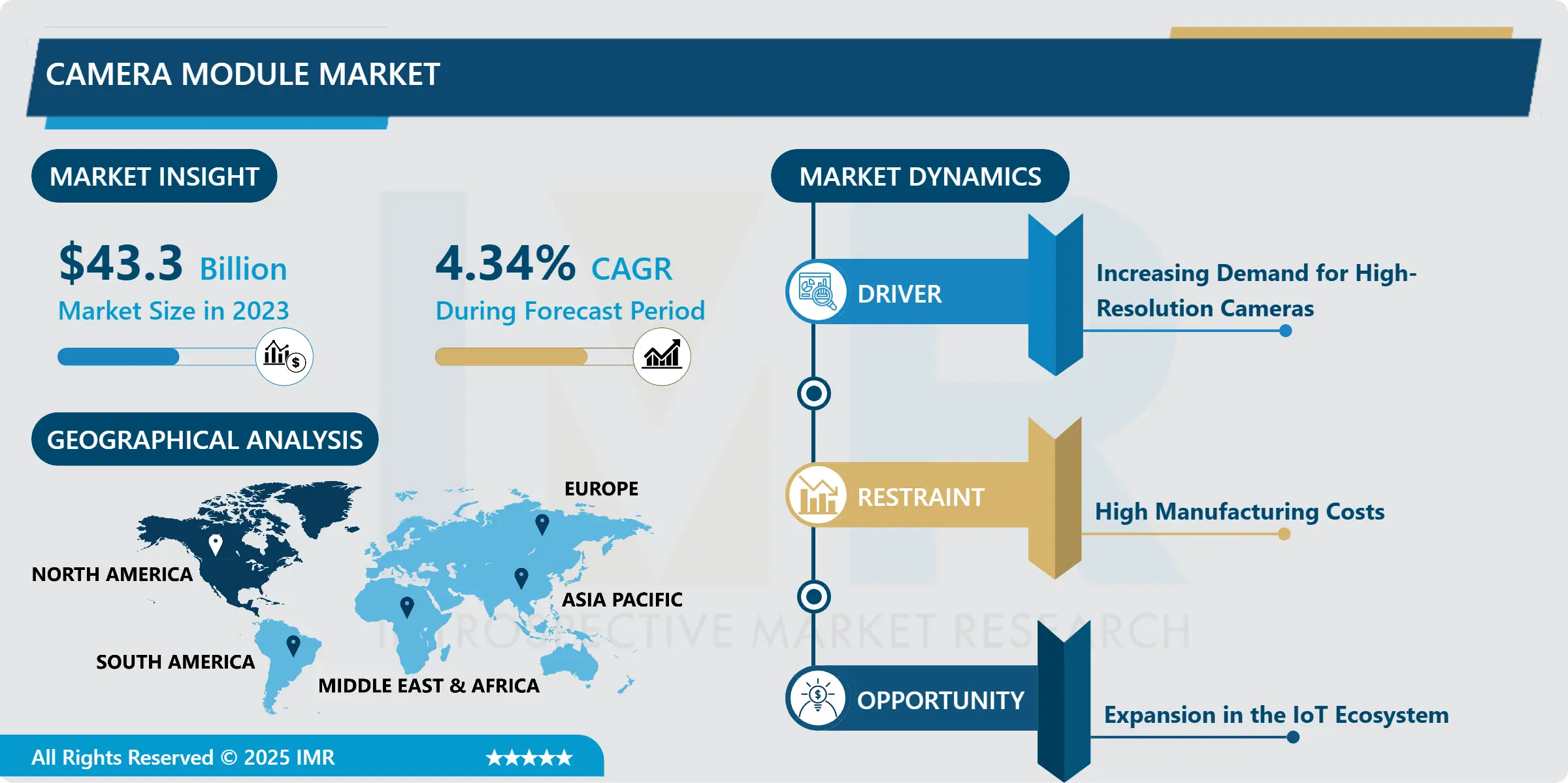
Camera Module Market Size Was Valued at USD 43.30 Billion in 2023, and is Projected to Reach USD 63.47 Billion by 2032, Growing at a CAGR of 4.34% From 2024-2032.
The camera module market refers to the industry that designs, manufactures, and supplies integrated camera systems used in various electronic devices, including smartphones, tablets, laptops, automotive applications, security systems, and medical devices. These modules typically consist of components like image sensors, lenses, and processing units, enabling devices to capture visual data. As demand for high-quality imaging, facial recognition, and augmented reality grows across consumer electronics, automotive, and other industries, the camera module market has experienced significant growth, driven by advancements in sensor technology, miniaturization, and the increasing integration of cameras in diverse applications..
Camera Module market has been developed rapidly due to the growing need for advanced imaging solutions in such devices as mobiles, tablets, wearable devices, cars, and security systems. Huge pop up of mobile phone use and social media websites which are based on content sharing can be attributed to this demand. As users want the camera to be better specifically on the smartphone manufacturers are trying to add a better camera including multiple lenses, high resolution, better low light, pass and better AI processing.
Automotive is also emerging as one of the key application segments in camera modules to support advanced safety features active in self-driving cars and facilitated by ADAS systems. Further, the increasing security and surveillance requirements in the public and private domain have also created increased demand for camera modules of superior quality. The increasing market consolidation is placing more demands on size and price, which is pushing forward breakthroughs in both the architectural and production of camera modules. Nevertheless, owing to its expanding quantity of uses in different industries along with the improvement in technology, the Camera Module market throughout the world is expected to experience a consistent growth in the future period.
Camera Module Market Trend Analysis:
Integration of Advanced Camera Modules in Consumer Electronics
-
Camera module is an essential part of most consumer electronics, especially portable devices, and the increasing tendency is the use of camera modules in smartphones. Since photography and video quality have gained more value to the users, the Smartphone makers have been innovating on their phones’ cameras. The following have resulted in the use of improved camera faculties that add compile resolution, larger sensor area, and new features such as optical zoom, improved image stabilization, and on-camera artificial intelligence. It paves way for capabilities synonymous with professional devices, where smartphones enables enhanced photography and videography as per the need of the users who rely on these devices for content creation to sharing on social media platform or even as individual documentation platforms.
- Smart tablets, notebooks, wearables, and security systems are also adapting technological advanced cameras to help satisfy advanced image applications. In tablets and laptops, the updated camera module offers better video calling capabilities, and in wearables, such as smart glasses and fitness trackers, miniaturized camera modules are used for AR. Furthermore, security systems like smart home camera are also using a better camera module for surveillance, night vision, and real-time monitoring. It is a testament to the scale of change being brought about by these advanced camera technologies that it’s redesigning the face of consumer electronics requirements across many industries.
Growth in Consumer Electronics and AR/VR Applications
-
The most striking trend for the camera module market is the growth of adopting enhanced camera in smartphone, tablets and other consumer electronics. While newcomers in the production of smartphones step by step enter the market and new models appear the emphasis is made on improving the quality of the imagery. This has led to the combination of multi-lens camera arrays, Artificial Intelligence incorporated systems, and optical zoom systems, which demand considerably more compact but significantly superior camera modules.
- In addition, an increasing number of applications of augmented reality (AR) and virtual reality (VR) in consumer electronics, games and entertainment has especially increased the demand for high end camera module. These technologies necessitate accurate, real-time imaging in order to boost the functionality of the interfaces involved – such as producing navigation tools for AR applications or designing immersive digital environments that one could actually interact with in VR. The future growth of camera modules will be in its ability provide the necessary visual data for future applications in AR and VR as the demand for those technologies increases. As depth sensing and motion tracking are introduced into more products and higher-definition lenses become widely used for photography, there is a more significant demand for higher-level camera modules, a good opportunity for camera module makers.
Camera Module Market Segment Analysis:
Camera Module Market Segmented on the basis of Component, Application, and Region
By Component, Image Sensor segment is expected to dominate the market during the forecast period
-
Image sensors are one of the key components of modules responsible for capturing light and transforming it into digital information, so they determine the main characteristics of a camera module. It contributes greatly to how such factors as resolution, sensitivity and color are going to be displayed. The number one market driver is the need for better quality image sensing that has been established in almost all fields but particularly mobile phones, electronic devices, and automotive. Image sensors plays essential role of capturing high resolution and apt images; that has proves the escalated usage of advanced technologies like CMOS and CCD.
- With the growing advancements in automated cameras and computational photo, the need for image sensors with superior performance is increasing at a faster pace. The appearance of such options as portrait mode, night time photography, and artificial intelligence improvements requires more advanced sensors to process data quickly. Another factor that triggers the usage of image sensors is automotive applications including ADAS, and automated vehicles. These applications demand application specific sensors with high resolution and short response time to allow safe and accurate positioning of the actuators.
By Application, Mobile segment expected to held the largest share
-
The mobile is one of the largest and a fast-evolving segment of camera module mainly attributed by the increasing customer appetite for advanced smart phone cameras. As smartphones are used as daily companion, people demand their phones to provide the best in terms of photographing. With integration of wide lenses, mobile camera modules incorporate features such as wide lens, optical zoom, not to mention the artificial intelligence in processing images resulting to high quality photos and high-definition videos. Implementing multiple perspectives into mobile brands camera modules are growing in complexity, allowing users to switch and take excellent photographs in many settings, including dark and fast-moving events.
- Optical advancements appear to be crucial in improving the whole smartphone experience through camera module advances. Merely adding to biographical modes that soften the background for a business like look and night photography that is the ability to capture images even in poorly lit areas has set a higher standard in mobile imaging. In addition, 3D imaging and augmented reality (AR) applications are challenging the definition of what the Mobile camera can achieve, which makes the Camera module a still more essential part. Since competition is increasing in the smartphone industry, advanced camera development remains at the forefront of innovation for the mobile camera module market.
Camera Module Market Regional Insights:
North America is Expected to Dominate the Market Over the Forecast period
-
Continued growth in the camera module market in North America is attributed by the enhanced development of the latest commercially of smartphone technology by giants such as Apple, Google and Qualcomm. Market evolution is driven directly by the continuing raised demand for super premium smartphones such as smartphones with new and distinctive CAMERAMOD, including multiple lenses, optical zoom, and upgraded image resolution. Because of improved smartphone technology with better imaging capabilities, North America is expected to be an active participant in the design and development of advanced camera module products like AI-assisted and better low light performance cameras.
- Also, the automotive industry in North America is developing steadily; camera module founds its place in connectivity, self-driving cars, ADAS, safety attributes like lane-keeping help, parking assist, collision detection, etc. The key developments required to convey these automotive technologies are the promotion of the natural language processing models and camera module demand is high to support these technologies. The market is also expanding due to new developments in imaging sensors to suit the automobile industry in the region. Analysts has found that as the autonomous driving technologies and safety systems are getting advanced, North America is likely to sustain the global market share of the camera modules.
Active Key Players in the Camera Module Market
-
Chicony Electronics Co. Ltd
- Cowell E Holdings Inc.
- Fujifilm Corporation
- LG Innotek Co. Ltd
- Samsung Electro-Mechanics Co. Ltd
- Primax Electronics Ltd
- LuxVisions Innovation Limited (Lite-On Technology Corporation)
- Sharp Corporation
- Sony Group Corporation
- STMicroelectronics NV
- Sunny Optical Technology (Group) Company Limited
- AMS OSRM AG
- On Semiconductor (Semiconductor Components Industries LLC)
- OFILM Group Co. Ltd
- OmniVision Technologies Inc.
- Other Active Players
|
Global Camera Module Market |
|||
|
Base Year: |
2023 |
Forecast Period: |
2024-2032 |
|
Historical Data: |
2017 to 2023 |
Market Size in 2023: |
USD 43.30 Billion |
|
Forecast Period 2024-32 CAGR: |
4.34% |
Market Size in 2032: |
USD 63.47 Billion |
|
Segments Covered: |
By Component |
|
|
|
By Application |
|
||
|
By Region |
|
||
|
Key Market Drivers: |
|
||
|
Key Market Restraints: |
|
||
|
Key Opportunities: |
|
||
|
Companies Covered in the report: |
|
||
Chapter 1: Introduction
1.1 Scope and Coverage
Chapter 2:Executive Summary
Chapter 3: Market Landscape
3.1 Market Dynamics
3.1.1 Drivers
3.1.2 Restraints
3.1.3 Opportunities
3.1.4 Challenges
3.2 Market Trend Analysis
3.3 PESTLE Analysis
3.4 Porter's Five Forces Analysis
3.5 Industry Value Chain Analysis
3.6 Ecosystem
3.7 Regulatory Landscape
3.8 Price Trend Analysis
3.9 Patent Analysis
3.10 Technology Evolution
3.11 Investment Pockets
3.12 Import-Export Analysis
Chapter 4: Camera Module Market by Component
4.1 Camera Module Market Snapshot and Growth Engine
4.2 Camera Module Market Overview
4.3 Image Sensor
4.3.1 Introduction and Market Overview
4.3.2 Historic and Forecasted Market Size in Value USD and Volume Units (2017-2032F)
4.3.3 Key Market Trends, Growth Factors and Opportunities
4.3.4 Image Sensor: Geographic Segmentation Analysis
4.4 Lens
4.4.1 Introduction and Market Overview
4.4.2 Historic and Forecasted Market Size in Value USD and Volume Units (2017-2032F)
4.4.3 Key Market Trends, Growth Factors and Opportunities
4.4.4 Lens: Geographic Segmentation Analysis
4.5 Camera Module Assembly and VCM Suppliers (AF & OIS)
4.5.1 Introduction and Market Overview
4.5.2 Historic and Forecasted Market Size in Value USD and Volume Units (2017-2032F)
4.5.3 Key Market Trends, Growth Factors and Opportunities
4.5.4 Camera Module Assembly and VCM Suppliers (AF & OIS): Geographic Segmentation Analysis
Chapter 5: Camera Module Market by Application
5.1 Camera Module Market Snapshot and Growth Engine
5.2 Camera Module Market Overview
5.3 Mobile
5.3.1 Introduction and Market Overview
5.3.2 Historic and Forecasted Market Size in Value USD and Volume Units (2017-2032F)
5.3.3 Key Market Trends, Growth Factors and Opportunities
5.3.4 Mobile: Geographic Segmentation Analysis
5.4 Consumer Electronics
5.4.1 Introduction and Market Overview
5.4.2 Historic and Forecasted Market Size in Value USD and Volume Units (2017-2032F)
5.4.3 Key Market Trends, Growth Factors and Opportunities
5.4.4 Consumer Electronics : Geographic Segmentation Analysis
Chapter 6: Company Profiles and Competitive Analysis
6.1 Competitive Landscape
6.1.1 Competitive Benchmarking
6.1.2 Camera Module Market Share by Manufacturer (2023)
6.1.3 Industry BCG Matrix
6.1.4 Heat Map Analysis
6.1.5 Mergers and Acquisitions
6.2 CHICONY ELECTRONICS CO. LTD
6.2.1 Company Overview
6.2.2 Key Executives
6.2.3 Company Snapshot
6.2.4 Role of the Company in the Market
6.2.5 Sustainability and Social Responsibility
6.2.6 Operating Business Segments
6.2.7 Product Portfolio
6.2.8 Business Performance
6.2.9 Key Strategic Moves and Recent Developments
6.2.10 SWOT Analysis
6.3 COWELL E HOLDINGS INC.
6.4 FUJIFILM CORPORATION
6.5 LG INNOTEK CO. LTD
6.6 SAMSUNG ELECTRO-MECHANICS CO. LTD
6.7 PRIMAX ELECTRONICS LTD
6.8 LUXVISIONS INNOVATION LIMITED (LITE-ON TECHNOLOGY CORPORATION)
6.9 SHARP CORPORATION
6.10 SONY GROUP CORPORATION
6.11 STMICROELECTRONICS NV
6.12 SUNNY OPTICAL TECHNOLOGY (GROUP) COMPANY LIMITED
6.13 AMS OSRM AG
6.14 ON SEMICONDUCTOR (SEMICONDUCTOR COMPONENTS INDUSTRIES LLC)
6.15 OFILM GROUP CO. LTD
6.16 OMNIVISION TECHNOLOGIES INC
6.17 OTHER ACTIVE PLAYERS
Chapter 7: Global Camera Module Market By Region
7.1 Overview
7.2. North America Camera Module Market
7.2.1 Key Market Trends, Growth Factors and Opportunities
7.2.2 Top Key Companies
7.2.3 Historic and Forecasted Market Size by Segments
7.2.4 Historic and Forecasted Market Size By Component
7.2.4.1 Image Sensor
7.2.4.2 Lens
7.2.4.3 Camera Module Assembly and VCM Suppliers (AF & OIS)
7.2.5 Historic and Forecasted Market Size By Application
7.2.5.1 Mobile
7.2.5.2 Consumer Electronics
7.2.6 Historic and Forecast Market Size by Country
7.2.6.1 US
7.2.6.2 Canada
7.2.6.3 Mexico
7.3. Eastern Europe Camera Module Market
7.3.1 Key Market Trends, Growth Factors and Opportunities
7.3.2 Top Key Companies
7.3.3 Historic and Forecasted Market Size by Segments
7.3.4 Historic and Forecasted Market Size By Component
7.3.4.1 Image Sensor
7.3.4.2 Lens
7.3.4.3 Camera Module Assembly and VCM Suppliers (AF & OIS)
7.3.5 Historic and Forecasted Market Size By Application
7.3.5.1 Mobile
7.3.5.2 Consumer Electronics
7.3.6 Historic and Forecast Market Size by Country
7.3.6.1 Russia
7.3.6.2 Bulgaria
7.3.6.3 The Czech Republic
7.3.6.4 Hungary
7.3.6.5 Poland
7.3.6.6 Romania
7.3.6.7 Rest of Eastern Europe
7.4. Western Europe Camera Module Market
7.4.1 Key Market Trends, Growth Factors and Opportunities
7.4.2 Top Key Companies
7.4.3 Historic and Forecasted Market Size by Segments
7.4.4 Historic and Forecasted Market Size By Component
7.4.4.1 Image Sensor
7.4.4.2 Lens
7.4.4.3 Camera Module Assembly and VCM Suppliers (AF & OIS)
7.4.5 Historic and Forecasted Market Size By Application
7.4.5.1 Mobile
7.4.5.2 Consumer Electronics
7.4.6 Historic and Forecast Market Size by Country
7.4.6.1 Germany
7.4.6.2 UK
7.4.6.3 France
7.4.6.4 The Netherlands
7.4.6.5 Italy
7.4.6.6 Spain
7.4.6.7 Rest of Western Europe
7.5. Asia Pacific Camera Module Market
7.5.1 Key Market Trends, Growth Factors and Opportunities
7.5.2 Top Key Companies
7.5.3 Historic and Forecasted Market Size by Segments
7.5.4 Historic and Forecasted Market Size By Component
7.5.4.1 Image Sensor
7.5.4.2 Lens
7.5.4.3 Camera Module Assembly and VCM Suppliers (AF & OIS)
7.5.5 Historic and Forecasted Market Size By Application
7.5.5.1 Mobile
7.5.5.2 Consumer Electronics
7.5.6 Historic and Forecast Market Size by Country
7.5.6.1 China
7.5.6.2 India
7.5.6.3 Japan
7.5.6.4 South Korea
7.5.6.5 Malaysia
7.5.6.6 Thailand
7.5.6.7 Vietnam
7.5.6.8 The Philippines
7.5.6.9 Australia
7.5.6.10 New Zealand
7.5.6.11 Rest of APAC
7.6. Middle East & Africa Camera Module Market
7.6.1 Key Market Trends, Growth Factors and Opportunities
7.6.2 Top Key Companies
7.6.3 Historic and Forecasted Market Size by Segments
7.6.4 Historic and Forecasted Market Size By Component
7.6.4.1 Image Sensor
7.6.4.2 Lens
7.6.4.3 Camera Module Assembly and VCM Suppliers (AF & OIS)
7.6.5 Historic and Forecasted Market Size By Application
7.6.5.1 Mobile
7.6.5.2 Consumer Electronics
7.6.6 Historic and Forecast Market Size by Country
7.6.6.1 Turkiye
7.6.6.2 Bahrain
7.6.6.3 Kuwait
7.6.6.4 Saudi Arabia
7.6.6.5 Qatar
7.6.6.6 UAE
7.6.6.7 Israel
7.6.6.8 South Africa
7.7. South America Camera Module Market
7.7.1 Key Market Trends, Growth Factors and Opportunities
7.7.2 Top Key Companies
7.7.3 Historic and Forecasted Market Size by Segments
7.7.4 Historic and Forecasted Market Size By Component
7.7.4.1 Image Sensor
7.7.4.2 Lens
7.7.4.3 Camera Module Assembly and VCM Suppliers (AF & OIS)
7.7.5 Historic and Forecasted Market Size By Application
7.7.5.1 Mobile
7.7.5.2 Consumer Electronics
7.7.6 Historic and Forecast Market Size by Country
7.7.6.1 Brazil
7.7.6.2 Argentina
7.7.6.3 Rest of SA
Chapter 8 Analyst Viewpoint and Conclusion
8.1 Recommendations and Concluding Analysis
8.2 Potential Market Strategies
Chapter 9 Research Methodology
9.1 Research Process
9.2 Primary Research
9.3 Secondary Research
|
Global Camera Module Market |
|||
|
Base Year: |
2023 |
Forecast Period: |
2024-2032 |
|
Historical Data: |
2017 to 2023 |
Market Size in 2023: |
USD 43.30 Billion |
|
Forecast Period 2024-32 CAGR: |
4.34% |
Market Size in 2032: |
USD 63.47 Billion |
|
Segments Covered: |
By Component |
|
|
|
By Application |
|
||
|
By Region |
|
||
|
Key Market Drivers: |
|
||
|
Key Market Restraints: |
|
||
|
Key Opportunities: |
|
||
|
Companies Covered in the report: |
|
||


