




Key Market Highlights
Behavioral Health Market Size Was Valued at USD 205.09 Billion in 2024, and is Projected to Reach USD 299.43 Billion by 2035, Growing at a CAGR of 3.50% from 2025-2035.
- Market Size in 2024: USD 205.09 Billion
- Projected Market Size by 2035: USD 299.43 Billion
- CAGR (2025–2035): 3.50%
- Leading Market in 2024: North America
- Fastest-Growing Market: Asia-Pacific
- By Disorder: The Anxiety Disorders segment is anticipated to lead the market by accounting for 28.89% of the market share throughout the forecast period.
- By Setting of Care: The Hospitals segment is expected to capture 27.45% of the market share, thereby maintaining its dominance over the forecast period.
- By Region: North America region is projected to hold 31.30% of the market share during the forecast period.
- Active Players: Acadia Healthcare (U.S.), American Addiction Centers (U.S.), Beacon Health Strategies (U.S.), BHG Holdings, LLC (U.S.), Centers for Behavioral Health (U.S.), Other Active Players, and Other Active Players.
Behavioral Health Market Synopsis:
Behavioral health refers to a person’s emotional, psychological, and social well-being, including mental health conditions and substance use disorders. The behavioral health market represents the network of services that support prevention, diagnosis, treatment, and long-term recovery. The market scenario is driven by rising cases of anxiety, depression, addiction, and stress-related disorders across all age groups. Growing awareness, reduced stigma, and better insurance coverage are encouraging more people to seek professional care. The present market condition shows strong demand for accessible services, supported by the rapid growth of teletherapy, digital platforms, and community-based programs. Behavioral health is now recognized as a vital part of overall healthcare.
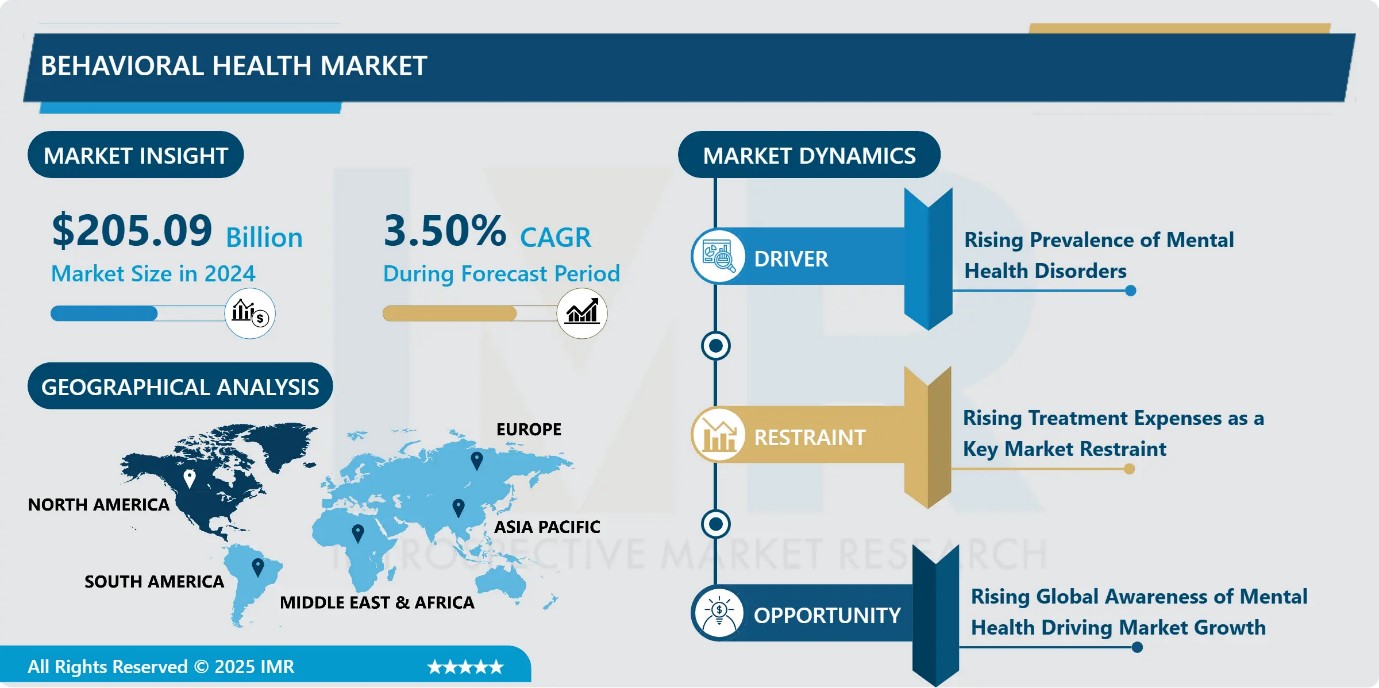
Behavioral Health Market Dynamics and Trend Analysis:
Behavioral Health Market Growth Driver
Rising Prevalence of Mental Health Disorders
- The growing burden of mental health disorders is playing a major role in the expansion of the behavioral health services market. Rising cases of stress, trauma, substance abuse, and unhealthy lifestyles have increased the occurrence of anxiety, depression, eating disorders, and post-traumatic stress disorder. In the United States, government data for 2022 shows that around 59.3 million adults, nearly one out of every four, were living with a mental illness. During the same year, about 48.7 million people aged 12 and above, or 17.3% of the population, were affected by substance use disorders.
- In India, studies indicate that nearly 15% of the population experiences some form of mental health condition. Increasing awareness, reduced social stigma, and better access to care are encouraging more individuals to seek professional help, which is steadily strengthening demand for behavioral health services nationwide.
Behavioral Health Market Limiting Factor
Rising Treatment Expenses as a Key Market Restraint
- The high cost of treatment is one of the key factors limiting the growth of the behavioral health market. Mental health conditions often require long-term therapy, regular consultations, medication, and in some cases rehabilitation, which increases the overall financial burden on patients. Even though insurance coverage for mental healthcare is legally required in the U.S., many individuals continue to face high out-of-pocket expenses. In 2022, around 11.1% of adults with mental illness had no insurance coverage, making professional care unaffordable for a large portion of the population. High therapy costs, limited reimbursement, and financial constraints, particularly in rural areas, continue to restrict access to behavioral health services.
Behavioral Health Market Expansion Opportunity
Rising Global Awareness of Mental Health Driving Market Growth
- Increasing awareness of mental health worldwide offers a major growth opportunity for the behavioral health market. Media campaigns, public figures sharing experiences, and government initiatives are reducing stigma and encouraging open discussions. Global events such as Mental Health Awareness Month reach millions annually, while the COVID-19 pandemic and social challenges have highlighted mental well-being. Studies indicate that around 50–60% of adults in developed countries now recognize the importance of mental health and are seeking professional care.
- The rising use of online counseling, telehealth, mobile apps, and digital mental health platforms is expanding access, particularly in rural and underserved regions. Evidence-based therapies like Cognitive Behavioral Therapy (CBT) and Dialectical Behavior Therapy (DBT), supported by health IT and virtual care, are improving outcomes and driving global market growth.
Behavioral Health Market Challenge and Risk
Shortage of Skilled Mental Health Professionals
- The behavioral health market faces significant challenges due to the shortage of trained mental health professionals. The growing number of people with mental illness and substance use disorders has increased the demand for care, while the availability of psychiatrists, psychologists, counselors, and therapists remains limited. As of December 2023, nearly 169 million people in the U.S. lived in areas classified as having a shortage of mental health professionals, highlighting a major gap in service availability. This uneven distribution, especially in rural and underserved regions, restricts timely access to care, increases patient wait times, and places additional pressure on existing providers, slowing the overall growth of the behavioral health market.
Behavioral Health Market Trend
Shift Toward Digital Tools in Behavioral Health
- The behavioral health market is increasingly adopting digital tools due to their convenience, cost benefits, and improved patient monitoring. In the U.S., healthcare providers are integrating Electronic Health Records (EHRs) and digital platforms to enhance service delivery; for instance, in July 2023, Universal Health Services implemented Oracle’s EHR across its behavioral health facilities. Teletherapy use has risen significantly, with reports showing more than a 50% increase in India over the past year.
- In Spain, tele-home care for children and families was about 9% less expensive than traditional hospital treatment. Digital tools including mobile apps, virtual reality therapies, and AI-based diagnostic insights are improving access to care, especially in rural areas, while allowing providers to track patient outcomes more effectively. These innovations are shaping the behavioral health sector and driving market growth globally.
Behavioral Health Market Segment Analysis:
Market is segmented based on Type Disorder, Service, Setting of care, and Region.
By Disorder, Anxiety disorder segment is expected to dominate the market with around 28.89% share during the forecast period.
- In 2024, the anxiety disorder segment led the behavioral health market, accounting for a 28.89% revenue share, and is expected to grow at the fastest rate during the forecast period. This segment includes generalized anxiety disorder (GAD), panic disorder, social anxiety disorder, and specific phobias. Its growth is driven by rising stress from academic, professional, and financial pressures, greater public awareness of mental health, and reduced stigma around seeking care. Digital tools, such as mobile apps for mood tracking, guided meditation, and cognitive-behavioral therapy, have improved accessibility and convenience. For example, AbleTo, Inc. offers a three-minute assessment tool for anxiety and depression.
- The substance disorder segment, which includes alcohol, opioid, and drug abuse, is also expected to grow strongly. Rising prevalence among young adults, supportive government initiatives, telehealth adoption, and digital therapeutics like the FDA-approved reSET app are increasing access and treatment effectiveness, further driving market growth.
By Setting of Care, Hospital is expected to dominate with close to 27.45% market share during the forecast period.
- In 2024, hospitals dominated the global behavioral health market, contributing around 27.45% of total revenue, due to their capacity to provide emergency care, inpatient treatment, and comprehensive psychiatric services. Increased investments and adoption of behavioral health software have further strengthened this segment. Meanwhile, online platforms and virtual care are growing rapidly, driven by rising mental health awareness, smartphone penetration, and the demand for convenient, affordable care. The digital psychotherapeutics market is expected to grow at a strong CAGR over the coming years. These trends highlight hospitals’ continued importance alongside the fast expansion of digital and remote behavioral health services.
Behavioral Health Market Regional Insights:
North America region is estimated to lead the market with around 31.30% share during the forecast period.
- The global behavioral health market is segmented into North America, Europe, Asia-Pacific, Middle East & Africa, and Latin America. North America remains the leading regional market, supported by the high burden of anxiety, depression, and substance use disorders across the population. In 2024, the region generated around 31.30% of total revenue from behavioral health software and services. Market leadership is mainly driven by strong reimbursement frameworks, early adoption of digital health technologies, widespread use of integrated electronic health records, and continuous government funding for mental health programs. The U.S. contributes the largest share due to high healthcare spending and favorable regulatory support.
- Asia-Pacific is projected to record the highest growth rate from 2025 to 2035, owing to rising mental health awareness, government-led digital health initiatives, expanding telehealth access, and improving healthcare infrastructure across emerging economies such as China and India.
Behavioral Health Market Active Players:
- Acadia Healthcare (U.S.)
- American Addiction Centers (U.S.)
- Beacon Health Strategies (U.S.)
- BHG Holdings, LLC (U.S.)
- Centers for Behavioral Health (U.S.)
- CuraLinc Healthcare (U.S.)
- EPIC Behavioral Healthcare (U.S.)
- HCA Healthcare (U.S.)
- Holmusk (Singapore / U.S.)
- Integrated Behavioral Health (U.S.)
- Magellan Health Inc. (U.S.)
- North Range Behavioral Health (U.S.)
- Promises Behavioral Health (U.S.)
- Sevita (U.S.)
- Universal Health Services, Inc. (U.S.)Other Active Players
Key Industry Developments in the Behavioral Health Market:
- In May 2025, CuraLinc Healthcare acquired CorpCare Associates’ employee assistance program (EAP), enhancing its mental health and wellbeing offerings. Backed by Lightyear Capital, the acquisition aims to provide clients with expanded resources, innovative capabilities, and high-impact, advocacy-based support.
- In November 2025, Magellan Behavioral Health of Pennsylvania began operations as the new HealthChoices BH-MCO, providing behavioral health services in Somerset and Bedford Counties. This marks an expansion of managed behavioral healthcare services in the region.
Technical Innovations and Digital Integration Driving Growth in the Global Behavioral Health Market
- The behavioral health market is driven by technological innovations and digital healthcare integration. Key tools include electronic health records (EHRs), telehealth platforms, mobile mental health applications, and data analytics for patient monitoring and treatment personalization. Digital therapeutics use cognitive-behavioral therapy (CBT), mindfulness, and virtual reality interventions for anxiety, depression, PTSD, and substance use disorders. Health Information Technology (HIT) supports care coordination, crisis intervention, and policy development.
- Cloud-based and software-as-a-service (SaaS) solutions improve scalability and interoperability across hospitals, clinics, and remote care providers. Emerging digital biomarkers and machine learning tools enable early detection and real-time outcome tracking. These technologies enhance treatment access, operational efficiency, and care quality, supporting growth in both developed and emerging markets.
|
Behavioral Health Market |
|||
|
Base Year: |
2024 |
Forecast Period: |
2025-2035 |
|
Historical Data: |
2018 to 2023 |
Market Size in 2024: |
USD 205.09 Bn. |
|
Forecast Period 2025-32 CAGR: |
3.50% |
Market Size in 2035: |
USD 299.43 Bn. |
|
Segments Covered: |
By Disorder Type |
|
|
|
By Setting of Care
|
|
||
|
By Service Type |
|
||
|
By Region |
|
||
|
Growth Driver: |
|
||
|
Limiting Factor |
|
||
|
Expansion Opportunity |
|
||
|
Challenge and Risk |
|
||
|
Companies Covered in the Report: |
|
||
Chapter 1: Introduction
1.1 Scope and Coverage
Chapter 2:Executive Summary
Chapter 3: Market Landscape
3.1 Market Dynamics and Opportunity Analysis
3.1.1 Growth Drivers
3.1.2 Limiting Factors
3.1.3 Growth Opportunities
3.1.4 Challenges and Risks
3.2 Market Trend Analysis
3.3 Industry Ecosystem
3.4 Industry Value Chain Mapping
3.5 Strategic PESTLE Overview
3.6 Porter's Five Forces Framework
3.7 Regulatory Framework
3.8 Pricing Trend Analysis
3.9 Intellectual Property Review
3.10 Technology Evolution
3.11 Import-Export Analysis
3.12 Consumer Behavior Analysis
3.13 Investment Pocket Analysis
3.14 Go-To Market Strategy
Chapter 4: Behavioral Health Market by Disorder Type (2018-2035)
4.1 Behavioral Health Market Snapshot and Growth Engine
4.2 Market Overview
4.3 Anxiety Disorders
4.3.1 Introduction and Market Overview
4.3.2 Historic and Forecasted Market Size in Value USD and Volume Units
4.3.3 Key Market Trends, Growth Factors, and Opportunities
4.3.4 Geographic Segmentation Analysis
4.4 Mood Disorders
4.5 Hyperactivity Disorder (ADHD)
4.6 Schizophrenia & Other Psychotic Disorders
4.7 Post-Traumatic Stress Disorder (PTSD)
4.8 Eating Disorders
4.9 Obsessive-Compulsive & Related Disorders
4.10 Sleep Disorders
4.11 Others
Chapter 5: Behavioral Health Market by Service Type (2018-2035)
5.1 Behavioral Health Market Snapshot and Growth Engine
5.2 Market Overview
5.3 Inpatient Treatment Services
5.3.1 Introduction and Market Overview
5.3.2 Historic and Forecasted Market Size in Value USD and Volume Units
5.3.3 Key Market Trends, Growth Factors, and Opportunities
5.3.4 Geographic Segmentation Analysis
5.4 Psychiatric Hospitals
5.5 Social Work & Housing Support
Chapter 6: Behavioral Health Market by Setting of Care (2018-2035)
6.1 Behavioral Health Market Snapshot and Growth Engine
6.2 Market Overview
6.3 Hospitals
6.3.1 Introduction and Market Overview
6.3.2 Historic and Forecasted Market Size in Value USD and Volume Units
6.3.3 Key Market Trends, Growth Factors, and Opportunities
6.3.4 Geographic Segmentation Analysis
6.4 Outpatient Clinics
6.5 Homecare Settings
6.6 Online Platforms
Chapter 7: Company Profiles and Competitive Analysis
7.1 Competitive Landscape
7.1.1 Competitive Benchmarking
7.1.2 Behavioral Health Market Share by Manufacturer/Service Provider(2024)
7.1.3 Industry BCG Matrix
7.1.4 PArtnerships, Mergers & Acquisitions
7.2 ACADIA HEALTHCARE (USA)
7.2.1 Company Overview
7.2.2 Key Executives
7.2.3 Company Snapshot
7.2.4 Role of the Company in the Market
7.2.5 Sustainability and Social Responsibility
7.2.6 Operating Business Segments
7.2.7 Product Portfolio
7.2.8 Business Performance
7.2.9 Recent News & Developments
7.2.10 SWOT Analysis
7.3 AMERICAN ADDICTION CENTERS (USA)
7.4 BEACON HEALTH STRATEGIES (USA)
7.5 BHG HOLDINGS
7.6 LLC (USA)
7.7 CENTERS FOR BEHAVIORAL HEALTH (USA)
7.8 CURALINC HEALTHCARE (USA)
7.9 EPIC BEHAVIORAL HEALTHCARE (USA)
7.10 HCA HEALTHCARE (USA)
7.11 HOLMUSK (SINGAPORE/USA)
7.12 INTEGRATED BEHAVIORAL HEALTH (USA)
7.13 MAGELLAN HEALTH INC. (USA)
7.14 NORTH RANGE BEHAVIORAL HEALTH (USA)
7.15 PROMISES BEHAVIORAL HEALTH (USA)
7.16 SEVITA (USA)
7.17 UNIVERSAL HEALTH SERVICES
7.18 INC. (USA)
7.19 AND OTHER ACTIVE PLAYERS
Chapter 8: Global Behavioral Health Market By Region
8.1 Overview
8.2. North America Behavioral Health Market
8.2.1 Key Market Trends, Growth Factors and Opportunities
8.2.2 Top Key Companies
8.2.3 Historic and Forecasted Market Size by Segments
8.2.4 Historic and Forecast Market Size by Country
8.2.4.1 US
8.2.4.2 Canada
8.2.4.3 Mexico
8.3. Eastern Europe Behavioral Health Market
8.3.1 Key Market Trends, Growth Factors and Opportunities
8.3.2 Top Key Companies
8.3.3 Historic and Forecasted Market Size by Segments
8.3.4 Historic and Forecast Market Size by Country
8.3.4.1 Russia
8.3.4.2 Bulgaria
8.3.4.3 The Czech Republic
8.3.4.4 Hungary
8.3.4.5 Poland
8.3.4.6 Romania
8.3.4.7 Rest of Eastern Europe
8.4. Western Europe Behavioral Health Market
8.4.1 Key Market Trends, Growth Factors and Opportunities
8.4.2 Top Key Companies
8.4.3 Historic and Forecasted Market Size by Segments
8.4.4 Historic and Forecast Market Size by Country
8.4.4.1 Germany
8.4.4.2 UK
8.4.4.3 France
8.4.4.4 The Netherlands
8.4.4.5 Italy
8.4.4.6 Spain
8.4.4.7 Rest of Western Europe
8.5. Asia Pacific Behavioral Health Market
8.5.1 Key Market Trends, Growth Factors and Opportunities
8.5.2 Top Key Companies
8.5.3 Historic and Forecasted Market Size by Segments
8.5.4 Historic and Forecast Market Size by Country
8.5.4.1 China
8.5.4.2 India
8.5.4.3 Japan
8.5.4.4 South Korea
8.5.4.5 Malaysia
8.5.4.6 Thailand
8.5.4.7 Vietnam
8.5.4.8 The Philippines
8.5.4.9 Australia
8.5.4.10 New Zealand
8.5.4.11 Rest of APAC
8.6. Middle East & Africa Behavioral Health Market
8.6.1 Key Market Trends, Growth Factors and Opportunities
8.6.2 Top Key Companies
8.6.3 Historic and Forecasted Market Size by Segments
8.6.4 Historic and Forecast Market Size by Country
8.6.4.1 Turkiye
8.6.4.2 Bahrain
8.6.4.3 Kuwait
8.6.4.4 Saudi Arabia
8.6.4.5 Qatar
8.6.4.6 UAE
8.6.4.7 Israel
8.6.4.8 South Africa
8.7. South America Behavioral Health Market
8.7.1 Key Market Trends, Growth Factors and Opportunities
8.7.2 Top Key Companies
8.7.3 Historic and Forecasted Market Size by Segments
8.7.4 Historic and Forecast Market Size by Country
8.7.4.1 Brazil
8.7.4.2 Argentina
8.7.4.3 Rest of SA
Chapter 9 Analyst Viewpoint and Conclusion
Chapter 10 Our Thematic Research Methodology
10.1 Research Process
10.2 Primary Research
10.3 Secondary Research
Chapter 11 Case Study
Chapter 12 Appendix
12.1 Sources
12.2 List of Tables and figures
12.3 Short Forms and Citations
12.4 Assumption and Conversion
12.5 Disclaimer
|
Behavioral Health Market |
|||
|
Base Year: |
2024 |
Forecast Period: |
2025-2035 |
|
Historical Data: |
2018 to 2023 |
Market Size in 2024: |
USD 205.09 Bn. |
|
Forecast Period 2025-32 CAGR: |
3.50% |
Market Size in 2035: |
USD 299.43 Bn. |
|
Segments Covered: |
By Disorder Type |
|
|
|
By Setting of Care
|
|
||
|
By Service Type |
|
||
|
By Region |
|
||
|
Growth Driver: |
|
||
|
Limiting Factor |
|
||
|
Expansion Opportunity |
|
||
|
Challenge and Risk |
|
||
|
Companies Covered in the Report: |
|
||


