




Automotive Upholstery Market Synopsis:
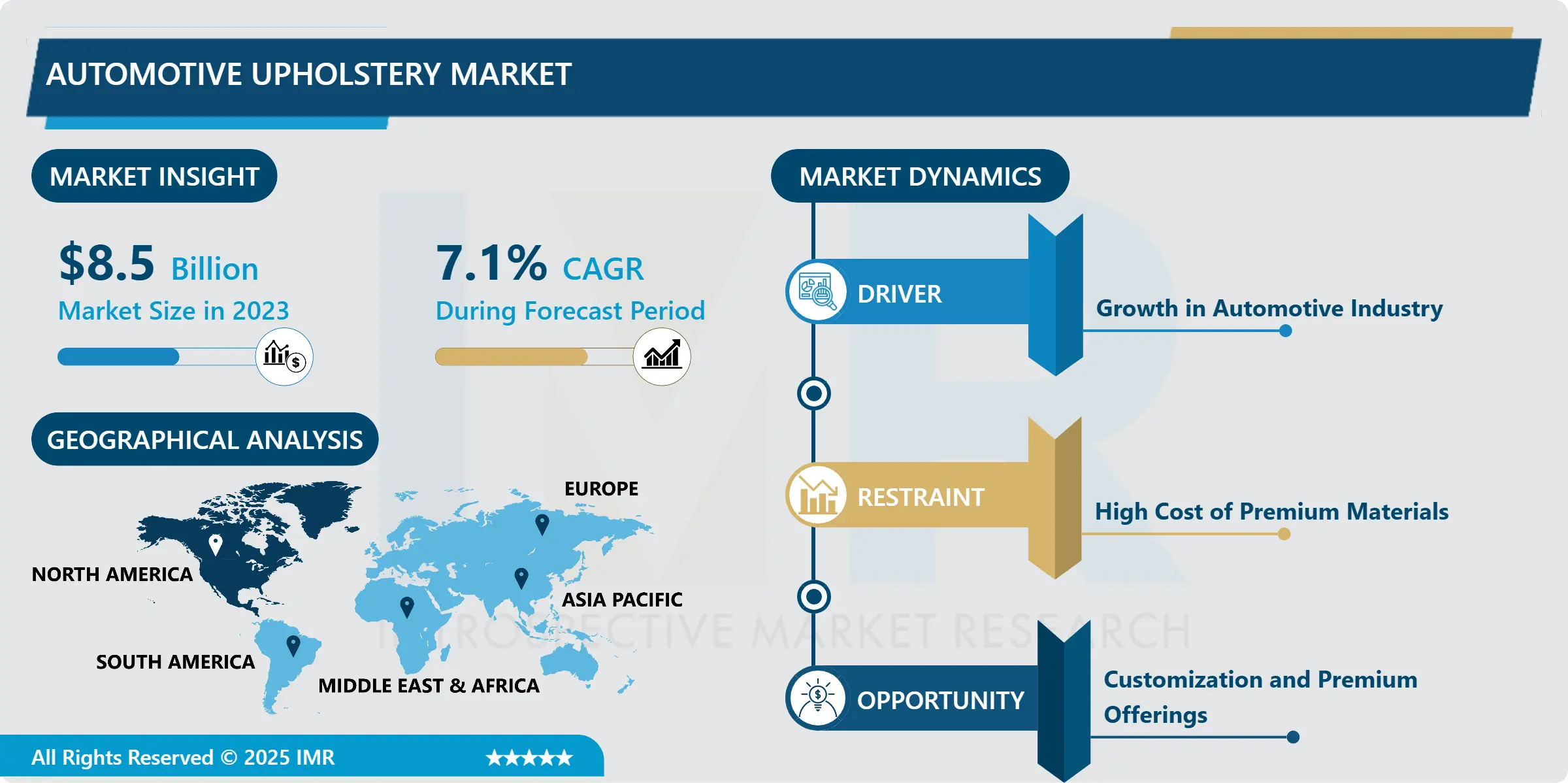
Automotive Upholstery Market Size Was Valued at USD 8.50 Billion in 2023, and is Projected to Reach USD 15.76 Billion by 2032, Growing at a CAGR of 7.10% From 2024-2032.
The automotive upholstery comprises of fabrics and materials applied for car interiors things such as seats, door trims, floor mats, roofs, and consoles. Automotive upholstery materials are materials that are imbued with comforts, that create aesthetics value in autos, material that have endurability. The market covers fabrics associated with leathers as well as leather goods and it targets the OEMs and the aftermarket.
There has been rising growth in the automotive upholstery industry due to the growing necessities of high quality automobile interiors as well as changing customer trends of comfort, style, and utility. With consumer attention turning toward interior looks and comfort, auto makers are paying more attention to providing even superior interiors for passengers. Thus, upholstery occupies an important position in the definition of improving the quality of the vehicle, as it is also able to make the car more comfortable and contribute to the overall design solution of the car.
The other issue that has reached the market is the use of the sustainable materials due to environmental regulation concerning car manufactures and customer’s demand of green products. In the current world, and as the public wakes up to other effects of using traditional materials, there is a growing call for the use of recycled or biodegradable materials. This trend also ties in well with advancements in man made textiles and leathers which not only are visually appealing with high but long-lasting textures, so are beneficial to auto makers who are looking for more eco-friendly materials.
Extending of cars and luxurious interiors’ demand has entailed the need for upgrading upholstery materials. Another driver to the market has also been the growth of the automotive industry especially in the growing world economies. Growing disposable income, the demand for better class cars, and fast-paced urbanization are some of the factors that are helping the demand for better upholstery solutions.
Parallel to the development in technology, manufacturers are also working on improving the uphosltery by the addition of new features like heating, cooling and massage functions. This has on top of that added to the promoting of innovation through the automotive upholstery market. There is rising pressure on automakers to be unique and offer the best interiors hence pushing the automotive sector to enhance upholstery solutions.
Automotive Upholstery Market Trend Analysis:
Rising Demand for Eco-Friendly Upholstery Materials
-
From the statistics it emerged that due to this awareness of environmental conservation, there is a high demand for environment friendly products in automotive seat materials. Sophisticated finishing processes are being replaced with biodegradable and eco-friendly leathers, organic fabrics and natural polyurethane foam. Of these segments, the trend is especially pronounced in the luxury segment, where purchasers are willing to make decisions in favour of environmentally friendly cars without significant detriment to their performance or appearance.
- To meet these new trends among car buyers, auto makers are integrating these materials into new car models. It is worth mentioning that there are already many firms that have started integrating sustainable upholstery materials among theirother efforts with noteworthy efficacy solutions towards having lesser carbon footprint and marking sustainability in various processes in the production line. There are growth in the bio-degradable and recyclable materials used in fabrics which has also aided the trend as manufacturers of automobiles battle to meet environmental regulations while satisfying consumers’ demands for quality durable products.
Customization and Premium Offerings
-
The development potential in the automotive upholstery industry can be harnessed from higher demand for luxury car interior.Customer requirements that beckon the automotive upholstery industry more are for intricate and sophisticated designs. Cosh as consumer demand increasingly favours individually tailored interiors for vehicles, a marked trend will be observed toward the use of exclusive upholstery materials. There are always new colors and materials to introduce, interiors people want to have individuality and not be like everyone else. Car companies can piggyback on this need by providing consumers with the luxurious and personalised interiors which do add impressive value to a car.
- In addition, because of increasing sales of high-end and luxury vehicles, manufacturers are increasingly incorporating premium interior materials such as high-quality leather, suede and new-generation fabrics that are effectively luxurious and comfortable to passengers. This presents a reason for manufacturers to take the role of superior segment providers of interior experiences to a new level. Incorporating high-quality and diverse materials let car makers to stand out against competitors in the market.
Automotive Upholstery Market Segment Analysis:
Automotive Upholstery Market is Segmented on the basis of Product Type, Material Type, Vehicle Type, End User, and Region
By Product Type, Seat Covers segment is expected to dominate the market during the forecast period
-
Automotive upholstery can be divided into product type such as seat covers, door panels, floor carpets, headliners and armrests. EACH category of product has a large niche in the total market; however, seat covers and door panels are the most popular products. Seat covers are even more important in providing comfort and appearance and thus manufacturers are aiming at developing as many types of fabric as possible right from luxurious leather to synthetic fabric. The door panels and floor carpets are the other parts that contribute to the interior looks and feel as well as functionality and as demand for high quality materials with enhanced durability rises, then these two categories will also grow.
- With recent trends suggesting that consumers in the automotive industry are beginning to expect more options to make individual choices that will be personalized to their specific requirements the above product categories are helping to fill the market need for more differentiated upholstery solutions. Other products like heated and ventilated seat covers, acoustic headliners to reduce the noise level, new materials in armrests are the other ones that are also driving this market. Due to the continuing emphasis on comfort, luxury and individuality, this growth trend should also persist in all areas of automotive seating.
By End User, OEM (Original Equipment Manufacturer) segment expected to held the largest share
-
The automotive upholstery market is divided into two key end-user segments: OEM stands for Original Equipment Manufacturer and aftermarket. This segment is more focused on new vehicles, and OEMs are principal suppliers of upholstery materials; this segment is rather growing on the base of the new car models’ releases and top-quality developments for car interiors. The automotive industry has shifted its focus to trends for car interiors including using sustainable and expensive fabrics for comfort among other needs of the people.
- The new aftermarket segment, on the other hand, is expanding fast as new car owners seek addi¬¬tional comfort and refinement for their car interiors. A wide range of customers’ car parts accessories preferences is the area of custom seat covers, floor mats, and other interior accessories since people always want to improve the look and comfort of their car. This segment also has the advantage of an aging car parc, as owners look for new replacement interiors, which are worn out. The aftermarket segment remains a vast prospect area for suppliers who offer as many goods and services that would meet consumers’ demands.
Automotive Upholstery Market Regional Insights:
North America is Expected to Dominate the Market Over the Forecast period
-
As of now, the automotive upholstery market is led by North America because of the increased demand for cars and a well-developed automotive industry. Some of the leading automotive manufacturers are located in this region and have huge requirements for new and superior quality upholstery products. Furthermore, the increasing desire of customers to personalise their car and the increasing interest in comfort equipment and interior design are encouraging the use of high-quality and expensive materials in car interiors.
- North American market is also witnessing improvements in automotive technology, and therefore, electric and self-driving vehicles are getting more popular. Since these vehicles are usually constructed with improved interior designs, there is increased need for refined and eco-friendly interior materials. Additionally, North America continually leads this market due to the availability of a solid aftermarket market, with many suppliers offering tailored upholstery solutions.
Active Key Players in the Automotive Upholstery Market:
-
Adient - Ireland
- BASF SE - Germany
- Borgers - Germany
- Faurecia - France
- Gurit Holding AG - Switzerland
- International Automotive Components Group (IAC) - Luxembourg
- Kraton Polymers - USA
- Lear Corporation - USA
- MGX Creative - USA
- Sage Automotive Interiors - USA
- Suminoe Textile Co., Ltd. - Japan
- Toyota Boshoku Corporation - Japan
- Other Active Players
Key Industry Developments in the Automotive Upholstery Market:
-
May 25, 2023: Acme Mills Company announced the launch of Natura, a revolutionary line of flushable and compostable wipes.
- September 20, 2023: Adient PLC presented seating innovations that focus on sustainability, cost, and comfort.
- January 9, 2023: Borgers Se & Co. KGaA was acquired by Autoneum. Autoneum signed an agreement to acquire the automotive business of Borgers. The acquisition was expected to close in April 2023 following antitrust clearance.
|
Global Automotive Upholstery Market |
|||
|
Base Year: |
2023 |
Forecast Period: |
2024-2032 |
|
Historical Data: |
2017 to 2023 |
Market Size in 2023: |
USD 8.50 Billion |
|
Forecast Period 2024-32 CAGR: |
7.10% |
Market Size in 2032: |
USD 15.76 Billion |
|
Segments Covered: |
By Product Type |
|
|
|
By Material Type |
|
||
|
By Vehicle Type |
|
||
|
By End-User |
|
||
|
By Region |
|
||
|
Key Market Drivers: |
|
||
|
Key Market Restraints: |
|
||
|
Key Opportunities: |
|
||
|
Companies Covered in the report: |
|
||
Chapter 1: Introduction
1.1 Scope and Coverage
Chapter 2:Executive Summary
Chapter 3: Market Landscape
3.1 Market Dynamics
3.1.1 Drivers
3.1.2 Restraints
3.1.3 Opportunities
3.1.4 Challenges
3.2 Market Trend Analysis
3.3 PESTLE Analysis
3.4 Porter's Five Forces Analysis
3.5 Industry Value Chain Analysis
3.6 Ecosystem
3.7 Regulatory Landscape
3.8 Price Trend Analysis
3.9 Patent Analysis
3.10 Technology Evolution
3.11 Investment Pockets
3.12 Import-Export Analysis
Chapter 4: Automotive Upholstery Market by Material Type
4.1 Automotive Upholstery Market Snapshot and Growth Engine
4.2 Automotive Upholstery Market Overview
4.3 Leather
4.3.1 Introduction and Market Overview
4.3.2 Historic and Forecasted Market Size in Value USD and Volume Units (2017-2032F)
4.3.3 Key Market Trends, Growth Factors and Opportunities
4.3.4 Leather: Geographic Segmentation Analysis
4.4 Fabric
4.4.1 Introduction and Market Overview
4.4.2 Historic and Forecasted Market Size in Value USD and Volume Units (2017-2032F)
4.4.3 Key Market Trends, Growth Factors and Opportunities
4.4.4 Fabric: Geographic Segmentation Analysis
4.5 Vinyl
4.5.1 Introduction and Market Overview
4.5.2 Historic and Forecasted Market Size in Value USD and Volume Units (2017-2032F)
4.5.3 Key Market Trends, Growth Factors and Opportunities
4.5.4 Vinyl: Geographic Segmentation Analysis
4.6 Synthetic Leather
4.6.1 Introduction and Market Overview
4.6.2 Historic and Forecasted Market Size in Value USD and Volume Units (2017-2032F)
4.6.3 Key Market Trends, Growth Factors and Opportunities
4.6.4 Synthetic Leather: Geographic Segmentation Analysis
Chapter 5: Automotive Upholstery Market by Vehicle Type
5.1 Automotive Upholstery Market Snapshot and Growth Engine
5.2 Automotive Upholstery Market Overview
5.3 Passenger Cars
5.3.1 Introduction and Market Overview
5.3.2 Historic and Forecasted Market Size in Value USD and Volume Units (2017-2032F)
5.3.3 Key Market Trends, Growth Factors and Opportunities
5.3.4 Passenger Cars: Geographic Segmentation Analysis
5.4 Commercial Vehicles
5.4.1 Introduction and Market Overview
5.4.2 Historic and Forecasted Market Size in Value USD and Volume Units (2017-2032F)
5.4.3 Key Market Trends, Growth Factors and Opportunities
5.4.4 Commercial Vehicles: Geographic Segmentation Analysis
5.5 Electric Vehicles (EVs)
5.5.1 Introduction and Market Overview
5.5.2 Historic and Forecasted Market Size in Value USD and Volume Units (2017-2032F)
5.5.3 Key Market Trends, Growth Factors and Opportunities
5.5.4 Electric Vehicles (EVs): Geographic Segmentation Analysis
Chapter 6: Automotive Upholstery Market by Product Type
6.1 Automotive Upholstery Market Snapshot and Growth Engine
6.2 Automotive Upholstery Market Overview
6.3 Seat Covers
6.3.1 Introduction and Market Overview
6.3.2 Historic and Forecasted Market Size in Value USD and Volume Units (2017-2032F)
6.3.3 Key Market Trends, Growth Factors and Opportunities
6.3.4 Seat Covers: Geographic Segmentation Analysis
6.4 Door Panels
6.4.1 Introduction and Market Overview
6.4.2 Historic and Forecasted Market Size in Value USD and Volume Units (2017-2032F)
6.4.3 Key Market Trends, Growth Factors and Opportunities
6.4.4 Door Panels: Geographic Segmentation Analysis
6.5 Floor Carpets
6.5.1 Introduction and Market Overview
6.5.2 Historic and Forecasted Market Size in Value USD and Volume Units (2017-2032F)
6.5.3 Key Market Trends, Growth Factors and Opportunities
6.5.4 Floor Carpets: Geographic Segmentation Analysis
6.6 Headliners
6.6.1 Introduction and Market Overview
6.6.2 Historic and Forecasted Market Size in Value USD and Volume Units (2017-2032F)
6.6.3 Key Market Trends, Growth Factors and Opportunities
6.6.4 Headliners: Geographic Segmentation Analysis
6.7 Armrests
6.7.1 Introduction and Market Overview
6.7.2 Historic and Forecasted Market Size in Value USD and Volume Units (2017-2032F)
6.7.3 Key Market Trends, Growth Factors and Opportunities
6.7.4 Armrests: Geographic Segmentation Analysis
Chapter 7: Automotive Upholstery Market by End-User
7.1 Automotive Upholstery Market Snapshot and Growth Engine
7.2 Automotive Upholstery Market Overview
7.3 OEM (Original Equipment Manufacturer
7.3.1 Introduction and Market Overview
7.3.2 Historic and Forecasted Market Size in Value USD and Volume Units (2017-2032F)
7.3.3 Key Market Trends, Growth Factors and Opportunities
7.3.4 OEM (Original Equipment Manufacturer: Geographic Segmentation Analysis
7.4 After
7.4.1 Introduction and Market Overview
7.4.2 Historic and Forecasted Market Size in Value USD and Volume Units (2017-2032F)
7.4.3 Key Market Trends, Growth Factors and Opportunities
7.4.4 After: Geographic Segmentation Analysis
Chapter 8: Company Profiles and Competitive Analysis
8.1 Competitive Landscape
8.1.1 Competitive Benchmarking
8.1.2 Automotive Upholstery Market Share by Manufacturer (2023)
8.1.3 Industry BCG Matrix
8.1.4 Heat Map Analysis
8.1.5 Mergers and Acquisitions
8.2 FAURECIA - FRANCE
8.2.1 Company Overview
8.2.2 Key Executives
8.2.3 Company Snapshot
8.2.4 Role of the Company in the Market
8.2.5 Sustainability and Social Responsibility
8.2.6 Operating Business Segments
8.2.7 Product Portfolio
8.2.8 Business Performance
8.2.9 Key Strategic Moves and Recent Developments
8.2.10 SWOT Analysis
8.3 LEAR CORPORATION - USA
8.4 ADIENT - IRELAND
8.5 TOYOTA BOSHOKU CORPORATION - JAPAN
8.6 BASF SE - GERMANY
8.7 INTERNATIONAL AUTOMOTIVE COMPONENTS GROUP (IAC) - LUXEMBOURG
8.8 GURIT HOLDING AG - SWITZERLAND
8.9 SAGE AUTOMOTIVE INTERIORS - USA
8.10 BORGERS - GERMANY
8.11 SUMINOE TEXTILE CO. LTD. - JAPAN
8.12 KRATON POLYMERS - USA
8.13 MGX CREATIVE - USA
8.14 OTHER ACTIVE PLAYERS
Chapter 9: Global Automotive Upholstery Market By Region
9.1 Overview
9.2. North America Automotive Upholstery Market
9.2.1 Key Market Trends, Growth Factors and Opportunities
9.2.2 Top Key Companies
9.2.3 Historic and Forecasted Market Size by Segments
9.2.4 Historic and Forecasted Market Size By Material Type
9.2.4.1 Leather
9.2.4.2 Fabric
9.2.4.3 Vinyl
9.2.4.4 Synthetic Leather
9.2.5 Historic and Forecasted Market Size By Vehicle Type
9.2.5.1 Passenger Cars
9.2.5.2 Commercial Vehicles
9.2.5.3 Electric Vehicles (EVs)
9.2.6 Historic and Forecasted Market Size By Product Type
9.2.6.1 Seat Covers
9.2.6.2 Door Panels
9.2.6.3 Floor Carpets
9.2.6.4 Headliners
9.2.6.5 Armrests
9.2.7 Historic and Forecasted Market Size By End-User
9.2.7.1 OEM (Original Equipment Manufacturer
9.2.7.2 After
9.2.8 Historic and Forecast Market Size by Country
9.2.8.1 US
9.2.8.2 Canada
9.2.8.3 Mexico
9.3. Eastern Europe Automotive Upholstery Market
9.3.1 Key Market Trends, Growth Factors and Opportunities
9.3.2 Top Key Companies
9.3.3 Historic and Forecasted Market Size by Segments
9.3.4 Historic and Forecasted Market Size By Material Type
9.3.4.1 Leather
9.3.4.2 Fabric
9.3.4.3 Vinyl
9.3.4.4 Synthetic Leather
9.3.5 Historic and Forecasted Market Size By Vehicle Type
9.3.5.1 Passenger Cars
9.3.5.2 Commercial Vehicles
9.3.5.3 Electric Vehicles (EVs)
9.3.6 Historic and Forecasted Market Size By Product Type
9.3.6.1 Seat Covers
9.3.6.2 Door Panels
9.3.6.3 Floor Carpets
9.3.6.4 Headliners
9.3.6.5 Armrests
9.3.7 Historic and Forecasted Market Size By End-User
9.3.7.1 OEM (Original Equipment Manufacturer
9.3.7.2 After
9.3.8 Historic and Forecast Market Size by Country
9.3.8.1 Russia
9.3.8.2 Bulgaria
9.3.8.3 The Czech Republic
9.3.8.4 Hungary
9.3.8.5 Poland
9.3.8.6 Romania
9.3.8.7 Rest of Eastern Europe
9.4. Western Europe Automotive Upholstery Market
9.4.1 Key Market Trends, Growth Factors and Opportunities
9.4.2 Top Key Companies
9.4.3 Historic and Forecasted Market Size by Segments
9.4.4 Historic and Forecasted Market Size By Material Type
9.4.4.1 Leather
9.4.4.2 Fabric
9.4.4.3 Vinyl
9.4.4.4 Synthetic Leather
9.4.5 Historic and Forecasted Market Size By Vehicle Type
9.4.5.1 Passenger Cars
9.4.5.2 Commercial Vehicles
9.4.5.3 Electric Vehicles (EVs)
9.4.6 Historic and Forecasted Market Size By Product Type
9.4.6.1 Seat Covers
9.4.6.2 Door Panels
9.4.6.3 Floor Carpets
9.4.6.4 Headliners
9.4.6.5 Armrests
9.4.7 Historic and Forecasted Market Size By End-User
9.4.7.1 OEM (Original Equipment Manufacturer
9.4.7.2 After
9.4.8 Historic and Forecast Market Size by Country
9.4.8.1 Germany
9.4.8.2 UK
9.4.8.3 France
9.4.8.4 The Netherlands
9.4.8.5 Italy
9.4.8.6 Spain
9.4.8.7 Rest of Western Europe
9.5. Asia Pacific Automotive Upholstery Market
9.5.1 Key Market Trends, Growth Factors and Opportunities
9.5.2 Top Key Companies
9.5.3 Historic and Forecasted Market Size by Segments
9.5.4 Historic and Forecasted Market Size By Material Type
9.5.4.1 Leather
9.5.4.2 Fabric
9.5.4.3 Vinyl
9.5.4.4 Synthetic Leather
9.5.5 Historic and Forecasted Market Size By Vehicle Type
9.5.5.1 Passenger Cars
9.5.5.2 Commercial Vehicles
9.5.5.3 Electric Vehicles (EVs)
9.5.6 Historic and Forecasted Market Size By Product Type
9.5.6.1 Seat Covers
9.5.6.2 Door Panels
9.5.6.3 Floor Carpets
9.5.6.4 Headliners
9.5.6.5 Armrests
9.5.7 Historic and Forecasted Market Size By End-User
9.5.7.1 OEM (Original Equipment Manufacturer
9.5.7.2 After
9.5.8 Historic and Forecast Market Size by Country
9.5.8.1 China
9.5.8.2 India
9.5.8.3 Japan
9.5.8.4 South Korea
9.5.8.5 Malaysia
9.5.8.6 Thailand
9.5.8.7 Vietnam
9.5.8.8 The Philippines
9.5.8.9 Australia
9.5.8.10 New Zealand
9.5.8.11 Rest of APAC
9.6. Middle East & Africa Automotive Upholstery Market
9.6.1 Key Market Trends, Growth Factors and Opportunities
9.6.2 Top Key Companies
9.6.3 Historic and Forecasted Market Size by Segments
9.6.4 Historic and Forecasted Market Size By Material Type
9.6.4.1 Leather
9.6.4.2 Fabric
9.6.4.3 Vinyl
9.6.4.4 Synthetic Leather
9.6.5 Historic and Forecasted Market Size By Vehicle Type
9.6.5.1 Passenger Cars
9.6.5.2 Commercial Vehicles
9.6.5.3 Electric Vehicles (EVs)
9.6.6 Historic and Forecasted Market Size By Product Type
9.6.6.1 Seat Covers
9.6.6.2 Door Panels
9.6.6.3 Floor Carpets
9.6.6.4 Headliners
9.6.6.5 Armrests
9.6.7 Historic and Forecasted Market Size By End-User
9.6.7.1 OEM (Original Equipment Manufacturer
9.6.7.2 After
9.6.8 Historic and Forecast Market Size by Country
9.6.8.1 Turkiye
9.6.8.2 Bahrain
9.6.8.3 Kuwait
9.6.8.4 Saudi Arabia
9.6.8.5 Qatar
9.6.8.6 UAE
9.6.8.7 Israel
9.6.8.8 South Africa
9.7. South America Automotive Upholstery Market
9.7.1 Key Market Trends, Growth Factors and Opportunities
9.7.2 Top Key Companies
9.7.3 Historic and Forecasted Market Size by Segments
9.7.4 Historic and Forecasted Market Size By Material Type
9.7.4.1 Leather
9.7.4.2 Fabric
9.7.4.3 Vinyl
9.7.4.4 Synthetic Leather
9.7.5 Historic and Forecasted Market Size By Vehicle Type
9.7.5.1 Passenger Cars
9.7.5.2 Commercial Vehicles
9.7.5.3 Electric Vehicles (EVs)
9.7.6 Historic and Forecasted Market Size By Product Type
9.7.6.1 Seat Covers
9.7.6.2 Door Panels
9.7.6.3 Floor Carpets
9.7.6.4 Headliners
9.7.6.5 Armrests
9.7.7 Historic and Forecasted Market Size By End-User
9.7.7.1 OEM (Original Equipment Manufacturer
9.7.7.2 After
9.7.8 Historic and Forecast Market Size by Country
9.7.8.1 Brazil
9.7.8.2 Argentina
9.7.8.3 Rest of SA
Chapter 10 Analyst Viewpoint and Conclusion
10.1 Recommendations and Concluding Analysis
10.2 Potential Market Strategies
Chapter 11 Research Methodology
11.1 Research Process
11.2 Primary Research
11.3 Secondary Research
|
Global Automotive Upholstery Market |
|||
|
Base Year: |
2023 |
Forecast Period: |
2024-2032 |
|
Historical Data: |
2017 to 2023 |
Market Size in 2023: |
USD 8.50 Billion |
|
Forecast Period 2024-32 CAGR: |
7.10% |
Market Size in 2032: |
USD 15.76 Billion |
|
Segments Covered: |
By Product Type |
|
|
|
By Material Type |
|
||
|
By Vehicle Type |
|
||
|
By End-User |
|
||
|
By Region |
|
||
|
Key Market Drivers: |
|
||
|
Key Market Restraints: |
|
||
|
Key Opportunities: |
|
||
|
Companies Covered in the report: |
|
||


