Audio Interface Market Synopsis:
Audio Interface Market Size Was Valued at USD 7.23 Billion in 2023, and is Projected to Reach USD 17.03 Billion by 2032, Growing at a CAGR of 9.82% From 2024-2032.
The audio interface market is defined as the worldwide market for devices that connect audio input/output devices to computers and or recording systems; these interfaces translate analog audio signals into digital formats and vice versa. These devices have an essential contribution for quality audio for music, podcast, radio and tv broadcasting, video game, and related professional and individual uses. As technology improves and consumer needs in the recording studio field observe increasing demand for simplicity and ease of use the market has grown to offer bottom to top calibration, recording equipment appealing to both professional, serious studio and hobbyist level users.
The popularity of audio interfaces is rising significantly to cater for the growing requirement of superior quality audio across the entertainment, gaming and content creation domains. Due to increased usage of computer-based music workstation, growth of independent musicians and home recording studio has boosted the market for audio interfaces. The market, as it emerges, receives a clear positive impulse from the rapidly growing trend of decentralized audio production where both high-level professionals and amateurs in search of suitable, compact and efficient means to create professional sound.
The audio interfaces are becoming more expanded with the I/O connectivity on the USB-C, Thunderbolt, and network protocols for versatile user application. Growing updates to low latency, high definition sound, and dual-platform compatibility of the product continue to appeal to a wide consumer base. Further, the ever-increasing video streaming articles and videos increased the need for reliable but easy-to-use sound interfaces that allow creators to produce high-quality audio products to their audience.
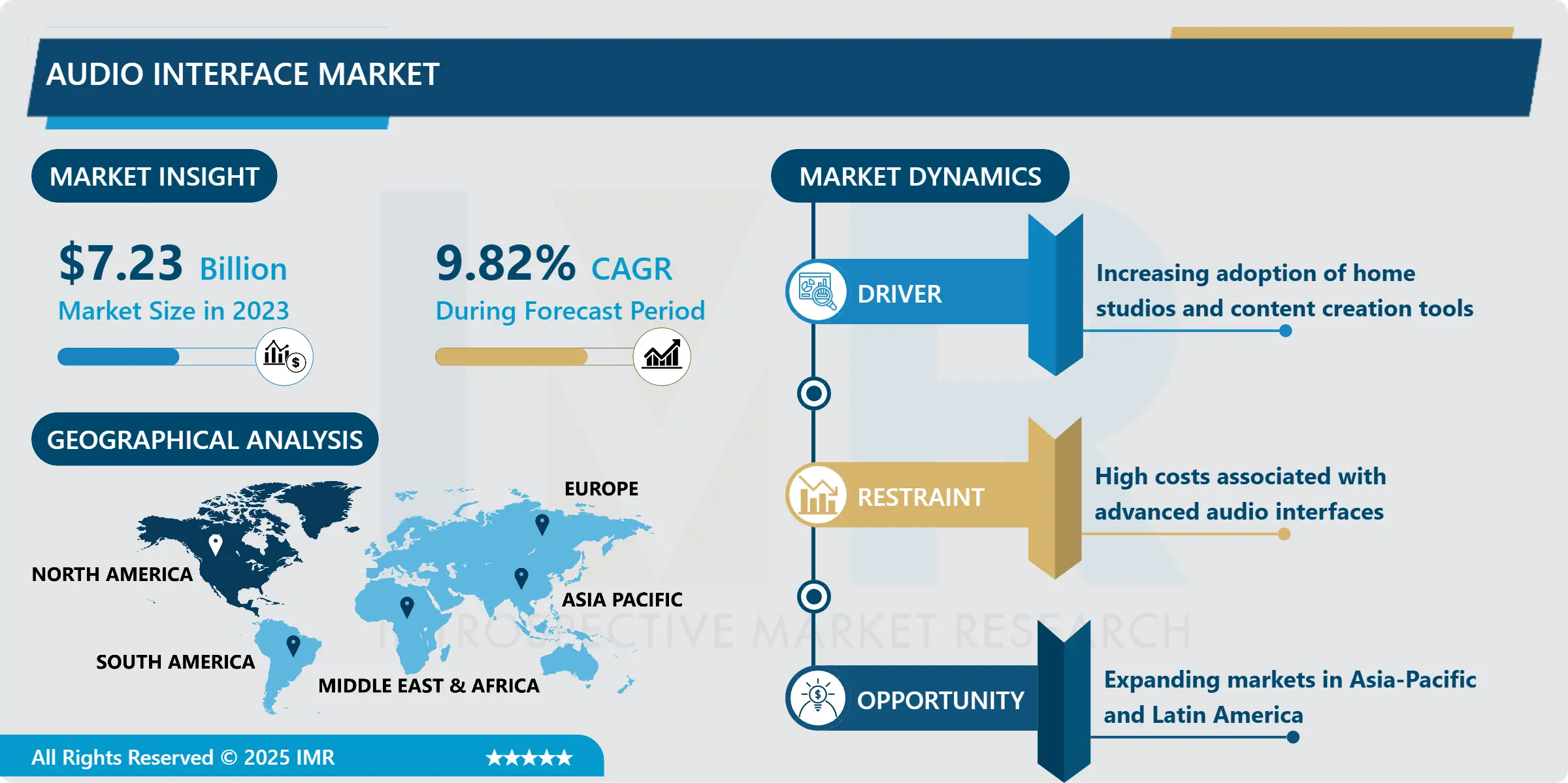
Audio Interface Market Trend Analysis:
Technological Innovation Driving Advanced Interfaces
-
The audio interface market is expanding rapidly, driven by technological advancements and evolving user demands. Key innovations now include ultra-low latency performance, high-resolution audio sampling up to 192 kHz, and support for USB 4.0 and Thunderbolt 4 connectivity. Wireless audio interfaces are also gaining traction, meeting the need for mobile and flexible audio solutions.
- AI and machine learning are being integrated to enhance real-time sound processing, offering features like noise reduction and audio optimization for superior quality. These developments cater to both professional and casual users, ensuring clearer, more reliable audio performance. As the market grows, manufacturers are focusing on user-friendly designs, seamless connectivity, and cutting-edge features to stay competitive. The future promises even smarter, more efficient audio interfaces with enhanced wireless capabilities and AI-driven enhancements.
Expanding Adoption in Emerging Markets
-
The interactive audio interface market is experiencing significant growth in emerging economies, driven by expanding internet services, rising per capita income, and increasing demand for digital content. Regions like Asia-Pacific, Latin America, and the Middle East are witnessing a surge in creative industries, with more independent musicians, podcasters, and content creators adopting digital tools. Governments and private sectors in these regions are investing in digital infrastructure and cultural activities, further boosting the market.
- As consumers shift from traditional sound systems to digital platforms, the demand for high-quality yet affordable audio interfaces is rising. This trend is expected to accelerate as accessibility improves, fostering innovation and competition in the market. The growing creator economy and digitalization of entertainment will continue to drive adoption, making interactive audio interfaces a key growth segment in the global tech landscape.
Audio Interface Market Segment Analysis:
Audio Interface Market Segmented on the basis of Type, Application, and Region.
By Type, Universal Serial Bus (USB) segment is expected to dominate the market during the forecast period
-
Over the forecast period, the USB segment will continue to be the most significant audio interface segment due to its use and compatibility. USB audio interfaces are used often because they are easy to use, quite inexpensive, and can be connected to most computers and operation systems. The existence of USB 2.0, USB 3.0 and USB C type provide users with interfaces they require in terms of speed and connectivity and make them more popular.
- Subsequent products of USB audio interfaces are portable, and users can easily plug them and play, well suited for both beginner and professional musicians or producers. Today’s USB devices have relatively small latency problem and provide very good sound quality, which is why these devices have gained a lot of popularity. With the continuous technological development and witnessing the versatile nature that interfaces need to be into accommodate a number of applications, interfaces such as USB interfaces are expected to remain dominant in the market.
By Application, Professional segment expected to held the largest share
-
The professional segment is expected to have largest market share, attributable to the increasing market need for professional audio equipment in studio, broadcasting and live performances. Some of the extra specifications that concern only professionals include HDR, low distortion rate, and robust connectivity alternatives, all of which can be provided by the finest audio interfaces. The growing production of multimedia content; music; and sounds has also contributed to the rising demand for professional-level devices.
- The pandemic put an emphasis on virtual events and remote production, which cannot be achieved without great audio equipment to back up the interface. Many of these professionals need quality and sustainable products hence making the professional segment the backbone of the market. Increased entertainment industry plus developments in studio technologies are other factors that will further support it this segment in coming years.
Audio Interface Market Regional Insights:
North America is Expected to Dominate the Market Over the Forecast period
-
North America continues to dominate the global audio interface market, driven by its thriving music and entertainment industry, which hosts the highest concentration of professional recording studios and content creators. The region's leadership is further reinforced by the rapid growth of home studios, fueled by independent musicians, podcasters, and digital content producers.
- North America is home to several leading audio interface manufacturers, ensuring cutting-edge technology and a wide range of products for professionals and hobbyists alike. The strong demand for high-quality recording equipment, coupled with advancements in digital audio workstations (DAWs), sustains the region's market supremacy. With continuous innovation and a robust ecosystem for audio production, North America remains the key hub for audio interface development and adoption worldwide.
Active Key Players in the Audio Interface Market
-
Avid Technology (USA)
- Behringer (Germany)
- Focusrite PLC (UK)
- IK Multimedia (Italy)
- M-Audio (USA)
- Mackie (USA)
- MOTU (USA)
- Native Instruments (Germany)
- PreSonus Audio Electronics (USA)
- RME Audio (Germany)
- Roland Corporation (Japan)
- Solid State Logic (UK)
- Steinberg Media Technologies (Germany)
- Tascam (Japan)
- Universal Audio (USA), and Other Active Players
|
Global Audio Interface Market |
|||
|
Base Year: |
2023 |
Forecast Period: |
2024-2032 |
|
Historical Data: |
2017 to 2023 |
Market Size in 2023: |
USD 7.23 Billion |
|
Forecast Period 2024-32 CAGR: |
9.82% |
Market Size in 2032: |
USD 17.03 Billion |
|
Segments Covered: |
By Type |
|
|
|
By Application |
|
||
|
By Region |
|
||
|
Key Market Drivers: |
|
||
|
Key Market Restraints: |
|
||
|
Key Opportunities: |
|
||
|
Companies Covered in the report: |
|
||
Chapter 1: Introduction
1.1 Scope and Coverage
Chapter 2:Executive Summary
Chapter 3: Market Landscape
3.1 Market Dynamics
3.1.1 Drivers
3.1.2 Restraints
3.1.3 Opportunities
3.1.4 Challenges
3.2 Market Trend Analysis
3.3 PESTLE Analysis
3.4 Porter's Five Forces Analysis
3.5 Industry Value Chain Analysis
3.6 Ecosystem
3.7 Regulatory Landscape
3.8 Price Trend Analysis
3.9 Patent Analysis
3.10 Technology Evolution
3.11 Investment Pockets
3.12 Import-Export Analysis
Chapter 4: Audio Interface Market by Type
4.1 Audio Interface Market Snapshot and Growth Engine
4.2 Audio Interface Market Overview
4.3 Universal Serial Bus (USB)
4.3.1 Introduction and Market Overview
4.3.2 Historic and Forecasted Market Size in Value USD and Volume Units (2017-2032F)
4.3.3 Key Market Trends, Growth Factors and Opportunities
4.3.4 Universal Serial Bus (USB): Geographic Segmentation Analysis
4.4 Firewire
4.4.1 Introduction and Market Overview
4.4.2 Historic and Forecasted Market Size in Value USD and Volume Units (2017-2032F)
4.4.3 Key Market Trends, Growth Factors and Opportunities
4.4.4 Firewire: Geographic Segmentation Analysis
4.5 Musical Instrument Digital Interface
4.5.1 Introduction and Market Overview
4.5.2 Historic and Forecasted Market Size in Value USD and Volume Units (2017-2032F)
4.5.3 Key Market Trends, Growth Factors and Opportunities
4.5.4 Musical Instrument Digital Interface: Geographic Segmentation Analysis
4.6 Thunderbolt
4.6.1 Introduction and Market Overview
4.6.2 Historic and Forecasted Market Size in Value USD and Volume Units (2017-2032F)
4.6.3 Key Market Trends, Growth Factors and Opportunities
4.6.4 Thunderbolt: Geographic Segmentation Analysis
Chapter 5: Audio Interface Market by Application
5.1 Audio Interface Market Snapshot and Growth Engine
5.2 Audio Interface Market Overview
5.3 Professional
5.3.1 Introduction and Market Overview
5.3.2 Historic and Forecasted Market Size in Value USD and Volume Units (2017-2032F)
5.3.3 Key Market Trends, Growth Factors and Opportunities
5.3.4 Professional: Geographic Segmentation Analysis
5.4 Amateurs
5.4.1 Introduction and Market Overview
5.4.2 Historic and Forecasted Market Size in Value USD and Volume Units (2017-2032F)
5.4.3 Key Market Trends, Growth Factors and Opportunities
5.4.4 Amateurs: Geographic Segmentation Analysis
Chapter 6: Company Profiles and Competitive Analysis
6.1 Competitive Landscape
6.1.1 Competitive Benchmarking
6.1.2 Audio Interface Market Share by Manufacturer (2023)
6.1.3 Industry BCG Matrix
6.1.4 Heat Map Analysis
6.1.5 Mergers and Acquisitions
6.2 AVID TECHNOLOGY (USA)
6.2.1 Company Overview
6.2.2 Key Executives
6.2.3 Company Snapshot
6.2.4 Role of the Company in the Market
6.2.5 Sustainability and Social Responsibility
6.2.6 Operating Business Segments
6.2.7 Product Portfolio
6.2.8 Business Performance
6.2.9 Key Strategic Moves and Recent Developments
6.2.10 SWOT Analysis
6.3 BEHRINGER (GERMANY)
6.4 FOCUSRITE PLC (UK)
6.5 IK MULTIMEDIA (ITALY)
6.6 M-AUDIO (USA)
6.7 MACKIE (USA)
6.8 MOTU (USA)
6.9 NATIVE INSTRUMENTS (GERMANY)
6.10 PRESONUS AUDIO ELECTRONICS (USA)
6.11 RME AUDIO (GERMANY)
6.12 ROLAND CORPORATION (JAPAN)
6.13 SOLID STATE LOGIC (UK)
6.14 STEINBERG MEDIA TECHNOLOGIES (GERMANY)
6.15 TASCAM (JAPAN)
6.16 UNIVERSAL AUDIO (USA)
6.17 OTHER ACTIVE PLAYERS
Chapter 7: Global Audio Interface Market By Region
7.1 Overview
7.2. North America Audio Interface Market
7.2.1 Key Market Trends, Growth Factors and Opportunities
7.2.2 Top Key Companies
7.2.3 Historic and Forecasted Market Size by Segments
7.2.4 Historic and Forecasted Market Size By Type
7.2.4.1 Universal Serial Bus (USB)
7.2.4.2 Firewire
7.2.4.3 Musical Instrument Digital Interface
7.2.4.4 Thunderbolt
7.2.5 Historic and Forecasted Market Size By Application
7.2.5.1 Professional
7.2.5.2 Amateurs
7.2.6 Historic and Forecast Market Size by Country
7.2.6.1 US
7.2.6.2 Canada
7.2.6.3 Mexico
7.3. Eastern Europe Audio Interface Market
7.3.1 Key Market Trends, Growth Factors and Opportunities
7.3.2 Top Key Companies
7.3.3 Historic and Forecasted Market Size by Segments
7.3.4 Historic and Forecasted Market Size By Type
7.3.4.1 Universal Serial Bus (USB)
7.3.4.2 Firewire
7.3.4.3 Musical Instrument Digital Interface
7.3.4.4 Thunderbolt
7.3.5 Historic and Forecasted Market Size By Application
7.3.5.1 Professional
7.3.5.2 Amateurs
7.3.6 Historic and Forecast Market Size by Country
7.3.6.1 Russia
7.3.6.2 Bulgaria
7.3.6.3 The Czech Republic
7.3.6.4 Hungary
7.3.6.5 Poland
7.3.6.6 Romania
7.3.6.7 Rest of Eastern Europe
7.4. Western Europe Audio Interface Market
7.4.1 Key Market Trends, Growth Factors and Opportunities
7.4.2 Top Key Companies
7.4.3 Historic and Forecasted Market Size by Segments
7.4.4 Historic and Forecasted Market Size By Type
7.4.4.1 Universal Serial Bus (USB)
7.4.4.2 Firewire
7.4.4.3 Musical Instrument Digital Interface
7.4.4.4 Thunderbolt
7.4.5 Historic and Forecasted Market Size By Application
7.4.5.1 Professional
7.4.5.2 Amateurs
7.4.6 Historic and Forecast Market Size by Country
7.4.6.1 Germany
7.4.6.2 UK
7.4.6.3 France
7.4.6.4 The Netherlands
7.4.6.5 Italy
7.4.6.6 Spain
7.4.6.7 Rest of Western Europe
7.5. Asia Pacific Audio Interface Market
7.5.1 Key Market Trends, Growth Factors and Opportunities
7.5.2 Top Key Companies
7.5.3 Historic and Forecasted Market Size by Segments
7.5.4 Historic and Forecasted Market Size By Type
7.5.4.1 Universal Serial Bus (USB)
7.5.4.2 Firewire
7.5.4.3 Musical Instrument Digital Interface
7.5.4.4 Thunderbolt
7.5.5 Historic and Forecasted Market Size By Application
7.5.5.1 Professional
7.5.5.2 Amateurs
7.5.6 Historic and Forecast Market Size by Country
7.5.6.1 China
7.5.6.2 India
7.5.6.3 Japan
7.5.6.4 South Korea
7.5.6.5 Malaysia
7.5.6.6 Thailand
7.5.6.7 Vietnam
7.5.6.8 The Philippines
7.5.6.9 Australia
7.5.6.10 New Zealand
7.5.6.11 Rest of APAC
7.6. Middle East & Africa Audio Interface Market
7.6.1 Key Market Trends, Growth Factors and Opportunities
7.6.2 Top Key Companies
7.6.3 Historic and Forecasted Market Size by Segments
7.6.4 Historic and Forecasted Market Size By Type
7.6.4.1 Universal Serial Bus (USB)
7.6.4.2 Firewire
7.6.4.3 Musical Instrument Digital Interface
7.6.4.4 Thunderbolt
7.6.5 Historic and Forecasted Market Size By Application
7.6.5.1 Professional
7.6.5.2 Amateurs
7.6.6 Historic and Forecast Market Size by Country
7.6.6.1 Turkiye
7.6.6.2 Bahrain
7.6.6.3 Kuwait
7.6.6.4 Saudi Arabia
7.6.6.5 Qatar
7.6.6.6 UAE
7.6.6.7 Israel
7.6.6.8 South Africa
7.7. South America Audio Interface Market
7.7.1 Key Market Trends, Growth Factors and Opportunities
7.7.2 Top Key Companies
7.7.3 Historic and Forecasted Market Size by Segments
7.7.4 Historic and Forecasted Market Size By Type
7.7.4.1 Universal Serial Bus (USB)
7.7.4.2 Firewire
7.7.4.3 Musical Instrument Digital Interface
7.7.4.4 Thunderbolt
7.7.5 Historic and Forecasted Market Size By Application
7.7.5.1 Professional
7.7.5.2 Amateurs
7.7.6 Historic and Forecast Market Size by Country
7.7.6.1 Brazil
7.7.6.2 Argentina
7.7.6.3 Rest of SA
Chapter 8 Analyst Viewpoint and Conclusion
8.1 Recommendations and Concluding Analysis
8.2 Potential Market Strategies
Chapter 9 Research Methodology
9.1 Research Process
9.2 Primary Research
9.3 Secondary Research
|
Global Audio Interface Market |
|||
|
Base Year: |
2023 |
Forecast Period: |
2024-2032 |
|
Historical Data: |
2017 to 2023 |
Market Size in 2023: |
USD 7.23 Billion |
|
Forecast Period 2024-32 CAGR: |
9.82% |
Market Size in 2032: |
USD 17.03 Billion |
|
Segments Covered: |
By Type |
|
|
|
By Application |
|
||
|
By Region |
|
||
|
Key Market Drivers: |
|
||
|
Key Market Restraints: |
|
||
|
Key Opportunities: |
|
||
|
Companies Covered in the report: |
|
||