




Anticonvulsant Drugs Market Synopsis:
Anticonvulsant Drugs Market Size Was Valued at USD 7.01 Billion in 2023, and is Projected to Reach USD 8.67 Billion by 2032, Growing at a CAGR of 2.40% From 2024-2032.
Anticonvulsant medications also called anti-epileptic medications are medicines employed to treat epilepsy or seizures through regulation of electric discharge within the brain cells. They are also used for many other purposes, such as to treat bipolar disorder and to manage neuropathic pain since these drugs’ therapeutic approaches are quite broad.
The anticonvulsant drugs market has shown steady growth over the years in response to the rising incidence of diseases of the central nervous system, including epilepsy and neuropathic pain. Since epilepsy is a disease that affects almost 50 million people around the world according to the WHO the need for efficient antiepileptic medications remains high. In addition, fear and anxiety associated with epilepsy have brought innovations in the early diagnosis of such conditions and enabling optimal management of the conscience, which has accelerated the growth of the market.
Development of versatile formulations and additional product packages, new age preparations for drugs and improved drug delivery systems are significantly changing the market environment. Further, it is expected that spending more on research and development innovation for effective drugs with less side effects will be one of the future trends. The existence of generics and government approval to support orphan drugs for various forms of epilepsy also put the market on the advancement.
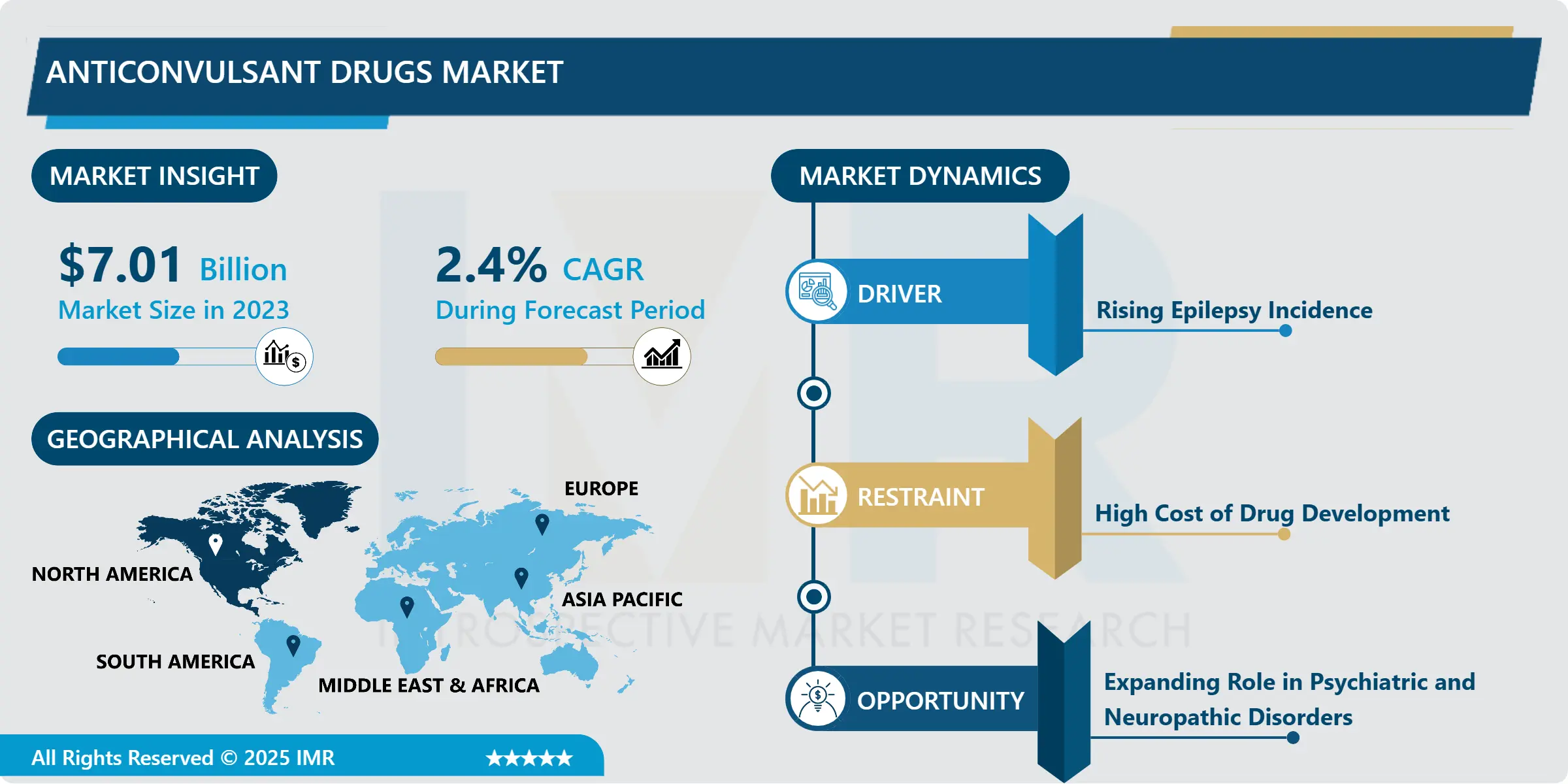
Anticonvulsant Drugs Market Trend Analysis:
Personalized Treatment Approaches
- The anticonvulsant drugs market has become dominated by the ongoing shift towards personalized medicine for neurological disorders altering the way the condition is treated. Pharmacogenomics has helped to delineate personized medicine based on genetic makeup, mainly improving the outcomes of treatment with reduced undue side effects. Of especial use, such a technique is especially necessary in the treatment of refractory epilepsy; a condition whereby conventional antiepileptic therapy is insufficient in terms of efficacy. Recognizing specific genetic traits that affect drug metabolism and the patient’s reaction to treatment, there is the increased success rate of therapy.
- Current trend shows that biomarker-based research is being well exploited by pharmaceutical firms to formulate niche treatments that can effectively target specific patient populations. The identified innovations not only enhance the effectiveness of case management of complex epilepsy but also offer a conceptual innovation in the treatment of epilepsy. The emphasis on a specific population of patients is also stimulating research in novel drugs and increasing the choice of better and safer drugs. This change in the manner that patients will be utilized in the future is a projection of the value of personalized medicine as one of the key areas for growth for the anticonvulsant drugs market.
Expanding Applications Beyond Epilepsy
- Some of which are being identified for use in other indications that are other than epilepsy hence opening up new prospects in a broader therapeutic arena. The following drugs have been shown to effectively treat different neurological and psychiatric disorders on a number of occasions: bipolar affective disorder, anxiety disorders, and chronic pain. This adaptability is contributing to their use by healthcare organizations in search of efficient therapies for numerous challenging diseases. Consequently, the anticonvulsant market moves towards new directions in order to widen its therapeutic application fields based on real evidences supporting the efficacy of such drugs.
- The increase in neuropathic pain, particularly diabetes, cancer, and post-herpetic neuralgia, has added extra value to anticonvulsants for pain relief. Further, increasing utilization for psychiatric disorders in the new indications also illustrates their advancing application with time. Obtaining of approvals to these widened uses has not only served to expand the market for anticonvulsant drugs but has also motivated the drug manufacturing firms to search for other experimental formulations aimed at these disorders. There is potential to expand the therapeutic application and increase the therapeutic market revenue in the future.
Anticonvulsant Drugs Market Segment Analysis:
Anticonvulsant Drugs Market is Segmented on the basis of Drug Type, Indication, Distribution Channel, and Region.
By Drug Type, the First-generation anticonvulsants segment is expected to dominate the market during the forecast period
- The anticonvulsant drugs market is broadly segmented by drug type including first generation, second generation and third generation anticonvulsants. Older generation of anticonvulsants namely phenytoin, phenobarbital, and carbamazepine has been used since long time and is still useful in many epilepsy patients. However, these drugs are associated with several side effects including dizziness, hepatotoxicity and drug interactions that have placed their use in the current practice paradigm, into question. Altogether, due to these disadvantages, inexpensive and effective, these technologies do not lose their relevancy in the conditions of high medical-needy countries.
- Newer anticonvulsants, second- and third-generation drugs are being prescribed more frequently because they are safer and more versatile in their uses. Newer forms of medications such as; lamotrigine, gabapentin, and levetiracetam are more favourable due to their side effect profile and are used in conditions aside from epilepsy for instance, neuropathic pain and bipolar disorders. Newer-generation anticonvulsants are lacosamide and perampanel to mention but a few, and which have high efficacy with little risk of side effects. These new drugs became needed for the treatment of pharmacoresistant epilepsy and many other specific neurological disorders, which is why growth has shifted to the development of breakthrough drugs and personalized therapies.
By indication, anxiety segment expected to held the largest share
- The anticonvulsant drugs market has a rich application portfolio, but it mainly targets epilepsy. Epilepsy now affects millions of people worldwide, creating constant need for seizure medications that do not disappoint. Anticonvulsants are widely used as a staple medication for epilepsy, as they act on abnormally hyperactive neurons and make epileptic patients’ lives less miserable. As the compositions of medications become better, there is a new emergence of the third-generation anti-epileptic drugs that provide for better control of the seizure more especially if they do not cause side effects that make the patients to worsen.
- Anticonvulsants have ventured into treatment of neuropathic pain, bipolar disorder, anxiety and other neurological/psychiatric disorders. One kind of chronic pain includes neuropathic pain related to diabetes or cancer; the evidence-based drugs for its treatment include gabapentin and pregabalin. Likewise, while anticonvulsants have been useful for bipolar disorder and anxiety with their mood stabilizing effect, they have suggested new possibilities for treatment. These applications prove the increasing acceptance of anticonvulsants as being useful drugs in the neurological and psychiatric disorder treatment, and they should be seen as valuable agents necessary for treatment of many forms of disorders.
Anticonvulsant Drugs Market Regional Insights:
North America is Expected to Dominate the Market Over the Forecast period
- The global anticonvulsant drugs market in the year 2023 was marked by North America as the forerunning region due to its sophisticated healthcare system alongside marked investments as a region in the neurological research. The region occupied 35 to 40 percent market share of the total global market vis-à-vis leadership in discovery and putting into use of drugs. This has been boosted by increased healthcare spending and increased government policies intended to enhance epilepsy and neurological disorder treatment. The often-elevated experience of diagnostic tools and clinical networks also guarantee that patients within North America demand well-timed and effective treatment, boosting the market.
- The US was right in the middle of this, contributing the most within the north-American region of the world. Other attraction like patients access to plan, innovation research units, health institutions and pharmaceutical industries cooperation experience have contributed to its success. Further, government reimbursement policies, people’s increased awareness of neurological disorders, andMHN advocacy provide a favourable environment for the anticonvulsant drugs market. This strong cocktail of factors serves North America well as a place of innovation and growth in global market.
Active Key Players in the Anticonvulsant Drugs Market:
- Abbott Laboratories (USA)
- Amneal Pharmaceuticals (USA)
- Bausch Health (Canada)
- Dr. Reddy’s Laboratories (India)
- Eisai Co., Ltd. (Japan)
- GlaxoSmithKline (UK)
- Johnson & Johnson (USA)
- Lupin Limited (India)
- Novartis AG (Switzerland)
- Pfizer Inc. (USA)
- Sanofi (France)
- Sun Pharmaceutical Industries (India)
- Teva Pharmaceutical Industries (Israel)
- UCB Pharma (Belgium)
- Zydus Cadila (India)
- Other Active Players
|
Anticonvulsant Drugs Market |
|||
|
Base Year: |
2023 |
Forecast Period: |
2024-2032 |
|
Historical Data: |
2017 to 2023 |
Market Size in 2023: |
USD 7.01 Billion |
|
Forecast Period 2024-32 CAGR: |
2.40% |
Market Size in 2032: |
USD 8.67 Billion |
|
Segments Covered: |
By Drug Type |
|
|
|
By Indication |
|
||
|
By Distribution Channel |
|
||
|
By Region |
|
||
|
Key Market Drivers: |
|
||
|
Key Market Restraints: |
|
||
|
Key Opportunities: |
|
||
|
Companies Covered in the report: |
|
||
Chapter 1: Introduction
1.1 Scope and Coverage
Chapter 2:Executive Summary
Chapter 3: Market Landscape
3.1 Market Dynamics
3.1.1 Drivers
3.1.2 Restraints
3.1.3 Opportunities
3.1.4 Challenges
3.2 Market Trend Analysis
3.3 PESTLE Analysis
3.4 Porter's Five Forces Analysis
3.5 Industry Value Chain Analysis
3.6 Ecosystem
3.7 Regulatory Landscape
3.8 Price Trend Analysis
3.9 Patent Analysis
3.10 Technology Evolution
3.11 Investment Pockets
3.12 Import-Export Analysis
Chapter 4: Anticonvulsant Drugs Market by Drug Type
4.1 Anticonvulsant Drugs Market Snapshot and Growth Engine
4.2 Anticonvulsant Drugs Market Overview
4.3 First-generation anticonvulsants
4.3.1 Introduction and Market Overview
4.3.2 Historic and Forecasted Market Size in Value USD and Volume Units (2017-2032F)
4.3.3 Key Market Trends, Growth Factors and Opportunities
4.3.4 First-generation anticonvulsants: Geographic Segmentation Analysis
4.4 Second-generation anticonvulsants
4.4.1 Introduction and Market Overview
4.4.2 Historic and Forecasted Market Size in Value USD and Volume Units (2017-2032F)
4.4.3 Key Market Trends, Growth Factors and Opportunities
4.4.4 Second-generation anticonvulsants: Geographic Segmentation Analysis
4.5 Third-generation anticonvulsants
4.5.1 Introduction and Market Overview
4.5.2 Historic and Forecasted Market Size in Value USD and Volume Units (2017-2032F)
4.5.3 Key Market Trends, Growth Factors and Opportunities
4.5.4 Third-generation anticonvulsants: Geographic Segmentation Analysis
Chapter 5: Anticonvulsant Drugs Market by indication
5.1 Anticonvulsant Drugs Market Snapshot and Growth Engine
5.2 Anticonvulsant Drugs Market Overview
5.3 Epilepsy
5.3.1 Introduction and Market Overview
5.3.2 Historic and Forecasted Market Size in Value USD and Volume Units (2017-2032F)
5.3.3 Key Market Trends, Growth Factors and Opportunities
5.3.4 Epilepsy: Geographic Segmentation Analysis
5.4 Neuropathic pain
5.4.1 Introduction and Market Overview
5.4.2 Historic and Forecasted Market Size in Value USD and Volume Units (2017-2032F)
5.4.3 Key Market Trends, Growth Factors and Opportunities
5.4.4 Neuropathic pain: Geographic Segmentation Analysis
5.5 Bipolar disorder
5.5.1 Introduction and Market Overview
5.5.2 Historic and Forecasted Market Size in Value USD and Volume Units (2017-2032F)
5.5.3 Key Market Trends, Growth Factors and Opportunities
5.5.4 Bipolar disorder: Geographic Segmentation Analysis
5.6 Anxiety
5.6.1 Introduction and Market Overview
5.6.2 Historic and Forecasted Market Size in Value USD and Volume Units (2017-2032F)
5.6.3 Key Market Trends, Growth Factors and Opportunities
5.6.4 Anxiety: Geographic Segmentation Analysis
5.7 Other neurological and psychiatric disorders
5.7.1 Introduction and Market Overview
5.7.2 Historic and Forecasted Market Size in Value USD and Volume Units (2017-2032F)
5.7.3 Key Market Trends, Growth Factors and Opportunities
5.7.4 Other neurological and psychiatric disorders: Geographic Segmentation Analysis
Chapter 6: Anticonvulsant Drugs Market by Distribution Channel
6.1 Anticonvulsant Drugs Market Snapshot and Growth Engine
6.2 Anticonvulsant Drugs Market Overview
6.3 Hospital pharmacies
6.3.1 Introduction and Market Overview
6.3.2 Historic and Forecasted Market Size in Value USD and Volume Units (2017-2032F)
6.3.3 Key Market Trends, Growth Factors and Opportunities
6.3.4 Hospital pharmacies: Geographic Segmentation Analysis
6.4 Retail pharmacies
6.4.1 Introduction and Market Overview
6.4.2 Historic and Forecasted Market Size in Value USD and Volume Units (2017-2032F)
6.4.3 Key Market Trends, Growth Factors and Opportunities
6.4.4 Retail pharmacies: Geographic Segmentation Analysis
6.5 Online pharmacies
6.5.1 Introduction and Market Overview
6.5.2 Historic and Forecasted Market Size in Value USD and Volume Units (2017-2032F)
6.5.3 Key Market Trends, Growth Factors and Opportunities
6.5.4 Online pharmacies: Geographic Segmentation Analysis
Chapter 7: Company Profiles and Competitive Analysis
7.1 Competitive Landscape
7.1.1 Competitive Benchmarking
7.1.2 Anticonvulsant Drugs Market Share by Manufacturer (2023)
7.1.3 Industry BCG Matrix
7.1.4 Heat Map Analysis
7.1.5 Mergers and Acquisitions
7.2 ABBOTT LABORATORIES
7.2.1 Company Overview
7.2.2 Key Executives
7.2.3 Company Snapshot
7.2.4 Role of the Company in the Market
7.2.5 Sustainability and Social Responsibility
7.2.6 Operating Business Segments
7.2.7 Product Portfolio
7.2.8 Business Performance
7.2.9 Key Strategic Moves and Recent Developments
7.2.10 SWOT Analysis
7.3 AMNEAL PHARMACEUTICALS
7.4 EISAI CO. LTD.
7.5 GLAXOSMITHKLINE
7.6 NOVARTIS AG
7.7 OTHER ACTIVE PLAYERS
Chapter 8: Global Anticonvulsant Drugs Market By Region
8.1 Overview
8.2. North America Anticonvulsant Drugs Market
8.2.1 Key Market Trends, Growth Factors and Opportunities
8.2.2 Top Key Companies
8.2.3 Historic and Forecasted Market Size by Segments
8.2.4 Historic and Forecasted Market Size By Drug Type
8.2.4.1 First-generation anticonvulsants
8.2.4.2 Second-generation anticonvulsants
8.2.4.3 Third-generation anticonvulsants
8.2.5 Historic and Forecasted Market Size By indication
8.2.5.1 Epilepsy
8.2.5.2 Neuropathic pain
8.2.5.3 Bipolar disorder
8.2.5.4 Anxiety
8.2.5.5 Other neurological and psychiatric disorders
8.2.6 Historic and Forecasted Market Size By Distribution Channel
8.2.6.1 Hospital pharmacies
8.2.6.2 Retail pharmacies
8.2.6.3 Online pharmacies
8.2.7 Historic and Forecast Market Size by Country
8.2.7.1 US
8.2.7.2 Canada
8.2.7.3 Mexico
8.3. Eastern Europe Anticonvulsant Drugs Market
8.3.1 Key Market Trends, Growth Factors and Opportunities
8.3.2 Top Key Companies
8.3.3 Historic and Forecasted Market Size by Segments
8.3.4 Historic and Forecasted Market Size By Drug Type
8.3.4.1 First-generation anticonvulsants
8.3.4.2 Second-generation anticonvulsants
8.3.4.3 Third-generation anticonvulsants
8.3.5 Historic and Forecasted Market Size By indication
8.3.5.1 Epilepsy
8.3.5.2 Neuropathic pain
8.3.5.3 Bipolar disorder
8.3.5.4 Anxiety
8.3.5.5 Other neurological and psychiatric disorders
8.3.6 Historic and Forecasted Market Size By Distribution Channel
8.3.6.1 Hospital pharmacies
8.3.6.2 Retail pharmacies
8.3.6.3 Online pharmacies
8.3.7 Historic and Forecast Market Size by Country
8.3.7.1 Russia
8.3.7.2 Bulgaria
8.3.7.3 The Czech Republic
8.3.7.4 Hungary
8.3.7.5 Poland
8.3.7.6 Romania
8.3.7.7 Rest of Eastern Europe
8.4. Western Europe Anticonvulsant Drugs Market
8.4.1 Key Market Trends, Growth Factors and Opportunities
8.4.2 Top Key Companies
8.4.3 Historic and Forecasted Market Size by Segments
8.4.4 Historic and Forecasted Market Size By Drug Type
8.4.4.1 First-generation anticonvulsants
8.4.4.2 Second-generation anticonvulsants
8.4.4.3 Third-generation anticonvulsants
8.4.5 Historic and Forecasted Market Size By indication
8.4.5.1 Epilepsy
8.4.5.2 Neuropathic pain
8.4.5.3 Bipolar disorder
8.4.5.4 Anxiety
8.4.5.5 Other neurological and psychiatric disorders
8.4.6 Historic and Forecasted Market Size By Distribution Channel
8.4.6.1 Hospital pharmacies
8.4.6.2 Retail pharmacies
8.4.6.3 Online pharmacies
8.4.7 Historic and Forecast Market Size by Country
8.4.7.1 Germany
8.4.7.2 UK
8.4.7.3 France
8.4.7.4 The Netherlands
8.4.7.5 Italy
8.4.7.6 Spain
8.4.7.7 Rest of Western Europe
8.5. Asia Pacific Anticonvulsant Drugs Market
8.5.1 Key Market Trends, Growth Factors and Opportunities
8.5.2 Top Key Companies
8.5.3 Historic and Forecasted Market Size by Segments
8.5.4 Historic and Forecasted Market Size By Drug Type
8.5.4.1 First-generation anticonvulsants
8.5.4.2 Second-generation anticonvulsants
8.5.4.3 Third-generation anticonvulsants
8.5.5 Historic and Forecasted Market Size By indication
8.5.5.1 Epilepsy
8.5.5.2 Neuropathic pain
8.5.5.3 Bipolar disorder
8.5.5.4 Anxiety
8.5.5.5 Other neurological and psychiatric disorders
8.5.6 Historic and Forecasted Market Size By Distribution Channel
8.5.6.1 Hospital pharmacies
8.5.6.2 Retail pharmacies
8.5.6.3 Online pharmacies
8.5.7 Historic and Forecast Market Size by Country
8.5.7.1 China
8.5.7.2 India
8.5.7.3 Japan
8.5.7.4 South Korea
8.5.7.5 Malaysia
8.5.7.6 Thailand
8.5.7.7 Vietnam
8.5.7.8 The Philippines
8.5.7.9 Australia
8.5.7.10 New Zealand
8.5.7.11 Rest of APAC
8.6. Middle East & Africa Anticonvulsant Drugs Market
8.6.1 Key Market Trends, Growth Factors and Opportunities
8.6.2 Top Key Companies
8.6.3 Historic and Forecasted Market Size by Segments
8.6.4 Historic and Forecasted Market Size By Drug Type
8.6.4.1 First-generation anticonvulsants
8.6.4.2 Second-generation anticonvulsants
8.6.4.3 Third-generation anticonvulsants
8.6.5 Historic and Forecasted Market Size By indication
8.6.5.1 Epilepsy
8.6.5.2 Neuropathic pain
8.6.5.3 Bipolar disorder
8.6.5.4 Anxiety
8.6.5.5 Other neurological and psychiatric disorders
8.6.6 Historic and Forecasted Market Size By Distribution Channel
8.6.6.1 Hospital pharmacies
8.6.6.2 Retail pharmacies
8.6.6.3 Online pharmacies
8.6.7 Historic and Forecast Market Size by Country
8.6.7.1 Turkiye
8.6.7.2 Bahrain
8.6.7.3 Kuwait
8.6.7.4 Saudi Arabia
8.6.7.5 Qatar
8.6.7.6 UAE
8.6.7.7 Israel
8.6.7.8 South Africa
8.7. South America Anticonvulsant Drugs Market
8.7.1 Key Market Trends, Growth Factors and Opportunities
8.7.2 Top Key Companies
8.7.3 Historic and Forecasted Market Size by Segments
8.7.4 Historic and Forecasted Market Size By Drug Type
8.7.4.1 First-generation anticonvulsants
8.7.4.2 Second-generation anticonvulsants
8.7.4.3 Third-generation anticonvulsants
8.7.5 Historic and Forecasted Market Size By indication
8.7.5.1 Epilepsy
8.7.5.2 Neuropathic pain
8.7.5.3 Bipolar disorder
8.7.5.4 Anxiety
8.7.5.5 Other neurological and psychiatric disorders
8.7.6 Historic and Forecasted Market Size By Distribution Channel
8.7.6.1 Hospital pharmacies
8.7.6.2 Retail pharmacies
8.7.6.3 Online pharmacies
8.7.7 Historic and Forecast Market Size by Country
8.7.7.1 Brazil
8.7.7.2 Argentina
8.7.7.3 Rest of SA
Chapter 9 Analyst Viewpoint and Conclusion
9.1 Recommendations and Concluding Analysis
9.2 Potential Market Strategies
Chapter 10 Research Methodology
10.1 Research Process
10.2 Primary Research
10.3 Secondary Research
|
Anticonvulsant Drugs Market |
|||
|
Base Year: |
2023 |
Forecast Period: |
2024-2032 |
|
Historical Data: |
2017 to 2023 |
Market Size in 2023: |
USD 7.01 Billion |
|
Forecast Period 2024-32 CAGR: |
2.40% |
Market Size in 2032: |
USD 8.67 Billion |
|
Segments Covered: |
By Drug Type |
|
|
|
By Indication |
|
||
|
By Distribution Channel |
|
||
|
By Region |
|
||
|
Key Market Drivers: |
|
||
|
Key Market Restraints: |
|
||
|
Key Opportunities: |
|
||
|
Companies Covered in the report: |
|
||


