
Antibiotics Market - Global Size & Upcoming Industry Trends 2025-2035
Pharmaceutical and HealthcarePublished On : Mar 2026

Allergic Conjunctivitis Market Type (Seasonal Allergic Conjunctivitis, Perennial Allergic Conjunctivitis), Treatment (Antihistamines, Mast Cell Stabilizers, Nonsteroidal Anti-inflammatory Drugs (NSAIDs), Corticosteroids, Others), End-User (Hospitals, Ophthalmology Clinics, Home Care Settings), and Region



Allergic Conjunctivitis Market Size was valued at USD 4.3 Billion in 2024, and is Projected to Reach USD 6.39 Billion by 2035, Growing at a CAGR of 4.5% From 2025-2035.
Allergic conjunctivitis is an inflammation of the conjunctiva, a thin membrane that covers the eye’s white part and the inner eyelid as a result of an allergic reaction. This is a commonly known eye condition that results when the eyes come into contact with allergens like pollen, dust, mites or even animal skin. The condition can be seasonal or perennial and its management includes; antihistamines, mast cell stabilizers, corticosteroids among others.
This is one of the main reasons for the growth of the Allergic Conjunctivitis market; as allergies become more common around the world. Air pollution, altered life patterns, and growing interaction with allergens add to the considerably higher rates of allergic reactions such as conjunctivitis. Also, the increased visibility and accessibility of OT&E and prescription products are also driving the sales of allergy relief products.
Another factor that is causing this particular market to expand is the growing reliance to digital devices – with more time on the screens, most people experience eye strain and pauediculitis worsening the allergic conjunctivitis. Also, the prolonged existence of chronic allergies in people means that the target population is increasing along with the aging of society. Continual improvements in diagnostic equipment and a steady progress made in the development of superior medical drugs also contribute to the growing market.
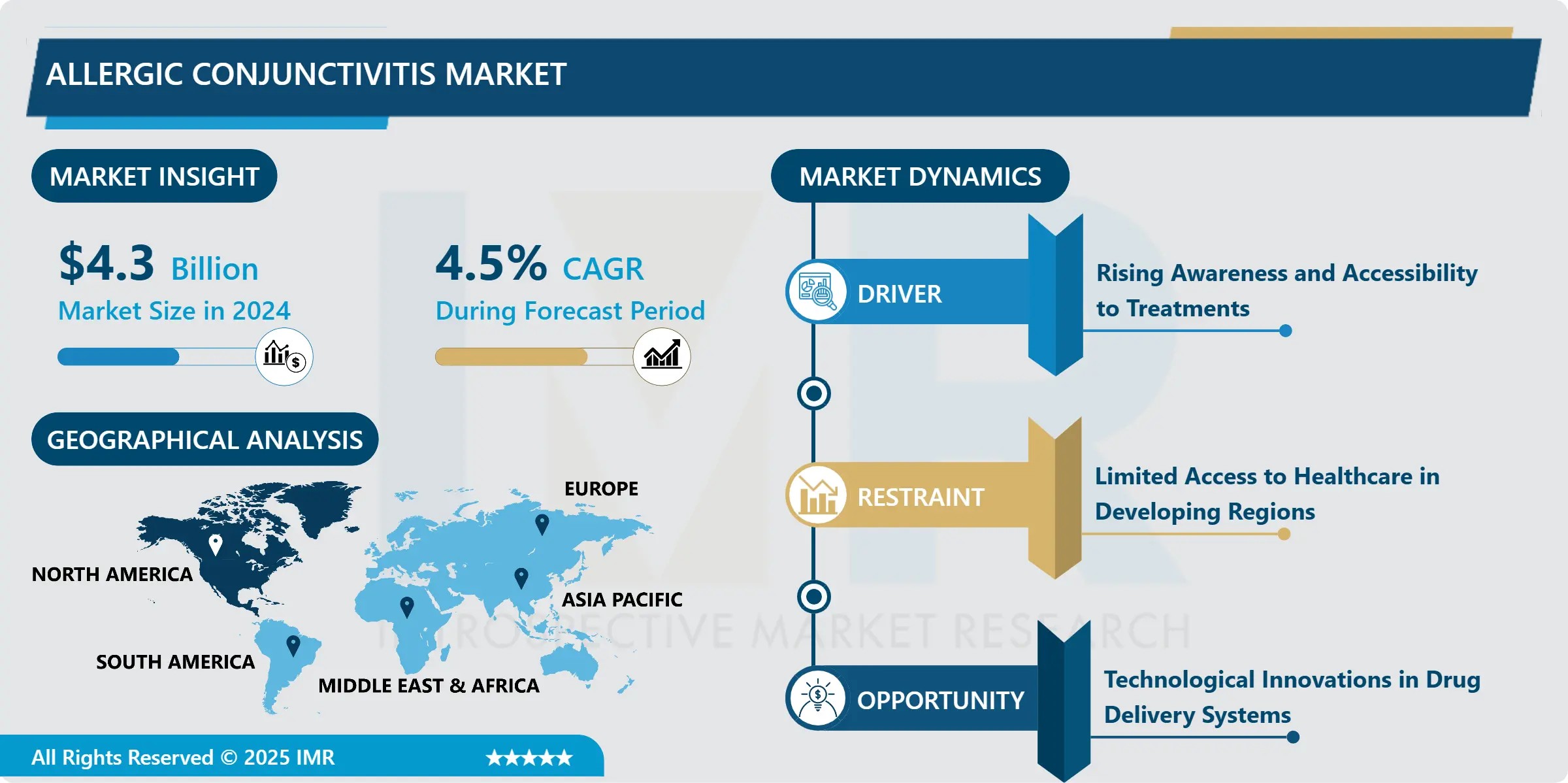
Allergic Conjunctivitis Market is segmented on the basis of Type, Treatment, End-User, and Region

|
Global Allergic Conjunctivitis Market |
|||
|
Base Year: |
2024 |
Forecast Period: |
2025-2035 |
|
Historical Data: |
2018 to 2023 |
Market Size in 2024: |
USD 4.3 Billion |
|
Forecast Period 2025-35 CAGR: |
4.5% |
Market Size in 2035: |
USD 6.39 Billion |
|
Segments Covered: |
Type |
|
|
|
Treatment |
|
||
|
End-User |
|
||
|
By Region |
|
||
|
Key Market Drivers: |
|
||
|
Key Market Restraints: |
|
||
|
Key Opportunities: |
|
||
|
Companies Covered in the report: |
|
||
Chapter 1: Introduction
1.1 Scope and Coverage
Chapter 2:Executive Summary
Chapter 3: Market Landscape
3.1 Market Dynamics
3.1.1 Drivers
3.1.2 Restraints
3.1.3 Opportunities
3.1.4 Challenges
3.2 Market Trend Analysis
3.3 PESTLE Analysis
3.4 Porter's Five Forces Analysis
3.5 Industry Value Chain Analysis
3.6 Ecosystem
3.7 Regulatory Landscape
3.8 Price Trend Analysis
3.9 Patent Analysis
3.10 Technology Evolution
3.11 Investment Pockets
3.12 Import-Export Analysis
Chapter 4: Allergic Conjunctivitis Market by Type (2018-2035)
4.1 Allergic Conjunctivitis Market Snapshot and Growth Engine
4.2 Market Overview
4.3 Seasonal Allergic Conjunctivitis
4.3.1 Introduction and Market Overview
4.3.2 Historic and Forecasted Market Size in Value USD and Volume Units
4.3.3 Key Market Trends, Growth Factors, and Opportunities
4.3.4 Geographic Segmentation Analysis
4.4 Perennial Allergic Conjunctivitis
Chapter 5: Allergic Conjunctivitis Market by Treatment (2018-2035)
5.1 Allergic Conjunctivitis Market Snapshot and Growth Engine
5.2 Market Overview
5.3 Antihistamines
5.3.1 Introduction and Market Overview
5.3.2 Historic and Forecasted Market Size in Value USD and Volume Units
5.3.3 Key Market Trends, Growth Factors, and Opportunities
5.3.4 Geographic Segmentation Analysis
5.4 Mast Cell Stabilizers
5.5 Nonsteroidal Anti-inflammatory Drugs(NSAIDs)
5.6 Corticosteroids
5.7 Others
Chapter 6: Allergic Conjunctivitis Market by End-User (2018-2035)
6.1 Allergic Conjunctivitis Market Snapshot and Growth Engine
6.2 Market Overview
6.3 Hospitals
6.3.1 Introduction and Market Overview
6.3.2 Historic and Forecasted Market Size in Value USD and Volume Units
6.3.3 Key Market Trends, Growth Factors, and Opportunities
6.3.4 Geographic Segmentation Analysis
6.4 Ophthalmology Clinics
6.5 Home Care Settings
Chapter 7: Company Profiles and Competitive Analysis
7.1 Competitive Landscape
7.1.1 Competitive Benchmarking
7.1.2 Allergic Conjunctivitis Market Share by Manufacturer (2024)
7.1.3 Industry BCG Matrix
7.1.4 Heat Map Analysis
7.1.5 Mergers and Acquisitions
7.2 ABBVIE (USA)
7.2.1 Company Overview
7.2.2 Key Executives
7.2.3 Company Snapshot
7.2.4 Role of the Company in the Market
7.2.5 Sustainability and Social Responsibility
7.2.6 Operating Business Segments
7.2.7 Product Portfolio
7.2.8 Business Performance
7.2.9 Key Strategic Moves and Recent Developments
7.2.10 SWOT Analysis
7.3 ALCON (SWITZERLAND)
7.4 BAUSCH & LOMB (USA)
7.5 JOHNSON & JOHNSON VISION CARE (USA)
7.6 MEDA PHARMACEUTICALS (SWEDEN)
7.7 NOVARTIS (SWITZERLAND)
7.8 OCULAR THERAPEUTIX (USA)
7.9 REGENERON PHARMACEUTICALS (USA)
7.10 SANOFI (FRANCE)
7.11 SANTEN PHARMACEUTICAL (JAPAN)
7.12
Chapter 8: Global Allergic Conjunctivitis Market By Region
8.1 Overview
8.2. North America Allergic Conjunctivitis Market
8.2.1 Key Market Trends, Growth Factors and Opportunities
8.2.2 Top Key Companies
8.2.3 Historic and Forecasted Market Size by Segments
8.2.4 Historic and Forecasted Market Size By Type
8.2.4.1 Seasonal Allergic Conjunctivitis
8.2.4.2 Perennial Allergic Conjunctivitis
8.2.5 Historic and Forecasted Market Size By Treatment
8.2.5.1 Antihistamines
8.2.5.2 Mast Cell Stabilizers
8.2.5.3 Nonsteroidal Anti-inflammatory Drugs(NSAIDs)
8.2.5.4 Corticosteroids
8.2.5.5 Others
8.2.6 Historic and Forecasted Market Size By End-User
8.2.6.1 Hospitals
8.2.6.2 Ophthalmology Clinics
8.2.6.3 Home Care Settings
8.2.7 Historic and Forecast Market Size by Country
8.2.7.1 US
8.2.7.2 Canada
8.2.7.3 Mexico
8.3. Eastern Europe Allergic Conjunctivitis Market
8.3.1 Key Market Trends, Growth Factors and Opportunities
8.3.2 Top Key Companies
8.3.3 Historic and Forecasted Market Size by Segments
8.3.4 Historic and Forecasted Market Size By Type
8.3.4.1 Seasonal Allergic Conjunctivitis
8.3.4.2 Perennial Allergic Conjunctivitis
8.3.5 Historic and Forecasted Market Size By Treatment
8.3.5.1 Antihistamines
8.3.5.2 Mast Cell Stabilizers
8.3.5.3 Nonsteroidal Anti-inflammatory Drugs(NSAIDs)
8.3.5.4 Corticosteroids
8.3.5.5 Others
8.3.6 Historic and Forecasted Market Size By End-User
8.3.6.1 Hospitals
8.3.6.2 Ophthalmology Clinics
8.3.6.3 Home Care Settings
8.3.7 Historic and Forecast Market Size by Country
8.3.7.1 Russia
8.3.7.2 Bulgaria
8.3.7.3 The Czech Republic
8.3.7.4 Hungary
8.3.7.5 Poland
8.3.7.6 Romania
8.3.7.7 Rest of Eastern Europe
8.4. Western Europe Allergic Conjunctivitis Market
8.4.1 Key Market Trends, Growth Factors and Opportunities
8.4.2 Top Key Companies
8.4.3 Historic and Forecasted Market Size by Segments
8.4.4 Historic and Forecasted Market Size By Type
8.4.4.1 Seasonal Allergic Conjunctivitis
8.4.4.2 Perennial Allergic Conjunctivitis
8.4.5 Historic and Forecasted Market Size By Treatment
8.4.5.1 Antihistamines
8.4.5.2 Mast Cell Stabilizers
8.4.5.3 Nonsteroidal Anti-inflammatory Drugs(NSAIDs)
8.4.5.4 Corticosteroids
8.4.5.5 Others
8.4.6 Historic and Forecasted Market Size By End-User
8.4.6.1 Hospitals
8.4.6.2 Ophthalmology Clinics
8.4.6.3 Home Care Settings
8.4.7 Historic and Forecast Market Size by Country
8.4.7.1 Germany
8.4.7.2 UK
8.4.7.3 France
8.4.7.4 The Netherlands
8.4.7.5 Italy
8.4.7.6 Spain
8.4.7.7 Rest of Western Europe
8.5. Asia Pacific Allergic Conjunctivitis Market
8.5.1 Key Market Trends, Growth Factors and Opportunities
8.5.2 Top Key Companies
8.5.3 Historic and Forecasted Market Size by Segments
8.5.4 Historic and Forecasted Market Size By Type
8.5.4.1 Seasonal Allergic Conjunctivitis
8.5.4.2 Perennial Allergic Conjunctivitis
8.5.5 Historic and Forecasted Market Size By Treatment
8.5.5.1 Antihistamines
8.5.5.2 Mast Cell Stabilizers
8.5.5.3 Nonsteroidal Anti-inflammatory Drugs(NSAIDs)
8.5.5.4 Corticosteroids
8.5.5.5 Others
8.5.6 Historic and Forecasted Market Size By End-User
8.5.6.1 Hospitals
8.5.6.2 Ophthalmology Clinics
8.5.6.3 Home Care Settings
8.5.7 Historic and Forecast Market Size by Country
8.5.7.1 China
8.5.7.2 India
8.5.7.3 Japan
8.5.7.4 South Korea
8.5.7.5 Malaysia
8.5.7.6 Thailand
8.5.7.7 Vietnam
8.5.7.8 The Philippines
8.5.7.9 Australia
8.5.7.10 New Zealand
8.5.7.11 Rest of APAC
8.6. Middle East & Africa Allergic Conjunctivitis Market
8.6.1 Key Market Trends, Growth Factors and Opportunities
8.6.2 Top Key Companies
8.6.3 Historic and Forecasted Market Size by Segments
8.6.4 Historic and Forecasted Market Size By Type
8.6.4.1 Seasonal Allergic Conjunctivitis
8.6.4.2 Perennial Allergic Conjunctivitis
8.6.5 Historic and Forecasted Market Size By Treatment
8.6.5.1 Antihistamines
8.6.5.2 Mast Cell Stabilizers
8.6.5.3 Nonsteroidal Anti-inflammatory Drugs(NSAIDs)
8.6.5.4 Corticosteroids
8.6.5.5 Others
8.6.6 Historic and Forecasted Market Size By End-User
8.6.6.1 Hospitals
8.6.6.2 Ophthalmology Clinics
8.6.6.3 Home Care Settings
8.6.7 Historic and Forecast Market Size by Country
8.6.7.1 Turkiye
8.6.7.2 Bahrain
8.6.7.3 Kuwait
8.6.7.4 Saudi Arabia
8.6.7.5 Qatar
8.6.7.6 UAE
8.6.7.7 Israel
8.6.7.8 South Africa
8.7. South America Allergic Conjunctivitis Market
8.7.1 Key Market Trends, Growth Factors and Opportunities
8.7.2 Top Key Companies
8.7.3 Historic and Forecasted Market Size by Segments
8.7.4 Historic and Forecasted Market Size By Type
8.7.4.1 Seasonal Allergic Conjunctivitis
8.7.4.2 Perennial Allergic Conjunctivitis
8.7.5 Historic and Forecasted Market Size By Treatment
8.7.5.1 Antihistamines
8.7.5.2 Mast Cell Stabilizers
8.7.5.3 Nonsteroidal Anti-inflammatory Drugs(NSAIDs)
8.7.5.4 Corticosteroids
8.7.5.5 Others
8.7.6 Historic and Forecasted Market Size By End-User
8.7.6.1 Hospitals
8.7.6.2 Ophthalmology Clinics
8.7.6.3 Home Care Settings
8.7.7 Historic and Forecast Market Size by Country
8.7.7.1 Brazil
8.7.7.2 Argentina
8.7.7.3 Rest of SA
Chapter 9 Analyst Viewpoint and Conclusion
9.1 Recommendations and Concluding Analysis
9.2 Potential Market Strategies
Chapter 10 Research Methodology
10.1 Research Process
10.2 Primary Research
10.3 Secondary Research
|
Global Allergic Conjunctivitis Market |
|||
|
Base Year: |
2024 |
Forecast Period: |
2025-2035 |
|
Historical Data: |
2018 to 2023 |
Market Size in 2024: |
USD 4.3 Billion |
|
Forecast Period 2025-35 CAGR: |
4.5% |
Market Size in 2035: |
USD 6.39 Billion |
|
Segments Covered: |
Type |
|
|
|
Treatment |
|
||
|
End-User |
|
||
|
By Region |
|
||
|
Key Market Drivers: |
|
||
|
Key Market Restraints: |
|
||
|
Key Opportunities: |
|
||
|
Companies Covered in the report: |
|
||
Related Reports
Understand your customers' needs so can deliver better services and experiences.
Stay in touch with us to get latest news and discount coupons.