




5G Smartphone Market Synopsis
5G Smartphone Market Size Was Valued at USD 189.70 Billion in 2023, and is Projected to Reach USD 1,956.65 Billion by 2032, Growing at a CAGR of 29.6% From 2024-2032.
The industry in focus is the global market that deals in products that use 5G technology in the production of smartphones. This technology offers internet connectivity, increased connection and interaction along with better functioning than previous technologies like 4G. This generation of smartphones is capable of considerable data download and upload, low latency while handling the huge number of connected gadgets required for all types of applications including entertainment, business and industries.
The portion of the global populated using 5G smartphones is growing at a very healthy rate due to the need for a better solution in the mobile communication market with improved data transfer rates, low latency and new opportunities in areas like Augmented Reality (AR), Virtual Reality (VR) as well as Internet of Things (IoT). As most telecommunication companies and network providers are also deploying 5G networks across many countries worldwide, consumers are equally embracing their 5G smartphones to get the best of the connectivity. The market is expected to rise significantly owing to the 5G upgrade that consumer are likely to do by replacing their 4G gadgets with 5G smartphones.
The 5G smartphone is more or less opened up for various key players to compete and stake their stake on it. Currently, Mobile phone manufacturers such as Apple, Samsung, Xiaomi and others are at the forefront of developing new generation most efficient devices which are compatible with 5G. Fluctuation of smartphone design, processing power, camera technology, and the ever-changing technology makes the 5G capability smartphones demand to rise. Furthermore, with the expansion of the networks to thebrutors and availability of 5G subscription plans, the consumers migrate to 5G mobiles to get the better network experience. Due to the increasing trend towards the direct-sale on the internet, the online sales channels are also integral aspect in the purchase of Smartphones; this has also boosted the growth of this market.
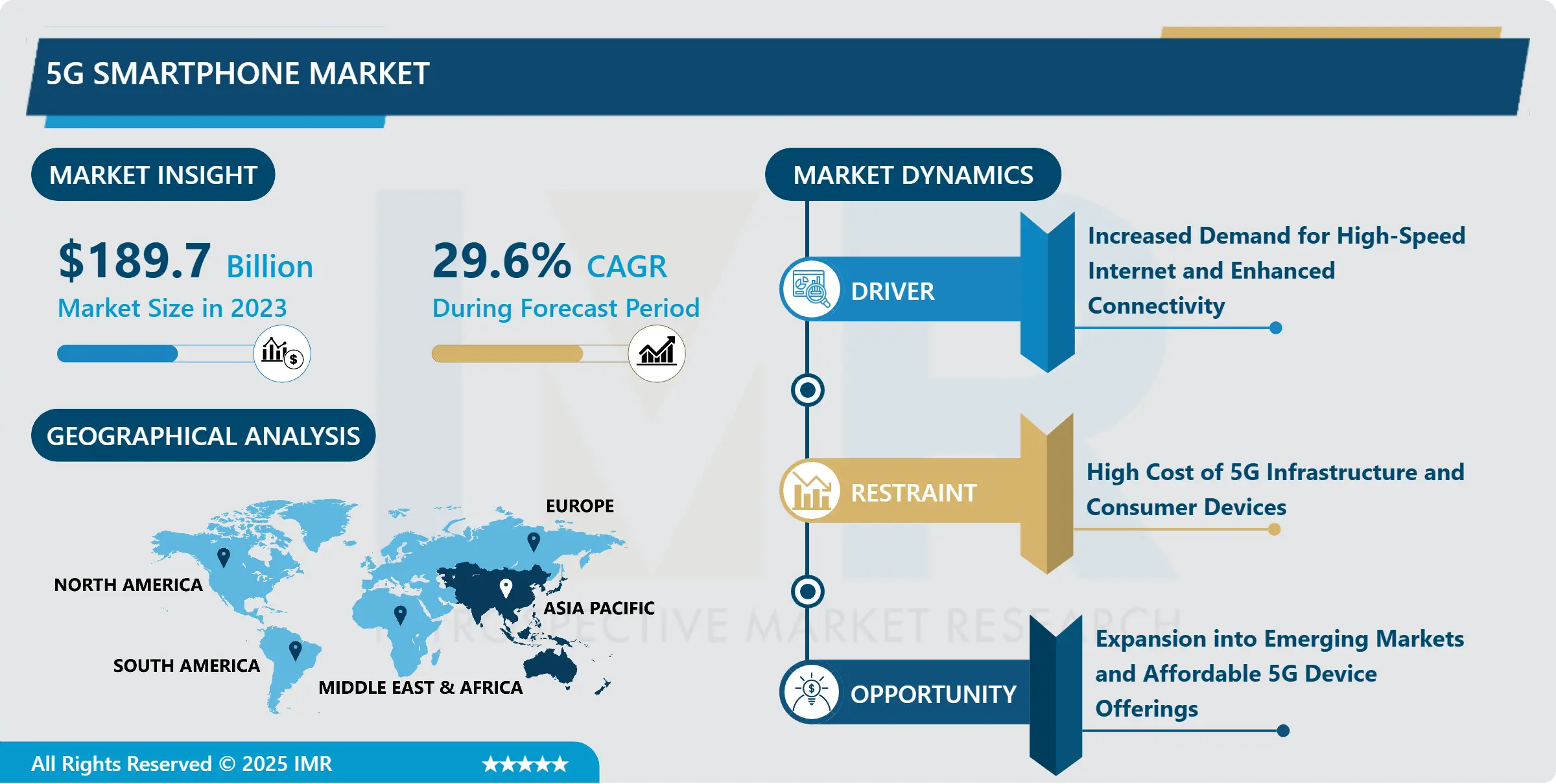
5G Smartphone Market Trend Analysis:
Growing 5G Network Expansion and Smartphone Adoption
- This rapid growth in 5G network coverage across the world is one of the factors that has accelerated the growth of 5G smartphone market. As more parts of the world are developing the infrastructure for 5G more consumers are beginning to appreciate the benefits of this form of connectivity. This is a development that smartphone makers have not left unnoticed, they are now launching more and more sub$200 5G devices that would make the tech a more mainstream feature. This is backed up by the rising number of telecom operators who are moving into the 5G services offering, which compel consumer to purchase compatible devices to enjoy so much benefit from the faster and more reliable internet connection. With network coverage continuing to expand, demand for 5G smartphones as standard forms from people will increase further due to new application cases in different fields like automobile, medical, and gaming.
Strategic Partnerships with Network Providers and Expansion into Emerging Markets
- Perhaps the greatest opportunity that innovators have in the 5G smartphone market is in developing strategic alliances with the network providers to sell the smartphone models bundled with service packages. Such partnerships can bring several incentives, bonuses, and customised service packages to make a shift to 5G smoother for consumers. The next option is the further penetration into emergent markets where the popularity of low-cost smartphones is especially rapidly growing. Thus, bringing 5G-price effective smartphones to these places can help companies access value-intersest areas and expand the market share. Also, as demand for the mobile data continues to rise in these markets, 5G technology will be a must have enabling requirement for smartphones, thus leading to more demand.
5G Smartphone Market Segment Analysis:
5G Smartphone Market is Segmented on the basis of Operating System, Sales Channel, and Region.
By Operating System, Android segment is expected to dominate the market during the forecast period
- The Android segment is expected to lead the 5G smartphones market during the forecast period due to the general acceptance of Android 5G phones in all classes of products. Smartphones using android are available from all companies including Samsung, Xiaomi and Oppo in the range of low end to high end brands. LT; This huge variety means that the consumer has more options, making Android phones the clear favourite for 5G. Still, the openness of the source code also offers flexibility appealing to various manufacturers while the innovation of the target market can be incorporated into the features of Android.
- Moreover, Android has its high market share supported by the richest application store indicating they consumers will be able to easily get the services and apps built for 5G. Some of the significant participants in the market are launching 5G enabled Android smartphones across the price segments so this segment is expected facilitate Android to remain dominant and perform better than iOS and other operating systems. Given the fact that the coverage of the networks is gradually improving its market share of Android is also expected rise even more as people upgrade to the 5G devices.
By Sales Channel, segment expected to held the largest share
- The information and communication technology sales channel is anticipated to dominate the 5G smartphone market throughout the forecast period through the online component. People are using e-commerce portals like Amazon, Flipkart, and the official page of 5G smartphone companies to buy smartphones with this technology. One of the major strengths comparing to the traditional sales is easy possibility to compare several models, to read various other customers’ comments, and, finally, to receive devices through enthusiasts’ doors. Besides, the online channel also provides other benefits such as basic discounts, promotion offers, and pre-order sales to purchase smartphones more than the physical channel.
- Also, due to the increase of COVID-19 cases, consumers seem to shop online, and even when COVID-19 is no longer a big threat to the population, they will continue to purchase things online since it is more convenient for them and there are usually better deals. Following the trend of directly reaching out to the customer via the internet, the direct selling of the 5G smartphone is expected to continue its large market share.
5G Smartphone Market Regional Insights:
Asia Pacific is Expected to Dominate the Market Over the Forecast period
- The Asia-Pacific (APAC) region accounted for the largest share in the global 5G smartphone market. This region captured a largest market share due to the presence of China, South Korea and Japan that are leading in 5G network implementation and smartphone use. China stood out as the market leader, having a colossal users’ base along with the 5G network operators and smartphone manufacturers. According to the current statistics, the APAC region dominated the global 5G smartphone total, being followed by rapidly increasing countries such as India due to the increasing availability of affordable 5G smartphones and networks.
Active Key Players in the 5G Smartphone Market
- Apple (USA)
- Asus (Taiwan)
- Google (USA)
- Huawei (China)
- LG Electronics (South Korea)
- Motorola (USA)
- Nokia (Finland)
- OnePlus (China)
- Oppo (China)
- Realme (China)
- Samsung (South Korea)
- Sony (Japan)
- Vivo (China)
- Xiaomi (China)
- ZTE (China)
- Other Active Players.
|
Global 5G Smartphone Market |
|||
|
Base Year: |
2023 |
Forecast Period: |
2024-2032 |
|
Historical Data: |
2017 to 2023 |
Market Size in 2023: |
USD 189.70 Billion |
|
Forecast Period 2024-32 CAGR: |
29.6% |
Market Size in 2032: |
USD 1,956.65 Billion |
|
Segments Covered: |
By Operating System |
|
|
|
By Sales Channel |
|
||
|
By Region |
|
||
|
Key Market Drivers: |
|
||
|
Key Market Restraints: |
|
||
|
Key Opportunities: |
|
||
|
Companies Covered in the report: |
|
||
Chapter 1: Introduction
1.1 Scope and Coverage
Chapter 2:Executive Summary
Chapter 3: Market Landscape
3.1 Market Dynamics
3.1.1 Drivers
3.1.2 Restraints
3.1.3 Opportunities
3.1.4 Challenges
3.2 Market Trend Analysis
3.3 PESTLE Analysis
3.4 Porter's Five Forces Analysis
3.5 Industry Value Chain Analysis
3.6 Ecosystem
3.7 Regulatory Landscape
3.8 Price Trend Analysis
3.9 Patent Analysis
3.10 Technology Evolution
3.11 Investment Pockets
3.12 Import-Export Analysis
Chapter 4: 5G Smartphone Market by Operating System
4.1 5G Smartphone Market Snapshot and Growth Engine
4.2 5G Smartphone Market Overview
4.3 Android
4.3.1 Introduction and Market Overview
4.3.2 Historic and Forecasted Market Size in Value USD and Volume Units (2017-2032F)
4.3.3 Key Market Trends, Growth Factors and Opportunities
4.3.4 Android: Geographic Segmentation Analysis
4.4 Windows
4.4.1 Introduction and Market Overview
4.4.2 Historic and Forecasted Market Size in Value USD and Volume Units (2017-2032F)
4.4.3 Key Market Trends, Growth Factors and Opportunities
4.4.4 Windows: Geographic Segmentation Analysis
4.5 IOS
4.5.1 Introduction and Market Overview
4.5.2 Historic and Forecasted Market Size in Value USD and Volume Units (2017-2032F)
4.5.3 Key Market Trends, Growth Factors and Opportunities
4.5.4 IOS: Geographic Segmentation Analysis
4.6 Others (Blackberry
4.6.1 Introduction and Market Overview
4.6.2 Historic and Forecasted Market Size in Value USD and Volume Units (2017-2032F)
4.6.3 Key Market Trends, Growth Factors and Opportunities
4.6.4 Others (Blackberry: Geographic Segmentation Analysis
4.7 Sailfish
4.7.1 Introduction and Market Overview
4.7.2 Historic and Forecasted Market Size in Value USD and Volume Units (2017-2032F)
4.7.3 Key Market Trends, Growth Factors and Opportunities
4.7.4 Sailfish: Geographic Segmentation Analysis
4.8 Tizen)
4.8.1 Introduction and Market Overview
4.8.2 Historic and Forecasted Market Size in Value USD and Volume Units (2017-2032F)
4.8.3 Key Market Trends, Growth Factors and Opportunities
4.8.4 Tizen): Geographic Segmentation Analysis
Chapter 5: 5G Smartphone Market by Sales Channel
5.1 5G Smartphone Market Snapshot and Growth Engine
5.2 5G Smartphone Market Overview
5.3 (Online Sales
5.3.1 Introduction and Market Overview
5.3.2 Historic and Forecasted Market Size in Value USD and Volume Units (2017-2032F)
5.3.3 Key Market Trends, Growth Factors and Opportunities
5.3.4 (Online Sales: Geographic Segmentation Analysis
5.4 Offline Sales
5.4.1 Introduction and Market Overview
5.4.2 Historic and Forecasted Market Size in Value USD and Volume Units (2017-2032F)
5.4.3 Key Market Trends, Growth Factors and Opportunities
5.4.4 Offline Sales: Geographic Segmentation Analysis
Chapter 6: Company Profiles and Competitive Analysis
6.1 Competitive Landscape
6.1.1 Competitive Benchmarking
6.1.2 5G Smartphone Market Share by Manufacturer (2023)
6.1.3 Industry BCG Matrix
6.1.4 Heat Map Analysis
6.1.5 Mergers and Acquisitions
6.2 APPLE (USA)
6.2.1 Company Overview
6.2.2 Key Executives
6.2.3 Company Snapshot
6.2.4 Role of the Company in the Market
6.2.5 Sustainability and Social Responsibility
6.2.6 Operating Business Segments
6.2.7 Product Portfolio
6.2.8 Business Performance
6.2.9 Key Strategic Moves and Recent Developments
6.2.10 SWOT Analysis
6.3 ASUS (TAIWAN)
6.4 GOOGLE (USA)
6.5 HUAWEI (CHINA)
6.6 LG ELECTRONICS (SOUTH KOREA)
6.7 MOTOROLA (USA)
6.8 NOKIA (FINLAND)
6.9 ONEPLUS (CHINA)
6.10 OPPO (CHINA)
6.11 REALME (CHINA)
6.12 SAMSUNG (SOUTH KOREA)
6.13 SONY (JAPAN)
6.14 XIAOMI (CHINA)
6.15 VIVO (CHINA)
6.16 ZTE (CHINA)
6.17 OTHER ACTIVE PLAYERS
Chapter 7: Global 5G Smartphone Market By Region
7.1 Overview
7.2. North America 5G Smartphone Market
7.2.1 Key Market Trends, Growth Factors and Opportunities
7.2.2 Top Key Companies
7.2.3 Historic and Forecasted Market Size by Segments
7.2.4 Historic and Forecasted Market Size By Operating System
7.2.4.1 Android
7.2.4.2 Windows
7.2.4.3 IOS
7.2.4.4 Others (Blackberry
7.2.4.5 Sailfish
7.2.4.6 Tizen)
7.2.5 Historic and Forecasted Market Size By Sales Channel
7.2.5.1 (Online Sales
7.2.5.2 Offline Sales
7.2.6 Historic and Forecast Market Size by Country
7.2.6.1 US
7.2.6.2 Canada
7.2.6.3 Mexico
7.3. Eastern Europe 5G Smartphone Market
7.3.1 Key Market Trends, Growth Factors and Opportunities
7.3.2 Top Key Companies
7.3.3 Historic and Forecasted Market Size by Segments
7.3.4 Historic and Forecasted Market Size By Operating System
7.3.4.1 Android
7.3.4.2 Windows
7.3.4.3 IOS
7.3.4.4 Others (Blackberry
7.3.4.5 Sailfish
7.3.4.6 Tizen)
7.3.5 Historic and Forecasted Market Size By Sales Channel
7.3.5.1 (Online Sales
7.3.5.2 Offline Sales
7.3.6 Historic and Forecast Market Size by Country
7.3.6.1 Russia
7.3.6.2 Bulgaria
7.3.6.3 The Czech Republic
7.3.6.4 Hungary
7.3.6.5 Poland
7.3.6.6 Romania
7.3.6.7 Rest of Eastern Europe
7.4. Western Europe 5G Smartphone Market
7.4.1 Key Market Trends, Growth Factors and Opportunities
7.4.2 Top Key Companies
7.4.3 Historic and Forecasted Market Size by Segments
7.4.4 Historic and Forecasted Market Size By Operating System
7.4.4.1 Android
7.4.4.2 Windows
7.4.4.3 IOS
7.4.4.4 Others (Blackberry
7.4.4.5 Sailfish
7.4.4.6 Tizen)
7.4.5 Historic and Forecasted Market Size By Sales Channel
7.4.5.1 (Online Sales
7.4.5.2 Offline Sales
7.4.6 Historic and Forecast Market Size by Country
7.4.6.1 Germany
7.4.6.2 UK
7.4.6.3 France
7.4.6.4 The Netherlands
7.4.6.5 Italy
7.4.6.6 Spain
7.4.6.7 Rest of Western Europe
7.5. Asia Pacific 5G Smartphone Market
7.5.1 Key Market Trends, Growth Factors and Opportunities
7.5.2 Top Key Companies
7.5.3 Historic and Forecasted Market Size by Segments
7.5.4 Historic and Forecasted Market Size By Operating System
7.5.4.1 Android
7.5.4.2 Windows
7.5.4.3 IOS
7.5.4.4 Others (Blackberry
7.5.4.5 Sailfish
7.5.4.6 Tizen)
7.5.5 Historic and Forecasted Market Size By Sales Channel
7.5.5.1 (Online Sales
7.5.5.2 Offline Sales
7.5.6 Historic and Forecast Market Size by Country
7.5.6.1 China
7.5.6.2 India
7.5.6.3 Japan
7.5.6.4 South Korea
7.5.6.5 Malaysia
7.5.6.6 Thailand
7.5.6.7 Vietnam
7.5.6.8 The Philippines
7.5.6.9 Australia
7.5.6.10 New Zealand
7.5.6.11 Rest of APAC
7.6. Middle East & Africa 5G Smartphone Market
7.6.1 Key Market Trends, Growth Factors and Opportunities
7.6.2 Top Key Companies
7.6.3 Historic and Forecasted Market Size by Segments
7.6.4 Historic and Forecasted Market Size By Operating System
7.6.4.1 Android
7.6.4.2 Windows
7.6.4.3 IOS
7.6.4.4 Others (Blackberry
7.6.4.5 Sailfish
7.6.4.6 Tizen)
7.6.5 Historic and Forecasted Market Size By Sales Channel
7.6.5.1 (Online Sales
7.6.5.2 Offline Sales
7.6.6 Historic and Forecast Market Size by Country
7.6.6.1 Turkiye
7.6.6.2 Bahrain
7.6.6.3 Kuwait
7.6.6.4 Saudi Arabia
7.6.6.5 Qatar
7.6.6.6 UAE
7.6.6.7 Israel
7.6.6.8 South Africa
7.7. South America 5G Smartphone Market
7.7.1 Key Market Trends, Growth Factors and Opportunities
7.7.2 Top Key Companies
7.7.3 Historic and Forecasted Market Size by Segments
7.7.4 Historic and Forecasted Market Size By Operating System
7.7.4.1 Android
7.7.4.2 Windows
7.7.4.3 IOS
7.7.4.4 Others (Blackberry
7.7.4.5 Sailfish
7.7.4.6 Tizen)
7.7.5 Historic and Forecasted Market Size By Sales Channel
7.7.5.1 (Online Sales
7.7.5.2 Offline Sales
7.7.6 Historic and Forecast Market Size by Country
7.7.6.1 Brazil
7.7.6.2 Argentina
7.7.6.3 Rest of SA
Chapter 8 Analyst Viewpoint and Conclusion
8.1 Recommendations and Concluding Analysis
8.2 Potential Market Strategies
Chapter 9 Research Methodology
9.1 Research Process
9.2 Primary Research
9.3 Secondary Research
|
Global 5G Smartphone Market |
|||
|
Base Year: |
2023 |
Forecast Period: |
2024-2032 |
|
Historical Data: |
2017 to 2023 |
Market Size in 2023: |
USD 189.70 Billion |
|
Forecast Period 2024-32 CAGR: |
29.6% |
Market Size in 2032: |
USD 1,956.65 Billion |
|
Segments Covered: |
By Operating System |
|
|
|
By Sales Channel |
|
||
|
By Region |
|
||
|
Key Market Drivers: |
|
||
|
Key Market Restraints: |
|
||
|
Key Opportunities: |
|
||
|
Companies Covered in the report: |
|
||


