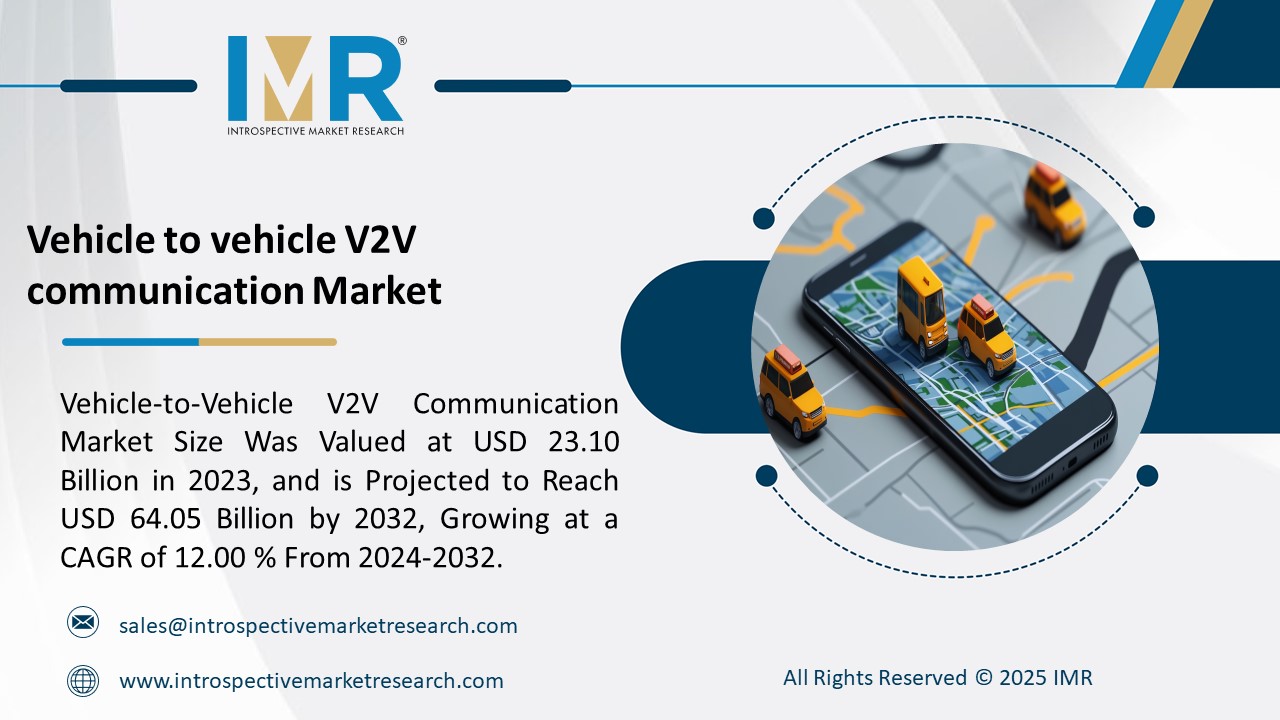
According to a new report published by Introspective Market Research, titled, Vehicle to Vehicle (V2V) Communication Market by Type (Dedicated Short-Range Communication (DSRC), Cellular-V2X (C-V2X)), Component (Hardware, Software), and Application (Traffic Management, Road Safety, Autonomous Driving), The Global Vehicle to Vehicle (V2V) Communication Market Size Was Valued at USD 23.10 Billion in 2023 and is Projected to Reach USD 64.05 Billion by 2032, Growing at a CAGR of 12.00%. Vehicle-to-Vehicle (V2V) communication is a crucial technology that enables vehicles to wirelessly exchange real-time information about their speed, location, direction, and other driving dynamics with nearby vehicles. This exchange of data, facilitated by technologies such as Dedicated Short-Range Communication (DSRC) or Cellular-V2X (C-V2X), creates a dynamic network that significantly enhances situational awareness for drivers and increasingly, for autonomous systems. The primary goal of V2V communication is to improve road safety, optimize traffic flow, and pave the way for fully autonomous driving.
The distinct advantage of V2V communication over traditional sensor-based safety systems is its ability to "see" beyond the line of sight, allowing vehicles to detect potential hazards and communicate intentions even around corners, through obstacles, or in adverse weather conditions. This proactive approach to safety can prevent a vast number of accidents, reduce traffic congestion, and minimize fuel consumption. Its main uses span critical applications in road safety warnings (e.g., collision avoidance, blind spot warnings), efficient traffic management, and as a foundational element for the development and deployment of cooperative autonomous driving systems.
A key growth driver for the Vehicle to Vehicle (V2V) Communication Market is the escalating global concern over road safety and the urgent need to reduce traffic accidents. V2V technology significantly mitigates collision risks by enabling vehicles to communicate warnings about impending hazards, sudden braking, or adverse road conditions. Governments and automotive manufacturers are increasingly mandating or promoting the integration of V2V systems to enhance driver awareness and reduce fatalities and injuries, thereby fueling rapid market expansion as a critical component of advanced safety features.
A significant market opportunity for Vehicle to Vehicle (V2V) Communication lies in its indispensable role in the advancement and widespread adoption of autonomous driving. V2V communication provides autonomous vehicles with an enriched perception of their surroundings, extending beyond the range of their onboard sensors and enabling cooperative maneuvers with other connected vehicles. As the automotive industry progresses towards higher levels of driving automation, the seamless and reliable exchange of information between vehicles via V2V technology will become fundamental, creating a substantial growth avenue for market players developing these crucial communication systems.
Vehicle to Vehicle (V2V) Communication Market, Segmentation
The Vehicle to Vehicle (V2V) Communication Market is segmented on the basis of Type, Component, and Application.
Type
-
The Type segment is further classified into Dedicated Short-Range Communication (DSRC) and Cellular-V2X (C-V2X). Among these, the Cellular-V2X (C-V2X) sub-segment accounted for the highest market share in 2023. Cellular-V2X (C-V2X) is increasingly dominating the V2V communication market due to its ability to leverage existing cellular infrastructure (LTE and 5G networks) for communication, offering broader coverage, enhanced reliability, and higher bandwidth compared to DSRC. C-V2X supports both direct communication between vehicles (sidelink) and communication via the network, providing a more versatile and scalable solution for connected vehicle ecosystems. Its integration with emerging 5G networks further enhances its capabilities, solidifying its position as the preferred technology for future V2V applications.
Component
-
The Component segment is further classified into Hardware and Software. Among these, the Hardware sub-segment accounted for the highest market share in 2023. The hardware component segment, which includes transceivers, antennas, onboard units (OBUs), and roadside units (RSUs), holds the largest market share due to its fundamental role in enabling V2V communication. Every vehicle and infrastructure point requiring V2V functionality necessitates the installation of these physical components. As V2V adoption expands, the demand for robust, reliable, and standardized hardware units for seamless data exchange will continue to be a primary driver, making it the dominant segment within the market.
Some of The Leading/Active Market Players Are-
- Qualcomm Technologies, Inc. (USA)
- NXP Semiconductors N.V. (Netherlands)
- Robert Bosch GmbH (Germany)
- Continental AG (Germany)
- Denso Corporation (Japan)
- Autotalks Ltd. (Israel)
- Huawei Technologies Co., Ltd. (China)
- Harman International (USA)
- Lear Corporation (USA)
- LG Electronics (South Korea)
- Delphi Technologies (UK)
- Infineon Technologies AG (Germany)
- Cohda Wireless (Australia)
- Kapsch TrafficCom AG (Austria)
- Marvell Technology, Inc. (USA)
- and other active players.
Key Industry Developments
- In February 2023, Qualcomm Technologies announced new advancements in its C-V2X platform, aimed at accelerating the deployment of advanced V2X use cases, including enhanced safety and autonomous driving features. These innovations focus on improving communication reliability and latency, crucial for real-time data exchange between vehicles. Qualcomm's continuous investment highlights the industry's commitment to evolving C-V2X technology to meet the demanding requirements of future connected and autonomous vehicles, solidifying its market leadership.
- In November 2022, Continental AG successfully demonstrated its latest C-V2X communication module integrated into production vehicles for real-world testing in Europe. This milestone marked a significant step towards the commercialization of C-V2X technology, showcasing its readiness for widespread adoption in various automotive platforms. Such successful demonstrations are vital for building confidence in the technology's capabilities among automakers and regulatory bodies, paving the way for broader implementation.
Key Findings of the Study
- Cellular-V2X (C-V2X) dominates the market due to its advanced capabilities and leverage of existing cellular networks.
- The Hardware component segment holds the largest market share as it is essential for V2V functionality.
- Key growth drivers include increasing focus on road safety and government mandates for V2V integration.
- A significant market opportunity exists in V2V's role as a foundational technology for autonomous driving.