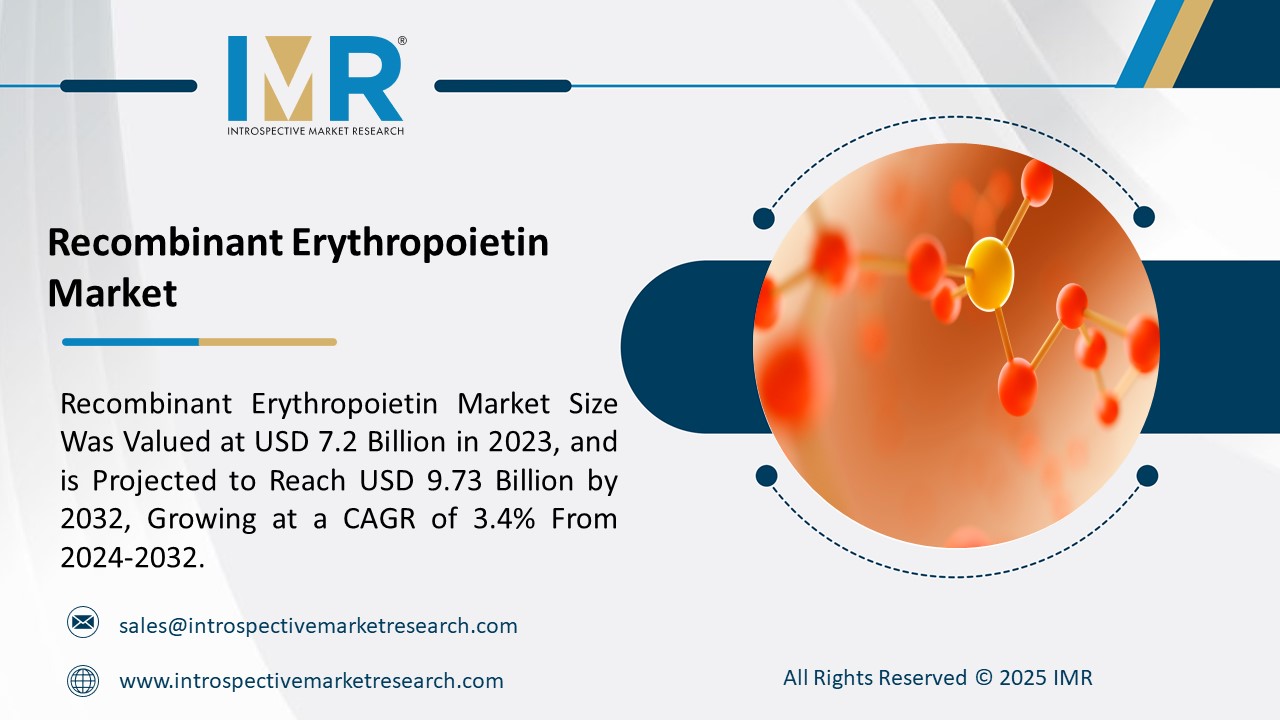
According to a new report published by Introspective Market Research, titled, Recombinant Erythropoietin Market by Drug Type (Epoetin-Alfa, Epoetin-Beta, Darbepoetin-Alfa, and Others), By Application (Anemia, Cancer, Renal Disease, HIV Treatment, and Others), By End-user (Hospitals, Clinics, Specialty Centers, and Others), The Global Recombinant Erythropoietin Market Size Was Valued at USD 7.2 Billion in 2023 and is Projected to Reach USD 9.73 Billion by 2032, Growing at a CAGR of 3.4%. The Recombinant Erythropoietin (EPO) Market comprises biopharmaceutical products that mimic the natural hormone erythropoietin, primarily responsible for stimulating red blood cell production in the bone marrow. These recombinant drugs are crucial in treating various forms of anemia, particularly those associated with chronic kidney disease (CKD), cancer chemotherapy, and certain viral infections like HIV. By artificially boosting red blood cell count, recombinant EPO helps to alleviate symptoms of anemia such as fatigue, weakness, and shortness of breath, significantly improving patients' quality of life.
The development of recombinant EPO has revolutionized the management of anemia, offering a highly effective alternative to blood transfusions, which carry risks of infection and immune reactions. Its main advantages include a targeted mechanism of action, reduced risk of blood-borne diseases, and improved patient outcomes in specific anemic conditions. Major industries relying on these products are the pharmaceutical and biotechnology sectors, with a strong focus on clinical applications in nephrology, oncology, and hematology, where chronic anemia poses a significant health challenge.
A significant growth driver for the Recombinant Erythropoietin Market is the increasing global prevalence of chronic kidney disease (CKD). Anemia is a common and severe complication of CKD, developing as the kidneys lose their ability to produce sufficient natural erythropoietin. With the rising incidence of CKD worldwide, often linked to diabetes and hypertension, the demand for recombinant EPO to manage associated anemia is steadily growing. These drugs are essential in preventing serious health complications and improving the quality of life for millions of CKD patients, thereby bolstering market expansion.
A key market opportunity for the Recombinant Erythropoietin Market lies in the development and adoption of biosimilars. As patents for original recombinant EPO drugs expire, biosimilar versions are entering the market, offering more affordable alternatives with comparable efficacy and safety profiles. This increased accessibility and cost-effectiveness can significantly expand treatment access in developing regions and reduce healthcare expenditures in developed countries. The growing acceptance and regulatory pathways for biosimilars present a substantial opportunity for both manufacturers and patients, driving market penetration and broader therapeutic use.
Recombinant Erythropoietin Market, Segmentation
Drug Type
-
The Drug Type segment is further classified into Epoetin-Alfa, Epoetin-Beta, Darbepoetin-Alfa, and Others. Among these, the Epoetin-Alfa sub-segment accounted for the highest market share in 2023. Epoetin-Alfa is one of the pioneering and most widely used recombinant erythropoietin drugs. It has a long-standing history of clinical use and is a cornerstone in the treatment of anemia associated with chronic kidney disease, cancer chemotherapy, and in certain surgical settings to reduce the need for blood transfusions. Its established efficacy, comprehensive clinical data, and widespread acceptance among healthcare professionals and regulatory bodies contribute significantly to its dominant market share.
Application
-
The Application segment is further classified into Anemia, Cancer, Renal Disease, HIV Treatment, and Others. Among these, the Renal Disease sub-segment accounted for the highest market share in 2023. Anemia is almost universally present in patients with chronic kidney disease (CKD) due to impaired erythropoietin production by damaged kidneys. Recombinant erythropoietin drugs are the primary treatment for this condition, making the renal disease application the largest segment. EPO therapy significantly improves hemoglobin levels, reduces the need for transfusions, and enhances the overall well-being and cardiovascular health of CKD patients, underscoring its critical role in nephrology. The rising global burden of CKD directly fuels the demand in this application area.
Some of The Leading/Active Market Players Are-
- Amgen Inc. (USA)
- Johnson & Johnson (USA)
- F. Hoffmann-La Roche Ltd (Switzerland)
- Novartis AG (Switzerland)
- Pfizer Inc. (USA)
- LG Chem (South Korea)
- Kyowa Kirin Co., Ltd. (Japan)
- Biocon Ltd. (India)
- Dr. Reddy’s Laboratories Ltd. (India)
- Samsung Bioepis (South Korea)
- Celltrion Healthcare Co., Ltd. (South Korea)
- Stada Arzneimittel AG (Germany)
- Accord Healthcare (UK)
- Sandoz (Novartis subsidiary, Switzerland)
- Teva Pharmaceutical Industries Ltd. (Israel)
- other active players.
Key Industry Developments
-
In February 2023, a major pharmaceutical company announced positive phase 3 trial results for a novel long-acting erythropoietin biosimilar aimed at treating anemia in chronic kidney disease patients. This development signifies ongoing efforts to provide more convenient dosing schedules and cost-effective alternatives, potentially expanding patient access and market competition. The successful trial moves the biosimilar closer to regulatory approval and market entry.
- In July 2022, a biotechnology firm received regulatory approval in a key European market for its new Epoetin-Beta biosimilar. This approval further diversifies the treatment options available to patients suffering from anemia associated with renal disease and chemotherapy. The introduction of new biosimilars is crucial for driving down healthcare costs and increasing the availability of essential medicines across various regions.
Key Findings of the Study
- Epoetin-Alfa holds the largest market share among drug types.
- Anemia associated with renal disease is the leading application segment.
- The increasing prevalence of chronic kidney disease is a key market driver.
- The rise of biosimilars presents a significant market opportunity.
- The market is evolving towards more cost-effective and convenient dosing regimens.