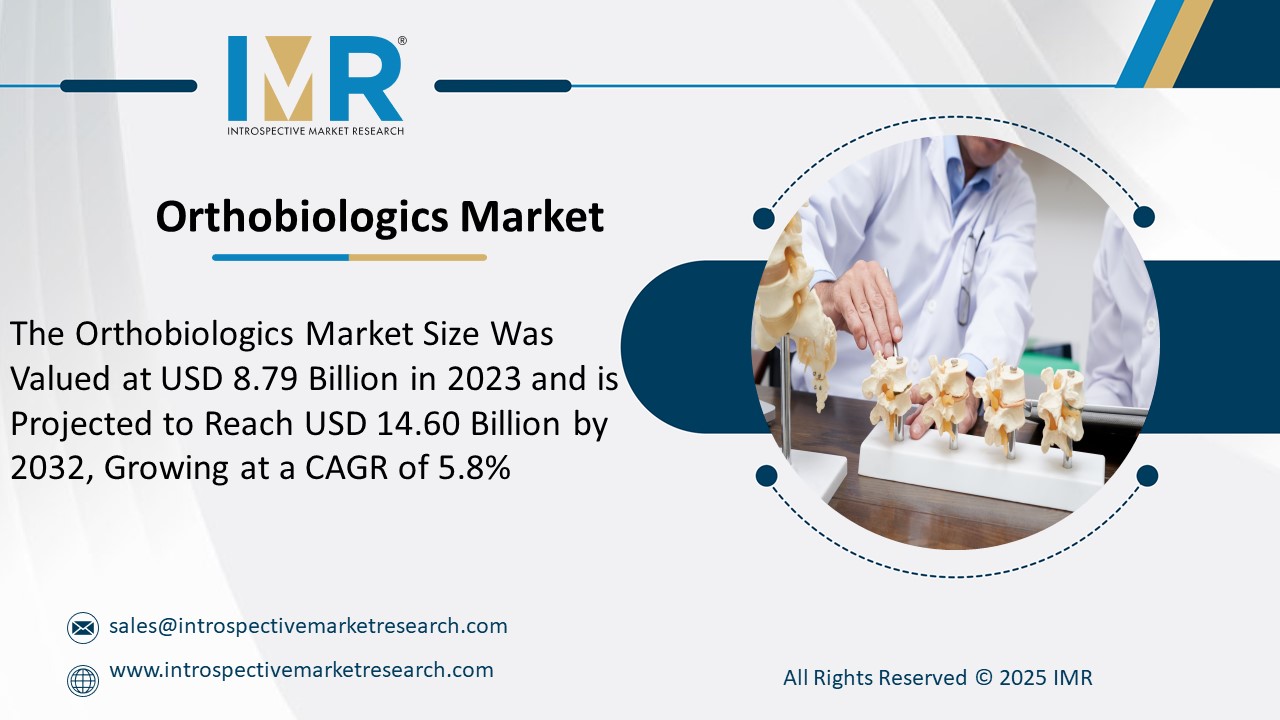
According to a new report published by Introspective Market Research, titled, Orthobiologics Market by Product, Application, and End-User, The Global Orthobiologics Market Size Was Valued at USD 8.79 Billion in 2023 and is Projected to Reach USD 14.60 Billion by 2032, Growing at a CAGR of 5.8% The Orthobiologics Market comprises biologically derived materials that enhance the body’s natural healing process in orthopedic injuries and musculoskeletal disorders. These products—such as bone graft substitutes, platelet-rich plasma (PRP), and stem cell-based therapies—are widely used to repair bone fractures, regenerate soft tissues, and accelerate post-surgical recovery.
Compared to conventional orthopedic treatments, orthobiologics offer faster recovery, reduced pain, and minimal risk of immune rejection. They have become a cornerstone in regenerative medicine and orthopedic surgeries, especially in spinal fusion, trauma repair, and sports medicine.
Increasing incidences of musculoskeletal injuries, rising geriatric population, and growing demand for minimally invasive regenerative treatments are driving global adoption. Continuous innovation in biomaterials and stem cell technology is further fueling market growth.
The Orthobiologics Market is segmented into Product, Application, and End-User. By Product, the market is categorized into (Bone Graft Substitutes, Viscosupplementation Products, Bone Growth Factors, Stem Cell Therapy, and Others). By Application, the market is categorized into (Spinal Fusion, Trauma Repair, Reconstructive Surgery, Osteoarthritis, and Others). By End-User, the market is categorized into (Hospitals, Orthopedic Clinics, and Research & Academic Centers).
One of the key growth drivers of the Orthobiologics Market is the increasing prevalence of osteoarthritis, degenerative bone diseases, and sports-related injuries worldwide. With the aging population expanding and more patients seeking quicker recovery options, the adoption of orthobiologic therapies that promote faster bone regeneration and tissue healing is rising. Furthermore, the growing preference for minimally invasive procedures supports sustained demand across healthcare facilities globally.
The major market opportunity lies in the development of next-generation orthobiologic materials using advanced tissue engineering and stem cell technologies. Emerging economies, particularly in Asia-Pacific and Latin America, present untapped potential due to improving healthcare infrastructure and increased awareness about regenerative therapies. Collaborations between biotech firms and orthopedic device manufacturers could further accelerate market penetration and innovation.
Orthobiologics Market, Segmentation
The Orthobiologics Market is segmented on the basis of Product, Application, and End-User.
Product
The Product segment is further classified into Bone Graft Substitutes, Viscosupplementation Products, Bone Growth Factors, Stem Cell Therapy, and Others. Among these, the Bone Graft Substitutes sub-segment accounted for the highest market share in 2023. Bone graft substitutes, including synthetic and natural materials, are widely used in spinal and trauma surgeries. They enhance bone healing and regeneration while reducing the need for autografts, minimizing donor site complications, and offering consistent availability for large-scale procedures.
Application
The Application segment is further classified into Spinal Fusion, Trauma Repair, Reconstructive Surgery, Osteoarthritis, and Others. Among these, the Spinal Fusion sub-segment accounted for the highest market share in 2023. Orthobiologics used in spinal fusion procedures improve the integration of bone grafts and promote new bone growth, offering better fusion rates and faster recovery. Increasing spinal disorders and the rising number of elective spine surgeries contribute significantly to this segment’s growth.
Some of The Leading/Active Market Players Are-
- Medtronic plc (Ireland)
- Stryker Corporation (U.S.)
- Zimmer Biomet Holdings, Inc. (U.S.)
- DePuy Synthes (Johnson & Johnson) (U.S.)
- Orthofix Medical Inc. (U.S.)
- Smith & Nephew plc (U.K.)
- Bioventus LLC (U.S.)
- RTI Surgical (U.S.)
- Arthrex, Inc. (U.S.)
- Terumo BCT, Inc. (Japan)
- Anika Therapeutics, Inc. (U.S.)
- Seaspine Holdings Corporation (U.S.)
- Kuros Biosciences AG (Switzerland)
- Novadip Biosciences (Belgium)
- RegenLab SA (Switzerland)
- other active players.
Key Industry Developments
-
In February 2024, Medtronic launched its next-generation bone graft substitute “Grafton XT” to enhance bone fusion outcomes in spinal and trauma surgeries.
The product incorporates optimized collagen matrices to improve osteoconductivity and accelerate bone growth, reinforcing Medtronic’s leadership in regenerative orthopedic solutions. - In July 2023, Stryker Corporation announced a partnership with a regenerative medicine firm to co-develop stem cell-based orthopedic implants.
The collaboration aims to combine Stryker’s implant technology with bioactive stem cell solutions, targeting improved musculoskeletal repair and expanding its orthobiologics product line.
Key Findings of the Study
• Bone Graft Substitutes dominated the market in 2023.
• Spinal Fusion accounted for the largest application share.
• North America leads due to advanced healthcare and high procedure volumes.
• Growing adoption of regenerative and minimally invasive treatments drives growth.
• Emerging economies offer untapped expansion opportunities