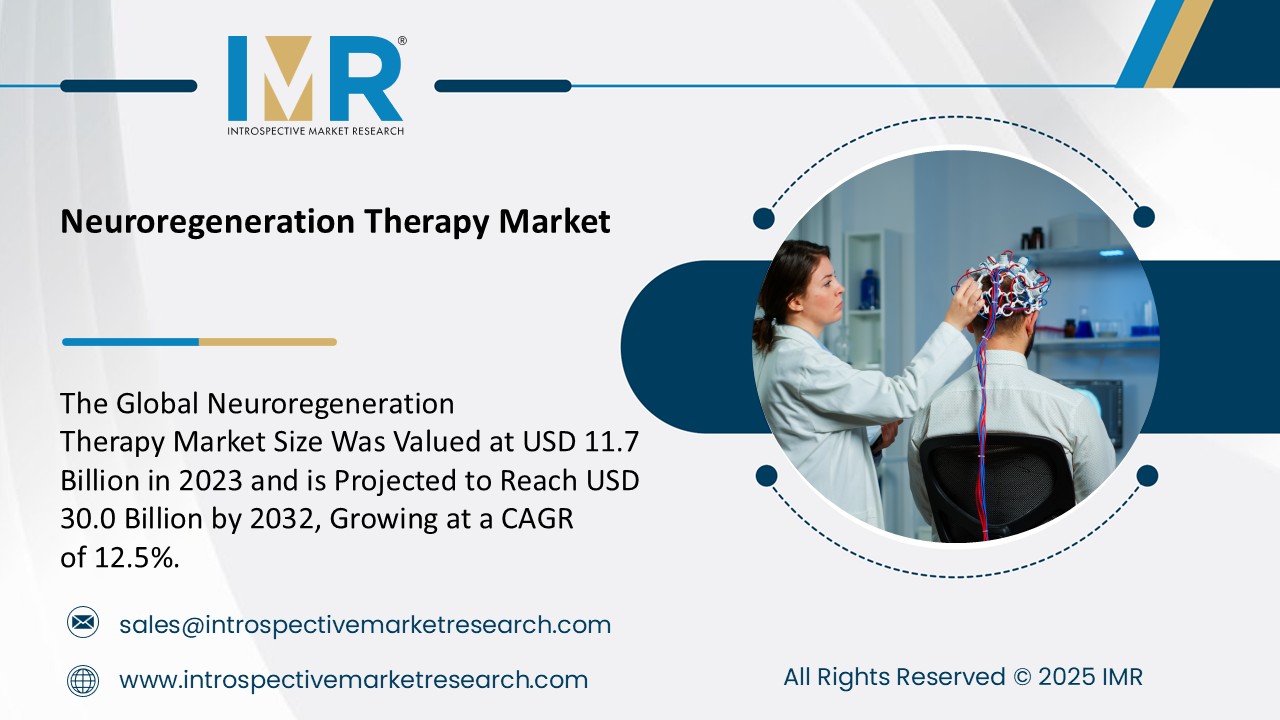
According to a new report published by Introspective Market Research, titled, Neuroregeneration Therapy Market by Treatment Type, Application, and End-Use, The Global Neuroregeneration Therapy Market Size Was Valued at USD 11.7 Billion in 2023 and is Projected to Reach USD 30.0 Billion by 2032, Growing at a CAGR of 12.5%. The neuroregeneration therapy market is witnessing significant growth as advancements in biotechnology and regenerative medicine drive innovation in treating neurological injuries and disorders. Neuroregeneration therapies are specialized treatments designed to repair, replace, or regenerate cells, tissues, and functions within the central and peripheral nervous systems. Unlike conventional drug therapies that largely focus on symptom management, these therapies target the root causes of neural degeneration, offering more effective and long-term recovery solutions.
The key advantages of neuroregeneration therapies include enhanced neural repair, improvement in motor and cognitive functions, and a reduced risk of secondary complications associated with neurological disorders. These treatments are becoming increasingly important for conditions such as spinal cord injuries, traumatic brain injuries, Alzheimer’s disease, Parkinson’s disease, and multiple sclerosis. Rising demand from the healthcare and research sectors, along with growing investments in stem cell technology and gene-based therapies, are fueling the global market demand.
The Neuroregeneration Therapy Market is segmented into Treatment Type, Application, and End-Use.
- By Treatment Type, the market is categorized into Cell-Based Therapies, Gene Therapies, Pharmacological Therapies, and Other Therapies.
- By Application, the market is categorized into Spinal Cord Injury, Traumatic Brain Injury, Neurodegenerative Diseases, and Other Applications.
- By End-Use, the market is categorized into Hospitals, Specialty Clinics, and Research Institutes.
One of the primary drivers of the neuroregeneration therapy market is the increasing global prevalence of neurodegenerative diseases such as Alzheimer’s, Parkinson’s, and multiple sclerosis. The aging population, combined with lifestyle-induced neurological complications, has led to a growing patient pool requiring advanced therapies. As traditional treatments fail to provide complete recovery, the demand for regenerative therapies that can restore neural function and improve quality of life is rapidly increasing. Additionally, ongoing research and government-backed initiatives are accelerating the adoption of these therapies worldwide.
A key opportunity for the neuroregeneration therapy market lies in the rapid expansion of stem-cell based therapies and clinical trials across emerging economies. Countries in Asia-Pacific and Latin America are investing heavily in biomedical research and offering supportive regulatory frameworks for regenerative medicine. This opens doors for global players to collaborate with local healthcare providers, expand clinical research networks, and establish affordable therapeutic solutions, thus tapping into underserved patient populations and enhancing market penetration worldwide.
Neuroregeneration Therapy Market, Segmentation
The Neuroregeneration Therapy Market is segmented on the basis of Treatment Type, Application, and End-Use.
Treatment Type
The Treatment Type segment is further classified into Cell-Based Therapies, Gene Therapies, Pharmacological Therapies, and Other Therapies. Among these, the Cell-Based Therapies sub-segment accounted for the highest market share in 2023. This dominance is attributed to extensive research in stem cell biology and its proven ability to replace damaged neurons and promote functional recovery. Many clinical trials have demonstrated significant potential for cell-based therapies in reversing neurological damage, thereby making it the most widely adopted modality in neuroregeneration practices.
Application
The Application segment is further classified into Spinal Cord Injuries, Traumatic Brain Injuries, Neurodegenerative Diseases, and Other Applications. Among these, the Neurodegenerative Diseases sub-segment accounted for the highest market share in 2023. Rising cases of Alzheimer’s and Parkinson’s disease, coupled with increasing healthcare expenditure on long-term neurological care, are key contributors. Neuroregeneration therapies offer new hope by slowing disease progression and restoring cognitive and motor functions, driving adoption across healthcare providers and patients.
Leading/Active Market Players
- Medtronic PLC (Ireland)
- Novo Nordisk A/S (Denmark)
- Athersys, Inc. (USA)
- Neuralstem, Inc. (USA)
- StemCells Inc. (USA)
- SanBio Co., Ltd. (Japan)
- ReNeuron Group Plc (UK)
- F. Hoffmann-La Roche Ltd. (Switzerland)
- Bayer AG (Germany)
- AxoGen, Inc. (USA)
- Biogen Inc. (USA)
- Abbott Laboratories (USA)
- Amgen Inc. (USA)
- Vericel Corporation (USA)
- Lonza Group AG (Switzerland)
- Other active players.
Key Industry Developments
In March 2024, Medtronic PLC announced a new collaboration with a leading research institute to develop advanced neuroregenerative cell-based products.
This partnership aims to accelerate clinical trials and bring innovative neuroregenerative therapies to market to address rising neurological disorders, especially among aging populations.
In July 2024, SanBio Co., Ltd. reported positive Phase II clinical trial results for its stem cell therapy for traumatic brain injury patients.
The study demonstrated significant improvements in motor recovery and patient quality of life, further validating the commercial potential of cell-based regenerative treatments for neurological diseases.
Key Findings of the Study
- Cell-Based Therapies dominated the treatment type segment in 2023.
- Neurodegenerative Diseases accounted for the largest application segment.
- North America led the global neuroregeneration therapy market due to strong R&D investments.
- Key growth driver: Rising prevalence of neurological disorders.
- Emerging trend: Increasing adoption of stem-cell therapies in Asia-Pacific.