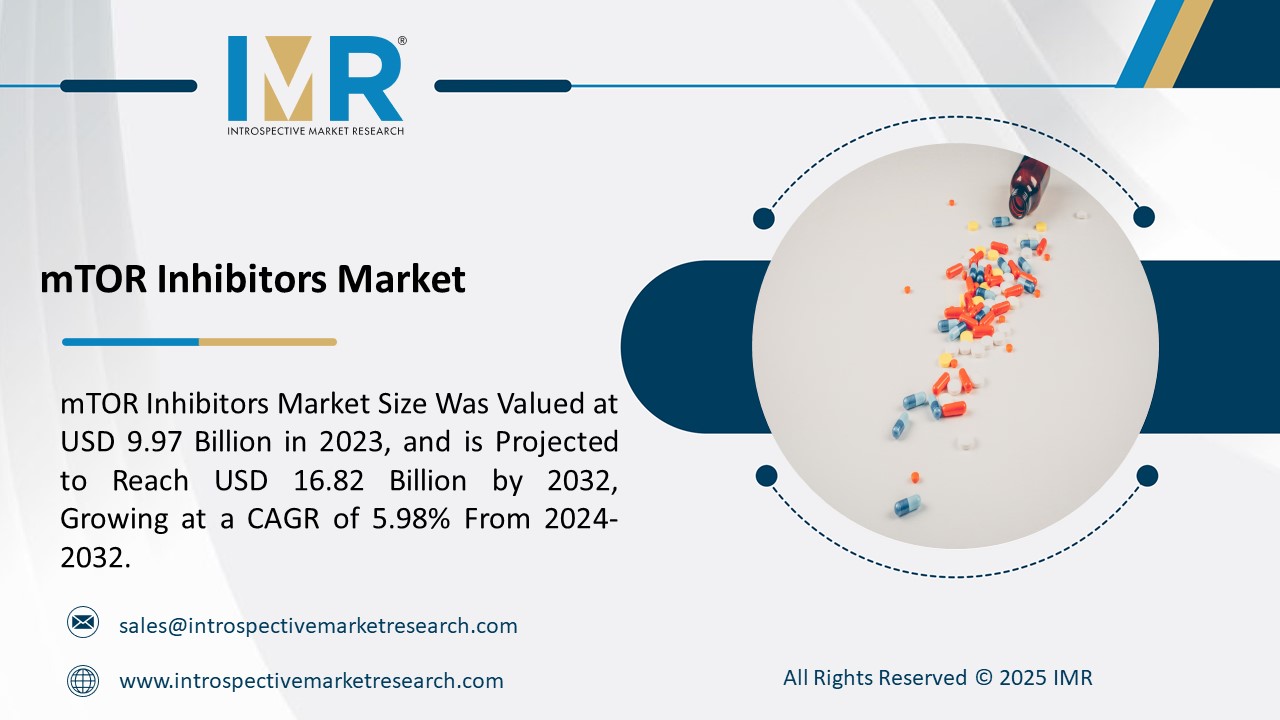
According to a new report published by Introspective Market Research, titled, mTOR Inhibitors Market by Drug Class, Application, and Distribution Channel, The Global mTOR Inhibitors Market Size Was Valued at USD 9.97 Billion in 2023 and is Projected to Reach USD 16.82 Billion by 2032, Growing at a CAGR of 5.98%. The mTOR inhibitors market focuses on a class of drugs that target the mammalian target of rapamycin (mTOR) pathway, a crucial regulator of cell growth, proliferation, metabolism, and survival. These inhibitors play a vital role in therapeutic strategies for various diseases, particularly in oncology and immunology, by disrupting the hyperactive signaling often observed in cancer and autoimmune conditions. Unlike traditional chemotherapy, mTOR inhibitors offer a more targeted approach, aiming to minimize damage to healthy cells.
These drugs are increasingly recognized for their efficacy in treating a range of cancers, including renal cell carcinoma, breast cancer, and certain neuroendocrine tumors, as well as preventing organ transplant rejection due to their immunosuppressive properties. Their ability to modulate complex cellular processes provides a significant advantage over broader-acting treatments, leading to improved patient outcomes and reduced side effects in many cases. The continuous advancements in understanding the mTOR pathway's role in disease pathophysiology are driving further research and development in this therapeutic area.
The rising global incidence of cancer is a primary growth driver for the mTOR inhibitors market. As cancer rates continue to climb worldwide, particularly for types where mTOR inhibitors are effective treatments such as renal cell carcinoma and breast cancer, the demand for these targeted therapies increases significantly. The growing understanding of cancer biology and the role of pathways like mTOR in tumor progression further drive the adoption of these inhibitors as part of multi-modal treatment regimens, aiming for improved patient survival and quality of life.
A significant market opportunity lies in the development of novel mTOR inhibitors with enhanced selectivity and reduced side effect profiles. While current inhibitors are effective, there is a continuous need for drugs that can specifically target different components or downstream effectors of the mTOR pathway, thereby potentially overcoming resistance mechanisms and improving therapeutic efficacy. Furthermore, exploring combination therapies with other targeted agents or immunotherapies presents a lucrative avenue to expand their application and improve patient outcomes across a wider range of challenging diseases.
mTOR Inhibitors Market, Segmentation
Drug Class
-
The Drug Class segment is further classified into Rapamycin Analogs (RapaLogs) and ATP-Competitive Inhibitors. Among these, the Rapamycin Analogs (RapaLogs) sub-segment accounted for the highest market share in 2023. RapaLogs, such as everolimus and sirolimus, have been foundational in the mTOR inhibitor market. Their established efficacy in treating various cancers, preventing organ rejection, and managing certain immunological disorders has led to their widespread adoption. These drugs work by forming a complex with FKBP12, which then binds to mTORC1, thereby inhibiting its activity. Their long-standing presence in clinical practice and extensive research history contribute to their dominant market position.
Application
-
The Application segment is further classified into Oncology, Organ Transplant Rejection, Immunological Disorders, and Others. Among these, the Oncology sub-segment accounted for the highest market share in 2023. The oncology application holds the largest market share due to the significant role of mTOR inhibitors in treating several types of cancer, including renal cell carcinoma, breast cancer, and neuroendocrine tumors. The hyperactivation of the mTOR pathway is a common feature in many malignancies, making it an attractive target for therapeutic intervention. Growing cancer incidence, coupled with the proven efficacy of these drugs in improving patient outcomes and survival rates, continues to drive their demand within cancer treatment protocols.
Some of The Leading/Active Market Players Are-
- Novartis AG (Switzerland)
- Pfizer Inc. (USA)
- AstraZeneca Plc (UK)
- Bristol-Myers Squibb Company (USA)
- Shionogi & Co., Ltd. (Japan)
- Bayer AG (Germany)
- Teva Pharmaceutical Industries Ltd. (Israel)
- Sun Pharmaceutical Industries Ltd. (India)
- Sandoz (A Novartis Division) (Switzerland)
- Cipla Ltd. (India)
- Dr. Reddy's Laboratories Ltd. (India)
- Glenmark Pharmaceuticals Limited (India)
- Zydus Lifesciences (India)
- Hikma Pharmaceuticals PLC (UK)
- Merck KGaA (Germany)
- other active players.
Key Industry Developments
- In May 2023, Novartis AG announced positive results from a Phase III clinical trial for an investigational mTOR inhibitor in combination with another targeted therapy for advanced breast cancer. This news underscored the potential for synergistic effects when mTOR inhibitors are combined with other agents. The positive trial outcomes could lead to new treatment options and expand the utility of mTOR-targeting drugs in oncology, benefiting a broader patient population.
- In November 2022, Pfizer Inc. received FDA fast-track designation for its novel ATP-competitive mTOR inhibitor for the treatment of a rare neurological disorder. This designation highlights the growing recognition of mTOR inhibitors beyond oncology and transplant applications. The fast-track status accelerates the development and review process, indicating the drug's potential to address an unmet medical need and offering hope for patients with limited treatment options for this specific condition.
Key Findings of the Study
- Rapamycin Analogs hold the largest share within drug classes.
- Oncology applications are the dominant segment.
- North America leads the market due to robust healthcare infrastructure.
- Rising cancer incidence is a key growth driver.
- Development of novel, targeted inhibitors is a significant market opportunity.