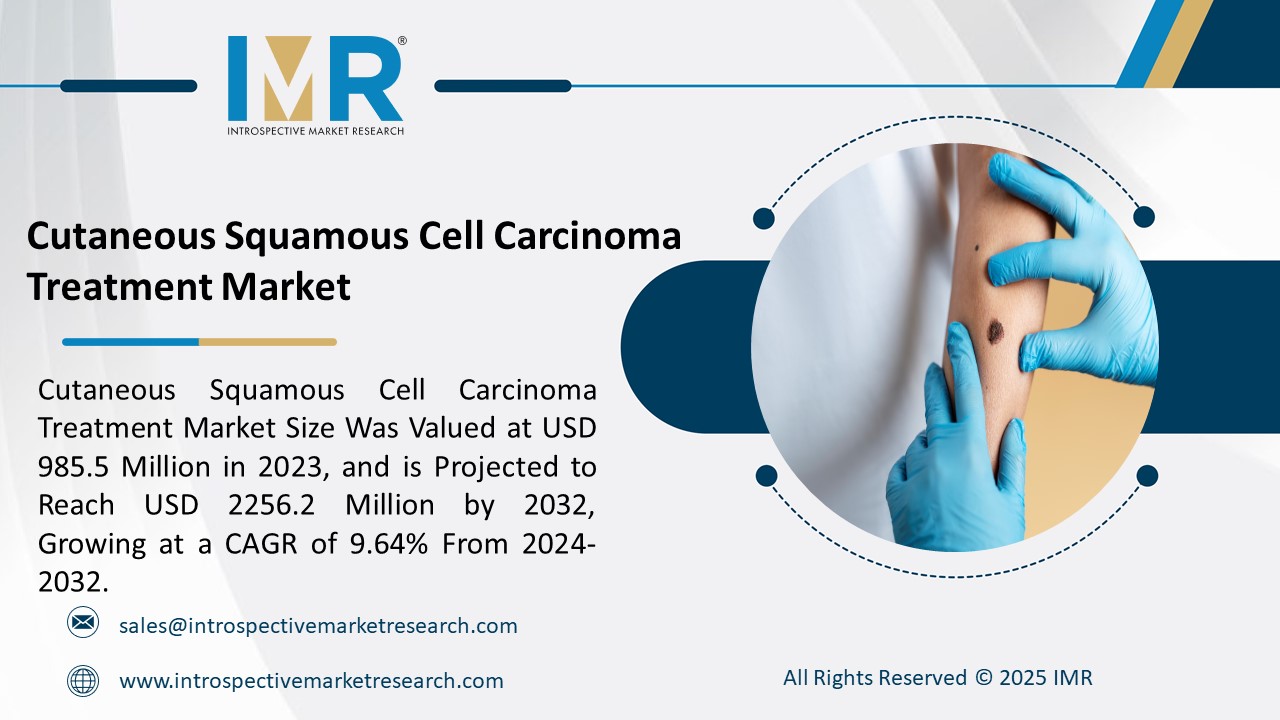
According to a new report published by Introspective Market Research, titled, Cutaneous Squamous Cell Carcinoma Treatment Market by Treatment Type, Route of Administration, and End-User, The Global Cutaneous Squamous Cell Carcinoma Treatment Market Size Was Valued at USD 985.5 Million in 2023 and is Projected to Reach USD 2,256.2 Million by 2032, Growing at a CAGR of 9.64%. The Cutaneous Squamous Cell Carcinoma (cSCC) Treatment Market is experiencing substantial growth, driven by the increasing incidence of non-melanoma skin cancers and rising awareness of early diagnosis and treatment options. cSCC is the second most common type of skin cancer, caused primarily by prolonged exposure to ultraviolet (UV) radiation. The demand for effective therapeutic options is increasing as patient populations expand, particularly among aging demographics and individuals with compromised immune systems.
The market encompasses various treatment modalities such as surgical excision, radiation therapy, and advanced targeted drug therapies. Recent advancements in immuno-oncology and biologics have transformed the treatment landscape, offering better survival outcomes and reduced recurrence rates. Moreover, the growing integration of molecular diagnostics and precision medicine enables clinicians to tailor therapies, leading to improved patient-specific results.
Pharmaceutical companies and research institutions are heavily investing in R&D to develop novel treatment options, including immune checkpoint inhibitors and targeted therapies. As healthcare infrastructure improves globally and clinical trials expand, the cSCC treatment market is expected to maintain its strong upward trajectory through 2032.
A key growth driver for the Cutaneous Squamous Cell Carcinoma Treatment Market is the increasing prevalence of UV-induced skin disorders and improved diagnostic accuracy. Rising cases of skin cancer due to ozone depletion, tanning bed usage, and prolonged sunlight exposure have heightened the demand for effective treatment solutions. Moreover, the development of advanced imaging and biopsy techniques allows for early detection, significantly improving treatment outcomes. The adoption of immunotherapy drugs and biologics is also accelerating as they offer higher efficacy and fewer side effects compared to traditional treatments.
A major opportunity in the market lies in the advancement of targeted therapies and immuno-oncology drugs. The increasing understanding of molecular pathways involved in cSCC has paved the way for therapies that specifically target tumor cell mechanisms. Emerging drugs such as PD-1 inhibitors (Cemiplimab, Pembrolizumab) and EGFR inhibitors (Cetuximab) have shown promising results in advanced or metastatic cases. Expanding clinical research and regulatory support for innovative drug approvals are expected to create significant opportunities for pharmaceutical companies aiming to expand their oncology portfolios.
Cutaneous Squamous Cell Carcinoma Treatment Market, Segmentation
The Cutaneous Squamous Cell Carcinoma Treatment Market is segmented on the basis of Treatment Type, Route of Administration, and End-User.
Treatment Type
-
The Treatment Type segment is further classified into Surgical Therapy, Radiation Therapy, Chemotherapy, Immunotherapy, and Targeted Therapy. Among these, the Surgical Therapy sub-segment accounted for the highest market share in 2023. Surgical excision remains the most common and effective treatment for localized cSCC, offering high cure rates and minimal recurrence. Its dominance is attributed to improved surgical technologies, availability of skilled dermatologic surgeons, and the effectiveness of procedures such as Mohs micrographic surgery.
Route of Administration
-
The Route of Administration segment is further classified into Oral, Injectable, and Topical. Among these, the Injectable sub-segment held the largest market share in 2023. Injectable therapies, especially immunotherapies and biologics, have gained widespread adoption due to their targeted mechanisms and robust clinical outcomes. Their growing use in combination therapies and advanced-stage cancer management further supports their market dominance.
Some of The Leading/Active Market Players Are:
- Sanofi S.A. (France)
- Regeneron Pharmaceuticals, Inc. (U.S.)
- Merck & Co., Inc. (U.S.)
- F. Hoffmann-La Roche Ltd. (Switzerland)
- Bristol Myers Squibb Company (U.S.)
- Novartis AG (Switzerland)
- Amgen Inc. (U.S.)
- Eli Lilly and Company (U.S.)
- Pfizer Inc. (U.S.)
- Sun Pharmaceutical Industries Ltd. (India)
- GlaxoSmithKline plc (U.K.)
- AstraZeneca plc (U.K.)
- Bayer AG (Germany)
- AbbVie Inc. (U.S.)
- Takeda Pharmaceutical Company Ltd. (Japan)
- and other active players.
Key Industry Developments
- In February 2024, Regeneron Pharmaceuticals and Sanofi announced new positive clinical trial results for Cemiplimab, demonstrating improved progression-free survival rates in patients with advanced cutaneous squamous cell carcinoma. The findings are expected to expand the drug’s indication portfolio globally.
- In July 2023, Merck & Co. initiated a Phase III clinical trial evaluating Pembrolizumab as a first-line treatment for recurrent and metastatic cSCC. The study aims to further establish the efficacy of PD-1 inhibitors in non-melanoma skin cancer treatment frameworks.
Key Findings of the Study
- Surgical Therapy dominated the market in 2023.
- Injectable Route of Administration held the largest market share.
- Hospitals were the leading end-user segment globally.
- North America led the market due to advanced healthcare infrastructure.
- Immunotherapy and targeted drugs are shaping the next phase of growth.