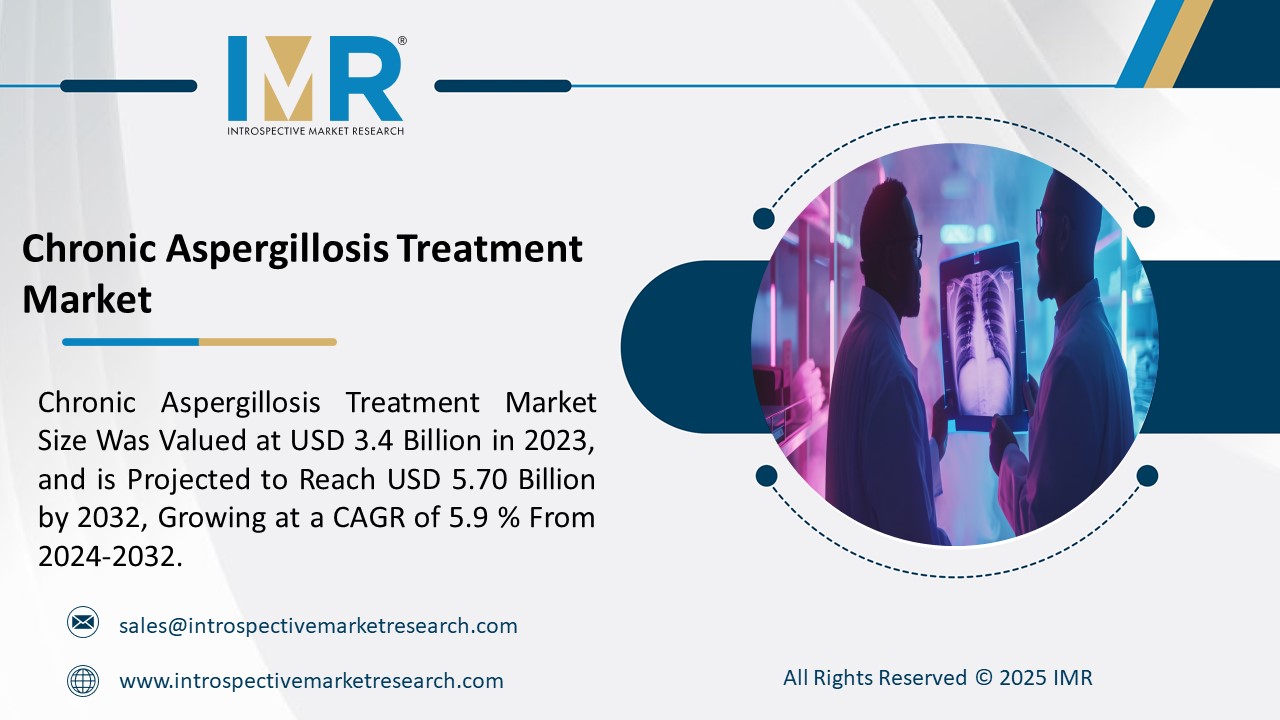
According to a new report published by Introspective Market Research, titled, Chronic Aspergillosis Treatment Market by Drug Class, Route of Administration, and Distribution Channel, The Global Chronic Aspergillosis Treatment Market Size Was Valued at USD 3.4 Billion in 2023 and is Projected to Reach USD 5.70 Billion by 2032, Growing at a CAGR of 5.9%. The Chronic Aspergillosis Treatment Market is witnessing steady growth, driven by the rising prevalence of chronic pulmonary aspergillosis (CPA) and increasing awareness regarding fungal infections. Aspergillosis is a life-threatening fungal infection caused by Aspergillus species, particularly affecting individuals with pre-existing lung conditions such as tuberculosis, COPD, or cystic fibrosis. The growing demand for effective antifungal therapies and advancements in diagnostic techniques are key factors supporting market expansion.
Pharmaceutical companies are increasingly focusing on developing novel antifungal drugs and combination therapies that target resistant strains of Aspergillus. Moreover, the availability of improved diagnostic tools, such as galactomannan assays and PCR-based methods, has enhanced the early detection and treatment outcomes of aspergillosis. The growing investment in R&D activities and the increasing approval rate of new antifungal drugs are creating favorable conditions for market growth.
Additionally, the rising geriatric population, higher exposure to immunosuppressive therapies, and growing incidences of lung diseases have further accelerated the demand for effective chronic aspergillosis treatment solutions. North America and Europe currently dominate the market due to robust healthcare infrastructure and significant awareness, while emerging economies in Asia-Pacific present lucrative growth opportunities.
A key growth driver for the Chronic Aspergillosis Treatment Market is the increasing prevalence of chronic respiratory diseases and immunocompromised patients. Individuals with weakened immune systems due to organ transplants, cancer treatments, or chronic lung disorders are more susceptible to aspergillosis infections. As healthcare awareness grows and diagnostic capabilities improve, there has been a significant rise in the identification and management of these infections. The development of newer antifungal formulations and advancements in drug delivery systems are further boosting treatment efficiency and patient compliance, driving the overall market forward.
A major market opportunity lies in the emergence of innovative antifungal agents and personalized treatment approaches. Researchers and pharmaceutical companies are focusing on developing next-generation antifungal drugs with enhanced efficacy and reduced toxicity, addressing the growing issue of drug resistance. Furthermore, the use of artificial intelligence (AI) in identifying resistant fungal strains and optimizing treatment protocols presents a promising frontier. Expanding healthcare access in developing regions and the introduction of cost-effective antifungal generics are expected to open new avenues for market expansion in the coming years.
Chronic Aspergillosis Treatment Market, Segmentation
The Chronic Aspergillosis Treatment Market is segmented on the basis of Drug Class, Route of Administration, and Distribution Channel.
Drug Class
-
The Drug Class segment is further classified into Azoles, Echinocandins, Polyenes, and Others. Among these, the Azoles segment accounted for the highest market share in 2023. Azole antifungals, including itraconazole and voriconazole, are the first-line treatment for chronic aspergillosis due to their broad-spectrum activity and proven clinical efficacy. These drugs inhibit ergosterol synthesis, a key component of fungal cell membranes, thereby restricting fungal growth. The rising availability of oral azole formulations and favorable patient outcomes continue to sustain this segment’s dominance.
Route of Administration
-
The Route of Administration segment is further classified into Oral, Intravenous, and Inhalation. Among these, the Oral sub-segment held the largest market share in 2023. Oral antifungal therapies are preferred due to their convenience, cost-effectiveness, and widespread use in outpatient settings. Additionally, the introduction of extended-release formulations and improved bioavailability products has further enhanced treatment adherence, reinforcing the growth of this segment.
Some of The Leading/Active Market Players Are-
- Pfizer Inc. (United States)
- Gilead Sciences, Inc. (United States)
- Novartis AG (Switzerland)
- Astellas Pharma Inc. (Japan)
- Merck & Co., Inc. (United States)
- Teva Pharmaceutical Industries Ltd. (Israel)
- Glenmark Pharmaceuticals (India)
- Hikma Pharmaceuticals PLC (United Kingdom)
- Cipla Ltd. (India)
- Mylan N.V. (United States)
- Sun Pharmaceutical Industries Ltd. (India)
- Abbott Laboratories (United States)
- Zydus Lifesciences Ltd. (India)
- Lupin Pharmaceuticals, Inc. (India)
- and other active players.
Key Industry Developments
- In January 2024, Pfizer Inc. announced the launch of a new triazole antifungal formulation aimed at improving oral bioavailability for patients with chronic aspergillosis.
- The new product is designed to reduce treatment duration and improve patient adherence by offering enhanced absorption and fewer side effects.
- In May 2024, Gilead Sciences, Inc. entered into a collaboration with Novartis AG to develop next-generation antifungal agents targeting resistant Aspergillus strains.
- This strategic partnership aims to combine Novartis’ drug discovery capabilities with Gilead’s infectious disease expertise to accelerate the development of innovative antifungal treatments.
Key Findings of the Study
- Azoles held the dominant share in the drug class segment in 2023.
- Oral route of administration accounted for the largest market share.
- North America led the global market in 2023, followed by Europe.
- Rising awareness and improved diagnostic capabilities drive market growth.
- Increasing R&D investments in antifungal drug development are key trends.