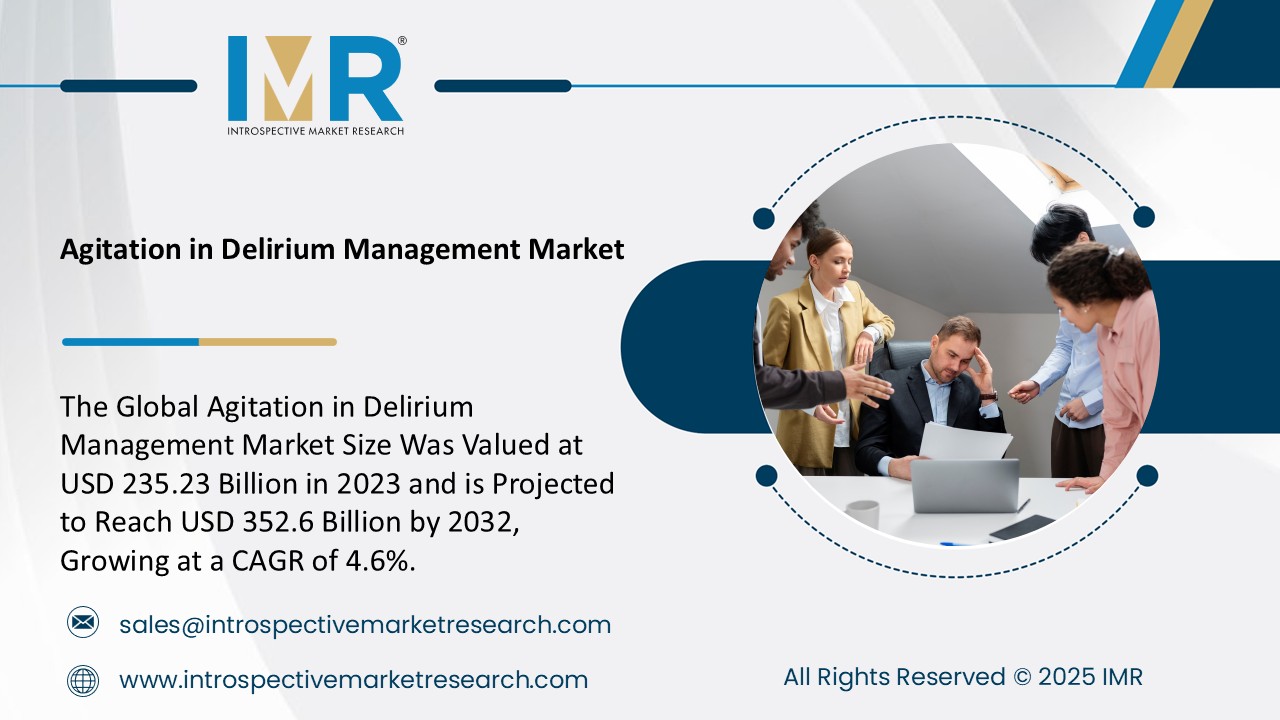
According to a new report published by Introspective Market Research, titled, Agitation in Delirium Management Market by Drug, Route of Administration, and End-User, The Global Agitation in Delirium Management Market Size Was Valued at USD 235.23 Billion in 2023 and is Projected to Reach USD 352.6 Billion by 2032, Growing at a CAGR of 4.6%. The Agitation in Delirium Management Market is rapidly evolving, with expanding demand for targeted therapies and comprehensive management strategies in hospital, intensive care, and elderly settings. Agitation, a prominent symptom of hyperactive delirium, poses significant challenges for patient safety and recovery, requiring both pharmacological treatments (antipsychotics, benzodiazepines) and non-pharmacological interventions (behavioral therapy, digital monitoring). Compared to traditional approaches, modern management protocols focus on early diagnosis, evidence-based interventions, and multidisciplinary care to reduce complications and improve outcomes.
Healthcare providers are increasingly adopting standardized protocols and advanced technologies—including real-time monitoring, telemedicine, and personalized medicine—to address agitation in delirium. These innovations enhance treatment precision and patient quality of life, supporting effective management across various clinical environments. The market’s growth is also driven by the rising prevalence of delirium in elderly populations, critical care admissions, and ongoing research into safer, more tolerable therapies.
The Agitation in Delirium Management Market is segmented into Drug, Route of Administration, and End-User.
- By Drug, the market is categorized into (First-generation Antipsychotics, Second-generation Antipsychotics, Benzodiazepines, Others).
- By Route of Administration, the market is categorized into (Oral, Intramuscular, Others).
- By End-User, the market is categorized into (Clinics, Hospitals, Others).
A key driver for this market is the escalating prevalence of delirium among elderly patients, critically ill individuals, and post-surgical populations, which underlines the urgent need for effective and holistic agitation management solutions. Increasing ICU admissions and growing awareness of the importance of early intervention are prompting healthcare providers to implement standardized therapies, blending pharmacological and behavioral strategies for better patient outcomes and reduced complications.
Significant opportunities lie in the adoption of telemedicine, digital monitoring, and personalized medicine for agitation in delirium care, especially in developing regions with aging populations. Integrating virtual consultation, remote intervention, and advanced analytics enables timely detection and intervention, improving therapy efficacy and expanding access to evidence-based treatment. Collaborative research among pharmaceutical firms and healthcare institutions is further accelerating the commercialization of innovative drug formulations and non-drug therapies.
Agitation in Delirium Management Market, Segmentation
The Agitation in Delirium Management Market is segmented on the basis of Drug, Route of Administration, and End-User.
Drug
The Drug segment is further classified into First-generation Antipsychotics, Second-generation Antipsychotics, Benzodiazepines, and Others. Among these, Second-generation Antipsychotics accounted for the highest market share in 2024. Their improved safety profile and lower risk of side effects make them preferred options among clinicians managing agitation in elderly and ICU patients. Drugs like risperidone and olanzapine offer flexible oral and injectable formulations, supporting widespread hospital and clinic adoption.
Route of Administration
The Route of Administration segment is further classified into Oral, Intramuscular, and Others. The Oral segment dominated the market in 2024. Its ease of use, higher patient compliance, and broad accessibility help ensure timely and effective management of agitation. Oral medications facilitate routine clinical workflows and offer safety benefits for elderly and vulnerable patient groups.
Some of The Leading/Active Market Players Are-
- Teva Pharmaceutical Industries Ltd. (Israel)
- Sun Pharmaceutical Industries Ltd. (India)
- Glenmark Pharmaceuticals Limited (India)
- Pfizer Inc. (U.S.)
- Fresenius Kabi AG (Germany)
- Zydus Cadila (India)
- BioXcel Therapeutics, Inc. (U.S.)
- Otsuka Holdings Co., Ltd. (Japan)
- Axsome Therapeutics, Inc. (U.S.)
- H. Lundbeck A/S (Denmark)
- Novartis AG (Switzerland)
- Mylan N.V. (U.S.)
- Akorn Incorporated (U.S.)
- Takeda Pharmaceutical Company Limited (Japan)
- 0ther active players.
Key Industry Developments
In September 2025, the American Psychiatric Association released updated guidelines for delirium prevention and treatment, recommending expanded use of second-generation antipsychotics and integrated behavioral protocols. These guidelines aim to improve early intervention, reduce complication rates, and address evolving clinical needs in ICU and geriatric care settings. The recommendations are expected to shape hospital protocols globally.
In December 2024, Johns Hopkins researchers started a pilot study of an AI-equipped headset designed to shorten the duration of delirium and delay post-delirium cognitive decline. The device uses eye-tracking and automated audio to deliver non-pharmacological interventions, representing an innovative approach to agitation management in intensive care. Early research holds promise for broader adoption of digital solutions.
Key Findings of the Study
- Second-generation antipsychotics and oral medications dominate market share.
- North America leads due to advanced hospital infrastructure and high adoption rates.
- Growth driven by rising prevalence of delirium, standardized protocols, and new guidelines.
- Opportunities in telemedicine, digital monitoring, and collaborative R&D.
- AI and personalized medicine trends are reshaping the market landscape.