




Missile Defense System Market Synopsis
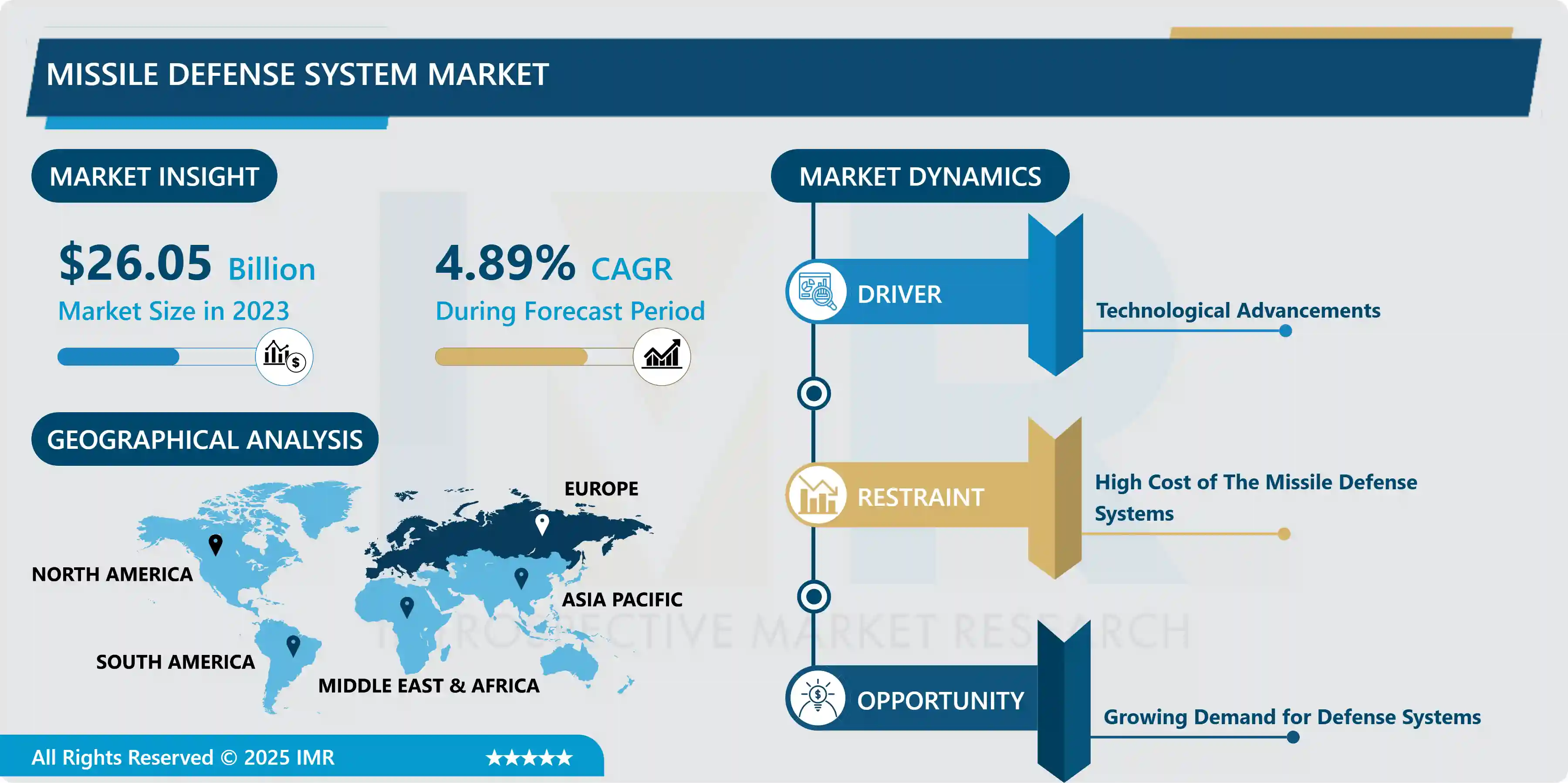
The Global Missile Defense System Market size is expected to grow from USD 26.05 billion in 2023 to USD 40.03 billion by 2032, at a CAGR of 4.89% during the forecast period (2024-2032).
Missile defense systems are land and sea-based technology that defense forces utilize to defend against a range of missiles, including cruise and ballistic missiles. The need for missile defense systems has increased significantly as a result of the growth in hostilities and war-like conditions in many regions of the world. Missile defense systems keep national assets and individuals safe from missile assaults.
The global Missile Defense System market has been experiencing notable growth, driven by increasing geopolitical tensions and the persistent threat of missile attacks. Countries around the world have been investing significantly in developing and upgrading their missile defense capabilities to safeguard against potential missile threats.
The market includes various types of missile defense systems, such as ground-based, sea-based, and air-based systems, each designed to intercept and neutralize incoming missiles at different stages of their trajectory. Key players in the market include major defense contractors and technology firms, and collaborations and partnerships among nations for joint missile defense initiatives have also contributed to the market's expansion.
Missile Defense System Market Trend Analysis
Technological Advancements
- Technological advancements play a pivotal role in propelling the growth of the missile defense system market. As nations face evolving security threats, the need for sophisticated and effective defense mechanisms has become paramount. The integration of cutting-edge technologies such as advanced sensors, artificial intelligence, and machine learning has significantly enhanced the capabilities of missile defense systems.
- Radar systems with improved detection and tracking capabilities enable early identification of incoming threats, allowing for timely and precise response measures. Additionally, advancements in interceptor missile technologies, including faster and more maneuverable interceptors, contribute to increased success rates in neutralizing incoming missiles.
- The integration of space-based assets, such as satellite-based sensors and communication systems, further enhances the overall effectiveness of missile defense systems. These advancements enable real-time data sharing and coordination, creating a more comprehensive and interconnected defense architecture.
- Furthermore, developments in directed energy weapons, like laser systems, offer new possibilities for intercepting and destroying missiles at the speed of light, presenting a futuristic dimension to missile defense capabilities.
Growing Demand for Defense Systems creates an Opportunity for Missile Defense System Market
- The growing demand for defense systems presents significant opportunities for the Missile Defense System (MDS) market. In an era marked by geopolitical tensions and evolving security threats, nations worldwide are increasingly prioritizing the development and enhancement of their missile defense capabilities. The escalating sophistication of ballistic missile technologies has underscored the need for robust defense mechanisms, driving investments in advanced MDS.
- Opportunities in the MDS market arise from the imperative to protect critical assets, population centers, and military installations from potential missile attacks. As nations seek to bolster their national security, the demand for cutting-edge missile defense solutions is on the rise. Additionally, collaborative efforts and alliances among countries to address shared security concerns contribute to the growth of the global MDS market.
- Technological advancements, such as the integration of artificial intelligence, advanced sensors, and precision interceptors, further enhance the effectiveness of missile defense systems. As governments allocate budgets to modernize and strengthen their defense infrastructure, the MDS market stands to benefit from sustained investment.
Missile Defense System Market Segment Analysis:
Missile Defense System Market Segmented on the basis of type, Range, and Domain.
By Type, Command & Control System segment is expected to dominate the market during the forecast period
- In the Missile Defense System Market, the Command & Control System segment is anticipated to assert dominance due to its critical role in orchestrating and coordinating various elements of missile defense operations. The Command & Control System serves as the nerve center, integrating sensors, interceptors, and communication systems to detect, track, and neutralize incoming threats effectively.
- This segment's dominance can be attributed to the increasing complexity of modern missile threats and the need for real-time decision-making capabilities. Advanced Command & Control Systems facilitate rapid data fusion, enabling military operators to assess and respond swiftly to evolving situations. The integration of artificial intelligence and machine learning technologies further enhances the system's ability to analyze vast amounts of data and improve overall situational awareness.
- Additionally, governments worldwide are investing significantly in upgrading their missile defense capabilities, with a focus on enhancing command and control functionalities. As geopolitical tensions persist and missile proliferation continues, the demand for robust Command & Control Systems is expected to remain high, further solidifying this segment's dominance in the Missile Defense System Market.
By Application, Short-Range segment held the largest share of 69% in 2022
- The Short-Range segment is poised to assert dominance within the market. This prominence can be attributed to several key factors driving the demand for short-range missile defense capabilities. Short-range missile defense systems are designed to intercept and neutralize incoming threats within relatively close proximity, offering rapid response times and enhanced protection for critical assets.
- The prevalence of regional conflicts and asymmetric threats has accentuated the need for agile and effective defense mechanisms, wherein short-range systems play a pivotal role. These systems are adept at safeguarding strategic locations, military installations, and population centers against short-range ballistic missiles and other airborne threats.
- Additionally, the cost-effectiveness and versatility of short-range missile defense systems contribute to their widespread adoption. Their ability to address a spectrum of evolving threats, ranging from tactical ballistic missiles to unmanned aerial vehicles, positions them as indispensable components of modern defense strategies.
Missile Defense System Market Regional Insights:
Europe is Expected to Dominate the Market Over the Forecast period
- Europe's dominance in the missile defense system market can be attributed to several factors. Geopolitical considerations and security concerns have prompted European nations to invest significantly in advanced defense technologies. The collaborative efforts of European countries, such as through organizations like the North Atlantic Treaty Organization (NATO), have led to joint initiatives for missile defense.
- Moreover, the complex security landscape, including potential threats from nearby regions, has underscored the importance of robust missile defense capabilities. European nations have been actively engaged in research, development, and deployment of state-of-the-art missile defense systems to protect against a range of potential threats.
Missile Defense System Market Top Key Players:
- Lockheed Martin (US)
- Raytheon Technologies (US)
- Northrop Grumman (US)
- Aerojet Rocketdyne Holdings, Inc. (US)
- L3Harris Technologies (US)
- Collins Aerospace (US)
- Honeywell International Inc. (US)
- General Dynamics (US)
- Boeing(US)
- BAE Systems (UK)
- MBDA France (France)
- Thales (France)
- Leonardo (Italy)
- Saab AB (Sweden)
- Rheinmetall (Germany)
- IAI - Israel Aerospace Industries Ltd. (Israel)
- Israel Aerospace Industries (Israel)
- Rafael Advanced Defense Systems Ltd. (Israel)
- Almaz-Antey Air Defense Concern (Russia)
- Bharat Dynamics Limited (India)
- China Aerospace Science and Technology Corporation (China)
- China North Industries Group Corporation (China)
- China South Industries Group Corporation (China)
- Hanwha Aerospace (South Korea)
- Mitsubishi Heavy Industries (Japan)
Key Industry Developments in the Missile Defense System Market:
- In July 2023, Raytheon successfully conducted the first flight test of its new Standard Missile 6 Block IA (SM-6 Block IA) interceptor. This upgrade boasts improved performance against hypersonic and maneuvering threats, including drones and cruise missiles.
- In August 2023, Lockheed Martin delivered the first Terminal High Altitude Area Defense (THAAD) Block IIA interceptor to the U.S. Army. This upgrade features enhancements in guidance and discrimination capabilities, aiming to counter evolving ballistic missile threats.
|
Global Missile Defense System Market |
|||
|
Base Year: |
2023 |
Forecast Period: |
2024-2032 |
|
Historical Data: |
2017 to 2023 |
Market Size in 2023: |
USD 26.05 Bn. |
|
Forecast Period 2024-34 CAGR: |
4.89% |
Market Size in 2032: |
USD 40.03 Bn. |
|
Segments Covered: |
By Type |
|
|
|
By Range |
|
||
|
By Domain |
|
||
|
By Region |
|
||
|
Key Market Drivers: |
|
||
|
Key Market Restraints: |
|
||
|
Key Opportunities: |
|
||
|
Companies Covered in the report: |
|
||
Chapter 1: Introduction
1.1 Scope and Coverage
Chapter 2:Executive Summary
Chapter 3: Market Landscape
3.1 Market Dynamics
3.1.1 Drivers
3.1.2 Restraints
3.1.3 Opportunities
3.1.4 Challenges
3.2 Market Trend Analysis
3.3 PESTLE Analysis
3.4 Porter's Five Forces Analysis
3.5 Industry Value Chain Analysis
3.6 Ecosystem
3.7 Regulatory Landscape
3.8 Price Trend Analysis
3.9 Patent Analysis
3.10 Technology Evolution
3.11 Investment Pockets
3.12 Import-Export Analysis
Chapter 4: Missile Defense System Market by Type (2018-2032)
4.1 Missile Defense System Market Snapshot and Growth Engine
4.2 Market Overview
4.3 Weapon System
4.3.1 Introduction and Market Overview
4.3.2 Historic and Forecasted Market Size in Value USD and Volume Units
4.3.3 Key Market Trends, Growth Factors, and Opportunities
4.3.4 Geographic Segmentation Analysis
4.4 Command & Control System
4.5 Fire Control System
4.6 Countermeasure System
Chapter 5: Missile Defense System Market by Range (2018-2032)
5.1 Missile Defense System Market Snapshot and Growth Engine
5.2 Market Overview
5.3 Short
5.3.1 Introduction and Market Overview
5.3.2 Historic and Forecasted Market Size in Value USD and Volume Units
5.3.3 Key Market Trends, Growth Factors, and Opportunities
5.3.4 Geographic Segmentation Analysis
5.4 Medium
5.5 Long
Chapter 6: Missile Defense System Market by Domain (2018-2032)
6.1 Missile Defense System Market Snapshot and Growth Engine
6.2 Market Overview
6.3 Ground
6.3.1 Introduction and Market Overview
6.3.2 Historic and Forecasted Market Size in Value USD and Volume Units
6.3.3 Key Market Trends, Growth Factors, and Opportunities
6.3.4 Geographic Segmentation Analysis
6.4 Marine
6.5 Air
6.6 Space
Chapter 7: Company Profiles and Competitive Analysis
7.1 Competitive Landscape
7.1.1 Competitive Benchmarking
7.1.2 Missile Defense System Market Share by Manufacturer (2024)
7.1.3 Industry BCG Matrix
7.1.4 Heat Map Analysis
7.1.5 Mergers and Acquisitions
7.2 IBM (US)
7.2.1 Company Overview
7.2.2 Key Executives
7.2.3 Company Snapshot
7.2.4 Role of the Company in the Market
7.2.5 Sustainability and Social Responsibility
7.2.6 Operating Business Segments
7.2.7 Product Portfolio
7.2.8 Business Performance
7.2.9 Key Strategic Moves and Recent Developments
7.2.10 SWOT Analysis
7.3 ORACLE (US)
7.4 MANHATTAN ASSOCIATES (US)
7.5 PTC (US)
7.6 INFOR (US)
7.7 SOFTEON (US)
7.8 BLUE YONDER (US)
7.9 IAM ROBOTICS (US)
7.10 EPICOR (US)
7.11 3PL CENTRAL (US)
7.12 BLUEJAY SOLUTIONS (US)
7.13 MANTIS (US)
7.14 SYNERGY LOGISTICS (US)
7.15 FOYSONIS (US)
7.16 LOCUS ROBOTICS (US)
7.17 SHIPHERO (US)
7.18 ORDERHIVE US)
7.19 LOGIWA (US)
7.20 TECSYS (CANADA)
7.21 GENERIC (FRANCE)
7.22 PSI LOGISTICS (GERMANY)
7.23 KORBER (GERMANY)
7.24 SAP (GERMANY)
7.25 REPLY (ITALY)
7.26 EASYECOM (INDIA)
7.27 VINCULUM (INDIA)
7.28 WAREIQ (INDIA) INCREFF (INDIA)
7.29 UNICOMMERCE (INDIA)
7.30 MICROLISTICS (AUSTRALIA)
Chapter 8: Global Missile Defense System Market By Region
8.1 Overview
8.2. North America Missile Defense System Market
8.2.1 Key Market Trends, Growth Factors and Opportunities
8.2.2 Top Key Companies
8.2.3 Historic and Forecasted Market Size by Segments
8.2.4 Historic and Forecasted Market Size by Type
8.2.4.1 Weapon System
8.2.4.2 Command & Control System
8.2.4.3 Fire Control System
8.2.4.4 Countermeasure System
8.2.5 Historic and Forecasted Market Size by Range
8.2.5.1 Short
8.2.5.2 Medium
8.2.5.3 Long
8.2.6 Historic and Forecasted Market Size by Domain
8.2.6.1 Ground
8.2.6.2 Marine
8.2.6.3 Air
8.2.6.4 Space
8.2.7 Historic and Forecast Market Size by Country
8.2.7.1 US
8.2.7.2 Canada
8.2.7.3 Mexico
8.3. Eastern Europe Missile Defense System Market
8.3.1 Key Market Trends, Growth Factors and Opportunities
8.3.2 Top Key Companies
8.3.3 Historic and Forecasted Market Size by Segments
8.3.4 Historic and Forecasted Market Size by Type
8.3.4.1 Weapon System
8.3.4.2 Command & Control System
8.3.4.3 Fire Control System
8.3.4.4 Countermeasure System
8.3.5 Historic and Forecasted Market Size by Range
8.3.5.1 Short
8.3.5.2 Medium
8.3.5.3 Long
8.3.6 Historic and Forecasted Market Size by Domain
8.3.6.1 Ground
8.3.6.2 Marine
8.3.6.3 Air
8.3.6.4 Space
8.3.7 Historic and Forecast Market Size by Country
8.3.7.1 Russia
8.3.7.2 Bulgaria
8.3.7.3 The Czech Republic
8.3.7.4 Hungary
8.3.7.5 Poland
8.3.7.6 Romania
8.3.7.7 Rest of Eastern Europe
8.4. Western Europe Missile Defense System Market
8.4.1 Key Market Trends, Growth Factors and Opportunities
8.4.2 Top Key Companies
8.4.3 Historic and Forecasted Market Size by Segments
8.4.4 Historic and Forecasted Market Size by Type
8.4.4.1 Weapon System
8.4.4.2 Command & Control System
8.4.4.3 Fire Control System
8.4.4.4 Countermeasure System
8.4.5 Historic and Forecasted Market Size by Range
8.4.5.1 Short
8.4.5.2 Medium
8.4.5.3 Long
8.4.6 Historic and Forecasted Market Size by Domain
8.4.6.1 Ground
8.4.6.2 Marine
8.4.6.3 Air
8.4.6.4 Space
8.4.7 Historic and Forecast Market Size by Country
8.4.7.1 Germany
8.4.7.2 UK
8.4.7.3 France
8.4.7.4 The Netherlands
8.4.7.5 Italy
8.4.7.6 Spain
8.4.7.7 Rest of Western Europe
8.5. Asia Pacific Missile Defense System Market
8.5.1 Key Market Trends, Growth Factors and Opportunities
8.5.2 Top Key Companies
8.5.3 Historic and Forecasted Market Size by Segments
8.5.4 Historic and Forecasted Market Size by Type
8.5.4.1 Weapon System
8.5.4.2 Command & Control System
8.5.4.3 Fire Control System
8.5.4.4 Countermeasure System
8.5.5 Historic and Forecasted Market Size by Range
8.5.5.1 Short
8.5.5.2 Medium
8.5.5.3 Long
8.5.6 Historic and Forecasted Market Size by Domain
8.5.6.1 Ground
8.5.6.2 Marine
8.5.6.3 Air
8.5.6.4 Space
8.5.7 Historic and Forecast Market Size by Country
8.5.7.1 China
8.5.7.2 India
8.5.7.3 Japan
8.5.7.4 South Korea
8.5.7.5 Malaysia
8.5.7.6 Thailand
8.5.7.7 Vietnam
8.5.7.8 The Philippines
8.5.7.9 Australia
8.5.7.10 New Zealand
8.5.7.11 Rest of APAC
8.6. Middle East & Africa Missile Defense System Market
8.6.1 Key Market Trends, Growth Factors and Opportunities
8.6.2 Top Key Companies
8.6.3 Historic and Forecasted Market Size by Segments
8.6.4 Historic and Forecasted Market Size by Type
8.6.4.1 Weapon System
8.6.4.2 Command & Control System
8.6.4.3 Fire Control System
8.6.4.4 Countermeasure System
8.6.5 Historic and Forecasted Market Size by Range
8.6.5.1 Short
8.6.5.2 Medium
8.6.5.3 Long
8.6.6 Historic and Forecasted Market Size by Domain
8.6.6.1 Ground
8.6.6.2 Marine
8.6.6.3 Air
8.6.6.4 Space
8.6.7 Historic and Forecast Market Size by Country
8.6.7.1 Turkiye
8.6.7.2 Bahrain
8.6.7.3 Kuwait
8.6.7.4 Saudi Arabia
8.6.7.5 Qatar
8.6.7.6 UAE
8.6.7.7 Israel
8.6.7.8 South Africa
8.7. South America Missile Defense System Market
8.7.1 Key Market Trends, Growth Factors and Opportunities
8.7.2 Top Key Companies
8.7.3 Historic and Forecasted Market Size by Segments
8.7.4 Historic and Forecasted Market Size by Type
8.7.4.1 Weapon System
8.7.4.2 Command & Control System
8.7.4.3 Fire Control System
8.7.4.4 Countermeasure System
8.7.5 Historic and Forecasted Market Size by Range
8.7.5.1 Short
8.7.5.2 Medium
8.7.5.3 Long
8.7.6 Historic and Forecasted Market Size by Domain
8.7.6.1 Ground
8.7.6.2 Marine
8.7.6.3 Air
8.7.6.4 Space
8.7.7 Historic and Forecast Market Size by Country
8.7.7.1 Brazil
8.7.7.2 Argentina
8.7.7.3 Rest of SA
Chapter 9 Analyst Viewpoint and Conclusion
9.1 Recommendations and Concluding Analysis
9.2 Potential Market Strategies
Chapter 10 Research Methodology
10.1 Research Process
10.2 Primary Research
10.3 Secondary Research
|
Global Missile Defense System Market |
|||
|
Base Year: |
2023 |
Forecast Period: |
2024-2032 |
|
Historical Data: |
2017 to 2023 |
Market Size in 2023: |
USD 26.05 Bn. |
|
Forecast Period 2024-34 CAGR: |
4.89% |
Market Size in 2032: |
USD 40.03 Bn. |
|
Segments Covered: |
By Type |
|
|
|
By Range |
|
||
|
By Domain |
|
||
|
By Region |
|
||
|
Key Market Drivers: |
|
||
|
Key Market Restraints: |
|
||
|
Key Opportunities: |
|
||
|
Companies Covered in the report: |
|
||


