
Protein Powder Market Growth Analysis & Forecast (2025-2035)
Food and BeveragesPublished On : Feb 2026

Antioxidant BHT Market Global Industry Analysis and Forecast (2025-2032) by Type (Natural, Synthetic), Application (Food Industry, Plastics & Rubber Industry, Cosmetics & Personal Care Products, Pharmaceuticals, Animal Feed), Distribution Channel (Direct Sales, Distributors, Online Retail), and Region



Antioxidant BHT Market Size Was Valued at USD 281.42 Million in 2024, and is Projected to Reach USD 437.82 Million by 2032, Growing at a CAGR of 5.68 % From 2025-2032.
Butylated Hydroxytoluene (BHT) is an antioxidant commonly used in various industries. It serves as a synthetic compound, inhibiting the oxidation of substances by neutralizing free radicals, thereby extending the shelf life of products. In the food industry, BHT preserves freshness in fats, oils, and snacks. It also finds application in plastics, cosmetics, and pharmaceuticals, preventing degradation caused by exposure to air and light. As a versatile antioxidant, BHT helps maintain product quality by preventing rancidity, discoloration, and other deterioration processes, contributing to the stability and durability of a wide range of consumer goods.
BHT functions as an effective synthetic antioxidant, offering exceptional protection against oxidative degradation in various products. Its advantage lies in its ability to prevent the formation of free radicals, which can cause spoilage and deterioration in foods, polymers, cosmetics, and pharmaceuticals. BHT extends the shelf life of products, ensuring they maintain quality and freshness for an extended period. The expansion of the food and beverage industry and increased consumer awareness regarding the benefits of antioxidant-rich products. With a surge in health-conscious consumers, the demand for products with extended shelf life and reduced oxidation-related risks is on the rise. The cosmetics and pharmaceutical industries are incorporating BHT to enhance the stability and longevity of their formulations. The demand for natural antioxidants is increasing in preference for clean-label and sustainable products. As industries continue to prioritize product quality and durability, BHT remains a key ingredient in formulations, meeting the demands of manufacturers and end-users.
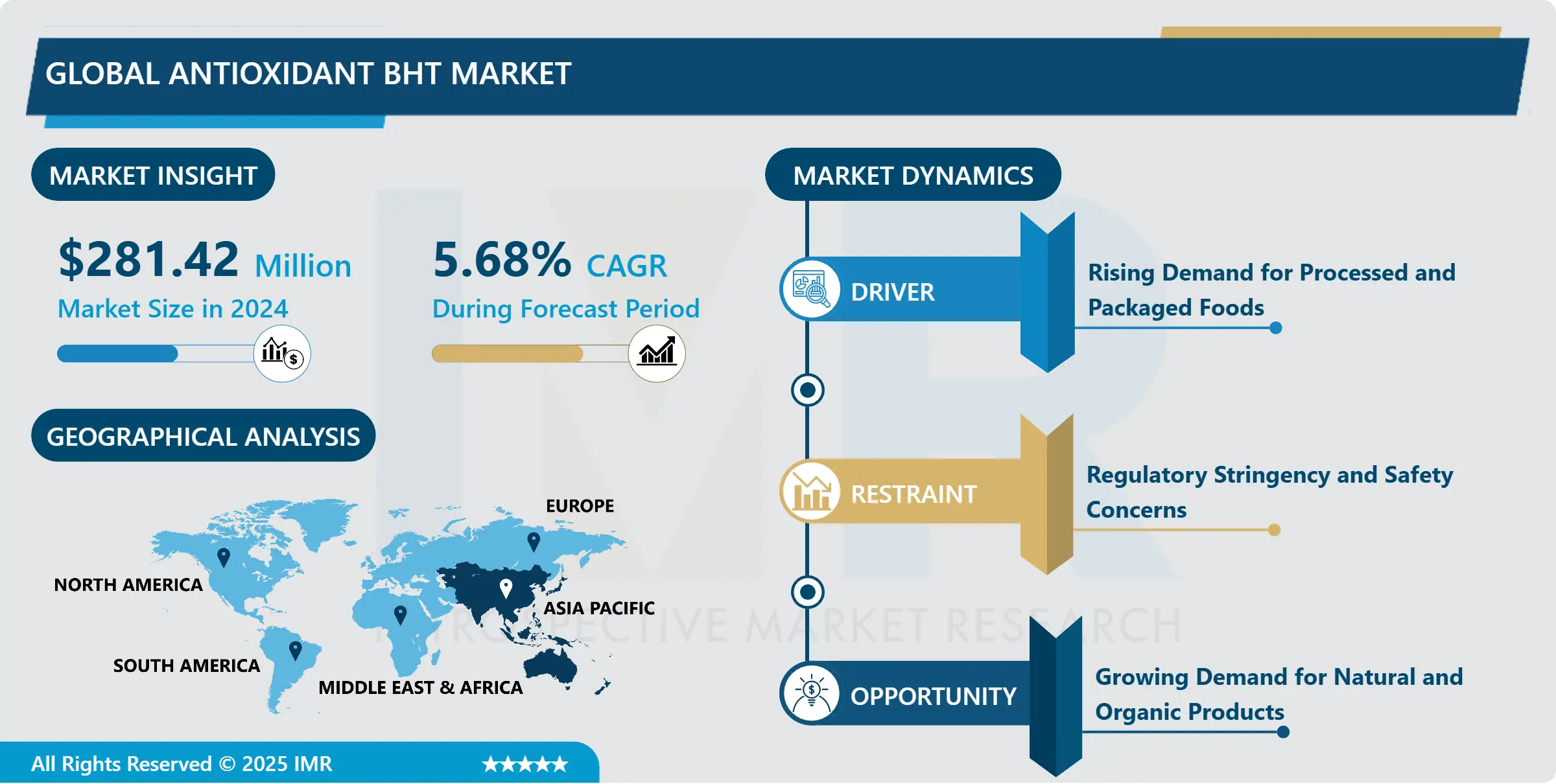
Antioxidant BHT Market Segmented based on Type, Application, and Distribution Channel
|
Global Antioxidant BHT Market |
|||
|
Base Year: |
2024 |
Forecast Period: |
2025-2032 |
|
Historical Data: |
2018 to 2023 |
Market Size in 2024 : |
USD 281.42 Mn. |
|
Forecast Period 2023-30 CAGR: |
5.68 % |
Market Size in 2032 : |
USD 437.82 Mn. |
|
Segments Covered: |
By Type |
|
|
|
By Application |
|
||
|
By Distribution Channel |
|
||
|
By Region |
|
||
|
Key Market Drivers: |
|
||
|
Key Market Restraints: |
|
||
|
Key Opportunities: |
|
||
|
Companies Covered in the report: |
|
||
Chapter 1: Introduction
1.1 Scope and Coverage
Chapter 2:Executive Summary
Chapter 3: Market Landscape
3.1 Market Dynamics
3.1.1 Drivers
3.1.2 Restraints
3.1.3 Opportunities
3.1.4 Challenges
3.2 Market Trend Analysis
3.3 PESTLE Analysis
3.4 Porter's Five Forces Analysis
3.5 Industry Value Chain Analysis
3.6 Ecosystem
3.7 Regulatory Landscape
3.8 Price Trend Analysis
3.9 Patent Analysis
3.10 Technology Evolution
3.11 Investment Pockets
3.12 Import-Export Analysis
Chapter 4: Antioxidant BHT Market by Type (2018-2032)
4.1 Antioxidant BHT Market Snapshot and Growth Engine
4.2 Market Overview
4.3 Natural
4.3.1 Introduction and Market Overview
4.3.2 Historic and Forecasted Market Size in Value USD and Volume Units
4.3.3 Key Market Trends, Growth Factors, and Opportunities
4.3.4 Geographic Segmentation Analysis
4.4 Synthetic
Chapter 5: Antioxidant BHT Market by Application (2018-2032)
5.1 Antioxidant BHT Market Snapshot and Growth Engine
5.2 Market Overview
5.3 Food Industry
5.3.1 Introduction and Market Overview
5.3.2 Historic and Forecasted Market Size in Value USD and Volume Units
5.3.3 Key Market Trends, Growth Factors, and Opportunities
5.3.4 Geographic Segmentation Analysis
5.4 Plastics & Rubber Industry
5.5 Cosmetics & Personal Care Products
5.6 Pharmaceuticals
5.7 Animal Feed
Chapter 6: Antioxidant BHT Market by Distribution Channel (2018-2032)
6.1 Antioxidant BHT Market Snapshot and Growth Engine
6.2 Market Overview
6.3 Direct Sales
6.3.1 Introduction and Market Overview
6.3.2 Historic and Forecasted Market Size in Value USD and Volume Units
6.3.3 Key Market Trends, Growth Factors, and Opportunities
6.3.4 Geographic Segmentation Analysis
6.4 Distributors
6.5 Online Retail
Chapter 7: Company Profiles and Competitive Analysis
7.1 Competitive Landscape
7.1.1 Competitive Benchmarking
7.1.2 Antioxidant BHT Market Share by Manufacturer (2024)
7.1.3 Industry BCG Matrix
7.1.4 Heat Map Analysis
7.1.5 Mergers and Acquisitions
7.2 AGCO CORPORATION (DULUTH
7.2.1 Company Overview
7.2.2 Key Executives
7.2.3 Company Snapshot
7.2.4 Role of the Company in the Market
7.2.5 Sustainability and Social Responsibility
7.2.6 Operating Business Segments
7.2.7 Product Portfolio
7.2.8 Business Performance
7.2.9 Key Strategic Moves and Recent Developments
7.2.10 SWOT Analysis
7.3 GEORGIA
7.4 USA)
7.5 ASPEE INDIA (MUMBAI
7.6 MAHARASHTRA
7.7 INDIA)
7.8 AVISON SPRAYERS (BOSTON
7.9 LINCOLNSHIRE
7.10 UK)
7.11 BOSTON CROP SPRAYERS LIMITED (BOSTON
7.12 LINCOLNSHIRE
7.13 UK)
7.14 BUCHER INDUSTRIES AG (NIEDERWENINGEN
7.15 SWITZERLAND)
7.16 CNH INDUSTRIAL N.V. (LONDON
7.17 UNITED KINGDOM)
7.18 CRYSTAL CROP PROTECTION LIMITED (NEW DELHI
7.19 INDIA)
7.20 DEERE AND COMPANY (MOLINE
7.21 ILLINOIS
7.22 USA)
7.23 EXEL INDUSTRIES (PARIS
7.24 FRANCE)
7.25 FOGGERS INDIA PVT. LTD. (MUMBAI
7.26 MAHARASHTRA
7.27 INDIA)
7.28 HOUSEHAM SPRAYERS LIMITED (LEADENHAM
7.29 LINCOLNSHIRE
7.30 UK)
7.31 JACTO INC. (POMPANO BEACH
7.32 FLORIDA
7.33 USA)
7.34 JOHN RHODES AS LIMITED (WORCESTERSHIRE
7.35 ENGLAND
7.36 UK)
7.37 KUBOTA CORPORATION (OSAKA
7.38 JAPAN)
7.39 MAHINDRA AND MAHINDRA LIMITED (MUMBAI
7.40 INDIA)
7.41 STIHL (WAIBLINGEN
7.42 GERMANY)
7.43 TAIZHOU SUNNY CROP MACHINERY COLTD. (ZHEJIANG
7.44 CHINA)
7.45 YAMAHA MOTOR COLTD. (IWATA
7.46 SHIZUOKA
7.47 JAPAN)
7.48 ZHEJIANG OUSEN MACHINERY CO. LTD. (ZHEJIANG
7.49 CHINA)
7.50 OTHER KEY PLAYERS
Chapter 8: Global Antioxidant BHT Market By Region
8.1 Overview
8.2. North America Antioxidant BHT Market
8.2.1 Key Market Trends, Growth Factors and Opportunities
8.2.2 Top Key Companies
8.2.3 Historic and Forecasted Market Size by Segments
8.2.4 Historic and Forecasted Market Size by Type
8.2.4.1 Natural
8.2.4.2 Synthetic
8.2.5 Historic and Forecasted Market Size by Application
8.2.5.1 Food Industry
8.2.5.2 Plastics & Rubber Industry
8.2.5.3 Cosmetics & Personal Care Products
8.2.5.4 Pharmaceuticals
8.2.5.5 Animal Feed
8.2.6 Historic and Forecasted Market Size by Distribution Channel
8.2.6.1 Direct Sales
8.2.6.2 Distributors
8.2.6.3 Online Retail
8.2.7 Historic and Forecast Market Size by Country
8.2.7.1 US
8.2.7.2 Canada
8.2.7.3 Mexico
8.3. Eastern Europe Antioxidant BHT Market
8.3.1 Key Market Trends, Growth Factors and Opportunities
8.3.2 Top Key Companies
8.3.3 Historic and Forecasted Market Size by Segments
8.3.4 Historic and Forecasted Market Size by Type
8.3.4.1 Natural
8.3.4.2 Synthetic
8.3.5 Historic and Forecasted Market Size by Application
8.3.5.1 Food Industry
8.3.5.2 Plastics & Rubber Industry
8.3.5.3 Cosmetics & Personal Care Products
8.3.5.4 Pharmaceuticals
8.3.5.5 Animal Feed
8.3.6 Historic and Forecasted Market Size by Distribution Channel
8.3.6.1 Direct Sales
8.3.6.2 Distributors
8.3.6.3 Online Retail
8.3.7 Historic and Forecast Market Size by Country
8.3.7.1 Russia
8.3.7.2 Bulgaria
8.3.7.3 The Czech Republic
8.3.7.4 Hungary
8.3.7.5 Poland
8.3.7.6 Romania
8.3.7.7 Rest of Eastern Europe
8.4. Western Europe Antioxidant BHT Market
8.4.1 Key Market Trends, Growth Factors and Opportunities
8.4.2 Top Key Companies
8.4.3 Historic and Forecasted Market Size by Segments
8.4.4 Historic and Forecasted Market Size by Type
8.4.4.1 Natural
8.4.4.2 Synthetic
8.4.5 Historic and Forecasted Market Size by Application
8.4.5.1 Food Industry
8.4.5.2 Plastics & Rubber Industry
8.4.5.3 Cosmetics & Personal Care Products
8.4.5.4 Pharmaceuticals
8.4.5.5 Animal Feed
8.4.6 Historic and Forecasted Market Size by Distribution Channel
8.4.6.1 Direct Sales
8.4.6.2 Distributors
8.4.6.3 Online Retail
8.4.7 Historic and Forecast Market Size by Country
8.4.7.1 Germany
8.4.7.2 UK
8.4.7.3 France
8.4.7.4 The Netherlands
8.4.7.5 Italy
8.4.7.6 Spain
8.4.7.7 Rest of Western Europe
8.5. Asia Pacific Antioxidant BHT Market
8.5.1 Key Market Trends, Growth Factors and Opportunities
8.5.2 Top Key Companies
8.5.3 Historic and Forecasted Market Size by Segments
8.5.4 Historic and Forecasted Market Size by Type
8.5.4.1 Natural
8.5.4.2 Synthetic
8.5.5 Historic and Forecasted Market Size by Application
8.5.5.1 Food Industry
8.5.5.2 Plastics & Rubber Industry
8.5.5.3 Cosmetics & Personal Care Products
8.5.5.4 Pharmaceuticals
8.5.5.5 Animal Feed
8.5.6 Historic and Forecasted Market Size by Distribution Channel
8.5.6.1 Direct Sales
8.5.6.2 Distributors
8.5.6.3 Online Retail
8.5.7 Historic and Forecast Market Size by Country
8.5.7.1 China
8.5.7.2 India
8.5.7.3 Japan
8.5.7.4 South Korea
8.5.7.5 Malaysia
8.5.7.6 Thailand
8.5.7.7 Vietnam
8.5.7.8 The Philippines
8.5.7.9 Australia
8.5.7.10 New Zealand
8.5.7.11 Rest of APAC
8.6. Middle East & Africa Antioxidant BHT Market
8.6.1 Key Market Trends, Growth Factors and Opportunities
8.6.2 Top Key Companies
8.6.3 Historic and Forecasted Market Size by Segments
8.6.4 Historic and Forecasted Market Size by Type
8.6.4.1 Natural
8.6.4.2 Synthetic
8.6.5 Historic and Forecasted Market Size by Application
8.6.5.1 Food Industry
8.6.5.2 Plastics & Rubber Industry
8.6.5.3 Cosmetics & Personal Care Products
8.6.5.4 Pharmaceuticals
8.6.5.5 Animal Feed
8.6.6 Historic and Forecasted Market Size by Distribution Channel
8.6.6.1 Direct Sales
8.6.6.2 Distributors
8.6.6.3 Online Retail
8.6.7 Historic and Forecast Market Size by Country
8.6.7.1 Turkiye
8.6.7.2 Bahrain
8.6.7.3 Kuwait
8.6.7.4 Saudi Arabia
8.6.7.5 Qatar
8.6.7.6 UAE
8.6.7.7 Israel
8.6.7.8 South Africa
8.7. South America Antioxidant BHT Market
8.7.1 Key Market Trends, Growth Factors and Opportunities
8.7.2 Top Key Companies
8.7.3 Historic and Forecasted Market Size by Segments
8.7.4 Historic and Forecasted Market Size by Type
8.7.4.1 Natural
8.7.4.2 Synthetic
8.7.5 Historic and Forecasted Market Size by Application
8.7.5.1 Food Industry
8.7.5.2 Plastics & Rubber Industry
8.7.5.3 Cosmetics & Personal Care Products
8.7.5.4 Pharmaceuticals
8.7.5.5 Animal Feed
8.7.6 Historic and Forecasted Market Size by Distribution Channel
8.7.6.1 Direct Sales
8.7.6.2 Distributors
8.7.6.3 Online Retail
8.7.7 Historic and Forecast Market Size by Country
8.7.7.1 Brazil
8.7.7.2 Argentina
8.7.7.3 Rest of SA
Chapter 9 Analyst Viewpoint and Conclusion
9.1 Recommendations and Concluding Analysis
9.2 Potential Market Strategies
Chapter 10 Research Methodology
10.1 Research Process
10.2 Primary Research
10.3 Secondary Research
|
Global Antioxidant BHT Market |
|||
|
Base Year: |
2024 |
Forecast Period: |
2025-2032 |
|
Historical Data: |
2018 to 2023 |
Market Size in 2024 : |
USD 281.42 Mn. |
|
Forecast Period 2023-30 CAGR: |
5.68 % |
Market Size in 2032 : |
USD 437.82 Mn. |
|
Segments Covered: |
By Type |
|
|
|
By Application |
|
||
|
By Distribution Channel |
|
||
|
By Region |
|
||
|
Key Market Drivers: |
|
||
|
Key Market Restraints: |
|
||
|
Key Opportunities: |
|
||
|
Companies Covered in the report: |
|
||
Related Reports
Understand your customers' needs so can deliver better services and experiences.
Stay in touch with us to get latest news and discount coupons.