




Forage & Crop Seeds Market Synopsis
Forage & Crop Seeds Market Size Was Valued at USD 3.34 Billion in 2024, and is Projected to Reach 4.64 USD Billion by 2032, Growing at a CAGR of 4.2 % From 2025-2032.
Forage crops, also known as fodder crops, are specifically grown to provide food for livestock. These crops are typically grown for their leaves and stems which are used as animal feed. They are normally fed by the livestock animals by grazing or in the form of harvested hay or silage. Forage seeds, including alfalfa, clover, and ryegrass, are essential for sustainable livestock farming. They provide nutrition for grazing animals, improve their health and productivity, and contribute to soil health through nitrogen fixation and erosion control. Forage crops also support diverse ecosystems by enhancing biodiversity and providing habitat for beneficial insects.
Crop seeds are the foundation of global agriculture, allowing for the cultivation of staple food crops like wheat, rice, and corn. They are carefully selected and bred to optimize traits like yield, disease resistance, and nutritional content. Advanced breeding techniques, including genetic modification, have led to the development of high-performing crop varieties, ensuring food security and meeting the global population's nutritional needs. Forage seeds improve livestock nutrition, promote sustainable agricultural practices, and support global hunger and malnutrition. They also contribute to soil health and biodiversity. Crop seeds address global hunger and malnutrition by supporting food systems worldwide. The development of resilient crop varieties helps farmers adapt to changing environmental conditions, ensuring stable yields. Together, forage and crop seeds contribute to a robust, sustainable food supply chain.
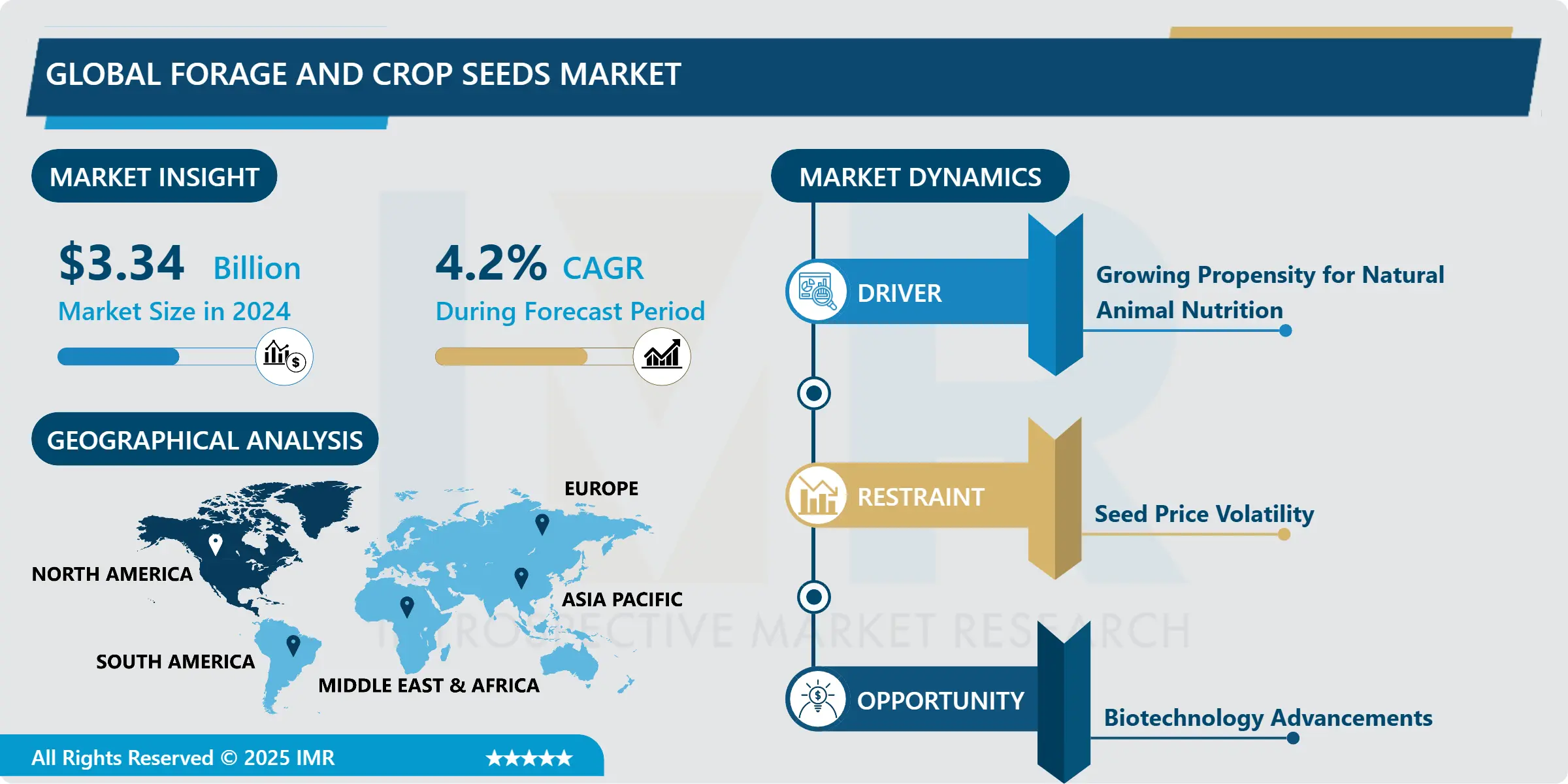

Forage & Crop Seeds Market Trend Analysis:
Growing Propensity for Natural Animal Nutrition
- The Forage and crop seed market is experiencing an upswing attributed to the increasing preference for natural animal nutrition. With consumers placing a greater emphasis on healthier and more sustainable food choices, there is a heightened demand for forage seeds. These seeds are essential to a vital role in augmenting the nutritional value of animal diets, particularly in the livestock industry, where natural forage contributes to the overall well-being of animals and the quality of the end products.
- Additionally, the focus on natural animal nutrition aligns with the broader trend of adopting clean and ethical farming practices. Consumers are growing more mindful of the environmental impact of agriculture and are actively seeking products sourced from animals raised on nutrient-rich forage. This shift has resulted in a surge in the cultivation of forage seeds that promote a holistic and natural approach to animal feeding.
- The momentum towards natural animal nutrition not only influences forage seeds but also has repercussions on crop seeds as a sustainable source of animal feed. The incorporation of diverse crops into livestock diets enhances nutritional diversity, ultimately contributing to the health and productivity of animals.
Biotechnology Advancements
- The forage and crop seeds market is poised for substantial growth, thanks to advancements in biotechnology. The integration of biotechnology in seed development has given rise to genetically modified (GM) seeds with enhanced characteristics. These traits encompass resistance to pests and diseases, improved tolerance to environmental stressors like drought or extreme temperatures, and heightened nutritional content. Consequently, farmers can achieve increased yields, minimize losses, and improve overall crop quality.
- Furthermore, biotechnology allows for the creation of seeds customized to specific geographic regions and agro-climatic conditions. This customization enhances adaptability, ensuring that farmers have access to seeds optimized for their local environments. Additionally, biotechnological research supports the development of seeds with enhanced sustainability features, contributing to environmentally friendly and resource-efficient agricultural practices.
- The market's growth propelled by biotechnology is further underscored by its potential to address global challenges, such as food security and climate change. Through the application of biotechnological innovations, the forage and crop seed industry a role in establishing a more resilient and sustainable agricultural system. This would meet the rising demand for food while minimizing the environmental impact of farming practices. As regulations evolve and public acceptance grows, the ongoing progress in biotechnology holds significant promise in shaping the future of the forage and crop seeds market.
Forage & Crop Seeds Market Segment Analysis:
Forage & Crop Seeds Market Segmented on the basis of Type, Breeding Technology, Species, Origin, Form, and Application
By Species, Grasses segment is expected to dominate the market during the forecast period
- The forage and crop seeds market is witnessing a notable shift, with the grasses segment positioned to take a leading role, signifying changing agricultural preferences. Grasses play a pivotal role in supplying forage for livestock and are integral components of sustainable crop rotations. Their widespread adoption is driven by their versatility, adaptability, and resilience, making them a preferred choice for farmers globally. The increasing demand for high-quality forage to meet the expanding needs of the livestock industry is expected to fuel sustained growth in the grasses segment.
- Moreover, their involvement in bioenergy production and carbon sequestration further boosts their prominence in the market. As the agricultural sector continues to prioritize sustainable and regenerative practices, the grasses segment is poised to dominate, presenting a comprehensive solution to address the evolving demands of both forage and crop cultivation.
By Breeding Technology, Hybrids segment held the largest share in 2024
- The forage and crop seeds market is experiencing significant growth, with the hybrids segment Holding the largest share, hybrid seeds are created through controlled cross-breeding of genetically distinct parent plants, combining desirable traits like heightened yield, disease resistance, and adaptability. Farmers are drawn to these hybrid seeds due to their consistent and superior performance, resulting in increased crop yields and improved overall farm profitability. This preference is particularly notable in major crops such as corn, rice, and wheat.
- The widespread adoption of hybrid seeds is fueled by their ability to express hybrid vigor, also known as heterosis, which leads to the manifestation of superior traits compared to their non-hybrid counterparts. The dominance of the hybrid segment underscores their crucial role in modern agriculture, addressing the global demand for enhanced food production and efficiency.
Forage & Crop Seeds Market Regional Insights:
North America is Expected to Dominate the Market Over the Forecast period
- North America is expected to establish a strong presence in the forage and crop seeds sector, driven by a combination of factors contributing to the region's agricultural excellence. With advanced agricultural infrastructure and extensive research and development initiatives, North America stands out as a leader in seed technology. The adoption of cutting-edge farming practices, such as precision agriculture and biotechnology, essential a crucial role in enhancing crop yields and overall quality.
- The diverse climatic conditions in North America support a broad range of crops and forages, allowing for year-round cultivation and catering to diverse regional demands. The region's robust demand for high-quality seeds, coupled with the presence of prominent seed companies and a well-established distribution network, further strengthens its dominance. As North America continues to prioritize sustainable and technologically advanced agricultural practices, it is poised to lead in shaping the forage and crop seeds market, serving as a benchmark for innovation and productivity on the global agricultural stage.
Forage & Crop Seeds Market Top Key Players:
- Corteva Agriscience (U.S.)
- GROWMARK, Inc. (U.S.)
- S & W Seed Co. (U.S.)
- Land O'Lakes, Inc. (U.S.)
- Barenbrug Seed Company (U.S.)
- Hancock Farm and Seed Co. Inc. (U.S.)
- Fosters Seed and Feed Ltd. (Canada)
- BrettYoung (Canada)
- Bayer AG (Germany)
- BASF SE (Germany)
- DLF (Denmark)
- KWS SAAT SE & Co. KGaA (Germany)
- RAGT Semences (France)
- Royal Barenbrug Group (Netherlands)
- Advanta Seeds – UPL (India), and Other Active Players.
Key Industry Developments in the Forage & Crop Seeds Market:
- In May 2024, S&W Seed Company, a global agricultural technology company, announced the expansion of its novel and proprietary sorghum trait technology portfolio with the commercial launch of Double Team Forage Sorghum. Double Team Forage Sorghum gives forage sorghum growers an over-the-top, non-GMO, grassy weed control option.
- In January 2023, GROWMARK, Inc. recently announced its acquisition of Idaho-based Allied Seed, LLC. Allied Seed provides a full line with forage, turfgrass, and cover crop seed in addition to services encompassing production, blending, packaging, and seed treatment.
|
Global Forage & Crop Seeds Market |
|||
|
Base Year: |
2024 |
Forecast Period: |
2025-2032 |
|
Historical Data: |
2018 to 2023 |
Market Size in 2024: |
USD 3.34 Bn. |
|
Forecast Period 2024-32 CAGR: |
4.2% |
Market Size in 2032: |
USD 4.64 Bn. |
|
Segments Covered: |
By Type |
|
|
|
By Breeding Technology |
|
||
|
By Species |
|
||
|
By Origin |
|
||
|
By Form |
|
||
|
By Livestock |
|
||
|
By Region |
|
||
|
Key Market Drivers: |
|
||
|
Key Market Restraints: |
|
||
|
Key Opportunities: |
|
||
|
Companies Covered in the report: |
|
||
Chapter 1: Introduction
1.1 Scope and Coverage
Chapter 2:Executive Summary
Chapter 3: Market Landscape
3.1 Market Dynamics
3.1.1 Drivers
3.1.2 Restraints
3.1.3 Opportunities
3.1.4 Challenges
3.2 Market Trend Analysis
3.3 PESTLE Analysis
3.4 Porter's Five Forces Analysis
3.5 Industry Value Chain Analysis
3.6 Ecosystem
3.7 Regulatory Landscape
3.8 Price Trend Analysis
3.9 Patent Analysis
3.10 Technology Evolution
3.11 Investment Pockets
3.12 Import-Export Analysis
Chapter 4: Forage & Crop Seeds Market by Type (2018-2032)
4.1 Forage & Crop Seeds Market Snapshot and Growth Engine
4.2 Market Overview
4.3 Rye
4.3.1 Introduction and Market Overview
4.3.2 Historic and Forecasted Market Size in Value USD and Volume Units
4.3.3 Key Market Trends, Growth Factors, and Opportunities
4.3.4 Geographic Segmentation Analysis
4.4 Oats
4.5 Wheat
4.6 Barley
4.7 Clover
Chapter 5: Forage & Crop Seeds Market by Breeding Technology (2018-2032)
5.1 Forage & Crop Seeds Market Snapshot and Growth Engine
5.2 Market Overview
5.3 Hybrids
5.3.1 Introduction and Market Overview
5.3.2 Historic and Forecasted Market Size in Value USD and Volume Units
5.3.3 Key Market Trends, Growth Factors, and Opportunities
5.3.4 Geographic Segmentation Analysis
5.4 Open Pollinated Varieties & Hybrid Derivatives
Chapter 6: Forage & Crop Seeds Market by Species (2018-2032)
6.1 Forage & Crop Seeds Market Snapshot and Growth Engine
6.2 Market Overview
6.3 Legumes
6.3.1 Introduction and Market Overview
6.3.2 Historic and Forecasted Market Size in Value USD and Volume Units
6.3.3 Key Market Trends, Growth Factors, and Opportunities
6.3.4 Geographic Segmentation Analysis
6.4 Grasses
Chapter 7: Forage & Crop Seeds Market by Origin (2018-2032)
7.1 Forage & Crop Seeds Market Snapshot and Growth Engine
7.2 Market Overview
7.3 Organic
7.3.1 Introduction and Market Overview
7.3.2 Historic and Forecasted Market Size in Value USD and Volume Units
7.3.3 Key Market Trends, Growth Factors, and Opportunities
7.3.4 Geographic Segmentation Analysis
7.4 Inorganic
Chapter 8: Forage & Crop Seeds Market by Form (2018-2032)
8.1 Forage & Crop Seeds Market Snapshot and Growth Engine
8.2 Market Overview
8.3 Green
8.3.1 Introduction and Market Overview
8.3.2 Historic and Forecasted Market Size in Value USD and Volume Units
8.3.3 Key Market Trends, Growth Factors, and Opportunities
8.3.4 Geographic Segmentation Analysis
8.4 Dry
Chapter 9: Forage & Crop Seeds Market by Livestock (2018-2032)
9.1 Forage & Crop Seeds Market Snapshot and Growth Engine
9.2 Market Overview
9.3 Cattle
9.3.1 Introduction and Market Overview
9.3.2 Historic and Forecasted Market Size in Value USD and Volume Units
9.3.3 Key Market Trends, Growth Factors, and Opportunities
9.3.4 Geographic Segmentation Analysis
9.4 Swine
9.5 Poultry
Chapter 10: Company Profiles and Competitive Analysis
10.1 Competitive Landscape
10.1.1 Competitive Benchmarking
10.1.2 Forage & Crop Seeds Market Share by Manufacturer (2024)
10.1.3 Industry BCG Matrix
10.1.4 Heat Map Analysis
10.1.5 Mergers and Acquisitions
10.2 ARRAY NETWORKS (U.S.)
10.2.1 Company Overview
10.2.2 Key Executives
10.2.3 Company Snapshot
10.2.4 Role of the Company in the Market
10.2.5 Sustainability and Social Responsibility
10.2.6 Operating Business Segments
10.2.7 Product Portfolio
10.2.8 Business Performance
10.2.9 Key Strategic Moves and Recent Developments
10.2.10 SWOT Analysis
10.3 A10 NETWORKS INC. (U.S.)
10.4 ARYAKA NETWORKS INC. (U.S.)
10.5 BROADCOM INC. (SYMANTEC CORPORATION) (U.S.)
10.6 CISCO SYSTEMS INC.(U.S.)
10.7 HEWLETT-PACKARD (HP) (U.S.)
10.8 CITRIX SYSTEMS INC. (U.S.)
10.9 VERIZON (U.S.)
10.10 DELL INC. (U.S.)
10.11 F5 NETWORKS INC. (U.S.)
10.12 AVI NETWORKS (VMWARE) (U.S.)
10.13 AKAMAI TECHNOLOGIES (U.S.)
10.14 RIVERBED TECHNOLOGY (U.S.)
10.15 ORACLE CORPORATION (U.S.)
10.16 BARRACUDA NETWORKS INC. (U.S.)
10.17 FORTINET (U.S.)
10.18 KEMP TECHNOLOGIES (IRELAND)
10.19 RADWARE CORPORATION (ISRAEL)
10.20
Chapter 11: Global Forage & Crop Seeds Market By Region
11.1 Overview
11.2. North America Forage & Crop Seeds Market
11.2.1 Key Market Trends, Growth Factors and Opportunities
11.2.2 Top Key Companies
11.2.3 Historic and Forecasted Market Size by Segments
11.2.4 Historic and Forecasted Market Size by Type
11.2.4.1 Rye
11.2.4.2 Oats
11.2.4.3 Wheat
11.2.4.4 Barley
11.2.4.5 Clover
11.2.5 Historic and Forecasted Market Size by Breeding Technology
11.2.5.1 Hybrids
11.2.5.2 Open Pollinated Varieties & Hybrid Derivatives
11.2.6 Historic and Forecasted Market Size by Species
11.2.6.1 Legumes
11.2.6.2 Grasses
11.2.7 Historic and Forecasted Market Size by Origin
11.2.7.1 Organic
11.2.7.2 Inorganic
11.2.8 Historic and Forecasted Market Size by Form
11.2.8.1 Green
11.2.8.2 Dry
11.2.9 Historic and Forecasted Market Size by Livestock
11.2.9.1 Cattle
11.2.9.2 Swine
11.2.9.3 Poultry
11.2.10 Historic and Forecast Market Size by Country
11.2.10.1 US
11.2.10.2 Canada
11.2.10.3 Mexico
11.3. Eastern Europe Forage & Crop Seeds Market
11.3.1 Key Market Trends, Growth Factors and Opportunities
11.3.2 Top Key Companies
11.3.3 Historic and Forecasted Market Size by Segments
11.3.4 Historic and Forecasted Market Size by Type
11.3.4.1 Rye
11.3.4.2 Oats
11.3.4.3 Wheat
11.3.4.4 Barley
11.3.4.5 Clover
11.3.5 Historic and Forecasted Market Size by Breeding Technology
11.3.5.1 Hybrids
11.3.5.2 Open Pollinated Varieties & Hybrid Derivatives
11.3.6 Historic and Forecasted Market Size by Species
11.3.6.1 Legumes
11.3.6.2 Grasses
11.3.7 Historic and Forecasted Market Size by Origin
11.3.7.1 Organic
11.3.7.2 Inorganic
11.3.8 Historic and Forecasted Market Size by Form
11.3.8.1 Green
11.3.8.2 Dry
11.3.9 Historic and Forecasted Market Size by Livestock
11.3.9.1 Cattle
11.3.9.2 Swine
11.3.9.3 Poultry
11.3.10 Historic and Forecast Market Size by Country
11.3.10.1 Russia
11.3.10.2 Bulgaria
11.3.10.3 The Czech Republic
11.3.10.4 Hungary
11.3.10.5 Poland
11.3.10.6 Romania
11.3.10.7 Rest of Eastern Europe
11.4. Western Europe Forage & Crop Seeds Market
11.4.1 Key Market Trends, Growth Factors and Opportunities
11.4.2 Top Key Companies
11.4.3 Historic and Forecasted Market Size by Segments
11.4.4 Historic and Forecasted Market Size by Type
11.4.4.1 Rye
11.4.4.2 Oats
11.4.4.3 Wheat
11.4.4.4 Barley
11.4.4.5 Clover
11.4.5 Historic and Forecasted Market Size by Breeding Technology
11.4.5.1 Hybrids
11.4.5.2 Open Pollinated Varieties & Hybrid Derivatives
11.4.6 Historic and Forecasted Market Size by Species
11.4.6.1 Legumes
11.4.6.2 Grasses
11.4.7 Historic and Forecasted Market Size by Origin
11.4.7.1 Organic
11.4.7.2 Inorganic
11.4.8 Historic and Forecasted Market Size by Form
11.4.8.1 Green
11.4.8.2 Dry
11.4.9 Historic and Forecasted Market Size by Livestock
11.4.9.1 Cattle
11.4.9.2 Swine
11.4.9.3 Poultry
11.4.10 Historic and Forecast Market Size by Country
11.4.10.1 Germany
11.4.10.2 UK
11.4.10.3 France
11.4.10.4 The Netherlands
11.4.10.5 Italy
11.4.10.6 Spain
11.4.10.7 Rest of Western Europe
11.5. Asia Pacific Forage & Crop Seeds Market
11.5.1 Key Market Trends, Growth Factors and Opportunities
11.5.2 Top Key Companies
11.5.3 Historic and Forecasted Market Size by Segments
11.5.4 Historic and Forecasted Market Size by Type
11.5.4.1 Rye
11.5.4.2 Oats
11.5.4.3 Wheat
11.5.4.4 Barley
11.5.4.5 Clover
11.5.5 Historic and Forecasted Market Size by Breeding Technology
11.5.5.1 Hybrids
11.5.5.2 Open Pollinated Varieties & Hybrid Derivatives
11.5.6 Historic and Forecasted Market Size by Species
11.5.6.1 Legumes
11.5.6.2 Grasses
11.5.7 Historic and Forecasted Market Size by Origin
11.5.7.1 Organic
11.5.7.2 Inorganic
11.5.8 Historic and Forecasted Market Size by Form
11.5.8.1 Green
11.5.8.2 Dry
11.5.9 Historic and Forecasted Market Size by Livestock
11.5.9.1 Cattle
11.5.9.2 Swine
11.5.9.3 Poultry
11.5.10 Historic and Forecast Market Size by Country
11.5.10.1 China
11.5.10.2 India
11.5.10.3 Japan
11.5.10.4 South Korea
11.5.10.5 Malaysia
11.5.10.6 Thailand
11.5.10.7 Vietnam
11.5.10.8 The Philippines
11.5.10.9 Australia
11.5.10.10 New Zealand
11.5.10.11 Rest of APAC
11.6. Middle East & Africa Forage & Crop Seeds Market
11.6.1 Key Market Trends, Growth Factors and Opportunities
11.6.2 Top Key Companies
11.6.3 Historic and Forecasted Market Size by Segments
11.6.4 Historic and Forecasted Market Size by Type
11.6.4.1 Rye
11.6.4.2 Oats
11.6.4.3 Wheat
11.6.4.4 Barley
11.6.4.5 Clover
11.6.5 Historic and Forecasted Market Size by Breeding Technology
11.6.5.1 Hybrids
11.6.5.2 Open Pollinated Varieties & Hybrid Derivatives
11.6.6 Historic and Forecasted Market Size by Species
11.6.6.1 Legumes
11.6.6.2 Grasses
11.6.7 Historic and Forecasted Market Size by Origin
11.6.7.1 Organic
11.6.7.2 Inorganic
11.6.8 Historic and Forecasted Market Size by Form
11.6.8.1 Green
11.6.8.2 Dry
11.6.9 Historic and Forecasted Market Size by Livestock
11.6.9.1 Cattle
11.6.9.2 Swine
11.6.9.3 Poultry
11.6.10 Historic and Forecast Market Size by Country
11.6.10.1 Turkiye
11.6.10.2 Bahrain
11.6.10.3 Kuwait
11.6.10.4 Saudi Arabia
11.6.10.5 Qatar
11.6.10.6 UAE
11.6.10.7 Israel
11.6.10.8 South Africa
11.7. South America Forage & Crop Seeds Market
11.7.1 Key Market Trends, Growth Factors and Opportunities
11.7.2 Top Key Companies
11.7.3 Historic and Forecasted Market Size by Segments
11.7.4 Historic and Forecasted Market Size by Type
11.7.4.1 Rye
11.7.4.2 Oats
11.7.4.3 Wheat
11.7.4.4 Barley
11.7.4.5 Clover
11.7.5 Historic and Forecasted Market Size by Breeding Technology
11.7.5.1 Hybrids
11.7.5.2 Open Pollinated Varieties & Hybrid Derivatives
11.7.6 Historic and Forecasted Market Size by Species
11.7.6.1 Legumes
11.7.6.2 Grasses
11.7.7 Historic and Forecasted Market Size by Origin
11.7.7.1 Organic
11.7.7.2 Inorganic
11.7.8 Historic and Forecasted Market Size by Form
11.7.8.1 Green
11.7.8.2 Dry
11.7.9 Historic and Forecasted Market Size by Livestock
11.7.9.1 Cattle
11.7.9.2 Swine
11.7.9.3 Poultry
11.7.10 Historic and Forecast Market Size by Country
11.7.10.1 Brazil
11.7.10.2 Argentina
11.7.10.3 Rest of SA
Chapter 12 Analyst Viewpoint and Conclusion
12.1 Recommendations and Concluding Analysis
12.2 Potential Market Strategies
Chapter 13 Research Methodology
13.1 Research Process
13.2 Primary Research
13.3 Secondary Research
|
Global Forage & Crop Seeds Market |
|||
|
Base Year: |
2024 |
Forecast Period: |
2025-2032 |
|
Historical Data: |
2018 to 2023 |
Market Size in 2024: |
USD 3.34 Bn. |
|
Forecast Period 2024-32 CAGR: |
4.2% |
Market Size in 2032: |
USD 4.64 Bn. |
|
Segments Covered: |
By Type |
|
|
|
By Breeding Technology |
|
||
|
By Species |
|
||
|
By Origin |
|
||
|
By Form |
|
||
|
By Livestock |
|
||
|
By Region |
|
||
|
Key Market Drivers: |
|
||
|
Key Market Restraints: |
|
||
|
Key Opportunities: |
|
||
|
Companies Covered in the report: |
|
||


