




Drug Delivery Systems Market Synopsis
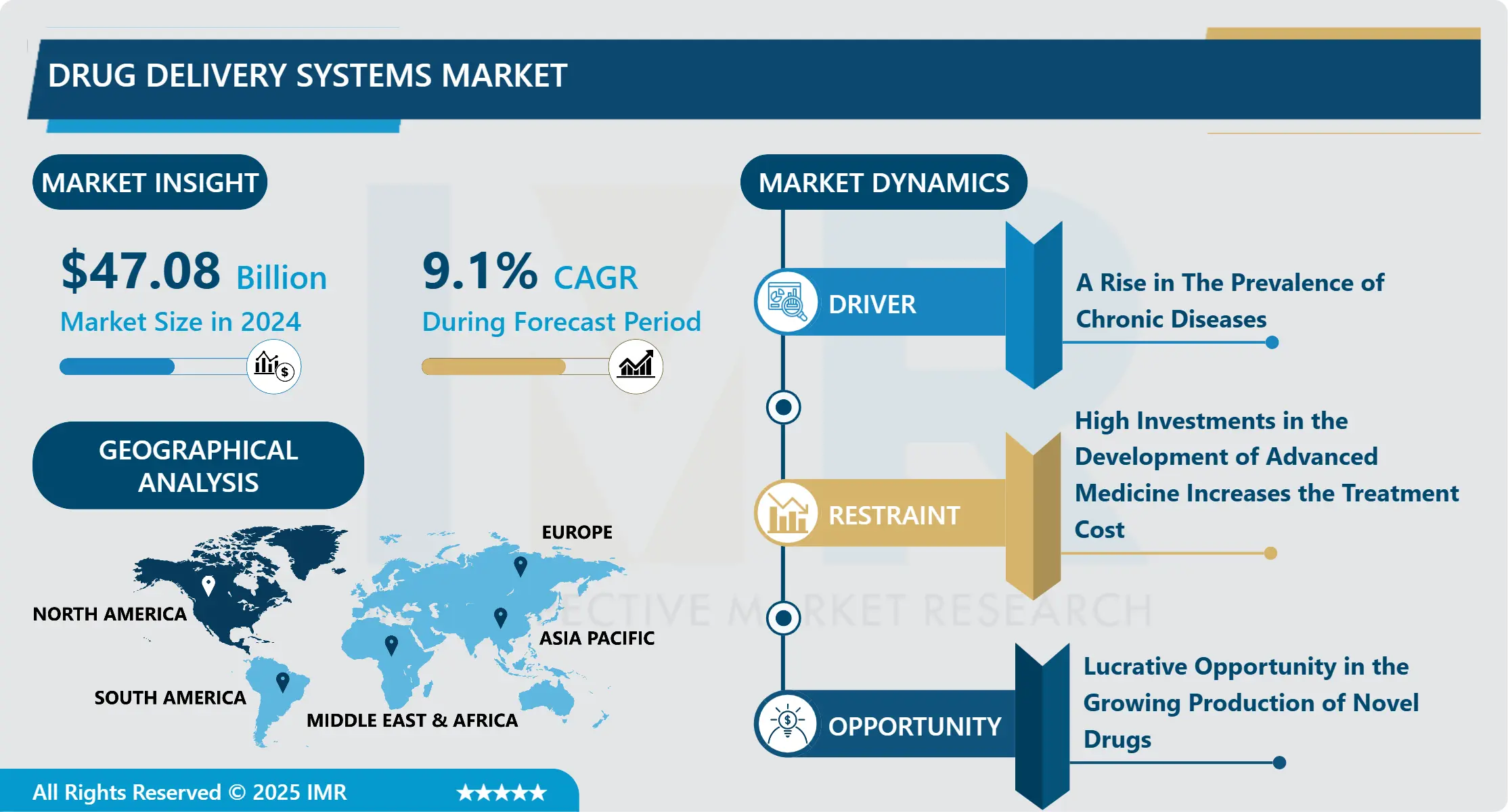
Drug Delivery Systems Market Size Was Valued at USD 47.08 Billion In 2024 And Is Projected to Reach USD 94.5 Billion By 2032, Growing at A CAGR of 9.1% From 2025 To 2032.
The process of administering a pharmaceutical compound to achieve a therapeutic effect in humans or animals is known as drug delivery. The first generation (1950–1980) produced a large number of oral and transdermal controlled release formulations for clinical applications. In the recent research and development (R & D) sector, scientific and technical developments are ready for the expansion of oral drug delivery systems.
The Drug Delivery Systems market has witnessed significant growth and innovation, driven by the increasing demand for targeted and controlled drug delivery in healthcare. These systems enhance the therapeutic efficacy of drugs while minimizing side effects, leading to improved patient outcomes. Key drivers include the rising prevalence of chronic diseases, technological advancements, and the need for personalized medicine.
Nanotechnology plays a pivotal role in drug delivery, enabling the development of nanoparticles and liposomes for precise drug targeting. Additionally, sustained-release formulations, implantable devices, and transdermal patches contribute to the market's expansion. Biopharmaceutical companies are investing in research and development to create novel drug delivery solutions, fostering collaborations and partnerships.
Geographically, North America and Europe dominate the market due to advanced healthcare infrastructure and substantial investments in research. However, Asia-Pacific is emerging as a key player, driven by increasing healthcare expenditure and a growing patient population.

Drug Delivery Systems Market Trend Analysis
A rise in The Prevalence of Chronic Diseases
- Chronic diseases increase in the world due to, the rising aging population, as well as changes in societal behavior, which are all contributing to a steady rise in these common and costly long-term health issues. People are becoming more sedentary as the middle class expands and urbanization accelerates leading to an increase in the use of tobacco and exposure to second-hand smoke. Poor nutrition, including diets low in fruits and vegetables and high in sodium and saturated fats. Physical Inactivity. It tends to rise the cases of chronic diseases. Obesity rates and cases of diseases such as diabetes are rising as a result.
- According to the World Health Organization, the prevalence of chronic diseases was 57% in 2020. Emerging markets will be hardest hit, as population growth is expected to be greatest in developing countries. The increased demand on healthcare systems as a result of chronic disease has become a major source of concern. The growing prevalence of chronic diseases is supposed to drive the growth of the drug delivery system market in the forecast period.
Lucrative Opportunity in the Growing Production of Novel Drugs
- The drug delivery system market is expected to healthy growth in the coming years, owing to the advances in the drug delivery system gaining attention and popularity as a result of the use of Nano formulations, which enable efficient, effective, and specific drug targeting. Liposomes, aptamers, quantum dots, peptides, polymers, metals, and magnetic nanoparticle-based delivery are examples of advanced-generation drug delivery systems.
- The structural complexity of Nano-based drug delivery systems, such as dendrimers, Nano sponges, nanocrystals, nanogels, and Nanocapsules, provides a large surface area for precise targeting in cancer management and other life-threatening diseases. The growing production of novel drugs and their dosage form tends to be a lucrative opportunity for the market of drug delivery systems in the upcoming year.
Drug Delivery Systems Market Segment Analysis:
Drug Delivery Systems Market Segmented on the basis of type, application, and Technology.
By Type, oral drug delivery segment is expected to dominate the market during the forecast period
- The oral drug delivery segment is forecasted to dominate the drug delivery system market in the upcoming future. The Oral drug delivery system is commonly used for the administration of the drug. It is the most preferred route and most well-known route of drug administration because it is easy to use, non-invasive in nature, cost-effective, and has high absorption properties in the gastrointestinal tract.
- It is suitable for frequent and extended use. It is cost-effective because the patient incurs no additional expenses. Where the drug is a solid, such as a tablet or capsule, the patient only needs one or two cups of water, which is usually readily available. If the drug is in liquid form, all that is required is a measuring tool, which is usually included with the drug. Thus, the oral drug delivery segment is expected to grow significantly during the forecast period due to the aforementioned factors.
By Technology, targeted drug delivery segment held the largest share in 2024
- The targeted drug delivery system segment is expected to dominate the drug delivery system market in the upcoming year. The targeted drug delivery system is a novel drug delivery system, drugs are directly delivered to the targeted body area. It is also called a smart drug delivery system. The targeted drug delivery systems have several advantages over conventional drug delivery such as low side effects, improvement of pharmaceutical activity, and reduction of the administered dose.
- The primary goal of a targeted drug delivery system is to direct the therapeutic agent's pharmacological action only to diseased organs while leaving healthy organs alone, particularly in the case of cancer treatment with chemotherapeutic agents. Thus, the drug delivery system segment is expected to grow significantly during the forecast period due to the aforementioned factors.
Drug Delivery Systems Market Regional Insights:
North America is Expected to Dominate the Market Over the Forecast period
- North America is anticipated to have the highest share of the drug delivery system market in the forecast period due to the increased adoption rate of new technological advancements in the drug delivery system. The United States is a prominent country in the North American region. During the forecast period, the US drug delivery systems market is expected to grow at the fastest rate.
- The increasing prevalence of chronic diseases and the growing number of products launched by key players, and the increasing use of drug delivery systems for disease management are driving the growth of this market. Strong demand for drug delivery systems is expected to drive the drug delivery systems market growth in North America during the forecast period, owing to an increase in hospital admissions in the region.
- According to a CIHI article published in April 2021, there were more than 3 million acute inpatient hospitalizations in Canada in 2019–2020. These hospitalizations are expected to increase the region's demand for drug delivery systems.
Drug Delivery Systems Market Top Key Players:
- 3M Company (US)
- Abbott Laboratories (US)
- Baxter International Inc. (US)
- Zimmer Biomet Holdings, Inc. (US)
- Cook Medical (US)
- Eli Lilly and Company (US)
- BD (Becton, Dickinson and Company) (US)
- Merck & Co., Inc. (US)
- Pfizer Inc. (US)
- Stryker Corporation (US)
- Johnson & Johnson (US)
- Sanofi (France)
- Bayer AG (Germany)
- Boehringer Ingelheim GmbH (Germany)
- Medtronic plc (Ireland)
- Alkermes plc (Ireland)
- AstraZeneca plc (UK)
- Novartis AG (Switzerland)
- F. Hoffmann-La Roche Ltd. (Switzerland)
- Roche Holding AG (Switzerland)
- Teva Pharmaceutical Industries Ltd. (Israel)
- Terumo Corporation (Japan)
- Samsung Medison Co., Ltd. (South Korea)
- Other Active Players
Key Industry Developments in the Drug Delivery Systems Market:
- In October 2024, DT Cloud Acquisition Corporation has announced a definitive business combination agreement with Maius Pharmaceutical Co., Ltd., a biopharmaceutical R&D company specializing in innovative formulations and targeted small-molecule chemical drugs. The merger, valued at $250 million, will result in Maius becoming a wholly-owned subsidiary of Maius Pharmaceutical Group Co., Ltd., a newly formed holding company, which will be listed on Nasdaq. The transaction, expected to close in the first half of 2025, aligns with the growing demand for advancements in drug delivery systems, as Maius focuses on developing treatments in oncology, autoimmune diseases, and infections.
- In January 2024, Kindeva Drug Delivery has acquired Summit Biosciences, an intranasal drug-delivery CDMO, from its founding family shareholders. This acquisition enhances Kindeva’s drug-delivery capabilities by adding a new intranasal platform, complementing its expertise in pulmonary, injectable, and transdermal drug-device combinations. Summit’s 55,000-square-foot FDA and EMA-approved facility in Lexington, Kentucky, strengthens Kindeva’s global manufacturing footprint and supports its mission to improve patient outcomes with innovative drug-delivery solutions. The acquisition expands Kindeva's ability to provide biopharma customers with non-invasive medication options in acute and emergency settings.
- In April 2023, DifGen Pharmaceuticals LLC has announced the acquisition of Aveva Drug Delivery Services Inc., a leading developer and manufacturer of Transdermal Delivery Systems (TDS) and Oral Dissolvable Films (ODF). With over 300 employees, Aveva brings significant US-based R&D and manufacturing capabilities to DifGen, enabling the company to enhance its offerings in complex dosage forms and drug-device combinations. The acquisition strengthens DifGen’s position in the drug delivery industry, particularly in areas requiring specialized formulations, processing, and equipment, ensuring the delivery of high-quality, affordable medication to patients with consistent supply.
|
Global Drug Delivery Systems Market |
|||
|
Base Year: |
2024 |
Forecast Period: |
2025-2032 |
|
Historical Data: |
2018 to 2023 |
Market Size in 2024: |
USD 47.08 Bn. |
|
Forecast Period 2025-32 CAGR: |
9.1 % |
Market Size in 2032: |
USD 94.5 Bn. |
|
Segments Covered: |
By Type |
|
|
|
By Application |
|
||
|
By Technology |
|
||
|
By Region |
|
||
|
Key Market Drivers: |
A Rise in The Prevalence of Chronic Diseases |
||
|
Key Market Restraints: |
High Investments in the Development of Advanced Medicine Increases the Treatment Cost |
||
|
Key Opportunities: |
Lucrative Opportunity in the Growing Production of Novel Drugs |
||
|
Companies Covered in the report: |
|
||
Chapter 1: Introduction
1.1 Scope and Coverage
Chapter 2:Executive Summary
Chapter 3: Market Landscape
3.1 Market Dynamics
3.1.1 Drivers
3.1.2 Restraints
3.1.3 Opportunities
3.1.4 Challenges
3.2 Market Trend Analysis
3.3 PESTLE Analysis
3.4 Porter's Five Forces Analysis
3.5 Industry Value Chain Analysis
3.6 Ecosystem
3.7 Regulatory Landscape
3.8 Price Trend Analysis
3.9 Patent Analysis
3.10 Technology Evolution
3.11 Investment Pockets
3.12 Import-Export Analysis
Chapter 4: Drug Delivery Systems Market by Type (2018-2032)
4.1 Drug Delivery Systems Market Snapshot and Growth Engine
4.2 Market Overview
4.3 Injection-Based Drug Delivery System
4.3.1 Introduction and Market Overview
4.3.2 Historic and Forecasted Market Size in Value USD and Volume Units
4.3.3 Key Market Trends, Growth Factors, and Opportunities
4.3.4 Geographic Segmentation Analysis
4.4 Oral Drug Delivery System
4.5 Inhalation/Pulmonary Drug Delivery System
4.6 Transmucosal Drug Delivery System
Chapter 5: Drug Delivery Systems Market by Application (2018-2032)
5.1 Drug Delivery Systems Market Snapshot and Growth Engine
5.2 Market Overview
5.3 Oncology
5.3.1 Introduction and Market Overview
5.3.2 Historic and Forecasted Market Size in Value USD and Volume Units
5.3.3 Key Market Trends, Growth Factors, and Opportunities
5.3.4 Geographic Segmentation Analysis
5.4 Cardiovascular Diseases
5.5 Urology
Chapter 6: Drug Delivery Systems Market by Technology (2018-2032)
6.1 Drug Delivery Systems Market Snapshot and Growth Engine
6.2 Market Overview
6.3 Prodrug
6.3.1 Introduction and Market Overview
6.3.2 Historic and Forecasted Market Size in Value USD and Volume Units
6.3.3 Key Market Trends, Growth Factors, and Opportunities
6.3.4 Geographic Segmentation Analysis
6.4 Implants
6.5 Intrauterine Devices
6.6 Targeted Drug Delivery
6.7 Polymeric Drug Delivery
Chapter 7: Company Profiles and Competitive Analysis
7.1 Competitive Landscape
7.1.1 Competitive Benchmarking
7.1.2 Drug Delivery Systems Market Share by Manufacturer (2024)
7.1.3 Industry BCG Matrix
7.1.4 Heat Map Analysis
7.1.5 Mergers and Acquisitions
7.2 ALLERGANINC. (IRELAND)
7.2.1 Company Overview
7.2.2 Key Executives
7.2.3 Company Snapshot
7.2.4 Role of the Company in the Market
7.2.5 Sustainability and Social Responsibility
7.2.6 Operating Business Segments
7.2.7 Product Portfolio
7.2.8 Business Performance
7.2.9 Key Strategic Moves and Recent Developments
7.2.10 SWOT Analysis
7.3 EVOLUSINC. (US)
7.4 PFIZERINC. (US)
7.5 ABBVIE (US)
7.6 SOLTA MEDICAL (US)
7.7 SYNERON CANDELA (US)
7.8 GALDERMA S.A. (SWITZERLAND)
7.9 LUMENIS (UK)
7.10 MERZ PHARMA (GERMANY)
7.11 MEDY TOX INC. (SK)
7.12 HUGELINC. (SK)
7.13 REVANCE THERAPEUTICS INC. (US)
7.14 WORLDMEDSLLC. (US)
7.15 IPSEN GROUP (FRANCE)
7.16 EISAI CO. LTD. (JAPAN)
7.17 LANZHOU INSTITUTE OF BIOLOGICAL PRODUCTS CO. LTD. (CHINA)
Chapter 8: Global Drug Delivery Systems Market By Region
8.1 Overview
8.2. North America Drug Delivery Systems Market
8.2.1 Key Market Trends, Growth Factors and Opportunities
8.2.2 Top Key Companies
8.2.3 Historic and Forecasted Market Size by Segments
8.2.4 Historic and Forecasted Market Size by Type
8.2.4.1 Injection-Based Drug Delivery System
8.2.4.2 Oral Drug Delivery System
8.2.4.3 Inhalation/Pulmonary Drug Delivery System
8.2.4.4 Transmucosal Drug Delivery System
8.2.5 Historic and Forecasted Market Size by Application
8.2.5.1 Oncology
8.2.5.2 Cardiovascular Diseases
8.2.5.3 Urology
8.2.6 Historic and Forecasted Market Size by Technology
8.2.6.1 Prodrug
8.2.6.2 Implants
8.2.6.3 Intrauterine Devices
8.2.6.4 Targeted Drug Delivery
8.2.6.5 Polymeric Drug Delivery
8.2.7 Historic and Forecast Market Size by Country
8.2.7.1 US
8.2.7.2 Canada
8.2.7.3 Mexico
8.3. Eastern Europe Drug Delivery Systems Market
8.3.1 Key Market Trends, Growth Factors and Opportunities
8.3.2 Top Key Companies
8.3.3 Historic and Forecasted Market Size by Segments
8.3.4 Historic and Forecasted Market Size by Type
8.3.4.1 Injection-Based Drug Delivery System
8.3.4.2 Oral Drug Delivery System
8.3.4.3 Inhalation/Pulmonary Drug Delivery System
8.3.4.4 Transmucosal Drug Delivery System
8.3.5 Historic and Forecasted Market Size by Application
8.3.5.1 Oncology
8.3.5.2 Cardiovascular Diseases
8.3.5.3 Urology
8.3.6 Historic and Forecasted Market Size by Technology
8.3.6.1 Prodrug
8.3.6.2 Implants
8.3.6.3 Intrauterine Devices
8.3.6.4 Targeted Drug Delivery
8.3.6.5 Polymeric Drug Delivery
8.3.7 Historic and Forecast Market Size by Country
8.3.7.1 Russia
8.3.7.2 Bulgaria
8.3.7.3 The Czech Republic
8.3.7.4 Hungary
8.3.7.5 Poland
8.3.7.6 Romania
8.3.7.7 Rest of Eastern Europe
8.4. Western Europe Drug Delivery Systems Market
8.4.1 Key Market Trends, Growth Factors and Opportunities
8.4.2 Top Key Companies
8.4.3 Historic and Forecasted Market Size by Segments
8.4.4 Historic and Forecasted Market Size by Type
8.4.4.1 Injection-Based Drug Delivery System
8.4.4.2 Oral Drug Delivery System
8.4.4.3 Inhalation/Pulmonary Drug Delivery System
8.4.4.4 Transmucosal Drug Delivery System
8.4.5 Historic and Forecasted Market Size by Application
8.4.5.1 Oncology
8.4.5.2 Cardiovascular Diseases
8.4.5.3 Urology
8.4.6 Historic and Forecasted Market Size by Technology
8.4.6.1 Prodrug
8.4.6.2 Implants
8.4.6.3 Intrauterine Devices
8.4.6.4 Targeted Drug Delivery
8.4.6.5 Polymeric Drug Delivery
8.4.7 Historic and Forecast Market Size by Country
8.4.7.1 Germany
8.4.7.2 UK
8.4.7.3 France
8.4.7.4 The Netherlands
8.4.7.5 Italy
8.4.7.6 Spain
8.4.7.7 Rest of Western Europe
8.5. Asia Pacific Drug Delivery Systems Market
8.5.1 Key Market Trends, Growth Factors and Opportunities
8.5.2 Top Key Companies
8.5.3 Historic and Forecasted Market Size by Segments
8.5.4 Historic and Forecasted Market Size by Type
8.5.4.1 Injection-Based Drug Delivery System
8.5.4.2 Oral Drug Delivery System
8.5.4.3 Inhalation/Pulmonary Drug Delivery System
8.5.4.4 Transmucosal Drug Delivery System
8.5.5 Historic and Forecasted Market Size by Application
8.5.5.1 Oncology
8.5.5.2 Cardiovascular Diseases
8.5.5.3 Urology
8.5.6 Historic and Forecasted Market Size by Technology
8.5.6.1 Prodrug
8.5.6.2 Implants
8.5.6.3 Intrauterine Devices
8.5.6.4 Targeted Drug Delivery
8.5.6.5 Polymeric Drug Delivery
8.5.7 Historic and Forecast Market Size by Country
8.5.7.1 China
8.5.7.2 India
8.5.7.3 Japan
8.5.7.4 South Korea
8.5.7.5 Malaysia
8.5.7.6 Thailand
8.5.7.7 Vietnam
8.5.7.8 The Philippines
8.5.7.9 Australia
8.5.7.10 New Zealand
8.5.7.11 Rest of APAC
8.6. Middle East & Africa Drug Delivery Systems Market
8.6.1 Key Market Trends, Growth Factors and Opportunities
8.6.2 Top Key Companies
8.6.3 Historic and Forecasted Market Size by Segments
8.6.4 Historic and Forecasted Market Size by Type
8.6.4.1 Injection-Based Drug Delivery System
8.6.4.2 Oral Drug Delivery System
8.6.4.3 Inhalation/Pulmonary Drug Delivery System
8.6.4.4 Transmucosal Drug Delivery System
8.6.5 Historic and Forecasted Market Size by Application
8.6.5.1 Oncology
8.6.5.2 Cardiovascular Diseases
8.6.5.3 Urology
8.6.6 Historic and Forecasted Market Size by Technology
8.6.6.1 Prodrug
8.6.6.2 Implants
8.6.6.3 Intrauterine Devices
8.6.6.4 Targeted Drug Delivery
8.6.6.5 Polymeric Drug Delivery
8.6.7 Historic and Forecast Market Size by Country
8.6.7.1 Turkiye
8.6.7.2 Bahrain
8.6.7.3 Kuwait
8.6.7.4 Saudi Arabia
8.6.7.5 Qatar
8.6.7.6 UAE
8.6.7.7 Israel
8.6.7.8 South Africa
8.7. South America Drug Delivery Systems Market
8.7.1 Key Market Trends, Growth Factors and Opportunities
8.7.2 Top Key Companies
8.7.3 Historic and Forecasted Market Size by Segments
8.7.4 Historic and Forecasted Market Size by Type
8.7.4.1 Injection-Based Drug Delivery System
8.7.4.2 Oral Drug Delivery System
8.7.4.3 Inhalation/Pulmonary Drug Delivery System
8.7.4.4 Transmucosal Drug Delivery System
8.7.5 Historic and Forecasted Market Size by Application
8.7.5.1 Oncology
8.7.5.2 Cardiovascular Diseases
8.7.5.3 Urology
8.7.6 Historic and Forecasted Market Size by Technology
8.7.6.1 Prodrug
8.7.6.2 Implants
8.7.6.3 Intrauterine Devices
8.7.6.4 Targeted Drug Delivery
8.7.6.5 Polymeric Drug Delivery
8.7.7 Historic and Forecast Market Size by Country
8.7.7.1 Brazil
8.7.7.2 Argentina
8.7.7.3 Rest of SA
Chapter 9 Analyst Viewpoint and Conclusion
9.1 Recommendations and Concluding Analysis
9.2 Potential Market Strategies
Chapter 10 Research Methodology
10.1 Research Process
10.2 Primary Research
10.3 Secondary Research
|
Global Drug Delivery Systems Market |
|||
|
Base Year: |
2024 |
Forecast Period: |
2025-2032 |
|
Historical Data: |
2018 to 2023 |
Market Size in 2024: |
USD 47.08 Bn. |
|
Forecast Period 2025-32 CAGR: |
9.1 % |
Market Size in 2032: |
USD 94.5 Bn. |
|
Segments Covered: |
By Type |
|
|
|
By Application |
|
||
|
By Technology |
|
||
|
By Region |
|
||
|
Key Market Drivers: |
A Rise in The Prevalence of Chronic Diseases |
||
|
Key Market Restraints: |
High Investments in the Development of Advanced Medicine Increases the Treatment Cost |
||
|
Key Opportunities: |
Lucrative Opportunity in the Growing Production of Novel Drugs |
||
|
Companies Covered in the report: |
|
||


