




Industrial Lighting Market Overview
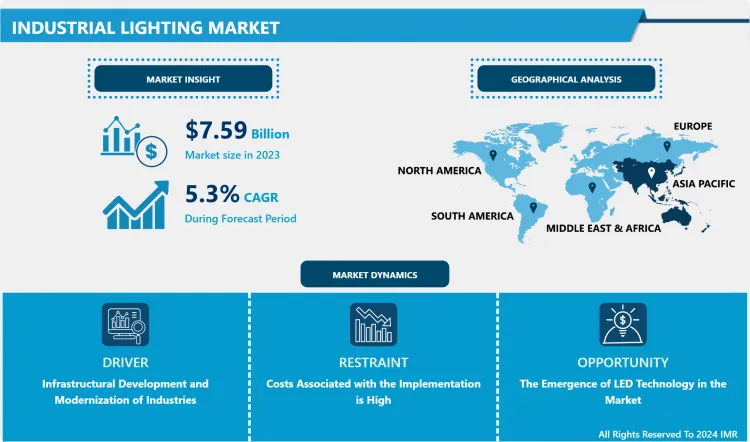
Industrial Lighting Market Size Was Valued at USD 7.99 Billion In 2024 And Is Projected to Reach USD 12.08 Billion By 2032, Growing at A CAGR of 5.3% From 2025-2032.
Industrial lighting is used in the several types of industries such as manufacturing, marine, mining, packaging and even in the sports industry. The major reason behind using this type of lighting system in these industries is for the safety concerns and for better visibility experience. Many industries pay utmost attention to evaluate their lighting systems to meet certain minimum requirements, like cost-effectiveness, energy optimization, better productivity, and plant safety.
Governments and public organizations across the whole world are increasingly deploying lighting systems like LED lighting networks, in order to address the maintenance issues arising from incandescent lamp usage. LEDs comes up with its own advantages making it worthy such as no ultraviolet or infrared radiations and hence further offering various benefits, such as lower cooling costs, prolonged product life, and maintenance simplification, also there is no damage to eyes and sensitive equipment and providing utmost safety in the industrial environment.
Covid-19 Impact Analysis on Industrial Lighting Market
As a consequence of COVID-19 pandemic, the industrial lighting market and other related areas witnessed production halts and disruptions in the supply chain and thus It weakened industrial output growth. The outbreak of COVID-19 also had its hand on the chemical industry globally, the market has also been susceptible to increased prices making the direct fluctuation in the lighting industry. The most considerable issue in the market was not the production but the supply chain disruption.
Around 30% of the electronic drivers and chips used to manufacture LED bulbs in countries such as India, are imported from Chinese vendors and wherefore the LED lighting industry has been witnessing short supply concerns.
Recently, a Texas-based industrial lighting company AZZ announced that, as per the Department of Homeland Security (DHS), the industrial lighting is an essential Infrastructure Business during the COVID-19 crisis, leaving some relief in the market. The imbalance in demand and supply due to the pandemic situation indicates a potential rise in prices of overall LED lightings, signify has already notified its US clients of a 3% increase in its offerings in mid -March 2020.

Market Dynamics And Factors
Drivers:
Infrastructural development and modernization of industries taking place globally is major driving factor behind the growth of this market. The ever-rising availability of a wide range of lighting products at most reasonable prices and the increasing demand for energy-efficient lighting systems across industrial sectors are driving the market growth. Lighting, which forms a significant portion of electricity expenses, is now seen as a point of emphasis for manufacturers and governments across regions, as they were under pressure to decrease carbon emissions from electricity generation, and hence the regulatory standards promoting the use of LED lightings, workers safety in industrial locations, the demand for cost-effective lighting solutions, high service life, and the replacement of traditional lighting systems with LEDs, are the true market drivers during the forecast period.
Industrial lighting holds many great benefits such as reduced energy consumption, lower maintenance cost, higher quality lighting, durability, longer life, low radiated heat, immediate lighting, directional illumination, high brightness and intensity are leading to growth of the market. Moreover, adoption of LEDs is increasing because of its reduced cost, its benefits for industrial usage, introduction of Wi-Fi control-based lighting and also demand of IoT based smart lighting technologies are helping the market by further pushing it towards the growth.
Restraints:
Despite of all the mentioned advantages to the lighting industry, the costs associated with the implementation in the industry are considerably high, for example, initial cost required to integrate or replace the existing lighting system in manufacturing plants and production facilities across the globe is high, especially for the small and medium industries hence this is pulling the market back for the development at some extent.
Also, the market faces lack of expertise in the maintenance of newer technologies which are stopping organizations from integrating LEDs into their manufacturing facilities. Though, assembly process for an LED is a complicated procedure.
However, the costs involved in the industry have a significant change towards a decrease in the past few years, but certain challenges still endure as consecutively this is leading to intense competition from Chinese players, who are offering lighting solutions at much a cheaper price.
Opportunities:
The emergence of LED technology has been changing its basic forms in the lighting sector and has brought unprecedented diversity in application. LED lighting holds significant opportunities for both the industry and the market as LEDs have created a compelling value proposition for the end -users and helped in enlarging the value chain of the industry.
Additionally, the lighting industry absorbs some extra benefits for instance, during the United Nations Framework Convention on Climate Change held in Paris, multiple countries such as India pledged to cut off their carbon emissions intensity by 33 -35% by year 2030. due to this pledge, the government has been undertaking several initiatives to promote the usage of LED products in the country.
LEDs are also gaining more and more importance as a viable option for hazardous locations, as users can realize the importance of low maintenance and the associated costs. Innovations, like solar power LEDs, are also expected to help cutting down on emissions. However, Solar LEDs have already been into application at very industrial sites, but since, the main focus is reduced energy costs and carbon, the development still continues.
Market Segmentation
Segmentation Insights:
By Light Source, the fluorescent lighting segment has occupied the largest market share, of 66.09%, according to year 2020. On the other hand, the LED segment is expected to witness the highest CAGR over the forecast period. Also, as the incandescent lamps were banned for commercial and industrial purposes the demand for HID (HIGH-INTENSITY DISCHARGE) lightings rose, especially for high-bay type lightings.
On the basis of product Type, the high/low bay lighting segment occupied the largest market share, of 63.24%, in 2020, and the same segment is expected to witness the highest CAGR in upcoming years. High/Low Bay Lighting business focuses and concludes that proper lighting solutions can become mood balancers and can definitely help in creating positive vibes. Bright lighting can also boost the productivity of employees working. Industrial units mainly require high-intensity lighting systems for various purposes and this is the need where flood lighting system is used.
By End-User Application, Oil and Gas segment comes at top in terms of revenue share, followed by manufacturing then, warehouse and then other applications. Warehouse is anticipated to grow at a very good CAGR. Other end user industries wherein the lighting systems are perceptibly used include the energy and power, food processing, and paint industry.
Regional Insights:
Geographically, Asia-Pacific accounted for the largest market share of the global industrial lighting market covering over 42.17%, of the market in year 2020 owning to diverse economies having different levels of development and an extensive assortment of industries. Asia-Pacific is also expected to hold the fastest CAGR over the forecast period.
Key Industry Developments
- Larson Electronics introduced a Solar LED Light Tower and a Solar Generator having a 16” square junction box at the top of the mast for mounting equipment, in 2021.
- In April 2021, Larson Electronics LLC United States announced the launch of an explosion -proof LED light to be used in wet locations and marine environments. This newly developed product with two-colours is ATEX/IECEx rated for use in flammable work sites.
- In January 2020, R Stahl expanded its range of EXLUX category by upgrading it with modern explosion-protected lighting systems with DALI interfaces. The market for industrial lighting is prone to various different creative and useful advancements.
Players Covered in Industrial Lighting market are :
- Siemens
- GE Lighting
- Signify (formerly Philips Lighting)
- USHIO America Inc.
- Crompton Greaves Ltd.
- Acuity Brands Lighting Inc.
- Litetronics InternationalInc.
- Havells India Ltd
- and OSRAM Gmbh
- among and others active players.
|
Industrial Lighting Market |
|||
|
Base Year: |
2024 |
Forecast Period: |
2025-2032 |
|
Historical Data: |
2018 to 2023 |
Market Size in 2024: |
USD 7.99 Bn. |
|
Forecast Period 2024-32 CAGR: |
5.3% |
Market Size in 2032: |
USD12.08 Bn. |
|
Segments Covered: |
By Type |
|
|
|
By Light Source |
|
||
|
By End-User |
|
||
|
By Region |
|
||
|
Key Market Drivers: |
|
||
|
Key Market Restraints: |
|
||
|
Key Opportunities: |
|
||
|
Companies Covered in the report: |
|
||
Chapter 1: Introduction
1.1 Scope and Coverage
Chapter 2:Executive Summary
Chapter 3: Market Landscape
3.1 Market Dynamics
3.1.1 Drivers
3.1.2 Restraints
3.1.3 Opportunities
3.1.4 Challenges
3.2 Market Trend Analysis
3.3 PESTLE Analysis
3.4 Porter's Five Forces Analysis
3.5 Industry Value Chain Analysis
3.6 Ecosystem
3.7 Regulatory Landscape
3.8 Price Trend Analysis
3.9 Patent Analysis
3.10 Technology Evolution
3.11 Investment Pockets
3.12 Import-Export Analysis
Chapter 4: Industrial Lighting Market by Type (2018-2032)
4.1 Industrial Lighting Market Snapshot and Growth Engine
4.2 Market Overview
4.3 High/Low Bay Lighting
4.3.1 Introduction and Market Overview
4.3.2 Historic and Forecasted Market Size in Value USD and Volume Units
4.3.3 Key Market Trends, Growth Factors, and Opportunities
4.3.4 Geographic Segmentation Analysis
4.4 Flood/Area Lighting
Chapter 5: Industrial Lighting Market by Light Source (2018-2032)
5.1 Industrial Lighting Market Snapshot and Growth Engine
5.2 Market Overview
5.3 LED
5.3.1 Introduction and Market Overview
5.3.2 Historic and Forecasted Market Size in Value USD and Volume Units
5.3.3 Key Market Trends, Growth Factors, and Opportunities
5.3.4 Geographic Segmentation Analysis
5.4 High-intensity Discharge (HID) Lighting
5.5 Fluorescent Lighting
Chapter 6: Industrial Lighting Market by End-User (2018-2032)
6.1 Industrial Lighting Market Snapshot and Growth Engine
6.2 Market Overview
6.3 Oil & Gas
6.3.1 Introduction and Market Overview
6.3.2 Historic and Forecasted Market Size in Value USD and Volume Units
6.3.3 Key Market Trends, Growth Factors, and Opportunities
6.3.4 Geographic Segmentation Analysis
6.4 Mining
6.5 Pharmaceutical
6.6 Manufacturing
6.7 Warehouse
6.8 Other
Chapter 7: Company Profiles and Competitive Analysis
7.1 Competitive Landscape
7.1.1 Competitive Benchmarking
7.1.2 Industrial Lighting Market Share by Manufacturer (2024)
7.1.3 Industry BCG Matrix
7.1.4 Heat Map Analysis
7.1.5 Mergers and Acquisitions
7.2 SYNOPSYS (US)
7.2.1 Company Overview
7.2.2 Key Executives
7.2.3 Company Snapshot
7.2.4 Role of the Company in the Market
7.2.5 Sustainability and Social Responsibility
7.2.6 Operating Business Segments
7.2.7 Product Portfolio
7.2.8 Business Performance
7.2.9 Key Strategic Moves and Recent Developments
7.2.10 SWOT Analysis
7.3 CADENCE DESIGN SYSTEMS (US)
7.4 ANSYS (US)
7.5 AUTODESK (US)
7.6 SILVACO (US)
7.7 AGILENT EESOF (US)
7.8 AGNISYS INC (US)
7.9 KEYSIGHT TECHNOLOGIES (US)
7.10 XILINX INC. (US)
7.11 AVANT! CORP. (US)
7.12 INNOVEDA INC. (US)
7.13 IKOS SYSTEMS INC. (US)
7.14 ANSOFT (US)
7.15 SYNPLICITY (US)
7.16 PTC (US)
7.17 RAMBUS (US)
7.18 SIEMENS EDA (GERMANY)
7.19 LAUTERBACH GMBH (GERMANY)
7.20 DASSAULT SYSTÈMES (FRANCE)
7.21 IMAGINATION TECHNOLOGIES (UK)
7.22 PULSIC (UK)
7.23 COGNIDOX (UK)
7.24 ALTIUM LIMITED (AUSTRALIA)
7.25 ZUKEN (JAPAN)
7.26 PROTEL INTERNATIONAL (NEW ZEALAND)
7.27 ONESPIN SOLUTIONS (ISRAEL)
7.28
Chapter 8: Global Industrial Lighting Market By Region
8.1 Overview
8.2. North America Industrial Lighting Market
8.2.1 Key Market Trends, Growth Factors and Opportunities
8.2.2 Top Key Companies
8.2.3 Historic and Forecasted Market Size by Segments
8.2.4 Historic and Forecasted Market Size by Type
8.2.4.1 High/Low Bay Lighting
8.2.4.2 Flood/Area Lighting
8.2.5 Historic and Forecasted Market Size by Light Source
8.2.5.1 LED
8.2.5.2 High-intensity Discharge (HID) Lighting
8.2.5.3 Fluorescent Lighting
8.2.6 Historic and Forecasted Market Size by End-User
8.2.6.1 Oil & Gas
8.2.6.2 Mining
8.2.6.3 Pharmaceutical
8.2.6.4 Manufacturing
8.2.6.5 Warehouse
8.2.6.6 Other
8.2.7 Historic and Forecast Market Size by Country
8.2.7.1 US
8.2.7.2 Canada
8.2.7.3 Mexico
8.3. Eastern Europe Industrial Lighting Market
8.3.1 Key Market Trends, Growth Factors and Opportunities
8.3.2 Top Key Companies
8.3.3 Historic and Forecasted Market Size by Segments
8.3.4 Historic and Forecasted Market Size by Type
8.3.4.1 High/Low Bay Lighting
8.3.4.2 Flood/Area Lighting
8.3.5 Historic and Forecasted Market Size by Light Source
8.3.5.1 LED
8.3.5.2 High-intensity Discharge (HID) Lighting
8.3.5.3 Fluorescent Lighting
8.3.6 Historic and Forecasted Market Size by End-User
8.3.6.1 Oil & Gas
8.3.6.2 Mining
8.3.6.3 Pharmaceutical
8.3.6.4 Manufacturing
8.3.6.5 Warehouse
8.3.6.6 Other
8.3.7 Historic and Forecast Market Size by Country
8.3.7.1 Russia
8.3.7.2 Bulgaria
8.3.7.3 The Czech Republic
8.3.7.4 Hungary
8.3.7.5 Poland
8.3.7.6 Romania
8.3.7.7 Rest of Eastern Europe
8.4. Western Europe Industrial Lighting Market
8.4.1 Key Market Trends, Growth Factors and Opportunities
8.4.2 Top Key Companies
8.4.3 Historic and Forecasted Market Size by Segments
8.4.4 Historic and Forecasted Market Size by Type
8.4.4.1 High/Low Bay Lighting
8.4.4.2 Flood/Area Lighting
8.4.5 Historic and Forecasted Market Size by Light Source
8.4.5.1 LED
8.4.5.2 High-intensity Discharge (HID) Lighting
8.4.5.3 Fluorescent Lighting
8.4.6 Historic and Forecasted Market Size by End-User
8.4.6.1 Oil & Gas
8.4.6.2 Mining
8.4.6.3 Pharmaceutical
8.4.6.4 Manufacturing
8.4.6.5 Warehouse
8.4.6.6 Other
8.4.7 Historic and Forecast Market Size by Country
8.4.7.1 Germany
8.4.7.2 UK
8.4.7.3 France
8.4.7.4 The Netherlands
8.4.7.5 Italy
8.4.7.6 Spain
8.4.7.7 Rest of Western Europe
8.5. Asia Pacific Industrial Lighting Market
8.5.1 Key Market Trends, Growth Factors and Opportunities
8.5.2 Top Key Companies
8.5.3 Historic and Forecasted Market Size by Segments
8.5.4 Historic and Forecasted Market Size by Type
8.5.4.1 High/Low Bay Lighting
8.5.4.2 Flood/Area Lighting
8.5.5 Historic and Forecasted Market Size by Light Source
8.5.5.1 LED
8.5.5.2 High-intensity Discharge (HID) Lighting
8.5.5.3 Fluorescent Lighting
8.5.6 Historic and Forecasted Market Size by End-User
8.5.6.1 Oil & Gas
8.5.6.2 Mining
8.5.6.3 Pharmaceutical
8.5.6.4 Manufacturing
8.5.6.5 Warehouse
8.5.6.6 Other
8.5.7 Historic and Forecast Market Size by Country
8.5.7.1 China
8.5.7.2 India
8.5.7.3 Japan
8.5.7.4 South Korea
8.5.7.5 Malaysia
8.5.7.6 Thailand
8.5.7.7 Vietnam
8.5.7.8 The Philippines
8.5.7.9 Australia
8.5.7.10 New Zealand
8.5.7.11 Rest of APAC
8.6. Middle East & Africa Industrial Lighting Market
8.6.1 Key Market Trends, Growth Factors and Opportunities
8.6.2 Top Key Companies
8.6.3 Historic and Forecasted Market Size by Segments
8.6.4 Historic and Forecasted Market Size by Type
8.6.4.1 High/Low Bay Lighting
8.6.4.2 Flood/Area Lighting
8.6.5 Historic and Forecasted Market Size by Light Source
8.6.5.1 LED
8.6.5.2 High-intensity Discharge (HID) Lighting
8.6.5.3 Fluorescent Lighting
8.6.6 Historic and Forecasted Market Size by End-User
8.6.6.1 Oil & Gas
8.6.6.2 Mining
8.6.6.3 Pharmaceutical
8.6.6.4 Manufacturing
8.6.6.5 Warehouse
8.6.6.6 Other
8.6.7 Historic and Forecast Market Size by Country
8.6.7.1 Turkiye
8.6.7.2 Bahrain
8.6.7.3 Kuwait
8.6.7.4 Saudi Arabia
8.6.7.5 Qatar
8.6.7.6 UAE
8.6.7.7 Israel
8.6.7.8 South Africa
8.7. South America Industrial Lighting Market
8.7.1 Key Market Trends, Growth Factors and Opportunities
8.7.2 Top Key Companies
8.7.3 Historic and Forecasted Market Size by Segments
8.7.4 Historic and Forecasted Market Size by Type
8.7.4.1 High/Low Bay Lighting
8.7.4.2 Flood/Area Lighting
8.7.5 Historic and Forecasted Market Size by Light Source
8.7.5.1 LED
8.7.5.2 High-intensity Discharge (HID) Lighting
8.7.5.3 Fluorescent Lighting
8.7.6 Historic and Forecasted Market Size by End-User
8.7.6.1 Oil & Gas
8.7.6.2 Mining
8.7.6.3 Pharmaceutical
8.7.6.4 Manufacturing
8.7.6.5 Warehouse
8.7.6.6 Other
8.7.7 Historic and Forecast Market Size by Country
8.7.7.1 Brazil
8.7.7.2 Argentina
8.7.7.3 Rest of SA
Chapter 9 Analyst Viewpoint and Conclusion
9.1 Recommendations and Concluding Analysis
9.2 Potential Market Strategies
Chapter 10 Research Methodology
10.1 Research Process
10.2 Primary Research
10.3 Secondary Research
|
Industrial Lighting Market |
|||
|
Base Year: |
2024 |
Forecast Period: |
2025-2032 |
|
Historical Data: |
2018 to 2023 |
Market Size in 2024: |
USD 7.99 Bn. |
|
Forecast Period 2024-32 CAGR: |
5.3% |
Market Size in 2032: |
USD12.08 Bn. |
|
Segments Covered: |
By Type |
|
|
|
By Light Source |
|
||
|
By End-User |
|
||
|
By Region |
|
||
|
Key Market Drivers: |
|
||
|
Key Market Restraints: |
|
||
|
Key Opportunities: |
|
||
|
Companies Covered in the report: |
|
||


