Cement Grinding Aids Market Synopsis:
Cement Grinding Aids Market Size Was Valued at USD 2,464.50 Million in 2024, and is Projected to Reach USD 3,931.00 Million by 2032, Growing at a CAGR of 6.01% from 2025-2032.
Cement grinding aids are chemical additions introduced to the cement in the course of the grinding operation to enhance its performance. These aids improve the efficiency of the mill, increase the flow rate of the grinding mill, and aid towards the obtainment of the mill’s required product size. They are commonly employed to enhance the Rheology of cement and to minimize energy required while processing. Cement Grinding Aids is an important part of this industry as these aids help in enhancing the grinding process and therefore helps in boosting productivity. The market has had remarkable growth in the last few years because of the growing usage of cement and energy crisis. Cement grinding aids enable the optimisation of cement production through the enhancement of the grinding procedure whilst decreasing energy usage. This market is also benefiting from the increasing construction industry based on development of infrastructure and urbanization.
Besides, energy conservation it has also other benifits such as enhancement of strength and other properties of cement. With the growing trends of high performance cement around the world especially in the construction of high rise buildings, bridges and roads, the functions of grinding aids are apparently enhanced. Market is also stimulated by increasing concerns for the green elements in construction, since these tend can prove helpful in reducing the CO2 emissions and help increase the sustainability of construction processes. With progress in scientific technology for chemical formulations likely to persist, the market for cement grinding aids is likely to progress with the emergence of newer and better formulations.
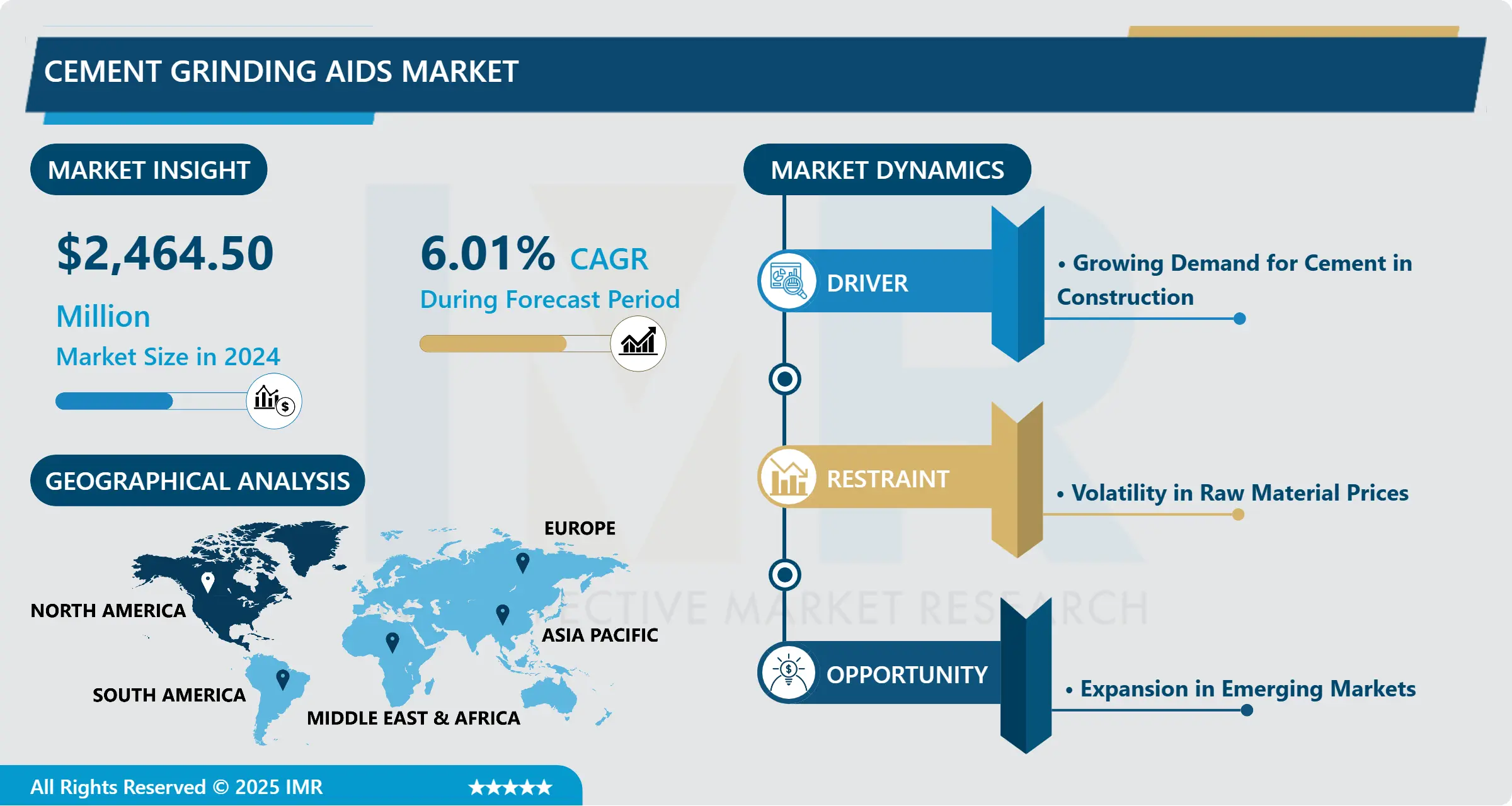
Cement Grinding Aids Market Trend Analysis:
Sustainability and Eco-Friendly Grinding Aids
- One of the key trends emerging from the current analysis is that more cement grinding aids are becoming environment friendly. There is, therefore, increased focus on ground cement grinding aids that produce less carbon emissions and improve energy use in cement making. This is due to increased awareness on environmental issues, enhanced polices on emissions as well as the cement industries work to embrace Environmental Conservation. Various environmentally friendly grinding aids are developed with a primary purpose to reduce energy requirement in the cement grind ing process and enhance the efficiency of the industry.
- Green products assist cement manufactures in meeting the legal emission standards while at the same time improving production performance. These modifications include the identification of novel or less hazardous substitutes for the normal bio-based/chemical grinding aid. This is why companies are focused on the production of new grinding aids, which will have almost no negative effects on the environment and are effective or even more effective than the existing ones.
Expansion in Emerging Markets
- Another promising factor that large cement grinding aids market has in its capacity is that the construction industry in many emerging countries is rapidly developing. With an added increase in the rate of urbanization particularly areas of Asia-Pacific, Latin America and Middle East, there will always be a constant market pull for cement. The call for better and more efficient solutions in cement production results in the need for grinding aids. Developing cement producer in these regions have however been using the grinding aids to boost production as demand for quality cement rises.
- Market seems particularly promising in those nations that have been experiencing a growth in infrastructure and construction of residential houses. Through the incorporation of grinding aids, cement producers in these countries and areas will be able to increase efficiency together with a decrease in the energy demand, which can be essential for competitiveness in a price sensitive market. The introduction of new cement grinding aid suppliers has followed the emerging economies into infrastructure development as the key growth factor.
Cement Grinding Aids Market Segment Analysis:
Cement Grinding Aids Market is Segmented on the basis of Type, Application, End User, and Region.
By Type, Chemical Grinding Aids segment is expected to dominate the market during the forecast period
- Cement grinding aids are classified into three primary types: These include; chemical grinding aids, organic grinding aids and inorganic grinding aids. They are normally inorganic and synthetic chemical facilitating the grinding process of materials and specifically developed to enhance the energy efficiency and production capacity of cement mills. Such aids have several benefits, they can provide very high performance while at the same time they are relatively cheap.
- Organic grinding aids are being preferred over other grinding aids because they are sourced mainly from natural materials and have significantly low impacts on the environment as well as being more sustainable. These aids improve the flowability of cement particles and thus their dispersion in the grinding process. Inorganic grinding aids are mineral based, and are in most occasions used where specific characteristics are desirable through the cement. There are certain benefits of each grinding aid and the option used depends on various factors, peculiar to cement production.
By Application, Portland Cement segment expected to held the largest share
- The main uses of cement grinding aids include portland cement, blended cement and other special cement. Portland cement also signifying the largest market position being a common type of cement that is commonly used in construction industry. Cement grinding aids are used in order to increase the efficiency of the process of making Portland cement whose demand is always high due to its usage in construction.
- Another large application area is blended cement which is Portland cement combined with other materials such as fly ash, slag or limestone. As a strategy to optimize the milling process of blended cement, grinding aids are employed in the cement production process. The remaining portion is composed of speciality cements required in certain construction applications, including high activity, fast setting cement that also consume grinding aids for their production.
Cement Grinding Aids Market Regional Insights:
North America is Expected to Dominate the Market Over the Forecast period
- The cement grinding aids market is dominated by North America region. Currently, the construction industry is robust, and the cement production technology in the region is equally developed making the market a strong one globally. North America is particularly steadily growing in both housing and commercial construction hence the demand for cement and cement grinding aids.
- The fact that many of the major cement manufacturers are located in North America and their efforts to increase production capacity are the main factors behind the demand for grinding aids. Thirdly, there are strict environmental laws in the region that promote the conventional as well as the use of energy efficient products such as the green grinding aids. This regulatory drive, coupled with increasing demand for better quality cement for use in the large projects in large infrastructure projects, continue to retain North America’s stranglehold on the market.
Active Key Players in the Cement Grinding Aids Market:
- BASF (Germany)
- Sika AG (Switzerland)
- Mapei S.p.A. (Italy)
- Dow Chemical Company (USA)
- Clariant AG (Switzerland)
- GCP Applied Technologies (USA)
- Cementaid International (Australia)
- Kao Corporation (Japan)
- Chr. Hansen Holding A/S (Denmark)
- Lanxess AG (Germany)
- Saint-Gobain (France)
- AkzoNobel (Netherlands), and Other Active Players
|
Global Cement Grinding Aids Market |
|||
|
Base Year: |
2024 |
Forecast Period: |
2025-2032 |
|
Historical Data: |
2018 to 2024 |
Market Size in 2024: |
USD 2,464.50 Million |
|
Forecast Period 2025-32 CAGR: |
6.01% |
Market Size in 2032: |
USD 3,931.00 Million |
|
Segments Covered: |
By Type |
|
|
|
By Application |
|
||
|
By End User |
|
||
|
By Region |
|
||
|
Key Market Drivers: |
|
||
|
Key Market Restraints: |
|
||
|
Key Opportunities: |
|
||
|
Companies Covered in the report: |
|
||
Chapter 1: Introduction
1.1 Scope and Coverage
Chapter 2:Executive Summary
Chapter 3: Market Landscape
3.1 Market Dynamics
3.1.1 Drivers
3.1.2 Restraints
3.1.3 Opportunities
3.1.4 Challenges
3.2 Market Trend Analysis
3.3 PESTLE Analysis
3.4 Porter's Five Forces Analysis
3.5 Industry Value Chain Analysis
3.6 Ecosystem
3.7 Regulatory Landscape
3.8 Price Trend Analysis
3.9 Patent Analysis
3.10 Technology Evolution
3.11 Investment Pockets
3.12 Import-Export Analysis
Chapter 4: Cement Grinding Aids Market by Type
4.1 Cement Grinding Aids Market Snapshot and Growth Engine
4.2 Cement Grinding Aids Market Overview
4.3 Chemical Grinding Aids
4.3.1 Introduction and Market Overview
4.3.2 Historic and Forecasted Market Size in Value USD and Volume Units (2017-2032F)
4.3.3 Key Market Trends, Growth Factors and Opportunities
4.3.4 Chemical Grinding Aids: Geographic Segmentation Analysis
4.4 Organic Grinding Aids
4.4.1 Introduction and Market Overview
4.4.2 Historic and Forecasted Market Size in Value USD and Volume Units (2017-2032F)
4.4.3 Key Market Trends, Growth Factors and Opportunities
4.4.4 Organic Grinding Aids: Geographic Segmentation Analysis
4.5 Inorganic Grinding Aids
4.5.1 Introduction and Market Overview
4.5.2 Historic and Forecasted Market Size in Value USD and Volume Units (2017-2032F)
4.5.3 Key Market Trends, Growth Factors and Opportunities
4.5.4 Inorganic Grinding Aids: Geographic Segmentation Analysis
Chapter 5: Cement Grinding Aids Market by Application
5.1 Cement Grinding Aids Market Snapshot and Growth Engine
5.2 Cement Grinding Aids Market Overview
5.3 Portland Cement
5.3.1 Introduction and Market Overview
5.3.2 Historic and Forecasted Market Size in Value USD and Volume Units (2017-2032F)
5.3.3 Key Market Trends, Growth Factors and Opportunities
5.3.4 Portland Cement: Geographic Segmentation Analysis
5.4 Blended Cement
5.4.1 Introduction and Market Overview
5.4.2 Historic and Forecasted Market Size in Value USD and Volume Units (2017-2032F)
5.4.3 Key Market Trends, Growth Factors and Opportunities
5.4.4 Blended Cement: Geographic Segmentation Analysis
5.5 Other
5.5.1 Introduction and Market Overview
5.5.2 Historic and Forecasted Market Size in Value USD and Volume Units (2017-2032F)
5.5.3 Key Market Trends, Growth Factors and Opportunities
5.5.4 Other: Geographic Segmentation Analysis
Chapter 6: Cement Grinding Aids Market by End-User
6.1 Cement Grinding Aids Market Snapshot and Growth Engine
6.2 Cement Grinding Aids Market Overview
6.3 Residential
6.3.1 Introduction and Market Overview
6.3.2 Historic and Forecasted Market Size in Value USD and Volume Units (2017-2032F)
6.3.3 Key Market Trends, Growth Factors and Opportunities
6.3.4 Residential: Geographic Segmentation Analysis
6.4 Commercial
6.4.1 Introduction and Market Overview
6.4.2 Historic and Forecasted Market Size in Value USD and Volume Units (2017-2032F)
6.4.3 Key Market Trends, Growth Factors and Opportunities
6.4.4 Commercial: Geographic Segmentation Analysis
6.5 Industrial
6.5.1 Introduction and Market Overview
6.5.2 Historic and Forecasted Market Size in Value USD and Volume Units (2017-2032F)
6.5.3 Key Market Trends, Growth Factors and Opportunities
6.5.4 Industrial: Geographic Segmentation Analysis
Chapter 7: Company Profiles and Competitive Analysis
7.1 Competitive Landscape
7.1.1 Competitive Benchmarking
7.1.2 Cement Grinding Aids Market Share by Manufacturer (2023)
7.1.3 Industry BCG Matrix
7.1.4 Heat Map Analysis
7.1.5 Mergers and Acquisitions
7.2 BASF (GERMANY)
7.2.1 Company Overview
7.2.2 Key Executives
7.2.3 Company Snapshot
7.2.4 Role of the Company in the Market
7.2.5 Sustainability and Social Responsibility
7.2.6 Operating Business Segments
7.2.7 Product Portfolio
7.2.8 Business Performance
7.2.9 Key Strategic Moves and Recent Developments
7.2.10 SWOT Analysis
7.3 SIKA AG (SWITZERLAND)
7.4 MAPEI S.P.A. (ITALY)
7.5 DOW CHEMICAL COMPANY (USA)
7.6 CLARIANT AG (SWITZERLAND)
7.7 GCP APPLIED TECHNOLOGIES (USA)
7.8 CEMENTAID INTERNATIONAL (AUSTRALIA)
7.9 KAO CORPORATION (JAPAN)
7.10 CHR. HANSEN HOLDING A/S (DENMARK)
7.11 LANXESS AG (GERMANY)
7.12 SAINT-GOBAIN (FRANCE)
7.13 AKZONOBEL (NETHERLANDS)
7.14 OTHER ACTIVE PLAYERS
Chapter 8: Global Cement Grinding Aids Market By Region
8.1 Overview
8.2. North America Cement Grinding Aids Market
8.2.1 Key Market Trends, Growth Factors and Opportunities
8.2.2 Top Key Companies
8.2.3 Historic and Forecasted Market Size by Segments
8.2.4 Historic and Forecasted Market Size By Type
8.2.4.1 Chemical Grinding Aids
8.2.4.2 Organic Grinding Aids
8.2.4.3 Inorganic Grinding Aids
8.2.5 Historic and Forecasted Market Size By Application
8.2.5.1 Portland Cement
8.2.5.2 Blended Cement
8.2.5.3 Other
8.2.6 Historic and Forecasted Market Size By End-User
8.2.6.1 Residential
8.2.6.2 Commercial
8.2.6.3 Industrial
8.2.7 Historic and Forecast Market Size by Country
8.2.7.1 US
8.2.7.2 Canada
8.2.7.3 Mexico
8.3. Eastern Europe Cement Grinding Aids Market
8.3.1 Key Market Trends, Growth Factors and Opportunities
8.3.2 Top Key Companies
8.3.3 Historic and Forecasted Market Size by Segments
8.3.4 Historic and Forecasted Market Size By Type
8.3.4.1 Chemical Grinding Aids
8.3.4.2 Organic Grinding Aids
8.3.4.3 Inorganic Grinding Aids
8.3.5 Historic and Forecasted Market Size By Application
8.3.5.1 Portland Cement
8.3.5.2 Blended Cement
8.3.5.3 Other
8.3.6 Historic and Forecasted Market Size By End-User
8.3.6.1 Residential
8.3.6.2 Commercial
8.3.6.3 Industrial
8.3.7 Historic and Forecast Market Size by Country
8.3.7.1 Russia
8.3.7.2 Bulgaria
8.3.7.3 The Czech Republic
8.3.7.4 Hungary
8.3.7.5 Poland
8.3.7.6 Romania
8.3.7.7 Rest of Eastern Europe
8.4. Western Europe Cement Grinding Aids Market
8.4.1 Key Market Trends, Growth Factors and Opportunities
8.4.2 Top Key Companies
8.4.3 Historic and Forecasted Market Size by Segments
8.4.4 Historic and Forecasted Market Size By Type
8.4.4.1 Chemical Grinding Aids
8.4.4.2 Organic Grinding Aids
8.4.4.3 Inorganic Grinding Aids
8.4.5 Historic and Forecasted Market Size By Application
8.4.5.1 Portland Cement
8.4.5.2 Blended Cement
8.4.5.3 Other
8.4.6 Historic and Forecasted Market Size By End-User
8.4.6.1 Residential
8.4.6.2 Commercial
8.4.6.3 Industrial
8.4.7 Historic and Forecast Market Size by Country
8.4.7.1 Germany
8.4.7.2 UK
8.4.7.3 France
8.4.7.4 The Netherlands
8.4.7.5 Italy
8.4.7.6 Spain
8.4.7.7 Rest of Western Europe
8.5. Asia Pacific Cement Grinding Aids Market
8.5.1 Key Market Trends, Growth Factors and Opportunities
8.5.2 Top Key Companies
8.5.3 Historic and Forecasted Market Size by Segments
8.5.4 Historic and Forecasted Market Size By Type
8.5.4.1 Chemical Grinding Aids
8.5.4.2 Organic Grinding Aids
8.5.4.3 Inorganic Grinding Aids
8.5.5 Historic and Forecasted Market Size By Application
8.5.5.1 Portland Cement
8.5.5.2 Blended Cement
8.5.5.3 Other
8.5.6 Historic and Forecasted Market Size By End-User
8.5.6.1 Residential
8.5.6.2 Commercial
8.5.6.3 Industrial
8.5.7 Historic and Forecast Market Size by Country
8.5.7.1 China
8.5.7.2 India
8.5.7.3 Japan
8.5.7.4 South Korea
8.5.7.5 Malaysia
8.5.7.6 Thailand
8.5.7.7 Vietnam
8.5.7.8 The Philippines
8.5.7.9 Australia
8.5.7.10 New Zealand
8.5.7.11 Rest of APAC
8.6. Middle East & Africa Cement Grinding Aids Market
8.6.1 Key Market Trends, Growth Factors and Opportunities
8.6.2 Top Key Companies
8.6.3 Historic and Forecasted Market Size by Segments
8.6.4 Historic and Forecasted Market Size By Type
8.6.4.1 Chemical Grinding Aids
8.6.4.2 Organic Grinding Aids
8.6.4.3 Inorganic Grinding Aids
8.6.5 Historic and Forecasted Market Size By Application
8.6.5.1 Portland Cement
8.6.5.2 Blended Cement
8.6.5.3 Other
8.6.6 Historic and Forecasted Market Size By End-User
8.6.6.1 Residential
8.6.6.2 Commercial
8.6.6.3 Industrial
8.6.7 Historic and Forecast Market Size by Country
8.6.7.1 Turkiye
8.6.7.2 Bahrain
8.6.7.3 Kuwait
8.6.7.4 Saudi Arabia
8.6.7.5 Qatar
8.6.7.6 UAE
8.6.7.7 Israel
8.6.7.8 South Africa
8.7. South America Cement Grinding Aids Market
8.7.1 Key Market Trends, Growth Factors and Opportunities
8.7.2 Top Key Companies
8.7.3 Historic and Forecasted Market Size by Segments
8.7.4 Historic and Forecasted Market Size By Type
8.7.4.1 Chemical Grinding Aids
8.7.4.2 Organic Grinding Aids
8.7.4.3 Inorganic Grinding Aids
8.7.5 Historic and Forecasted Market Size By Application
8.7.5.1 Portland Cement
8.7.5.2 Blended Cement
8.7.5.3 Other
8.7.6 Historic and Forecasted Market Size By End-User
8.7.6.1 Residential
8.7.6.2 Commercial
8.7.6.3 Industrial
8.7.7 Historic and Forecast Market Size by Country
8.7.7.1 Brazil
8.7.7.2 Argentina
8.7.7.3 Rest of SA
Chapter 9 Analyst Viewpoint and Conclusion
9.1 Recommendations and Concluding Analysis
9.2 Potential Market Strategies
Chapter 10 Research Methodology
10.1 Research Process
10.2 Primary Research
10.3 Secondary Research
|
Global Cement Grinding Aids Market |
|||
|
Base Year: |
2024 |
Forecast Period: |
2025-2032 |
|
Historical Data: |
2018 to 2024 |
Market Size in 2024: |
USD 2,464.50 Million |
|
Forecast Period 2025-32 CAGR: |
6.01% |
Market Size in 2032: |
USD 3,931.00 Million |
|
Segments Covered: |
By Type |
|
|
|
By Application |
|
||
|
By End User |
|
||
|
By Region |
|
||
|
Key Market Drivers: |
|
||
|
Key Market Restraints: |
|
||
|
Key Opportunities: |
|
||
|
Companies Covered in the report: |
|
||