




Neuroregeneration Therapy Market Synopsis:
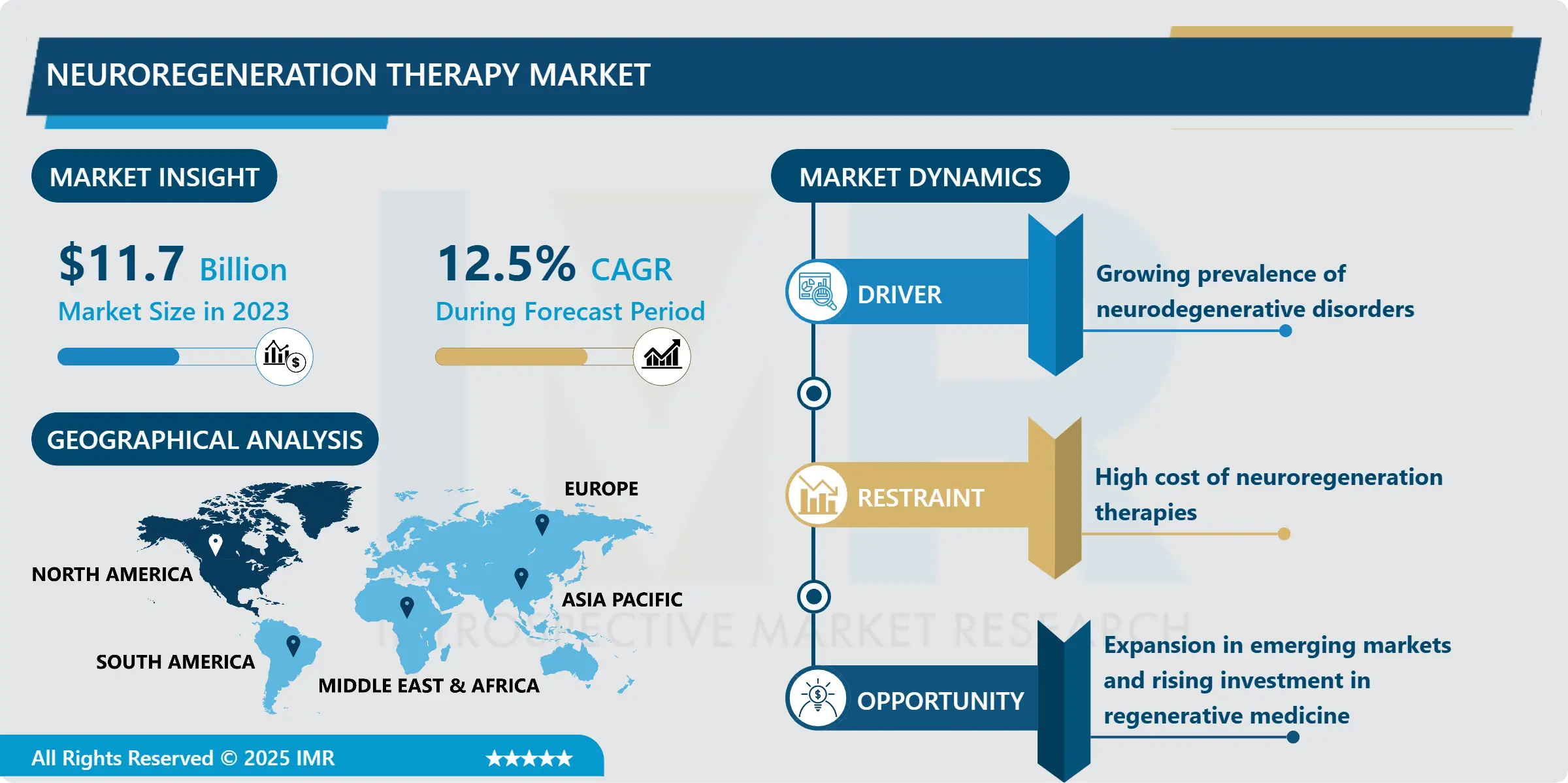
Neuroregeneration Therapy Market Size Was Valued at USD 11.7 Billion in 2023, and is Projected to Reach USD 30.0 Billion by 2032, Growing at a CAGR of 12.5% From 2024-2032.
The neuroregeneration therapy market is derived from treatments and medicines that are assigned to rebuild, reestablish or replace injured nervous tissues, cells and cellular products. This includes stem cell therapy, gene therapy and other other forms of expensive therapies targeted on neurological injury, arising from instances like spinal cord injuries, neurodegenerative diseases and TBI. This market remains continually growing, driven by enhanced biotechnology innovations and higher rates of neurological conditions, providing potential solution to unmet demand.
The neuroregeneration therapy market is expanding rapidly mainly due to innovative technology; funding the neurological research in the current years; Neuropathic disorders such as Alzheimer’s, Parkinson’s, and ALS are rapidly growing in the global market. These disorders result in neuronal degeneration and death and affect motor and cognitive functions motivating the development of stimulus for tissue repair and functional recovery. For such diseases, the disease burden is expected to rise with upcoming generations as the global population ages, enhancing the need for neuroregenerative therapies.
Furthermore, the regulatory authorities of different parts of the world are now more open to consider approving advanced therapy, as it has attracted many biotech companies to invest in this area. Patients can only benefit from such advancements because as if the focus of researchers is on the enhancement of clinical results of patients with known neurological disorders, stem cell-based therapies and gene editing are now being considered promising methods for replacing damaged or lost tissues and returning the brain to its normal functional state. The constant and highly active advancements in the neuroregeneration technology, the favorable governmental and private support and investment also ensures that the neuroregeneration therapy market will continue its steady as well as potentially unlimited expansion.
Neuroregeneration Therapy Market Trend Analysis:
Advances in Stem Cell Therapy
-
One prevailing trend provided in the neuroregeneration therapy market is attaining growth through the use of stem cell therapy for neurological disorders. NESCs can be used in various applications for neural tissue regeneration since cells come from stem cells possess the ability to specialize. The use of induced pluripotent stem cells (iPSCs) and mesenchymal stem cells (MSCs) is particularly owing to the clinical trials indicating the repaired and enhanced spinal cord tissue regeneration. This trend focuses on regenerative medicine and individualized therapy in neurology, as stem cell therapies are under creation for certain certain neurodegenerative diseases, thus increasing the likelihood of positive result.
Expansion in Emerging Markets
-
The neuroregeneration therapy has lot of unexplored growth opportunities especially being Asia-Pacific and Latin American regions. These regions are experiencing the growth of healthcare investments and the development of the need for improved treatment caused by the growing rate of neurological diseases awareness. Currently there is a large population of elderly people in country’s like China and India, and this brings with it high rates of neurological disorders. Greater availability of neuroregenerative products and services can utilize a large number of patients in these areas and offer relatively low-cost treatments; these regions can be viewed as promising for development and investment.
Neuroregeneration Therapy Market Segment Analysis:
Neuroregeneration Therapy Market is Segmented on the basis of Type, Indication, End User, and Region.
By Type, Stem Cell Therapy segment is expected to dominate the market during the forecast period
-
The neuroregeneration therapy market will see the stem cell therapy segment as the largest during the period under consideration. It therefore comes as no surprise that stem cell therapy is proving to be one of the most viable options for neuroregeneration because of the stem cell’s mechanisms of replacing damaged neurons and also stimulating the repair processes in cells. Clinical practice has indicated that stem cells can promote the out growth of nerves, thus there is hope for confronting circumstances such as severe spinal cord damage, stroke and other neurological disorders. Hence, various organizations such as corporate and research institutes are heavily investing in stem cell research hence would lead to increased market of the segment.
- Furthermore, advances in stem cell technology together with an increasing trend in terms of regulatory approval, stem cell therapies are shifting from experimental treatments into commercial products. This development is further underpinned by partnerships between the biotech industry and hospitals who are seeking to advance the use of these therapies faster. This kind of treatment based on stem cell neuroregeneration is expected to retain and even enhance the position of the type of treatment dominating this market.
By Indication, Spinal Cord Injury segment expected to held the largest share
-
Among the applications, the spinal cord injury will dominate the neuroregeneration therapy market in the forthcoming years. Spinal cord injuries result in dön’s to the nervous system that are permanent; they forestall sensation or motor function below the point of the injury. For these patients, neuroregeneration therapies such as stem cell treatments can be of hope, since they involve encouraging cells that make up the neural connections to regenerate and reconnect again. With development in research, newer neuroregenerative therapies have proved useful in enhancing motor as well as sensory characteristics in clients of spinal cord traumas hence solidifying the segment.
- Increase in the number of spinal cord related injuries from accidents, increase in war veterans soldiers and sportsmen & women with such injuries also drive the neuroregenerative market. These therapies are being embraced by healthcare providers because of insurance policies and a greater likelihood of seeking new therapies in developed areas. Owing to growth and subsequent support from the medical fraternity the spinal cord injury segment is expected to continue its dominance in the neuroregeneration therapy market.
Neuroregeneration Therapy Market Regional Insights:
North America is Expected to Dominate the Market Over the Forecast period
-
The estimation for the year 2023 shows that North America will remain at the apex of the neuroregeneration therapy market taking the largest market share of about 45%. This can be due to the improvements in healthcare facilities and neurological research, high market investment and significant players in the market localized in the area. In particular, such country as the United States largely contributes to this leading position by the increasing rate of neurodegenerative diseases and by the developed program of clinical trials linked with neuroregenerative therapy. Further, government policies aimed at building advanced therapy and an increasing understanding of regenerative medicine among patients establish the region as a market leader. For the same reasons, the North American region will remain in the apex for a long time as it sets pace for innovation in the area.
Active Key Players in the Neuroregeneration Therapy Market:
- AbbVie (USA)
- Athersys Inc. (USA)
- Biogen (USA)
- BioTime Inc. (USA)
- Brainstorm Cell Therapeutics (USA)
- Celgene Corporation (USA)
- Eli Lilly and Company (USA)
- GlaxoSmithKline (UK)
- Medtronic (USA)
- Merck KGaA (Germany)
- Neuralstem Inc. (USA)
- Novartis (Switzerland)
- Pfizer Inc. (USA)
- Q Therapeutics (USA)
- ReNeuron Group (UK)
- Other Active Players
|
Global Neuroregeneration Therapy Market |
|||
|
Base Year: |
2023 |
Forecast Period: |
2024-2032 |
|
Historical Data: |
2017 to 2023 |
Market Size in 2023: |
USD 11.7 Billion |
|
Forecast Period 2024-32 CAGR: |
12.5% |
Market Size in 2032: |
USD 30.0 Billion |
|
Segments Covered: |
By Type |
|
|
|
By Indication |
|
||
|
By End User |
|
||
|
By Region |
|
||
|
Key Market Drivers: |
|
||
|
Key Market Restraints: |
|
||
|
Key Opportunities: |
|
||
|
Companies Covered in the report: |
|
||
Chapter 1: Introduction
1.1 Scope and Coverage
Chapter 2:Executive Summary
Chapter 3: Market Landscape
3.1 Market Dynamics
3.1.1 Drivers
3.1.2 Restraints
3.1.3 Opportunities
3.1.4 Challenges
3.2 Market Trend Analysis
3.3 PESTLE Analysis
3.4 Porter's Five Forces Analysis
3.5 Industry Value Chain Analysis
3.6 Ecosystem
3.7 Regulatory Landscape
3.8 Price Trend Analysis
3.9 Patent Analysis
3.10 Technology Evolution
3.11 Investment Pockets
3.12 Import-Export Analysis
Chapter 4: Neuroregeneration Therapy Market by Type
4.1 Neuroregeneration Therapy Market Snapshot and Growth Engine
4.2 Neuroregeneration Therapy Market Overview
4.3 Stem Cell Therapy
4.3.1 Introduction and Market Overview
4.3.2 Historic and Forecasted Market Size in Value USD and Volume Units (2017-2032F)
4.3.3 Key Market Trends, Growth Factors and Opportunities
4.3.4 Stem Cell Therapy: Geographic Segmentation Analysis
4.4 Gene Therapy
4.4.1 Introduction and Market Overview
4.4.2 Historic and Forecasted Market Size in Value USD and Volume Units (2017-2032F)
4.4.3 Key Market Trends, Growth Factors and Opportunities
4.4.4 Gene Therapy: Geographic Segmentation Analysis
4.5 Pharmacological Therapy
4.5.1 Introduction and Market Overview
4.5.2 Historic and Forecasted Market Size in Value USD and Volume Units (2017-2032F)
4.5.3 Key Market Trends, Growth Factors and Opportunities
4.5.4 Pharmacological Therapy: Geographic Segmentation Analysis
4.6 Neurostimulation Therapy
4.6.1 Introduction and Market Overview
4.6.2 Historic and Forecasted Market Size in Value USD and Volume Units (2017-2032F)
4.6.3 Key Market Trends, Growth Factors and Opportunities
4.6.4 Neurostimulation Therapy: Geographic Segmentation Analysis
4.7 Others
4.7.1 Introduction and Market Overview
4.7.2 Historic and Forecasted Market Size in Value USD and Volume Units (2017-2032F)
4.7.3 Key Market Trends, Growth Factors and Opportunities
4.7.4 Others: Geographic Segmentation Analysis
Chapter 5: Neuroregeneration Therapy Market by Indication
5.1 Neuroregeneration Therapy Market Snapshot and Growth Engine
5.2 Neuroregeneration Therapy Market Overview
5.3 Spinal Cord Injury
5.3.1 Introduction and Market Overview
5.3.2 Historic and Forecasted Market Size in Value USD and Volume Units (2017-2032F)
5.3.3 Key Market Trends, Growth Factors and Opportunities
5.3.4 Spinal Cord Injury: Geographic Segmentation Analysis
5.4 Stroke
5.4.1 Introduction and Market Overview
5.4.2 Historic and Forecasted Market Size in Value USD and Volume Units (2017-2032F)
5.4.3 Key Market Trends, Growth Factors and Opportunities
5.4.4 Stroke: Geographic Segmentation Analysis
5.5 Traumatic Brain Injury
5.5.1 Introduction and Market Overview
5.5.2 Historic and Forecasted Market Size in Value USD and Volume Units (2017-2032F)
5.5.3 Key Market Trends, Growth Factors and Opportunities
5.5.4 Traumatic Brain Injury: Geographic Segmentation Analysis
5.6 Parkinson’s Disease
5.6.1 Introduction and Market Overview
5.6.2 Historic and Forecasted Market Size in Value USD and Volume Units (2017-2032F)
5.6.3 Key Market Trends, Growth Factors and Opportunities
5.6.4 Parkinson’s Disease: Geographic Segmentation Analysis
5.7 Alzheimer’s Disease
5.7.1 Introduction and Market Overview
5.7.2 Historic and Forecasted Market Size in Value USD and Volume Units (2017-2032F)
5.7.3 Key Market Trends, Growth Factors and Opportunities
5.7.4 Alzheimer’s Disease: Geographic Segmentation Analysis
5.8 Multiple Sclerosis
5.8.1 Introduction and Market Overview
5.8.2 Historic and Forecasted Market Size in Value USD and Volume Units (2017-2032F)
5.8.3 Key Market Trends, Growth Factors and Opportunities
5.8.4 Multiple Sclerosis: Geographic Segmentation Analysis
5.9 Peripheral Nerve Injury
5.9.1 Introduction and Market Overview
5.9.2 Historic and Forecasted Market Size in Value USD and Volume Units (2017-2032F)
5.9.3 Key Market Trends, Growth Factors and Opportunities
5.9.4 Peripheral Nerve Injury: Geographic Segmentation Analysis
5.10 Others
5.10.1 Introduction and Market Overview
5.10.2 Historic and Forecasted Market Size in Value USD and Volume Units (2017-2032F)
5.10.3 Key Market Trends, Growth Factors and Opportunities
5.10.4 Others: Geographic Segmentation Analysis
Chapter 6: Neuroregeneration Therapy Market by End User
6.1 Neuroregeneration Therapy Market Snapshot and Growth Engine
6.2 Neuroregeneration Therapy Market Overview
6.3 Hospitals
6.3.1 Introduction and Market Overview
6.3.2 Historic and Forecasted Market Size in Value USD and Volume Units (2017-2032F)
6.3.3 Key Market Trends, Growth Factors and Opportunities
6.3.4 Hospitals: Geographic Segmentation Analysis
6.4 Specialty Clinics
6.4.1 Introduction and Market Overview
6.4.2 Historic and Forecasted Market Size in Value USD and Volume Units (2017-2032F)
6.4.3 Key Market Trends, Growth Factors and Opportunities
6.4.4 Specialty Clinics: Geographic Segmentation Analysis
6.5 Research Institutes
6.5.1 Introduction and Market Overview
6.5.2 Historic and Forecasted Market Size in Value USD and Volume Units (2017-2032F)
6.5.3 Key Market Trends, Growth Factors and Opportunities
6.5.4 Research Institutes: Geographic Segmentation Analysis
6.6 Rehabilitation Centers
6.6.1 Introduction and Market Overview
6.6.2 Historic and Forecasted Market Size in Value USD and Volume Units (2017-2032F)
6.6.3 Key Market Trends, Growth Factors and Opportunities
6.6.4 Rehabilitation Centers: Geographic Segmentation Analysis
6.7 Others
6.7.1 Introduction and Market Overview
6.7.2 Historic and Forecasted Market Size in Value USD and Volume Units (2017-2032F)
6.7.3 Key Market Trends, Growth Factors and Opportunities
6.7.4 Others: Geographic Segmentation Analysis
Chapter 7: Company Profiles and Competitive Analysis
7.1 Competitive Landscape
7.1.1 Competitive Benchmarking
7.1.2 Neuroregeneration Therapy Market Share by Manufacturer (2023)
7.1.3 Industry BCG Matrix
7.1.4 Heat Map Analysis
7.1.5 Mergers and Acquisitions
7.2 ABBVIE (USA)
7.2.1 Company Overview
7.2.2 Key Executives
7.2.3 Company Snapshot
7.2.4 Role of the Company in the Market
7.2.5 Sustainability and Social Responsibility
7.2.6 Operating Business Segments
7.2.7 Product Portfolio
7.2.8 Business Performance
7.2.9 Key Strategic Moves and Recent Developments
7.2.10 SWOT Analysis
7.3 ATHERSYS INC. (USA)
7.4 BIOGEN (USA)
7.5 BIOTIME INC. (USA)
7.6 BRAINSTORM CELL THERAPEUTICS (USA)
7.7 CELGENE CORPORATION (USA)
7.8 ELI LILLY AND COMPANY (USA)
7.9 GLAXOSMITHKLINE (UK)
7.10 MEDTRONIC (USA)
7.11 MERCK KGAA (GERMANY)
7.12 NEURALSTEM INC. (USA)
7.13 NOVARTIS (SWITZERLAND)
7.14 PFIZER INC. (USA)
7.15 Q THERAPEUTICS (USA)
7.16 RENEURON GROUP (UK)
7.17 OTHER ACTIVE PLAYERS
Chapter 8: Global Neuroregeneration Therapy Market By Region
8.1 Overview
8.2. North America Neuroregeneration Therapy Market
8.2.1 Key Market Trends, Growth Factors and Opportunities
8.2.2 Top Key Companies
8.2.3 Historic and Forecasted Market Size by Segments
8.2.4 Historic and Forecasted Market Size By Type
8.2.4.1 Stem Cell Therapy
8.2.4.2 Gene Therapy
8.2.4.3 Pharmacological Therapy
8.2.4.4 Neurostimulation Therapy
8.2.4.5 Others
8.2.5 Historic and Forecasted Market Size By Indication
8.2.5.1 Spinal Cord Injury
8.2.5.2 Stroke
8.2.5.3 Traumatic Brain Injury
8.2.5.4 Parkinson’s Disease
8.2.5.5 Alzheimer’s Disease
8.2.5.6 Multiple Sclerosis
8.2.5.7 Peripheral Nerve Injury
8.2.5.8 Others
8.2.6 Historic and Forecasted Market Size By End User
8.2.6.1 Hospitals
8.2.6.2 Specialty Clinics
8.2.6.3 Research Institutes
8.2.6.4 Rehabilitation Centers
8.2.6.5 Others
8.2.7 Historic and Forecast Market Size by Country
8.2.7.1 US
8.2.7.2 Canada
8.2.7.3 Mexico
8.3. Eastern Europe Neuroregeneration Therapy Market
8.3.1 Key Market Trends, Growth Factors and Opportunities
8.3.2 Top Key Companies
8.3.3 Historic and Forecasted Market Size by Segments
8.3.4 Historic and Forecasted Market Size By Type
8.3.4.1 Stem Cell Therapy
8.3.4.2 Gene Therapy
8.3.4.3 Pharmacological Therapy
8.3.4.4 Neurostimulation Therapy
8.3.4.5 Others
8.3.5 Historic and Forecasted Market Size By Indication
8.3.5.1 Spinal Cord Injury
8.3.5.2 Stroke
8.3.5.3 Traumatic Brain Injury
8.3.5.4 Parkinson’s Disease
8.3.5.5 Alzheimer’s Disease
8.3.5.6 Multiple Sclerosis
8.3.5.7 Peripheral Nerve Injury
8.3.5.8 Others
8.3.6 Historic and Forecasted Market Size By End User
8.3.6.1 Hospitals
8.3.6.2 Specialty Clinics
8.3.6.3 Research Institutes
8.3.6.4 Rehabilitation Centers
8.3.6.5 Others
8.3.7 Historic and Forecast Market Size by Country
8.3.7.1 Russia
8.3.7.2 Bulgaria
8.3.7.3 The Czech Republic
8.3.7.4 Hungary
8.3.7.5 Poland
8.3.7.6 Romania
8.3.7.7 Rest of Eastern Europe
8.4. Western Europe Neuroregeneration Therapy Market
8.4.1 Key Market Trends, Growth Factors and Opportunities
8.4.2 Top Key Companies
8.4.3 Historic and Forecasted Market Size by Segments
8.4.4 Historic and Forecasted Market Size By Type
8.4.4.1 Stem Cell Therapy
8.4.4.2 Gene Therapy
8.4.4.3 Pharmacological Therapy
8.4.4.4 Neurostimulation Therapy
8.4.4.5 Others
8.4.5 Historic and Forecasted Market Size By Indication
8.4.5.1 Spinal Cord Injury
8.4.5.2 Stroke
8.4.5.3 Traumatic Brain Injury
8.4.5.4 Parkinson’s Disease
8.4.5.5 Alzheimer’s Disease
8.4.5.6 Multiple Sclerosis
8.4.5.7 Peripheral Nerve Injury
8.4.5.8 Others
8.4.6 Historic and Forecasted Market Size By End User
8.4.6.1 Hospitals
8.4.6.2 Specialty Clinics
8.4.6.3 Research Institutes
8.4.6.4 Rehabilitation Centers
8.4.6.5 Others
8.4.7 Historic and Forecast Market Size by Country
8.4.7.1 Germany
8.4.7.2 UK
8.4.7.3 France
8.4.7.4 The Netherlands
8.4.7.5 Italy
8.4.7.6 Spain
8.4.7.7 Rest of Western Europe
8.5. Asia Pacific Neuroregeneration Therapy Market
8.5.1 Key Market Trends, Growth Factors and Opportunities
8.5.2 Top Key Companies
8.5.3 Historic and Forecasted Market Size by Segments
8.5.4 Historic and Forecasted Market Size By Type
8.5.4.1 Stem Cell Therapy
8.5.4.2 Gene Therapy
8.5.4.3 Pharmacological Therapy
8.5.4.4 Neurostimulation Therapy
8.5.4.5 Others
8.5.5 Historic and Forecasted Market Size By Indication
8.5.5.1 Spinal Cord Injury
8.5.5.2 Stroke
8.5.5.3 Traumatic Brain Injury
8.5.5.4 Parkinson’s Disease
8.5.5.5 Alzheimer’s Disease
8.5.5.6 Multiple Sclerosis
8.5.5.7 Peripheral Nerve Injury
8.5.5.8 Others
8.5.6 Historic and Forecasted Market Size By End User
8.5.6.1 Hospitals
8.5.6.2 Specialty Clinics
8.5.6.3 Research Institutes
8.5.6.4 Rehabilitation Centers
8.5.6.5 Others
8.5.7 Historic and Forecast Market Size by Country
8.5.7.1 China
8.5.7.2 India
8.5.7.3 Japan
8.5.7.4 South Korea
8.5.7.5 Malaysia
8.5.7.6 Thailand
8.5.7.7 Vietnam
8.5.7.8 The Philippines
8.5.7.9 Australia
8.5.7.10 New Zealand
8.5.7.11 Rest of APAC
8.6. Middle East & Africa Neuroregeneration Therapy Market
8.6.1 Key Market Trends, Growth Factors and Opportunities
8.6.2 Top Key Companies
8.6.3 Historic and Forecasted Market Size by Segments
8.6.4 Historic and Forecasted Market Size By Type
8.6.4.1 Stem Cell Therapy
8.6.4.2 Gene Therapy
8.6.4.3 Pharmacological Therapy
8.6.4.4 Neurostimulation Therapy
8.6.4.5 Others
8.6.5 Historic and Forecasted Market Size By Indication
8.6.5.1 Spinal Cord Injury
8.6.5.2 Stroke
8.6.5.3 Traumatic Brain Injury
8.6.5.4 Parkinson’s Disease
8.6.5.5 Alzheimer’s Disease
8.6.5.6 Multiple Sclerosis
8.6.5.7 Peripheral Nerve Injury
8.6.5.8 Others
8.6.6 Historic and Forecasted Market Size By End User
8.6.6.1 Hospitals
8.6.6.2 Specialty Clinics
8.6.6.3 Research Institutes
8.6.6.4 Rehabilitation Centers
8.6.6.5 Others
8.6.7 Historic and Forecast Market Size by Country
8.6.7.1 Turkiye
8.6.7.2 Bahrain
8.6.7.3 Kuwait
8.6.7.4 Saudi Arabia
8.6.7.5 Qatar
8.6.7.6 UAE
8.6.7.7 Israel
8.6.7.8 South Africa
8.7. South America Neuroregeneration Therapy Market
8.7.1 Key Market Trends, Growth Factors and Opportunities
8.7.2 Top Key Companies
8.7.3 Historic and Forecasted Market Size by Segments
8.7.4 Historic and Forecasted Market Size By Type
8.7.4.1 Stem Cell Therapy
8.7.4.2 Gene Therapy
8.7.4.3 Pharmacological Therapy
8.7.4.4 Neurostimulation Therapy
8.7.4.5 Others
8.7.5 Historic and Forecasted Market Size By Indication
8.7.5.1 Spinal Cord Injury
8.7.5.2 Stroke
8.7.5.3 Traumatic Brain Injury
8.7.5.4 Parkinson’s Disease
8.7.5.5 Alzheimer’s Disease
8.7.5.6 Multiple Sclerosis
8.7.5.7 Peripheral Nerve Injury
8.7.5.8 Others
8.7.6 Historic and Forecasted Market Size By End User
8.7.6.1 Hospitals
8.7.6.2 Specialty Clinics
8.7.6.3 Research Institutes
8.7.6.4 Rehabilitation Centers
8.7.6.5 Others
8.7.7 Historic and Forecast Market Size by Country
8.7.7.1 Brazil
8.7.7.2 Argentina
8.7.7.3 Rest of SA
Chapter 9 Analyst Viewpoint and Conclusion
9.1 Recommendations and Concluding Analysis
9.2 Potential Market Strategies
Chapter 10 Research Methodology
10.1 Research Process
10.2 Primary Research
10.3 Secondary Research
|
Global Neuroregeneration Therapy Market |
|||
|
Base Year: |
2023 |
Forecast Period: |
2024-2032 |
|
Historical Data: |
2017 to 2023 |
Market Size in 2023: |
USD 11.7 Billion |
|
Forecast Period 2024-32 CAGR: |
12.5% |
Market Size in 2032: |
USD 30.0 Billion |
|
Segments Covered: |
By Type |
|
|
|
By Indication |
|
||
|
By End User |
|
||
|
By Region |
|
||
|
Key Market Drivers: |
|
||
|
Key Market Restraints: |
|
||
|
Key Opportunities: |
|
||
|
Companies Covered in the report: |
|
||


