




Medical Ceramics Market Synopsis:
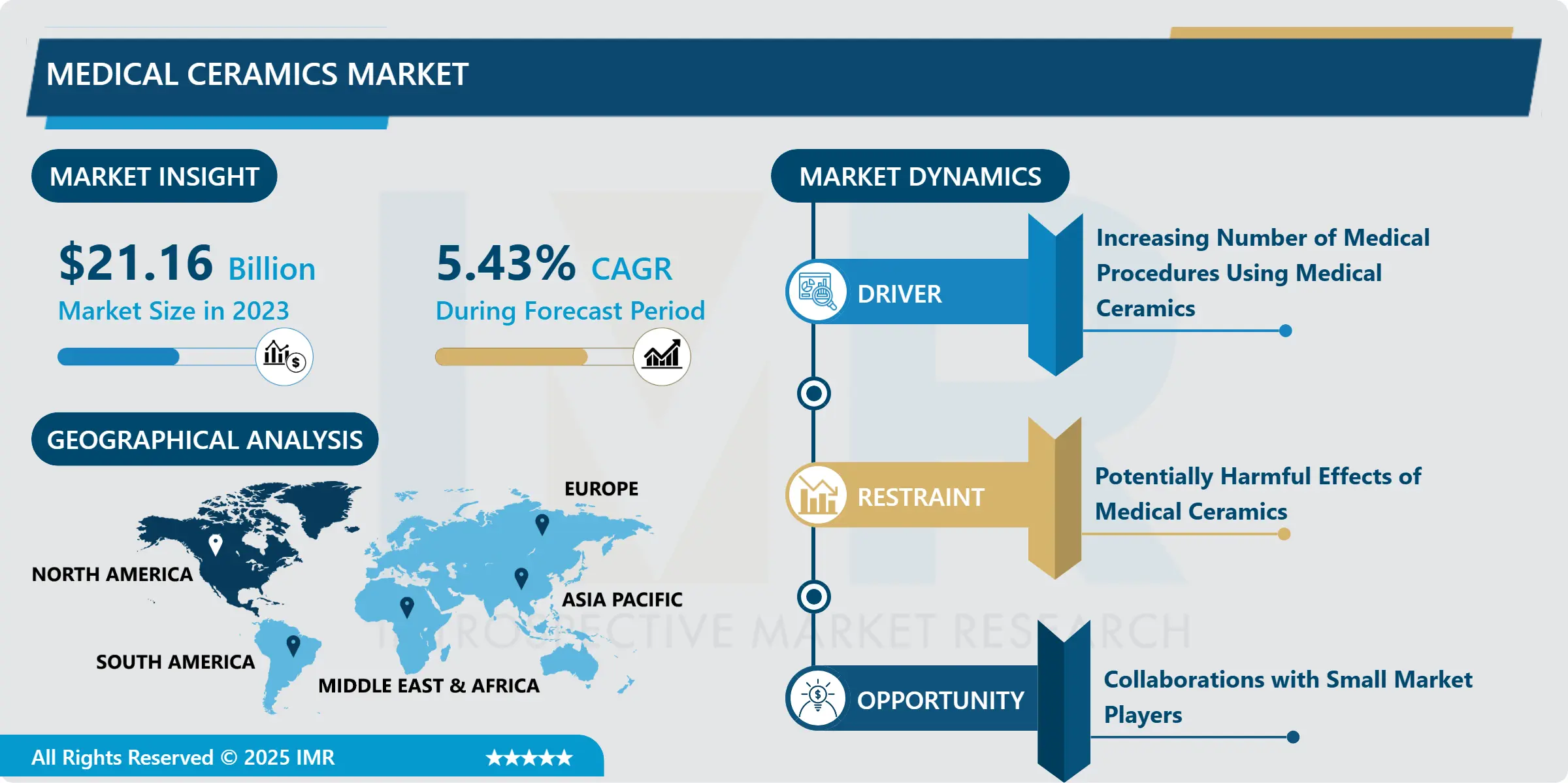
Medical Ceramics Market Size Was Valued at USD 21.16 Billion in 2023, and is Projected to Reach USD 34.06 Billion by 2032, Growing at a CAGR of 5.43% From 2024-2032.
Medical ceramics refers to a collection of complex ceramics with application in the health sector in areas such as implants, artificial limbs and surgical tools. It is biocompatible, mechanically strong, and resistant to both wearing and corrosion; therefore used in procedures for making dental implants, orthopedic implants, and bone grafts. It is fueled by growing demand of less invasive procedures, surging prevalent of diseases requiring orthopaedic and dental goods, and continuous advancement in ceramics for improving functionality and durability of operating instruments. The medical ceramics market is set to accelerate in step with the progress of the healthcare industry both in leader countries in material science and in the world in general and in the variety of medical applications of the ceramics, including in the such actively developing areas as regenerative medi cine and personalized medicine.
The global market for medical ceramics has become an important category in the healthcare business due to the growing need for higher technical medical equipment and implantation products. Medical ceramics; biocompatibility, mechanical properties, and chemical stability; Medical ceramics are used for surgical implants, dental repairs, and surgery tools. Increased incidence rates of chronic diseases and an ever-increasing elderly population are some of the main causes for the increasing need for ceramic-based healthcare products. Moreover, changes in the manufacturing technologies and materials science have contributed to the new types of ceramic products with improved characteristics which have increased their possibilities of application.
In terms of geographical segmentation, North America is identified to be dominating the medical ceramics market due to development of advanced healthcare facilities, higher spending in healthcare sector and emphasis on research and development activities. But Asia-Pacific is anticipated to show the highest growth rate because of increasing healthcare consciousness, increasing healthcare facilities and services, and increasing number of old age people. Major exporters such as China & India are extending their health care capacities and as a direct result are adopting more medical ceramics. Moreover, the backing that is given by regulatory frameworks to advanced materials in healthcare applications is another driver to the market.
The major market players in the medical ceramics industry are improving their market position and portfolio through partnerships and collaborations. The market is experiencing a shift towards bioactive ceramics and composites, which help stimulate tissue repair and regeneration, and thereby improve patient satisfaction. That is why the continued development of new materials for medical applications will be stimulated by the increasing demand for technologically highly sophisticated MICs and other such systems that require ceramics capable of withstanding the stresses inherent in fewer invasive operations. In all, the global medical ceramics market has great potential for growth that will be driven by technological development, a growing demand for health care and better quality life of patients.
Medical Ceramics Market Trend Analysis:
Prominent Trends in the Medical Ceramics Market
- Another important issue that advances in the medical ceramics market is bioactive ceramics, which aims at forming bonds with bone tissue, providing even better integration in orthopedic and dental medicine. They have been used more often in artificial limbs and dental plates especially since the ceramic material has to complement the human body for long term use. Bioactive ceramics have an enhanced osteoconductivity, which means that they improve the healing processes in the body to give the patient a much better prognosis. With greatly emphasized breakthrough expectations of implant materials performance and longevity, bioactive ceramics are expected to grow tremendously in demand.
- However, along with micro and nanostructured bioactive ceramics, the protruding technological trends of 2D and 3D printing are changing the manufacturing prospects of medical ceramics. This technology can help produce implants that are uniquely fitted on the patient, which will address each case and in effect improve surgery to reflect the specific patient anatomy. The delivery of personalized designs improves not only the prostheses’ fit and functionality, but also surgery time and risks. Future growth of medical ceramics is expected to be greatly facilitated by the growing application of 3D printing as this technology develops further.
Advancements in the Medical Ceramics Market
- Advancements in the healthcare industry have greatly expanded demand for entry-level medical applications and especially in other areas such as, orthopedic implant, dental prosthetics and made prosthesis. This heightened interest in advanced materials, they propose, arises from the quest for durable materials to support the demanding day-to-day uses as well as to guarantee the safety and comfort of patients. That is why medical ceramics has stepped into to these uses because of their high strength, abrasion and wear resistance and biocompatibility. Due to the compatibility between them and human tissues, these tissues could be used in long term implantation in the human body for functional and reconstructive purposes in medicine.
- This shift towards utilization of medical ceramics is further amplified by increase diseases and the aging population. Which is why accessible and efficient remedies are crucial as more people need surgeries or long-term implants. They fulfil these requirements and provide additional benefits including lower infection risk and increased mechanical performance compared to conventional substrates. Thus, advancing techniques and demands for more enduring treatments are still promising, and healthcare providers cannot help wanting to invest in ceramics thus creating good profits for manufacturers of medical ceramics and subsequent developers.
Medical Ceramics Market Segment Analysis:
Medical Ceramics Market is Segmented on the basis of Type, Application, End-User, and Region
By Type, Bioinert Ceramics segment is expected to dominate the market during the forecast period
- Bioinert ceramics are unique type of ceramics that are tailored in such a way that they will receive minimal response from the body’s tissue when inserted into the body. Non-reactive with biological environment is a fundamental feature of such ceramics, thereby making them suitable for long term uses. Although alumina and zirconia are widely used in orthopedic implants and dental products respectively, they possess strong mechanical properties and high wear resistance. These properties make them suitable to stand the expectations and challenges of bodily movements and environmental issues, and therefore, the best suitable materials as permanent implants in many operations.
- Hence, the present and future market for bioinert ceramics remains promising attributed to a rising demand for technically and biologically superior materials. This expansion has been driven by improvements in the fabrication techniques that improve the properties of these materials for use in the medical field encompassing better control and accuracy. In addition, a rise in healthcare expenditure and the rise in average life span due to chronic diseases call the need for advanced solutions that optimize patient experiences. Since people are constantly putting efforts into developing bioinert ceramics, it is assumed that in the future, they are going to play a very important role in the sphere of medical technologies, and their use in clinical activities is only going to increase.
By End-User, Hospitals and Clinics segment expected to held the largest share
- Ceramic materials are the main targeted customers through the medical centers, wing, clinics etc since it is used in most surgeries and treatments. The increased focus on quality and dependable medical ceramics and implants in these healthcare environments plays a major role in increasing this ceramics industry. Since chronic diseases are on the rise and people living longer, they are expected to need more technology-intensive ceramic solutions. This shift can be evidenced by the pursuit of quality materials across the healthcare field as various stakeholders embrace calls to utilize higher quality materials in order to improve the quality of patients’ experience as they receive their healthcare.
- In addition, an increase in technological advancements, for example, in minimal invasive surgery and lectures is further Market demands for ceramics in hospital and clinics. Such solutions sometimes entail the use of advanced materials which must be able to provide specific performance characteristics, but also must not pose a threat to patients’ well-being and must not cause discomfort to patients. The ability of ceramics to be used in a wide range of applications with no much threat of rejection from the human body makes them favourite for many uses such as in joint replacements to dental applications. To the degree that Heaton is correct in predicting that healthcare providers will continue to look for new applications that fit well with modern medicine delivery systems, ceramics should be recognized as an increasingly important component of modern health care delivery systems.
Medical Ceramics Market Regional Insights:
North America is Expected to Dominate the Market Over the Forecast period
- In North America, the market of industrial ceramics which are utilized at the medical production is rapidly developing due to the enhancement of the systems of medical technologies and the highly developed system of healthcare services. Many of today’s leading manufacturers and research institutions based in the region work on creating new ceramics materials NE for specialized application in medicine. This centralization of talent also strengthens the capacity for creating materials of good quality while being biocompatible, which is crucial for patients in primarily aimed applications. Furthermore, the tendency towards increased investment in research and development makes it possible to improve and develop the technology and range of products in medical ceramics in line with the growing requirements of the healthcare industry.
- Also, there is an increase in healthcare costs and the growing prevalence of elderly people who need implants, prostheses or dentistry made from advanced medical ceramics. Rising rate of obesity and other age-related factors have contributed to the rise of chronic illnesses and orthopedic complications which require surgical procedures and the optimum ceramic materials to support this necessity. The need for technologically sophisticated medical equipment is also driving market developments in North American healthcare systems. These factors have put North America at the forefront of the medical ceramics industry with a strong growth market over the years to come.
Active Key Players in the Medical Ceramics Market:
- 3M
- Institut Straumann AG
- Stryker
- Kyocera Corporation
- Nobel Biocare
- CoorsTek, Inc.
- Zimmer Biomet Holdings, Inc.
- DePuy Synthes
- CeramTec
- Rauschert Group
- Other Active Players
|
Medical Ceramics Market |
|||
|
Base Year: |
2023 |
Forecast Period: |
2024-2032 |
|
Historical Data: |
2017 to 2023 |
Market Size in 2023: |
USD 21.16 Billion |
|
Forecast Period 2024-32 CAGR: |
5.43% |
Market Size in 2032: |
USD 34.06 Billion |
|
Segments Covered: |
By Type |
|
|
|
By Application |
|
||
|
By End-User |
|
||
|
By Region |
|
||
|
Key Market Drivers: |
|
||
|
Key Market Restraints: |
|
||
|
Key Opportunities: |
|
||
|
Companies Covered in the report: |
|
||
Chapter 1: Introduction
1.1 Scope and Coverage
Chapter 2:Executive Summary
Chapter 3: Market Landscape
3.1 Market Dynamics
3.1.1 Drivers
3.1.2 Restraints
3.1.3 Opportunities
3.1.4 Challenges
3.2 Market Trend Analysis
3.3 PESTLE Analysis
3.4 Porter's Five Forces Analysis
3.5 Industry Value Chain Analysis
3.6 Ecosystem
3.7 Regulatory Landscape
3.8 Price Trend Analysis
3.9 Patent Analysis
3.10 Technology Evolution
3.11 Investment Pockets
3.12 Import-Export Analysis
Chapter 4: Medical Ceramics Market by Type
4.1 Medical Ceramics Market Snapshot and Growth Engine
4.2 Medical Ceramics Market Overview
4.3 Bioinert Ceramics
4.3.1 Introduction and Market Overview
4.3.2 Historic and Forecasted Market Size in Value USD and Volume Units (2017-2032F)
4.3.3 Key Market Trends, Growth Factors and Opportunities
4.3.4 Bioinert Ceramics: Geographic Segmentation Analysis
4.4 Bioactive Ceramics
4.4.1 Introduction and Market Overview
4.4.2 Historic and Forecasted Market Size in Value USD and Volume Units (2017-2032F)
4.4.3 Key Market Trends, Growth Factors and Opportunities
4.4.4 Bioactive Ceramics: Geographic Segmentation Analysis
4.5 Bioabsorbable Ceramics and Piezoceramics
4.5.1 Introduction and Market Overview
4.5.2 Historic and Forecasted Market Size in Value USD and Volume Units (2017-2032F)
4.5.3 Key Market Trends, Growth Factors and Opportunities
4.5.4 Bioabsorbable Ceramics and Piezoceramics: Geographic Segmentation Analysis
Chapter 5: Medical Ceramics Market by Application
5.1 Medical Ceramics Market Snapshot and Growth Engine
5.2 Medical Ceramics Market Overview
5.3 Dental
5.3.1 Introduction and Market Overview
5.3.2 Historic and Forecasted Market Size in Value USD and Volume Units (2017-2032F)
5.3.3 Key Market Trends, Growth Factors and Opportunities
5.3.4 Dental: Geographic Segmentation Analysis
5.4 Orthopedic
5.4.1 Introduction and Market Overview
5.4.2 Historic and Forecasted Market Size in Value USD and Volume Units (2017-2032F)
5.4.3 Key Market Trends, Growth Factors and Opportunities
5.4.4 Orthopedic: Geographic Segmentation Analysis
5.5 Cardiovascular
5.5.1 Introduction and Market Overview
5.5.2 Historic and Forecasted Market Size in Value USD and Volume Units (2017-2032F)
5.5.3 Key Market Trends, Growth Factors and Opportunities
5.5.4 Cardiovascular: Geographic Segmentation Analysis
5.6 Medical Device
5.6.1 Introduction and Market Overview
5.6.2 Historic and Forecasted Market Size in Value USD and Volume Units (2017-2032F)
5.6.3 Key Market Trends, Growth Factors and Opportunities
5.6.4 Medical Device: Geographic Segmentation Analysis
5.7 Plastic Surgery and Others
5.7.1 Introduction and Market Overview
5.7.2 Historic and Forecasted Market Size in Value USD and Volume Units (2017-2032F)
5.7.3 Key Market Trends, Growth Factors and Opportunities
5.7.4 Plastic Surgery and Others: Geographic Segmentation Analysis
Chapter 6: Medical Ceramics Market by End-User
6.1 Medical Ceramics Market Snapshot and Growth Engine
6.2 Medical Ceramics Market Overview
6.3 Hospitals and Clinics
6.3.1 Introduction and Market Overview
6.3.2 Historic and Forecasted Market Size in Value USD and Volume Units (2017-2032F)
6.3.3 Key Market Trends, Growth Factors and Opportunities
6.3.4 Hospitals and Clinics: Geographic Segmentation Analysis
6.4 Specialty Centers and Others
6.4.1 Introduction and Market Overview
6.4.2 Historic and Forecasted Market Size in Value USD and Volume Units (2017-2032F)
6.4.3 Key Market Trends, Growth Factors and Opportunities
6.4.4 Specialty Centers and Others: Geographic Segmentation Analysis
Chapter 7: Company Profiles and Competitive Analysis
7.1 Competitive Landscape
7.1.1 Competitive Benchmarking
7.1.2 Medical Ceramics Market Share by Manufacturer (2023)
7.1.3 Industry BCG Matrix
7.1.4 Heat Map Analysis
7.1.5 Mergers and Acquisitions
7.2 3M
7.2.1 Company Overview
7.2.2 Key Executives
7.2.3 Company Snapshot
7.2.4 Role of the Company in the Market
7.2.5 Sustainability and Social Responsibility
7.2.6 Operating Business Segments
7.2.7 Product Portfolio
7.2.8 Business Performance
7.2.9 Key Strategic Moves and Recent Developments
7.2.10 SWOT Analysis
7.3 INSTITUT STRAUMANN AG
7.4 STRYKER
7.5 KYOCERA CORPORATION
7.6 NOBEL BIOCARE
7.7 COORSTEK INC.
7.8 ZIMMER BIOMET HOLDINGS INC.
7.9 DEPUY SYNTHES
7.10 CERAMTEC
7.11 RAUSCHERT GROUP
7.12 OTHER ACTIVE PLAYERS
Chapter 8: Global Medical Ceramics Market By Region
8.1 Overview
8.2. North America Medical Ceramics Market
8.2.1 Key Market Trends, Growth Factors and Opportunities
8.2.2 Top Key Companies
8.2.3 Historic and Forecasted Market Size by Segments
8.2.4 Historic and Forecasted Market Size By Type
8.2.4.1 Bioinert Ceramics
8.2.4.2 Bioactive Ceramics
8.2.4.3 Bioabsorbable Ceramics and Piezoceramics
8.2.5 Historic and Forecasted Market Size By Application
8.2.5.1 Dental
8.2.5.2 Orthopedic
8.2.5.3 Cardiovascular
8.2.5.4 Medical Device
8.2.5.5 Plastic Surgery and Others
8.2.6 Historic and Forecasted Market Size By End-User
8.2.6.1 Hospitals and Clinics
8.2.6.2 Specialty Centers and Others
8.2.7 Historic and Forecast Market Size by Country
8.2.7.1 US
8.2.7.2 Canada
8.2.7.3 Mexico
8.3. Eastern Europe Medical Ceramics Market
8.3.1 Key Market Trends, Growth Factors and Opportunities
8.3.2 Top Key Companies
8.3.3 Historic and Forecasted Market Size by Segments
8.3.4 Historic and Forecasted Market Size By Type
8.3.4.1 Bioinert Ceramics
8.3.4.2 Bioactive Ceramics
8.3.4.3 Bioabsorbable Ceramics and Piezoceramics
8.3.5 Historic and Forecasted Market Size By Application
8.3.5.1 Dental
8.3.5.2 Orthopedic
8.3.5.3 Cardiovascular
8.3.5.4 Medical Device
8.3.5.5 Plastic Surgery and Others
8.3.6 Historic and Forecasted Market Size By End-User
8.3.6.1 Hospitals and Clinics
8.3.6.2 Specialty Centers and Others
8.3.7 Historic and Forecast Market Size by Country
8.3.7.1 Russia
8.3.7.2 Bulgaria
8.3.7.3 The Czech Republic
8.3.7.4 Hungary
8.3.7.5 Poland
8.3.7.6 Romania
8.3.7.7 Rest of Eastern Europe
8.4. Western Europe Medical Ceramics Market
8.4.1 Key Market Trends, Growth Factors and Opportunities
8.4.2 Top Key Companies
8.4.3 Historic and Forecasted Market Size by Segments
8.4.4 Historic and Forecasted Market Size By Type
8.4.4.1 Bioinert Ceramics
8.4.4.2 Bioactive Ceramics
8.4.4.3 Bioabsorbable Ceramics and Piezoceramics
8.4.5 Historic and Forecasted Market Size By Application
8.4.5.1 Dental
8.4.5.2 Orthopedic
8.4.5.3 Cardiovascular
8.4.5.4 Medical Device
8.4.5.5 Plastic Surgery and Others
8.4.6 Historic and Forecasted Market Size By End-User
8.4.6.1 Hospitals and Clinics
8.4.6.2 Specialty Centers and Others
8.4.7 Historic and Forecast Market Size by Country
8.4.7.1 Germany
8.4.7.2 UK
8.4.7.3 France
8.4.7.4 The Netherlands
8.4.7.5 Italy
8.4.7.6 Spain
8.4.7.7 Rest of Western Europe
8.5. Asia Pacific Medical Ceramics Market
8.5.1 Key Market Trends, Growth Factors and Opportunities
8.5.2 Top Key Companies
8.5.3 Historic and Forecasted Market Size by Segments
8.5.4 Historic and Forecasted Market Size By Type
8.5.4.1 Bioinert Ceramics
8.5.4.2 Bioactive Ceramics
8.5.4.3 Bioabsorbable Ceramics and Piezoceramics
8.5.5 Historic and Forecasted Market Size By Application
8.5.5.1 Dental
8.5.5.2 Orthopedic
8.5.5.3 Cardiovascular
8.5.5.4 Medical Device
8.5.5.5 Plastic Surgery and Others
8.5.6 Historic and Forecasted Market Size By End-User
8.5.6.1 Hospitals and Clinics
8.5.6.2 Specialty Centers and Others
8.5.7 Historic and Forecast Market Size by Country
8.5.7.1 China
8.5.7.2 India
8.5.7.3 Japan
8.5.7.4 South Korea
8.5.7.5 Malaysia
8.5.7.6 Thailand
8.5.7.7 Vietnam
8.5.7.8 The Philippines
8.5.7.9 Australia
8.5.7.10 New Zealand
8.5.7.11 Rest of APAC
8.6. Middle East & Africa Medical Ceramics Market
8.6.1 Key Market Trends, Growth Factors and Opportunities
8.6.2 Top Key Companies
8.6.3 Historic and Forecasted Market Size by Segments
8.6.4 Historic and Forecasted Market Size By Type
8.6.4.1 Bioinert Ceramics
8.6.4.2 Bioactive Ceramics
8.6.4.3 Bioabsorbable Ceramics and Piezoceramics
8.6.5 Historic and Forecasted Market Size By Application
8.6.5.1 Dental
8.6.5.2 Orthopedic
8.6.5.3 Cardiovascular
8.6.5.4 Medical Device
8.6.5.5 Plastic Surgery and Others
8.6.6 Historic and Forecasted Market Size By End-User
8.6.6.1 Hospitals and Clinics
8.6.6.2 Specialty Centers and Others
8.6.7 Historic and Forecast Market Size by Country
8.6.7.1 Turkiye
8.6.7.2 Bahrain
8.6.7.3 Kuwait
8.6.7.4 Saudi Arabia
8.6.7.5 Qatar
8.6.7.6 UAE
8.6.7.7 Israel
8.6.7.8 South Africa
8.7. South America Medical Ceramics Market
8.7.1 Key Market Trends, Growth Factors and Opportunities
8.7.2 Top Key Companies
8.7.3 Historic and Forecasted Market Size by Segments
8.7.4 Historic and Forecasted Market Size By Type
8.7.4.1 Bioinert Ceramics
8.7.4.2 Bioactive Ceramics
8.7.4.3 Bioabsorbable Ceramics and Piezoceramics
8.7.5 Historic and Forecasted Market Size By Application
8.7.5.1 Dental
8.7.5.2 Orthopedic
8.7.5.3 Cardiovascular
8.7.5.4 Medical Device
8.7.5.5 Plastic Surgery and Others
8.7.6 Historic and Forecasted Market Size By End-User
8.7.6.1 Hospitals and Clinics
8.7.6.2 Specialty Centers and Others
8.7.7 Historic and Forecast Market Size by Country
8.7.7.1 Brazil
8.7.7.2 Argentina
8.7.7.3 Rest of SA
Chapter 9 Analyst Viewpoint and Conclusion
9.1 Recommendations and Concluding Analysis
9.2 Potential Market Strategies
Chapter 10 Research Methodology
10.1 Research Process
10.2 Primary Research
10.3 Secondary Research
|
Medical Ceramics Market |
|||
|
Base Year: |
2023 |
Forecast Period: |
2024-2032 |
|
Historical Data: |
2017 to 2023 |
Market Size in 2023: |
USD 21.16 Billion |
|
Forecast Period 2024-32 CAGR: |
5.43% |
Market Size in 2032: |
USD 34.06 Billion |
|
Segments Covered: |
By Type |
|
|
|
By Application |
|
||
|
By End-User |
|
||
|
By Region |
|
||
|
Key Market Drivers: |
|
||
|
Key Market Restraints: |
|
||
|
Key Opportunities: |
|
||
|
Companies Covered in the report: |
|
||


