




Lyophilized Drugs Market Synopsis:
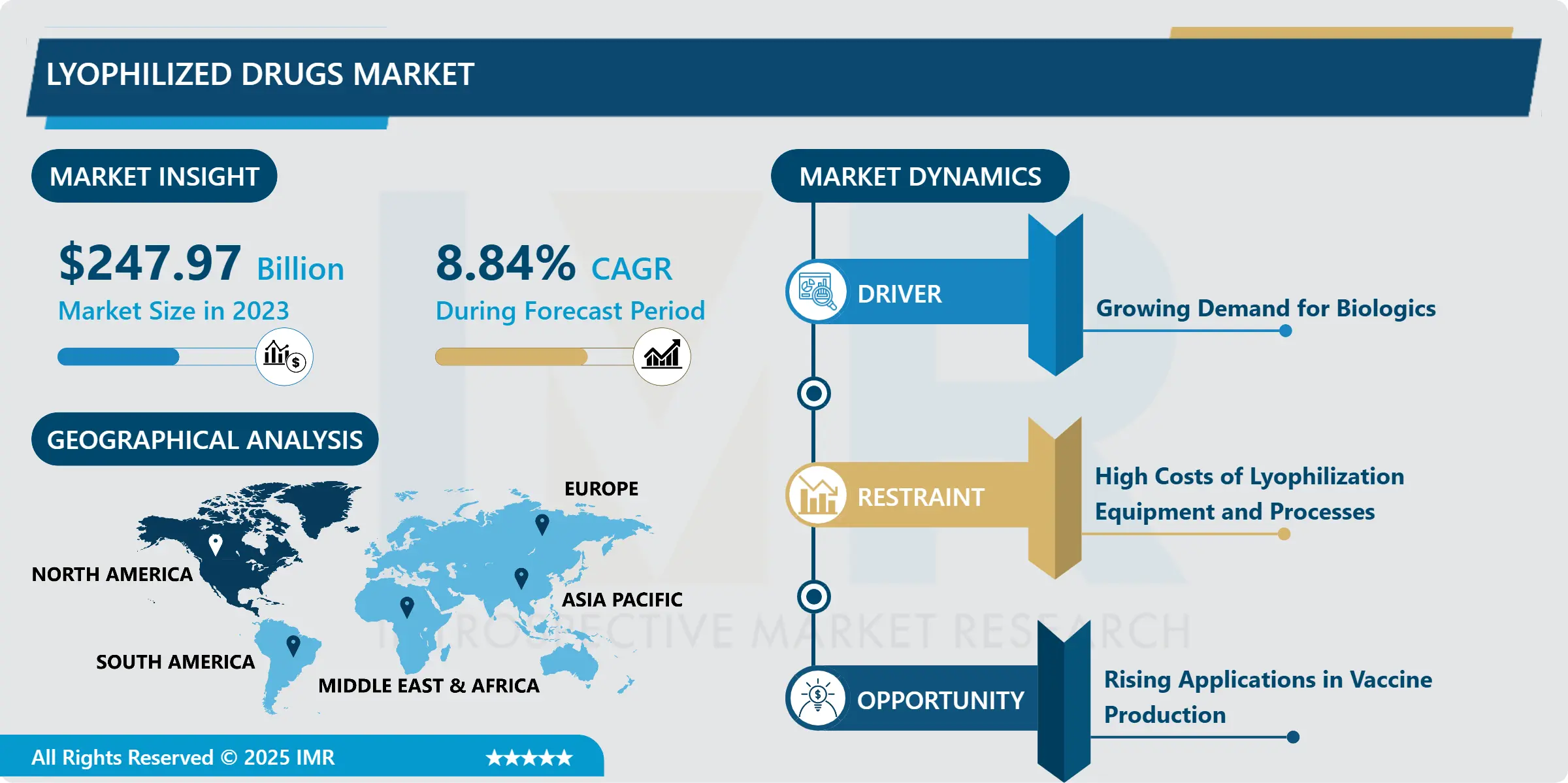
Lyophilized Drugs Market Size Was Valued at USD 247.97 Billion in 2023, and is Projected to Reach USD 531.78 Billion by 2032, Growing at a CAGR of 8.84% From 2024-2032.
It is the segment of pharmaceutical products wherein drugs are subjected to a process known as lyophilization so that most of the water content is removed and the products then placed on the market as a lyophilized drug. It just adds to the shelf life of drugs and makes them stable at room temperature that is a big plus when it comes to biologicals, vaccines, and injectable products. Its application is vast in those treatments where potency and purity of the active pharmaceutical substances are crucial, particularly in those ones that are susceptible to degradation at a liquid state. It consists of drug producers, equipment suppliers and service providers pertaining to the process of lyophilization.
The market for lyophilized drugs is fast-growing around the world in the past several years primarily due to the rate of biologic and injectable drug products. As the trends in the pharmaceutical market develop with an increased tendency of the development of new biologic drugs, the issue of the stability of the formulations which are sensitive to temperatures, grows to the foreground. Out of all of these techniques, one has come to the foreground due to its capacity to maintain the efficacy and potency of these drugs: this is lyophilization. Moreover, the continual development of vaccines particularly due to the virus, Covid-19, has promoted the utilization of lyophilized formulations as it is easier to transport than its liquid form.
This market is projected to increase gradually, given the technological progress that simplifies the freeze-drying processes in food industry. Further, with increasing interests of pharma majors in biologics as well as biosimilars, lyophilization is now a core element in the development and manufacture of drugs. There is also growing prominence of contract manufacturing organizations (CMOs) who provide lyophilization services that can be outsourced by the pharmaceutical firms.
Lyophilized Drugs Market Trend Analysis:
Rising Demand for Biologics and Injectable Drugs
-
Another obvious trend regarding the lyophilized drugs market is the increase in the consumption of biologics and injections. Biologic drugs are proteins separated from living organisms and therefore much more sensitive to an environment than small-molecule drugs. Therefore, depending on the formulation, such products may have to be lyophilized to preserve functionality of the active ingredients. This trend is reinforced by the growth in the incidence of chronic diseases for which biologic therapies are used, including cancer, diabetes, and autoimmune diseases. The increasing use of targeted therapeutic products such as personalized medicine and biologics is also putting increased pressure on using more sophisticated methods of lyophilization to preserve the drug’s functionality from the time of production to the time of administration.
Expanding Applications in Vaccines and Personalized Medicine
-
The worldwide lyophilized drugs market has vast growing scopes in the developing segments of vaccines and personalized medicine. Vaccine development has grown in the recent past, especially mRNA vaccines, and many of these vaccines are beneficial to undergo lyophilization since they need long-term storage and distribution. The rapid development of COVID 19 vaccines active research will surge the demand for new formulated vaccines with lyophilized form. Also, the modern approach of taking patient individualized medication, called pharmacogenomics, may involve biologic products that are sensitive to storage conditions. Pharmaceutical manufacturers as well as service providers rendering personalized therapy are expected to experience fresh growth horizons due to the increasing importance of lyophilization processes because of development in personalized therapy.
Lyophilized Drugs Market Segment Analysis:
Lyophilized Drugs Market is Segmented on the basis of Drug Type, Indication, End User, and Region
By Type, Diuretics segment is expected to dominate the market during the forecast period
-
The diuretics segment is anticipated to capture the largest revenue growth rate in the lyophilized drugs market within the forecast period due to rising incidences of hypertensive, cardiac, and renal issues for which diuretics are widely used.. This type of medicines is used often in outpatients and in treating chronic ailments where fluid retaining is a major worrism and therefore is crucial in long-term treatments. Lyophilization deck aids in protraction of shelf stability of these drugs; this is vital for injectable diuretic used in intensive care unit. The constantly growing global burden of cardiovascular and renal diseases couples with the need for reliable and stable diuretics is expected to drive this segment.
By Indication, Oncology segment expected to held the largest share
-
The oncology segment is anticipated to dominate the market by indicating lyophilized drugs during the forecast period as a result of the rising incidence of cancer and elevated utilization of biologic products in its treatment. Current Oncology drugs especially biologic/monoclonal antibodies are very sensitive to temperatures, therefore, require lyophilization to optimize stability & effectiveness over time. Since cancer treatments require complex chemicals that are administered to the patient over several years, stable formulations are called for. As the number of cancer patients increases across the world and further advancement of new cancer drugs oncology segment has the potential to emerge as market leader in the coming years.
Lyophilized Drugs Market Regional Insights:
North America is Expected to Dominate the Market Over the Forecast period
- Currently, North America holds the largest market share in the global Lyophilized Drugs Market which is supposed to reach 40.2% in 2024. This leadership is due to the presence of large pharmaceutical firms who are involved in a lot of R & D and new drug launch, creating an early and quick adoption of the lyophilization technology. The area is well equipped with a cold chain and deliver sophisticated JIT delivery systems required to maintain the temperature sensitivity of exported drugs within the healthcare system networks. Demand for lyophilized products is further boosted by FDA regulations that set quality control because the products are for export. Though in recent time there is pressure on the prices set by the payers which has affected US market. On the other hand, Asia Pacific is becoming the most promising regional market due to the favourable trends in countries such as China, India Japan& South Korea with the demand for dialysis and other related services driven by the improvements in income as well as advancement in the healthcare facilities. Now, the Chinese ‘Made in China 2025’ policy has given a right direction to the local manufacture and cut down the import’s ratio, so it allows the lyophilized products of China to compete well in global markets. Many other Asian countries are also now endorsing biosimilars and generic lyophilized drugs due to the substantial population of patients that requires cheap medication.
Active Key Players in the Lyophilized Drugs Market:
- Avara Pharmaceutical Services (U.S.)
- B. Braun Melsungen AG (Germany)
- Baxter International Inc. (U.S.)
- BioPharma Solutions (U.S.)
- Catalent, Inc. (U.S.)
- CordenPharma (Germany)
- GlaxoSmithKline plc (U.K.)
- Jubilant HollisterStier LLC (Canada)
- Lonza Group (Switzerland)
- Lyophilization Technology, Inc. (U.S.)
- Merck & Co., Inc. (U.S.)
- Pfizer Inc. (U.S.)
- Recipharm AB (Sweden)
- Sanofi S.A. (France)
- Vetter Pharma International GmbH (Germany)
- Other Active Players
|
Lyophilized Drugs Market |
|||
|
Base Year: |
2023 |
Forecast Period: |
2024-2032 |
|
Historical Data: |
2017 to 2023 |
Market Size in 2023: |
USD 247.97 Billion |
|
Forecast Period 2024-32 CAGR: |
8.84% |
Market Size in 2032: |
USD 531.78 Billion |
|
Segments Covered: |
By Drug Type |
|
|
|
By Indication |
|
||
|
End Users |
|
||
|
By Region |
|
||
|
Key Market Drivers: |
|
||
|
Key Market Restraints: |
|
||
|
Key Opportunities: |
|
||
|
Companies Covered in the report: |
|
||
Chapter 1: Introduction
1.1 Scope and Coverage
Chapter 2:Executive Summary
Chapter 3: Market Landscape
3.1 Market Dynamics
3.1.1 Drivers
3.1.2 Restraints
3.1.3 Opportunities
3.1.4 Challenges
3.2 Market Trend Analysis
3.3 PESTLE Analysis
3.4 Porter's Five Forces Analysis
3.5 Industry Value Chain Analysis
3.6 Ecosystem
3.7 Regulatory Landscape
3.8 Price Trend Analysis
3.9 Patent Analysis
3.10 Technology Evolution
3.11 Investment Pockets
3.12 Import-Export Analysis
Chapter 4: Lyophilized Drugs Market by Drug Type
4.1 Lyophilized Drugs Market Snapshot and Growth Engine
4.2 Lyophilized Drugs Market Overview
4.3 Anti-infective
4.3.1 Introduction and Market Overview
4.3.2 Historic and Forecasted Market Size in Value USD and Volume Units (2017-2032F)
4.3.3 Key Market Trends, Growth Factors and Opportunities
4.3.4 Anti-infective: Geographic Segmentation Analysis
4.4 Anti-neoplastic
4.4.1 Introduction and Market Overview
4.4.2 Historic and Forecasted Market Size in Value USD and Volume Units (2017-2032F)
4.4.3 Key Market Trends, Growth Factors and Opportunities
4.4.4 Anti-neoplastic: Geographic Segmentation Analysis
4.5 Diuretics
4.5.1 Introduction and Market Overview
4.5.2 Historic and Forecasted Market Size in Value USD and Volume Units (2017-2032F)
4.5.3 Key Market Trends, Growth Factors and Opportunities
4.5.4 Diuretics: Geographic Segmentation Analysis
4.6 Proton Pump Inhibitor
4.6.1 Introduction and Market Overview
4.6.2 Historic and Forecasted Market Size in Value USD and Volume Units (2017-2032F)
4.6.3 Key Market Trends, Growth Factors and Opportunities
4.6.4 Proton Pump Inhibitor: Geographic Segmentation Analysis
4.7 Anesthetic
4.7.1 Introduction and Market Overview
4.7.2 Historic and Forecasted Market Size in Value USD and Volume Units (2017-2032F)
4.7.3 Key Market Trends, Growth Factors and Opportunities
4.7.4 Anesthetic: Geographic Segmentation Analysis
4.8 Anticoagulant
4.8.1 Introduction and Market Overview
4.8.2 Historic and Forecasted Market Size in Value USD and Volume Units (2017-2032F)
4.8.3 Key Market Trends, Growth Factors and Opportunities
4.8.4 Anticoagulant: Geographic Segmentation Analysis
4.9 NSAID’s
4.9.1 Introduction and Market Overview
4.9.2 Historic and Forecasted Market Size in Value USD and Volume Units (2017-2032F)
4.9.3 Key Market Trends, Growth Factors and Opportunities
4.9.4 NSAID’s: Geographic Segmentation Analysis
4.10 Corticosteroids
4.10.1 Introduction and Market Overview
4.10.2 Historic and Forecasted Market Size in Value USD and Volume Units (2017-2032F)
4.10.3 Key Market Trends, Growth Factors and Opportunities
4.10.4 Corticosteroids: Geographic Segmentation Analysis
4.11 Others
4.11.1 Introduction and Market Overview
4.11.2 Historic and Forecasted Market Size in Value USD and Volume Units (2017-2032F)
4.11.3 Key Market Trends, Growth Factors and Opportunities
4.11.4 Others: Geographic Segmentation Analysis
Chapter 5: Lyophilized Drugs Market by Indication
5.1 Lyophilized Drugs Market Snapshot and Growth Engine
5.2 Lyophilized Drugs Market Overview
5.3 Oncology
5.3.1 Introduction and Market Overview
5.3.2 Historic and Forecasted Market Size in Value USD and Volume Units (2017-2032F)
5.3.3 Key Market Trends, Growth Factors and Opportunities
5.3.4 Oncology: Geographic Segmentation Analysis
5.4 Autoimmune Diseases
5.4.1 Introduction and Market Overview
5.4.2 Historic and Forecasted Market Size in Value USD and Volume Units (2017-2032F)
5.4.3 Key Market Trends, Growth Factors and Opportunities
5.4.4 Autoimmune Diseases: Geographic Segmentation Analysis
5.5 Hormonal Disorders
5.5.1 Introduction and Market Overview
5.5.2 Historic and Forecasted Market Size in Value USD and Volume Units (2017-2032F)
5.5.3 Key Market Trends, Growth Factors and Opportunities
5.5.4 Hormonal Disorders: Geographic Segmentation Analysis
5.6 Respiratory Diseases
5.6.1 Introduction and Market Overview
5.6.2 Historic and Forecasted Market Size in Value USD and Volume Units (2017-2032F)
5.6.3 Key Market Trends, Growth Factors and Opportunities
5.6.4 Respiratory Diseases: Geographic Segmentation Analysis
5.7 Gastrointestinal Disorders
5.7.1 Introduction and Market Overview
5.7.2 Historic and Forecasted Market Size in Value USD and Volume Units (2017-2032F)
5.7.3 Key Market Trends, Growth Factors and Opportunities
5.7.4 Gastrointestinal Disorders: Geographic Segmentation Analysis
5.8 Dermatological Disorders
5.8.1 Introduction and Market Overview
5.8.2 Historic and Forecasted Market Size in Value USD and Volume Units (2017-2032F)
5.8.3 Key Market Trends, Growth Factors and Opportunities
5.8.4 Dermatological Disorders: Geographic Segmentation Analysis
5.9 Ophthalmic Diseases
5.9.1 Introduction and Market Overview
5.9.2 Historic and Forecasted Market Size in Value USD and Volume Units (2017-2032F)
5.9.3 Key Market Trends, Growth Factors and Opportunities
5.9.4 Ophthalmic Diseases: Geographic Segmentation Analysis
5.10 Others
5.10.1 Introduction and Market Overview
5.10.2 Historic and Forecasted Market Size in Value USD and Volume Units (2017-2032F)
5.10.3 Key Market Trends, Growth Factors and Opportunities
5.10.4 Others: Geographic Segmentation Analysis
Chapter 6: Lyophilized Drugs Market by End User
6.1 Lyophilized Drugs Market Snapshot and Growth Engine
6.2 Lyophilized Drugs Market Overview
6.3 Hospitals
6.3.1 Introduction and Market Overview
6.3.2 Historic and Forecasted Market Size in Value USD and Volume Units (2017-2032F)
6.3.3 Key Market Trends, Growth Factors and Opportunities
6.3.4 Hospitals: Geographic Segmentation Analysis
6.4 Ambulatory Surgical Centers
6.4.1 Introduction and Market Overview
6.4.2 Historic and Forecasted Market Size in Value USD and Volume Units (2017-2032F)
6.4.3 Key Market Trends, Growth Factors and Opportunities
6.4.4 Ambulatory Surgical Centers: Geographic Segmentation Analysis
6.5 Specialty Clinics
6.5.1 Introduction and Market Overview
6.5.2 Historic and Forecasted Market Size in Value USD and Volume Units (2017-2032F)
6.5.3 Key Market Trends, Growth Factors and Opportunities
6.5.4 Specialty Clinics: Geographic Segmentation Analysis
6.6 Others
6.6.1 Introduction and Market Overview
6.6.2 Historic and Forecasted Market Size in Value USD and Volume Units (2017-2032F)
6.6.3 Key Market Trends, Growth Factors and Opportunities
6.6.4 Others: Geographic Segmentation Analysis
Chapter 7: Company Profiles and Competitive Analysis
7.1 Competitive Landscape
7.1.1 Competitive Benchmarking
7.1.2 Lyophilized Drugs Market Share by Manufacturer (2023)
7.1.3 Industry BCG Matrix
7.1.4 Heat Map Analysis
7.1.5 Mergers and Acquisitions
7.2 BAXTER INTERNATIONAL
7.2.1 Company Overview
7.2.2 Key Executives
7.2.3 Company Snapshot
7.2.4 Role of the Company in the Market
7.2.5 Sustainability and Social Responsibility
7.2.6 Operating Business Segments
7.2.7 Product Portfolio
7.2.8 Business Performance
7.2.9 Key Strategic Moves and Recent Developments
7.2.10 SWOT Analysis
7.3 PFIZER
7.4 SANOFI
7.5 GLAXOSMITHKLINE
7.6 AND MERCK & CO
7.7 OTHER ACTIVE PLAYERS
Chapter 8: Global Lyophilized Drugs Market By Region
8.1 Overview
8.2. North America Lyophilized Drugs Market
8.2.1 Key Market Trends, Growth Factors and Opportunities
8.2.2 Top Key Companies
8.2.3 Historic and Forecasted Market Size by Segments
8.2.4 Historic and Forecasted Market Size By Drug Type
8.2.4.1 Anti-infective
8.2.4.2 Anti-neoplastic
8.2.4.3 Diuretics
8.2.4.4 Proton Pump Inhibitor
8.2.4.5 Anesthetic
8.2.4.6 Anticoagulant
8.2.4.7 NSAID’s
8.2.4.8 Corticosteroids
8.2.4.9 Others
8.2.5 Historic and Forecasted Market Size By Indication
8.2.5.1 Oncology
8.2.5.2 Autoimmune Diseases
8.2.5.3 Hormonal Disorders
8.2.5.4 Respiratory Diseases
8.2.5.5 Gastrointestinal Disorders
8.2.5.6 Dermatological Disorders
8.2.5.7 Ophthalmic Diseases
8.2.5.8 Others
8.2.6 Historic and Forecasted Market Size By End User
8.2.6.1 Hospitals
8.2.6.2 Ambulatory Surgical Centers
8.2.6.3 Specialty Clinics
8.2.6.4 Others
8.2.7 Historic and Forecast Market Size by Country
8.2.7.1 US
8.2.7.2 Canada
8.2.7.3 Mexico
8.3. Eastern Europe Lyophilized Drugs Market
8.3.1 Key Market Trends, Growth Factors and Opportunities
8.3.2 Top Key Companies
8.3.3 Historic and Forecasted Market Size by Segments
8.3.4 Historic and Forecasted Market Size By Drug Type
8.3.4.1 Anti-infective
8.3.4.2 Anti-neoplastic
8.3.4.3 Diuretics
8.3.4.4 Proton Pump Inhibitor
8.3.4.5 Anesthetic
8.3.4.6 Anticoagulant
8.3.4.7 NSAID’s
8.3.4.8 Corticosteroids
8.3.4.9 Others
8.3.5 Historic and Forecasted Market Size By Indication
8.3.5.1 Oncology
8.3.5.2 Autoimmune Diseases
8.3.5.3 Hormonal Disorders
8.3.5.4 Respiratory Diseases
8.3.5.5 Gastrointestinal Disorders
8.3.5.6 Dermatological Disorders
8.3.5.7 Ophthalmic Diseases
8.3.5.8 Others
8.3.6 Historic and Forecasted Market Size By End User
8.3.6.1 Hospitals
8.3.6.2 Ambulatory Surgical Centers
8.3.6.3 Specialty Clinics
8.3.6.4 Others
8.3.7 Historic and Forecast Market Size by Country
8.3.7.1 Bulgaria
8.3.7.2 The Czech Republic
8.3.7.3 Hungary
8.3.7.4 Poland
8.3.7.5 Romania
8.3.7.6 Rest of Eastern Europe
8.4. Western Europe Lyophilized Drugs Market
8.4.1 Key Market Trends, Growth Factors and Opportunities
8.4.2 Top Key Companies
8.4.3 Historic and Forecasted Market Size by Segments
8.4.4 Historic and Forecasted Market Size By Drug Type
8.4.4.1 Anti-infective
8.4.4.2 Anti-neoplastic
8.4.4.3 Diuretics
8.4.4.4 Proton Pump Inhibitor
8.4.4.5 Anesthetic
8.4.4.6 Anticoagulant
8.4.4.7 NSAID’s
8.4.4.8 Corticosteroids
8.4.4.9 Others
8.4.5 Historic and Forecasted Market Size By Indication
8.4.5.1 Oncology
8.4.5.2 Autoimmune Diseases
8.4.5.3 Hormonal Disorders
8.4.5.4 Respiratory Diseases
8.4.5.5 Gastrointestinal Disorders
8.4.5.6 Dermatological Disorders
8.4.5.7 Ophthalmic Diseases
8.4.5.8 Others
8.4.6 Historic and Forecasted Market Size By End User
8.4.6.1 Hospitals
8.4.6.2 Ambulatory Surgical Centers
8.4.6.3 Specialty Clinics
8.4.6.4 Others
8.4.7 Historic and Forecast Market Size by Country
8.4.7.1 Germany
8.4.7.2 UK
8.4.7.3 France
8.4.7.4 Netherlands
8.4.7.5 Italy
8.4.7.6 Russia
8.4.7.7 Spain
8.4.7.8 Rest of Western Europe
8.5. Asia Pacific Lyophilized Drugs Market
8.5.1 Key Market Trends, Growth Factors and Opportunities
8.5.2 Top Key Companies
8.5.3 Historic and Forecasted Market Size by Segments
8.5.4 Historic and Forecasted Market Size By Drug Type
8.5.4.1 Anti-infective
8.5.4.2 Anti-neoplastic
8.5.4.3 Diuretics
8.5.4.4 Proton Pump Inhibitor
8.5.4.5 Anesthetic
8.5.4.6 Anticoagulant
8.5.4.7 NSAID’s
8.5.4.8 Corticosteroids
8.5.4.9 Others
8.5.5 Historic and Forecasted Market Size By Indication
8.5.5.1 Oncology
8.5.5.2 Autoimmune Diseases
8.5.5.3 Hormonal Disorders
8.5.5.4 Respiratory Diseases
8.5.5.5 Gastrointestinal Disorders
8.5.5.6 Dermatological Disorders
8.5.5.7 Ophthalmic Diseases
8.5.5.8 Others
8.5.6 Historic and Forecasted Market Size By End User
8.5.6.1 Hospitals
8.5.6.2 Ambulatory Surgical Centers
8.5.6.3 Specialty Clinics
8.5.6.4 Others
8.5.7 Historic and Forecast Market Size by Country
8.5.7.1 China
8.5.7.2 India
8.5.7.3 Japan
8.5.7.4 South Korea
8.5.7.5 Malaysia
8.5.7.6 Thailand
8.5.7.7 Vietnam
8.5.7.8 The Philippines
8.5.7.9 Australia
8.5.7.10 New Zealand
8.5.7.11 Rest of APAC
8.6. Middle East & Africa Lyophilized Drugs Market
8.6.1 Key Market Trends, Growth Factors and Opportunities
8.6.2 Top Key Companies
8.6.3 Historic and Forecasted Market Size by Segments
8.6.4 Historic and Forecasted Market Size By Drug Type
8.6.4.1 Anti-infective
8.6.4.2 Anti-neoplastic
8.6.4.3 Diuretics
8.6.4.4 Proton Pump Inhibitor
8.6.4.5 Anesthetic
8.6.4.6 Anticoagulant
8.6.4.7 NSAID’s
8.6.4.8 Corticosteroids
8.6.4.9 Others
8.6.5 Historic and Forecasted Market Size By Indication
8.6.5.1 Oncology
8.6.5.2 Autoimmune Diseases
8.6.5.3 Hormonal Disorders
8.6.5.4 Respiratory Diseases
8.6.5.5 Gastrointestinal Disorders
8.6.5.6 Dermatological Disorders
8.6.5.7 Ophthalmic Diseases
8.6.5.8 Others
8.6.6 Historic and Forecasted Market Size By End User
8.6.6.1 Hospitals
8.6.6.2 Ambulatory Surgical Centers
8.6.6.3 Specialty Clinics
8.6.6.4 Others
8.6.7 Historic and Forecast Market Size by Country
8.6.7.1 Turkey
8.6.7.2 Bahrain
8.6.7.3 Kuwait
8.6.7.4 Saudi Arabia
8.6.7.5 Qatar
8.6.7.6 UAE
8.6.7.7 Israel
8.6.7.8 South Africa
8.7. South America Lyophilized Drugs Market
8.7.1 Key Market Trends, Growth Factors and Opportunities
8.7.2 Top Key Companies
8.7.3 Historic and Forecasted Market Size by Segments
8.7.4 Historic and Forecasted Market Size By Drug Type
8.7.4.1 Anti-infective
8.7.4.2 Anti-neoplastic
8.7.4.3 Diuretics
8.7.4.4 Proton Pump Inhibitor
8.7.4.5 Anesthetic
8.7.4.6 Anticoagulant
8.7.4.7 NSAID’s
8.7.4.8 Corticosteroids
8.7.4.9 Others
8.7.5 Historic and Forecasted Market Size By Indication
8.7.5.1 Oncology
8.7.5.2 Autoimmune Diseases
8.7.5.3 Hormonal Disorders
8.7.5.4 Respiratory Diseases
8.7.5.5 Gastrointestinal Disorders
8.7.5.6 Dermatological Disorders
8.7.5.7 Ophthalmic Diseases
8.7.5.8 Others
8.7.6 Historic and Forecasted Market Size By End User
8.7.6.1 Hospitals
8.7.6.2 Ambulatory Surgical Centers
8.7.6.3 Specialty Clinics
8.7.6.4 Others
8.7.7 Historic and Forecast Market Size by Country
8.7.7.1 Brazil
8.7.7.2 Argentina
8.7.7.3 Rest of SA
Chapter 9 Analyst Viewpoint and Conclusion
9.1 Recommendations and Concluding Analysis
9.2 Potential Market Strategies
Chapter 10 Research Methodology
10.1 Research Process
10.2 Primary Research
10.3 Secondary Research
|
Lyophilized Drugs Market |
|||
|
Base Year: |
2023 |
Forecast Period: |
2024-2032 |
|
Historical Data: |
2017 to 2023 |
Market Size in 2023: |
USD 247.97 Billion |
|
Forecast Period 2024-32 CAGR: |
8.84% |
Market Size in 2032: |
USD 531.78 Billion |
|
Segments Covered: |
By Drug Type |
|
|
|
By Indication |
|
||
|
End Users |
|
||
|
By Region |
|
||
|
Key Market Drivers: |
|
||
|
Key Market Restraints: |
|
||
|
Key Opportunities: |
|
||
|
Companies Covered in the report: |
|
||


