




Light Therapy Market Synopsis:
Light Therapy Market Size Was Valued at USD 0.98 Billion in 2023, and is Projected to Reach USD 1.56 Billion by 2032, Growing at a CAGR of 5.33% From 2024-2032.
The light therapy is a sector that deals with the use of artificial light in various therapeutic procedures encompassing depressive illness such as SAD, skin diseases, and sleeping disorders. Lighting devices operate at a frequency, which is similar to sunlight which triggers favorable biological activities to enhance mood and skin quality, and regulate sleep. These devices are employed in hospitals, healthcare facilities, health clubs, and the various homes due to the growing consciousness of various invasive treatment and related diseases.
The global market of light therapies has experienced steady growth in recent years because of the increasing interest in non-drug treatments for somatic and mental health. Increased awareness of mental health and skincare has raised the demand of therapeutic light assistance for efficient and easily accessible treatments. While there is continued growth in the sources that people look for ways to alleviate seasonal affective disorder, acne, and insomnia, there will always be greater demand for the light therapy products. Marketing is also fuelled by advances of LED light technology on accessibility, as well as advancements in portable device manufacturing for broader consumership of such solutions.
Also, there is the increase in specialization, and differentiation in products with firms bringing new devices with certain health, or exclusively therapeutic purposes. It is also driven by the utilization of light therapy in dermatology for treating acne and having anti wrinkles effects besides in neurology for mental disease cure. Consumer interest and market growth is also being driven by the fact that light therapy is portable and can be used at home, on top of the fact that there are more portable devices available in the market.
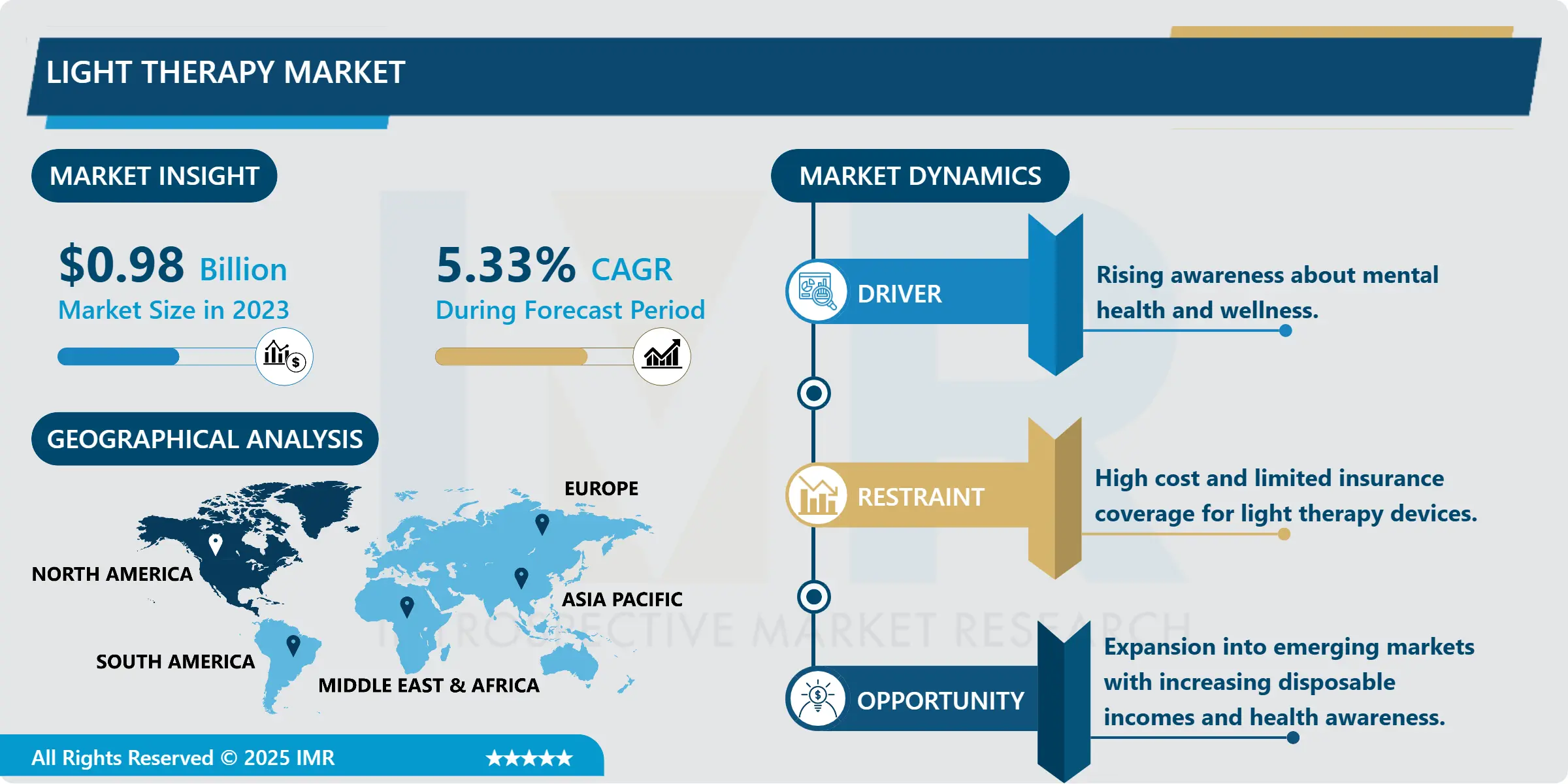
Light Therapy Market Trend Analysis:
Growing Popularity of At-Home Light Therapy Devices
-
The increasing popularity of home care has contributed to great desire in home-usage light therapy units. As LED and UV-free portable lighting devices improve, consumers are able to get their hands on gadgets that have dermatological, mood-lifting, and sleep regulating qualities without having to go to a clinic. Companies are producing simple and portable devices for use in only one area, for instance SAD lamps, blue light therapy devices in treating acne and red-light devices in treating wrinkles.
- Such devices are particularly preferred by those who want to treat mental health and skin disorders with no need to visit a doctor. Moreover, the changes in life attitude and increased focus on the prevention and maintenance has led consumers to search for therapeutic products that are not invasive and can be incorporated into an everyday life. The improvement in consumer awareness about home-utilized health products due to the COVID-19 pandemic also helped to increase demand, which is expected will continue in the future.
Expansion into Emerging Markets with High Demand for Wellness Products
-
New markets have a great potential in the development of light therapy products, particularly in countries where disposable cash income is rising, and people were becoming more concerned with their psychological and skin problems. People in Asia-Pacific, Latin America, and some parts of Eastern Europe are gradually getting informed about mental health and preventive skincare products creating a niche for penetration of light therapy products. Some of these firms are already seeking ways on how to increase their distribution networks and internet front ends in these areas. Also, the shifts in consumer behaviors towards online shopping have enabled consumers in area deficient or limited access to purchasing therapeutic devices, thus, enhancing growth in these segments. These untapped markets are being realized through partnerships with healthcare providers and local brands that help companies build their market position efficiently.
Light Therapy Market Segment Analysis:
Light Therapy Market is Segmented on the basis of Type, Application, End User, and Region.
By Type, Lightbox segment is expected to dominate the market during the forecast period
-
The lightbox segment is expected to reflect the largest growth in the light therapy market during the forecast period mainly because of its applicability in SAD and other mood disorders. Lightboxes produce light similar to natural sunlight which is perfect for people with mood disorders during dark seasons. These devices are commonly used in clinical as well as home environment thanks to the efficiency, simplicity and non-risk factor. As more people pay attention to mental health and the increasing rate of SAD especially in countries with long winter seasons there is high demand for light houses making light therapy products some of the best known.
By Application, Blue Light segment expected to held the largest share
-
The blue light segment is expected to cater to the largest share of the light therapy market in terms of an application, due to the efficiency of using blue light for the treatment of acne and skin disorders. Blue light therapy has become quite popular because besides being painless, it presents an effective way of eliminating bacteria that cause acne on the skin. It is also utilized in anti-ageing treatments as well as in enhancing skin colour and texture making it a top favourite among skin specialists. Increasing focus on skin health enhancing activities and subsequent demand for non-drug treatment solutions are expected to ensure successful continuation of the blue light therapy segment domination.
Light Therapy Market Regional Insights:
North America is Expected to Dominate the Market Over the Forecast period
-
North America holds the largest position in the global light therapy industry in 2023 due to high consumer knowledge, superior healthcare facilities, and tremendous community awareness of mental health. The American region interests a particularly significant market share, which constitutes roughly 35% following to the increasing incidence of SAD and high incorporation of state-of-art therapeutic tools and technologies. Canada also plays a significant role in this regard due to the rising concern of wellbeing and preventive healthcare products and services which added to increase the region’s dominance in the light therapy market. There are many players within the North American market and significant steering mechanisms driving the availability and use of such items.
Active Key Players in the Light Therapy Market:
-
Aura Daylight (USA)
- Beurer GmbH (Germany)
- BioPhotas, Inc. (USA)
- LED Technologies Inc. (USA)
- LightStim (USA)
- Lumie (UK)
- Luminette (Belgium)
- Nature Bright (USA)
- Northern Light Technologies (Canada)
- Philips Healthcare (Netherlands)
- Red Light Rising (UK)
- Solarc Systems Inc. (Canada)
- TheraLight, LLC (USA)
- Verilux, Inc. (USA)
- Zepter International (Switzerland)
- Other Active Players
Key Industry Developments in the Light Therapy Market:
-
June 2022, LightStim has launched its newest LED light therapy device, Elipsa, designed for seamless integration with BeautyHealth’s advanced HydraFacial system, Syndeo. LightStim Elipsa improves both the experience and the outcomes of treatment.
|
Light Therapy Market |
|||
|
Base Year: |
2023 |
Forecast Period: |
2024-2032 |
|
Historical Data: |
2017 to 2023 |
Market Size in 2023: |
USD 0.98 Billion |
|
Forecast Period 2024-32 CAGR: |
5.33 % |
Market Size in 2032: |
USD 1.56 Billion |
|
Segments Covered: |
By Type |
|
|
|
By Application |
|
||
|
End Users |
|
||
|
By Region |
|
||
|
Key Market Drivers: |
|
||
|
Key Market Restraints: |
|
||
|
Key Opportunities: |
|
||
|
Companies Covered in the report: |
|
||
Chapter 1: Introduction
1.1 Scope and Coverage
Chapter 2:Executive Summary
Chapter 3: Market Landscape
3.1 Market Dynamics
3.1.1 Drivers
3.1.2 Restraints
3.1.3 Opportunities
3.1.4 Challenges
3.2 Market Trend Analysis
3.3 PESTLE Analysis
3.4 Porter's Five Forces Analysis
3.5 Industry Value Chain Analysis
3.6 Ecosystem
3.7 Regulatory Landscape
3.8 Price Trend Analysis
3.9 Patent Analysis
3.10 Technology Evolution
3.11 Investment Pockets
3.12 Import-Export Analysis
Chapter 4: Light Therapy Market by Type
4.1 Light Therapy Market Snapshot and Growth Engine
4.2 Light Therapy Market Overview
4.3 Lightbox
4.3.1 Introduction and Market Overview
4.3.2 Historic and Forecasted Market Size in Value USD and Volume Units (2017-2032F)
4.3.3 Key Market Trends, Growth Factors and Opportunities
4.3.4 Lightbox: Geographic Segmentation Analysis
4.4 Floor & Desk Lamp
4.4.1 Introduction and Market Overview
4.4.2 Historic and Forecasted Market Size in Value USD and Volume Units (2017-2032F)
4.4.3 Key Market Trends, Growth Factors and Opportunities
4.4.4 Floor & Desk Lamp: Geographic Segmentation Analysis
Chapter 5: Light Therapy Market by Application
5.1 Light Therapy Market Snapshot and Growth Engine
5.2 Light Therapy Market Overview
5.3 Blue Light
5.3.1 Introduction and Market Overview
5.3.2 Historic and Forecasted Market Size in Value USD and Volume Units (2017-2032F)
5.3.3 Key Market Trends, Growth Factors and Opportunities
5.3.4 Blue Light: Geographic Segmentation Analysis
5.4 Red Light
5.4.1 Introduction and Market Overview
5.4.2 Historic and Forecasted Market Size in Value USD and Volume Units (2017-2032F)
5.4.3 Key Market Trends, Growth Factors and Opportunities
5.4.4 Red Light: Geographic Segmentation Analysis
Chapter 6: Light Therapy Market by End User
6.1 Light Therapy Market Snapshot and Growth Engine
6.2 Light Therapy Market Overview
6.3 Homecare Settings
6.3.1 Introduction and Market Overview
6.3.2 Historic and Forecasted Market Size in Value USD and Volume Units (2017-2032F)
6.3.3 Key Market Trends, Growth Factors and Opportunities
6.3.4 Homecare Settings: Geographic Segmentation Analysis
6.4 Dermatology Clinics
6.4.1 Introduction and Market Overview
6.4.2 Historic and Forecasted Market Size in Value USD and Volume Units (2017-2032F)
6.4.3 Key Market Trends, Growth Factors and Opportunities
6.4.4 Dermatology Clinics: Geographic Segmentation Analysis
6.5 Others
6.5.1 Introduction and Market Overview
6.5.2 Historic and Forecasted Market Size in Value USD and Volume Units (2017-2032F)
6.5.3 Key Market Trends, Growth Factors and Opportunities
6.5.4 Others: Geographic Segmentation Analysis
Chapter 7: Company Profiles and Competitive Analysis
7.1 Competitive Landscape
7.1.1 Competitive Benchmarking
7.1.2 Light Therapy Market Share by Manufacturer (2023)
7.1.3 Industry BCG Matrix
7.1.4 Heat Map Analysis
7.1.5 Mergers and Acquisitions
7.2 PHILIPS HEALTHCARE (NETHERLANDS)
7.2.1 Company Overview
7.2.2 Key Executives
7.2.3 Company Snapshot
7.2.4 Role of the Company in the Market
7.2.5 Sustainability and Social Responsibility
7.2.6 Operating Business Segments
7.2.7 Product Portfolio
7.2.8 Business Performance
7.2.9 Key Strategic Moves and Recent Developments
7.2.10 SWOT Analysis
7.3 VERILUX INC. (USA)
7.4 BEURER GMBH (GERMANY)
7.5 BIOPHOTAS INC. (USA)
7.6 NORTHERN LIGHT TECHNOLOGIES (CANADA)
7.7 OTHER ACTIVE PLAYERS
Chapter 8: Global Light Therapy Market By Region
8.1 Overview
8.2. North America Light Therapy Market
8.2.1 Key Market Trends, Growth Factors and Opportunities
8.2.2 Top Key Companies
8.2.3 Historic and Forecasted Market Size by Segments
8.2.4 Historic and Forecasted Market Size By Type
8.2.4.1 Lightbox
8.2.4.2 Floor & Desk Lamp
8.2.5 Historic and Forecasted Market Size By Application
8.2.5.1 Blue Light
8.2.5.2 Red Light
8.2.6 Historic and Forecasted Market Size By End User
8.2.6.1 Homecare Settings
8.2.6.2 Dermatology Clinics
8.2.6.3 Others
8.2.7 Historic and Forecast Market Size by Country
8.2.7.1 US
8.2.7.2 Canada
8.2.7.3 Mexico
8.3. Eastern Europe Light Therapy Market
8.3.1 Key Market Trends, Growth Factors and Opportunities
8.3.2 Top Key Companies
8.3.3 Historic and Forecasted Market Size by Segments
8.3.4 Historic and Forecasted Market Size By Type
8.3.4.1 Lightbox
8.3.4.2 Floor & Desk Lamp
8.3.5 Historic and Forecasted Market Size By Application
8.3.5.1 Blue Light
8.3.5.2 Red Light
8.3.6 Historic and Forecasted Market Size By End User
8.3.6.1 Homecare Settings
8.3.6.2 Dermatology Clinics
8.3.6.3 Others
8.3.7 Historic and Forecast Market Size by Country
8.3.7.1 Russia
8.3.7.2 Bulgaria
8.3.7.3 The Czech Republic
8.3.7.4 Hungary
8.3.7.5 Poland
8.3.7.6 Romania
8.3.7.7 Rest of Eastern Europe
8.4. Western Europe Light Therapy Market
8.4.1 Key Market Trends, Growth Factors and Opportunities
8.4.2 Top Key Companies
8.4.3 Historic and Forecasted Market Size by Segments
8.4.4 Historic and Forecasted Market Size By Type
8.4.4.1 Lightbox
8.4.4.2 Floor & Desk Lamp
8.4.5 Historic and Forecasted Market Size By Application
8.4.5.1 Blue Light
8.4.5.2 Red Light
8.4.6 Historic and Forecasted Market Size By End User
8.4.6.1 Homecare Settings
8.4.6.2 Dermatology Clinics
8.4.6.3 Others
8.4.7 Historic and Forecast Market Size by Country
8.4.7.1 Germany
8.4.7.2 UK
8.4.7.3 France
8.4.7.4 The Netherlands
8.4.7.5 Italy
8.4.7.6 Spain
8.4.7.7 Rest of Western Europe
8.5. Asia Pacific Light Therapy Market
8.5.1 Key Market Trends, Growth Factors and Opportunities
8.5.2 Top Key Companies
8.5.3 Historic and Forecasted Market Size by Segments
8.5.4 Historic and Forecasted Market Size By Type
8.5.4.1 Lightbox
8.5.4.2 Floor & Desk Lamp
8.5.5 Historic and Forecasted Market Size By Application
8.5.5.1 Blue Light
8.5.5.2 Red Light
8.5.6 Historic and Forecasted Market Size By End User
8.5.6.1 Homecare Settings
8.5.6.2 Dermatology Clinics
8.5.6.3 Others
8.5.7 Historic and Forecast Market Size by Country
8.5.7.1 China
8.5.7.2 India
8.5.7.3 Japan
8.5.7.4 South Korea
8.5.7.5 Malaysia
8.5.7.6 Thailand
8.5.7.7 Vietnam
8.5.7.8 The Philippines
8.5.7.9 Australia
8.5.7.10 New Zealand
8.5.7.11 Rest of APAC
8.6. Middle East & Africa Light Therapy Market
8.6.1 Key Market Trends, Growth Factors and Opportunities
8.6.2 Top Key Companies
8.6.3 Historic and Forecasted Market Size by Segments
8.6.4 Historic and Forecasted Market Size By Type
8.6.4.1 Lightbox
8.6.4.2 Floor & Desk Lamp
8.6.5 Historic and Forecasted Market Size By Application
8.6.5.1 Blue Light
8.6.5.2 Red Light
8.6.6 Historic and Forecasted Market Size By End User
8.6.6.1 Homecare Settings
8.6.6.2 Dermatology Clinics
8.6.6.3 Others
8.6.7 Historic and Forecast Market Size by Country
8.6.7.1 Turkiye
8.6.7.2 Bahrain
8.6.7.3 Kuwait
8.6.7.4 Saudi Arabia
8.6.7.5 Qatar
8.6.7.6 UAE
8.6.7.7 Israel
8.6.7.8 South Africa
8.7. South America Light Therapy Market
8.7.1 Key Market Trends, Growth Factors and Opportunities
8.7.2 Top Key Companies
8.7.3 Historic and Forecasted Market Size by Segments
8.7.4 Historic and Forecasted Market Size By Type
8.7.4.1 Lightbox
8.7.4.2 Floor & Desk Lamp
8.7.5 Historic and Forecasted Market Size By Application
8.7.5.1 Blue Light
8.7.5.2 Red Light
8.7.6 Historic and Forecasted Market Size By End User
8.7.6.1 Homecare Settings
8.7.6.2 Dermatology Clinics
8.7.6.3 Others
8.7.7 Historic and Forecast Market Size by Country
8.7.7.1 Brazil
8.7.7.2 Argentina
8.7.7.3 Rest of SA
Chapter 9 Analyst Viewpoint and Conclusion
9.1 Recommendations and Concluding Analysis
9.2 Potential Market Strategies
Chapter 10 Research Methodology
10.1 Research Process
10.2 Primary Research
10.3 Secondary Research
|
Light Therapy Market |
|||
|
Base Year: |
2023 |
Forecast Period: |
2024-2032 |
|
Historical Data: |
2017 to 2023 |
Market Size in 2023: |
USD 0.98 Billion |
|
Forecast Period 2024-32 CAGR: |
5.33 % |
Market Size in 2032: |
USD 1.56 Billion |
|
Segments Covered: |
By Type |
|
|
|
By Application |
|
||
|
End Users |
|
||
|
By Region |
|
||
|
Key Market Drivers: |
|
||
|
Key Market Restraints: |
|
||
|
Key Opportunities: |
|
||
|
Companies Covered in the report: |
|
||


