




Laboratory Filtration Market Synopsis:
Laboratory Filtration Market Size Was Valued at USD 3.5 Billion in 2023, and is Projected to Reach USD 6.2 Billion by 2032, Growing at a CAGR of 8.2% From 2024-2032.
This is the process of removing particles from fluids or gasses so as to clarify or purify them, acknowledged to as laboratory filtration. In laboratories, filtration techniques have been used in quite a number of processes such as in chemistry, biochemistry, water treatment and testing among other fields. It involves using filters such as membrane filters syringe filter, filter papers or vacuum filters, for the desired results to be obtained. This market covers instruments and reagents required in filtration and separation applications in laboratories for different sectors such as pharmaceutical as biotechnology, environmental, and food and beverages sectors.
The global laboratory filtration market has been growing at a steady rate because the need for analyzing samples in these industries has been growing. A cross-section of laboratories is investing in new filtration technologies to maintain high levels of accuracy and exclusion of impurities that slow down the workflow. Also, increasing activity in the research field especially in drug discovery and diagnostics has also increased the demand for good filtration systems. Some of the main filtration products in the market are membrane filtration, vacuum filtration, and gravity filtration, which may be used in the laboratory for sterilization, removal of particles or chemical analysis respectively.
The innovations in filtration technologies offered for laboratories have added onto the market growth of the laboratory filtration. For instance, automated filtration systems now replace human intervention in filtration and convey systems because they cause less error and higher throughput. Moreover, with the growing consciousness of the population and the consequent demand for green solutions, there emerged concerns for environmentally friendly filtration systems, which are predicted to gain much attention in the future years. There is also increased regulator standard requirement across markets where purity and quality of products are paramount, thus inspiring application of better filtration methods.
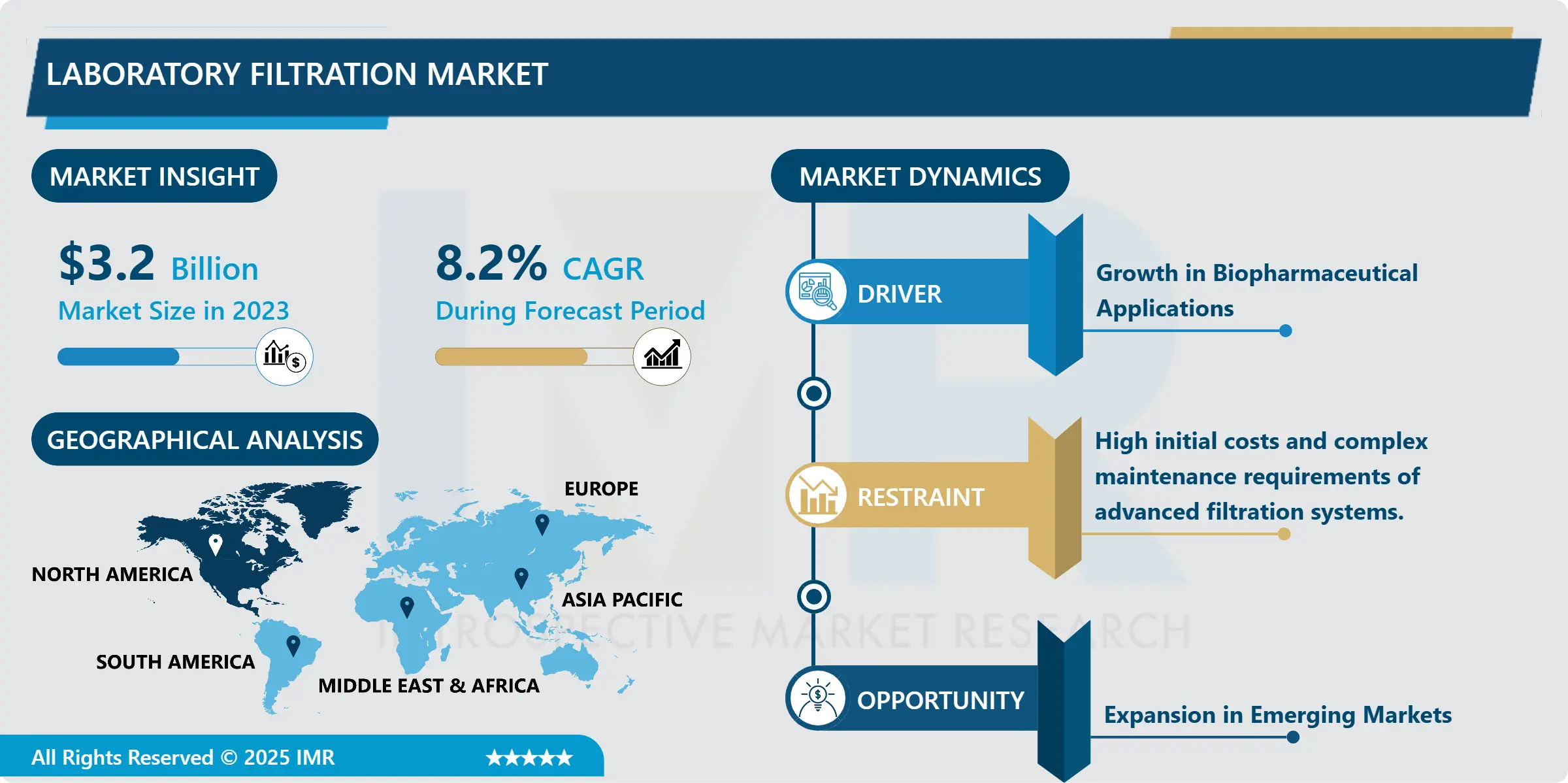
Laboratory Filtration Market Trend Analysis:
Growth in Biopharmaceutical Applications
This paper acknowledges that the use of filtration technologies in the laboratory filtration market particularly in the biopharmaceutical sector is a trend. Due to the increasing requirements for the quality and potency of biologics, vaccines, and gene therapies, biopharmaceutical industries have shifted to employing filtration solutions in order to address emerging industry regulations. Momentum in protein purification, sterilization and buffer preparation is highly on filtration technologies such as ultrafiltration (UF) and microfiltration (MF). Since the concerns for biologic drugs is increasing day by day, the filtration is an important area for growth in the market since it reduces the filtration process and enhances the efficient ways to conduct the same. Also, the use of filters is slowly increasing in the production line to guarantee that the final products satisfy the market quality as well as eliminating any accompanying impurities.
Expansion in Emerging Markets
- One of its major opportunities identified in the laboratories filtration market is the increasing R&D expenditures and extension of research facilities in developing Asia-Pacific, Middle Eastern and Latin American countries. As countries in these regions advance their economic status, there is continuing technological improvement in research, healthcare and life sciences industries and therefore enhancing the need for advanced filtration systems. Due to initiatives taken by the government to support research activities in different sectors like biotechnology, pharmaceuticals, and agriculture, demand for filtration technologies is expected to rise more rapidly. Furthermore, growth in academic study and enhancements of healthcare structures in these areas provide untouched potential for companies to bring revolutionary filtration products to meet the arising needs of laboratories and industries in these areas. Also, the increasing trend regarding healthcare and environmental standard in emerging economies should create new opportunities for the laboratory filtration solutions.
Laboratory Filtration Market Segment Analysis:
Laboratory Filtration Market is Segmented on the basis of Product, Technology, and Region.
By Product, Filtration Media segment is expected to dominate the market during the forecast period
- The product offering of the market is categorized into filtration media, filtration assemblies sub-segmented into filter frame, filter element and end user filtration accessories. The segmentation of the filtration media is membranes including membrane filters that dominated the market in 2015. This large share is attributed to their growing use in microbial analysis and for microfiltration as well as ultrafiltration applications.
- On the other hand, the capsule filters segment is forecasted to experience sturdy growth over the decade with a CAGR of over 7.3%. These filters deliver a dependable filtrate by the detention of very small microorganisms as well as hazardous elements. Having said that, microfiltration assemblies occupied a lion’s share of the filtration assemblies in the previous year, 2015. One of the most obvious reasons for the dominance of the water filtration segment is the massive adoption of microfiltration assemblies for quality control in the food & beverage industry.
By Technology, Microfiltration segment expected to held the largest share
- The main technologies in the market are reverse osmosis, ultrafiltration, vacuum filtration, nanofiltration and microfiltration. Among these, the microfiltration segment occupied this sector most in 2015. Microfiltration technology is the separation of particle by passing through the micro porous medium known as membrane filter.
- Micro filters play an important role in cold sterilization of API and enzymes and in the separation of solid-liquid phase in many application areas. It is widely applied in fractionalizing milk protein business. Optimises cell harvesting from fermentation broths, milk protein richness, corn syrup clarification and CIP chemical recovery.
- Ultrafiltration is one of the most rapidly developing technologies, and it is anticipated to have a high CAGR throughout the projection period. The ultrafiltration segment has advantages of gentle product treatment, ease of handling and lower energy consumption than in conventional cross-flow ultrafiltration methods. The upward trend in ultrafiltration used in the food processing industry, water treatment plants and purification purposes, and protein biosynthesis is estimated to boost the market status.
Laboratory Filtration Market Regional Insights:
North America is Expected to Dominate the Market Over the Forecast period
- The lab filtration market will be led by North America in the year 2023 with a projected market share of the major players in this region. It is clearly dominated by strong healthcare and life sciences sectors, considerable research activities, and high technology usage in the region. The market dominancy of the America is due to pharmaceutical and Bio technology companies, most processes in the drug formulation, drug research and sample analysis is done using laboratory filtration systems. Another factor that is contributing to the growth of this market is the rising R&D investment in this region which in addition to the stringent regulatory standards that seek to encourage higher levels of product purity. Moreover, several companies have their strategic position in this area and the progress of filtration technologies strengthens the region’s market leadership. For the year 2023 North America is anticipated to account for approximately 40-45% of total laboratory filtration market.
Active Key Players in the Laboratory Filtration Market:
- 3M Company (USA)
- Biotage AB (Sweden)
- Cantel Medical (USA)
- Corning Inc. (USA)
- Danaher Corporation (USA)
- Eaton Corporation (USA)
- Filtration Group Corporation (USA)
- GE Healthcare Life Sciences (USA)
- Merck KGaA (Germany)
- MilliporeSigma (USA)
- Novasep (France)
- Pall Corporation (USA)
- Sartorius AG (Germany)
- Thermo Fisher Scientific Inc. (USA)
- Veolia North America (USA)
- Other Active Players.
|
Laboratory Filtration Market |
|||
|
Base Year: |
2023 |
Forecast Period: |
2024-2032 |
|
Historical Data: |
2017 to 2023 |
Market Size in 2023: |
USD 3.2 Billion |
|
Forecast Period 2024-32 CAGR: |
8.2% |
Market Size in 2032: |
USD 6.2 Billion |
|
Segments Covered: |
By Product |
(Membrane Filters Filter Paper Quartz Filter Cellulose Filter Papers Glass Microfiber Filter Papers Syringe Filters Syringeless Filters Capsule Filters Filtration Microplates)
(Ultrafiltration Assemblies Microfiltration Assemblies Vacuum Filtration Assemblies Reverse Osmosis Assemblies)
(Filter Holders Filter Dispensers Filter Flasks Cartridge Filters Filter Funnels Filter Housings Seals Vacuum Pumps) |
|
|
By Technology |
|
||
|
By Region |
|
||
|
Key Market Drivers: |
|
||
|
Key Market Restraints: |
|
||
|
Key Opportunities: |
|
||
|
Companies Covered in the report: |
|
||
Chapter 1: Introduction
1.1 Scope and Coverage
Chapter 2:Executive Summary
Chapter 3: Market Landscape
3.1 Market Dynamics
3.1.1 Drivers
3.1.2 Restraints
3.1.3 Opportunities
3.1.4 Challenges
3.2 Market Trend Analysis
3.3 PESTLE Analysis
3.4 Porter's Five Forces Analysis
3.5 Industry Value Chain Analysis
3.6 Ecosystem
3.7 Regulatory Landscape
3.8 Price Trend Analysis
3.9 Patent Analysis
3.10 Technology Evolution
3.11 Investment Pockets
3.12 Import-Export Analysis
Chapter 4: Laboratory Filtration Market by Product
4.1 Laboratory Filtration Market Snapshot and Growth Engine
4.2 Laboratory Filtration Market Overview
4.3 Filtration Media(Membrane Filters
4.3.1 Introduction and Market Overview
4.3.2 Historic and Forecasted Market Size in Value USD and Volume Units (2017-2032F)
4.3.3 Key Market Trends, Growth Factors and Opportunities
4.3.4 Filtration Media(Membrane Filters : Geographic Segmentation Analysis
4.4 Filter Paper
4.4.1 Introduction and Market Overview
4.4.2 Historic and Forecasted Market Size in Value USD and Volume Units (2017-2032F)
4.4.3 Key Market Trends, Growth Factors and Opportunities
4.4.4 Filter Paper : Geographic Segmentation Analysis
4.5 Quartz Filter
4.5.1 Introduction and Market Overview
4.5.2 Historic and Forecasted Market Size in Value USD and Volume Units (2017-2032F)
4.5.3 Key Market Trends, Growth Factors and Opportunities
4.5.4 Quartz Filter : Geographic Segmentation Analysis
4.6 Cellulose Filter Papers
4.6.1 Introduction and Market Overview
4.6.2 Historic and Forecasted Market Size in Value USD and Volume Units (2017-2032F)
4.6.3 Key Market Trends, Growth Factors and Opportunities
4.6.4 Cellulose Filter Papers : Geographic Segmentation Analysis
4.7 Glass Microfiber Filter Papers
4.7.1 Introduction and Market Overview
4.7.2 Historic and Forecasted Market Size in Value USD and Volume Units (2017-2032F)
4.7.3 Key Market Trends, Growth Factors and Opportunities
4.7.4 Glass Microfiber Filter Papers : Geographic Segmentation Analysis
4.8 Syringe Filters
4.8.1 Introduction and Market Overview
4.8.2 Historic and Forecasted Market Size in Value USD and Volume Units (2017-2032F)
4.8.3 Key Market Trends, Growth Factors and Opportunities
4.8.4 Syringe Filters : Geographic Segmentation Analysis
4.9 Syringeless Filters
4.9.1 Introduction and Market Overview
4.9.2 Historic and Forecasted Market Size in Value USD and Volume Units (2017-2032F)
4.9.3 Key Market Trends, Growth Factors and Opportunities
4.9.4 Syringeless Filters : Geographic Segmentation Analysis
4.10 Capsule Filters
4.10.1 Introduction and Market Overview
4.10.2 Historic and Forecasted Market Size in Value USD and Volume Units (2017-2032F)
4.10.3 Key Market Trends, Growth Factors and Opportunities
4.10.4 Capsule Filters : Geographic Segmentation Analysis
4.11 Filtration Microplates
4.11.1 Introduction and Market Overview
4.11.2 Historic and Forecasted Market Size in Value USD and Volume Units (2017-2032F)
4.11.3 Key Market Trends, Growth Factors and Opportunities
4.11.4 Filtration Microplates: Geographic Segmentation Analysis
Chapter 5: Laboratory Filtration Market by Filtration Assemblies
5.1 Laboratory Filtration Market Snapshot and Growth Engine
5.2 Laboratory Filtration Market Overview
5.3 Ultrafiltration Assemblies
5.3.1 Introduction and Market Overview
5.3.2 Historic and Forecasted Market Size in Value USD and Volume Units (2017-2032F)
5.3.3 Key Market Trends, Growth Factors and Opportunities
5.3.4 Ultrafiltration Assemblies : Geographic Segmentation Analysis
5.4 Microfiltration Assemblies
5.4.1 Introduction and Market Overview
5.4.2 Historic and Forecasted Market Size in Value USD and Volume Units (2017-2032F)
5.4.3 Key Market Trends, Growth Factors and Opportunities
5.4.4 Microfiltration Assemblies : Geographic Segmentation Analysis
5.5 Vacuum Filtration Assemblies
5.5.1 Introduction and Market Overview
5.5.2 Historic and Forecasted Market Size in Value USD and Volume Units (2017-2032F)
5.5.3 Key Market Trends, Growth Factors and Opportunities
5.5.4 Vacuum Filtration Assemblies : Geographic Segmentation Analysis
5.6 Reverse Osmosis Assemblies
5.6.1 Introduction and Market Overview
5.6.2 Historic and Forecasted Market Size in Value USD and Volume Units (2017-2032F)
5.6.3 Key Market Trends, Growth Factors and Opportunities
5.6.4 Reverse Osmosis Assemblies: Geographic Segmentation Analysis
Chapter 6: Laboratory Filtration Market by Filtration Accessories
6.1 Laboratory Filtration Market Snapshot and Growth Engine
6.2 Laboratory Filtration Market Overview
6.3 Filter Holders
6.3.1 Introduction and Market Overview
6.3.2 Historic and Forecasted Market Size in Value USD and Volume Units (2017-2032F)
6.3.3 Key Market Trends, Growth Factors and Opportunities
6.3.4 Filter Holders : Geographic Segmentation Analysis
6.4 Filter Dispensers
6.4.1 Introduction and Market Overview
6.4.2 Historic and Forecasted Market Size in Value USD and Volume Units (2017-2032F)
6.4.3 Key Market Trends, Growth Factors and Opportunities
6.4.4 Filter Dispensers: Geographic Segmentation Analysis
6.5 Filter Flasks
6.5.1 Introduction and Market Overview
6.5.2 Historic and Forecasted Market Size in Value USD and Volume Units (2017-2032F)
6.5.3 Key Market Trends, Growth Factors and Opportunities
6.5.4 Filter Flasks : Geographic Segmentation Analysis
6.6 Cartridge Filters
6.6.1 Introduction and Market Overview
6.6.2 Historic and Forecasted Market Size in Value USD and Volume Units (2017-2032F)
6.6.3 Key Market Trends, Growth Factors and Opportunities
6.6.4 Cartridge Filters : Geographic Segmentation Analysis
6.7 Filter Funnels
6.7.1 Introduction and Market Overview
6.7.2 Historic and Forecasted Market Size in Value USD and Volume Units (2017-2032F)
6.7.3 Key Market Trends, Growth Factors and Opportunities
6.7.4 Filter Funnels : Geographic Segmentation Analysis
6.8 Filter Housings
6.8.1 Introduction and Market Overview
6.8.2 Historic and Forecasted Market Size in Value USD and Volume Units (2017-2032F)
6.8.3 Key Market Trends, Growth Factors and Opportunities
6.8.4 Filter Housings : Geographic Segmentation Analysis
6.9 Seals
6.9.1 Introduction and Market Overview
6.9.2 Historic and Forecasted Market Size in Value USD and Volume Units (2017-2032F)
6.9.3 Key Market Trends, Growth Factors and Opportunities
6.9.4 Seals : Geographic Segmentation Analysis
6.10 Vacuum Pumps
6.10.1 Introduction and Market Overview
6.10.2 Historic and Forecasted Market Size in Value USD and Volume Units (2017-2032F)
6.10.3 Key Market Trends, Growth Factors and Opportunities
6.10.4 Vacuum Pumps: Geographic Segmentation Analysis
Chapter 7: Laboratory Filtration Market by Technology
7.1 Laboratory Filtration Market Snapshot and Growth Engine
7.2 Laboratory Filtration Market Overview
7.3 Microfiltration
7.3.1 Introduction and Market Overview
7.3.2 Historic and Forecasted Market Size in Value USD and Volume Units (2017-2032F)
7.3.3 Key Market Trends, Growth Factors and Opportunities
7.3.4 Microfiltration: Geographic Segmentation Analysis
7.4 Nanofiltration
7.4.1 Introduction and Market Overview
7.4.2 Historic and Forecasted Market Size in Value USD and Volume Units (2017-2032F)
7.4.3 Key Market Trends, Growth Factors and Opportunities
7.4.4 Nanofiltration : Geographic Segmentation Analysis
7.5 Vacuum Filtration
7.5.1 Introduction and Market Overview
7.5.2 Historic and Forecasted Market Size in Value USD and Volume Units (2017-2032F)
7.5.3 Key Market Trends, Growth Factors and Opportunities
7.5.4 Vacuum Filtration : Geographic Segmentation Analysis
7.6 Ultrafiltration
7.6.1 Introduction and Market Overview
7.6.2 Historic and Forecasted Market Size in Value USD and Volume Units (2017-2032F)
7.6.3 Key Market Trends, Growth Factors and Opportunities
7.6.4 Ultrafiltration : Geographic Segmentation Analysis
7.7 Reverse Osmosis
7.7.1 Introduction and Market Overview
7.7.2 Historic and Forecasted Market Size in Value USD and Volume Units (2017-2032F)
7.7.3 Key Market Trends, Growth Factors and Opportunities
7.7.4 Reverse Osmosis: Geographic Segmentation Analysis
Chapter 8: Company Profiles and Competitive Analysis
8.1 Competitive Landscape
8.1.1 Competitive Benchmarking
8.1.2 Laboratory Filtration Market Share by Manufacturer (2023)
8.1.3 Industry BCG Matrix
8.1.4 Heat Map Analysis
8.1.5 Mergers and Acquisitions
8.2 3M COMPANY (USA)
8.2.1 Company Overview
8.2.2 Key Executives
8.2.3 Company Snapshot
8.2.4 Role of the Company in the Market
8.2.5 Sustainability and Social Responsibility
8.2.6 Operating Business Segments
8.2.7 Product Portfolio
8.2.8 Business Performance
8.2.9 Key Strategic Moves and Recent Developments
8.2.10 SWOT Analysis
8.3 BIOTAGE AB (SWEDEN)
8.4 CANTEL MEDICAL (USA)
8.5 CORNING INC. (USA)
8.6 DANAHER CORPORATION (USA)
8.7 EATON CORPORATION (USA)
8.8 FILTRATION GROUP CORPORATION (USA)
8.9 GE HEALTHCARE LIFE SCIENCES (USA)
8.10 MERCK KGAA (GERMANY)
8.11 MILLIPORESIGMA (USA)
8.12 NOVASEP (FRANCE)
8.13 PALL CORPORATION (USA)
8.14 SARTORIUS AG (GERMANY)
8.15 THERMO FISHER SCIENTIFIC INC. (USA)
8.16 VEOLIA NORTH AMERICA (USA)
8.17 .
8.18 OTHER ACTIVE PLAYERS
Chapter 9: Global Laboratory Filtration Market By Region
9.1 Overview
9.2. North America Laboratory Filtration Market
9.2.1 Key Market Trends, Growth Factors and Opportunities
9.2.2 Top Key Companies
9.2.3 Historic and Forecasted Market Size by Segments
9.2.4 Historic and Forecasted Market Size By Product
9.2.4.1 Filtration Media(Membrane Filters
9.2.4.2 Filter Paper
9.2.4.3 Quartz Filter
9.2.4.4 Cellulose Filter Papers
9.2.4.5 Glass Microfiber Filter Papers
9.2.4.6 Syringe Filters
9.2.4.7 Syringeless Filters
9.2.4.8 Capsule Filters
9.2.4.9 Filtration Microplates
9.2.5 Historic and Forecasted Market Size By Filtration Assemblies
9.2.5.1 Ultrafiltration Assemblies
9.2.5.2 Microfiltration Assemblies
9.2.5.3 Vacuum Filtration Assemblies
9.2.5.4 Reverse Osmosis Assemblies
9.2.6 Historic and Forecasted Market Size By Filtration Accessories
9.2.6.1 Filter Holders
9.2.6.2 Filter Dispensers
9.2.6.3 Filter Flasks
9.2.6.4 Cartridge Filters
9.2.6.5 Filter Funnels
9.2.6.6 Filter Housings
9.2.6.7 Seals
9.2.6.8 Vacuum Pumps
9.2.7 Historic and Forecasted Market Size By Technology
9.2.7.1 Microfiltration
9.2.7.2 Nanofiltration
9.2.7.3 Vacuum Filtration
9.2.7.4 Ultrafiltration
9.2.7.5 Reverse Osmosis
9.2.8 Historic and Forecast Market Size by Country
9.2.8.1 US
9.2.8.2 Canada
9.2.8.3 Mexico
9.3. Eastern Europe Laboratory Filtration Market
9.3.1 Key Market Trends, Growth Factors and Opportunities
9.3.2 Top Key Companies
9.3.3 Historic and Forecasted Market Size by Segments
9.3.4 Historic and Forecasted Market Size By Product
9.3.4.1 Filtration Media(Membrane Filters
9.3.4.2 Filter Paper
9.3.4.3 Quartz Filter
9.3.4.4 Cellulose Filter Papers
9.3.4.5 Glass Microfiber Filter Papers
9.3.4.6 Syringe Filters
9.3.4.7 Syringeless Filters
9.3.4.8 Capsule Filters
9.3.4.9 Filtration Microplates
9.3.5 Historic and Forecasted Market Size By Filtration Assemblies
9.3.5.1 Ultrafiltration Assemblies
9.3.5.2 Microfiltration Assemblies
9.3.5.3 Vacuum Filtration Assemblies
9.3.5.4 Reverse Osmosis Assemblies
9.3.6 Historic and Forecasted Market Size By Filtration Accessories
9.3.6.1 Filter Holders
9.3.6.2 Filter Dispensers
9.3.6.3 Filter Flasks
9.3.6.4 Cartridge Filters
9.3.6.5 Filter Funnels
9.3.6.6 Filter Housings
9.3.6.7 Seals
9.3.6.8 Vacuum Pumps
9.3.7 Historic and Forecasted Market Size By Technology
9.3.7.1 Microfiltration
9.3.7.2 Nanofiltration
9.3.7.3 Vacuum Filtration
9.3.7.4 Ultrafiltration
9.3.7.5 Reverse Osmosis
9.3.8 Historic and Forecast Market Size by Country
9.3.8.1 Russia
9.3.8.2 Bulgaria
9.3.8.3 The Czech Republic
9.3.8.4 Hungary
9.3.8.5 Poland
9.3.8.6 Romania
9.3.8.7 Rest of Eastern Europe
9.4. Western Europe Laboratory Filtration Market
9.4.1 Key Market Trends, Growth Factors and Opportunities
9.4.2 Top Key Companies
9.4.3 Historic and Forecasted Market Size by Segments
9.4.4 Historic and Forecasted Market Size By Product
9.4.4.1 Filtration Media(Membrane Filters
9.4.4.2 Filter Paper
9.4.4.3 Quartz Filter
9.4.4.4 Cellulose Filter Papers
9.4.4.5 Glass Microfiber Filter Papers
9.4.4.6 Syringe Filters
9.4.4.7 Syringeless Filters
9.4.4.8 Capsule Filters
9.4.4.9 Filtration Microplates
9.4.5 Historic and Forecasted Market Size By Filtration Assemblies
9.4.5.1 Ultrafiltration Assemblies
9.4.5.2 Microfiltration Assemblies
9.4.5.3 Vacuum Filtration Assemblies
9.4.5.4 Reverse Osmosis Assemblies
9.4.6 Historic and Forecasted Market Size By Filtration Accessories
9.4.6.1 Filter Holders
9.4.6.2 Filter Dispensers
9.4.6.3 Filter Flasks
9.4.6.4 Cartridge Filters
9.4.6.5 Filter Funnels
9.4.6.6 Filter Housings
9.4.6.7 Seals
9.4.6.8 Vacuum Pumps
9.4.7 Historic and Forecasted Market Size By Technology
9.4.7.1 Microfiltration
9.4.7.2 Nanofiltration
9.4.7.3 Vacuum Filtration
9.4.7.4 Ultrafiltration
9.4.7.5 Reverse Osmosis
9.4.8 Historic and Forecast Market Size by Country
9.4.8.1 Germany
9.4.8.2 UK
9.4.8.3 France
9.4.8.4 The Netherlands
9.4.8.5 Italy
9.4.8.6 Spain
9.4.8.7 Rest of Western Europe
9.5. Asia Pacific Laboratory Filtration Market
9.5.1 Key Market Trends, Growth Factors and Opportunities
9.5.2 Top Key Companies
9.5.3 Historic and Forecasted Market Size by Segments
9.5.4 Historic and Forecasted Market Size By Product
9.5.4.1 Filtration Media(Membrane Filters
9.5.4.2 Filter Paper
9.5.4.3 Quartz Filter
9.5.4.4 Cellulose Filter Papers
9.5.4.5 Glass Microfiber Filter Papers
9.5.4.6 Syringe Filters
9.5.4.7 Syringeless Filters
9.5.4.8 Capsule Filters
9.5.4.9 Filtration Microplates
9.5.5 Historic and Forecasted Market Size By Filtration Assemblies
9.5.5.1 Ultrafiltration Assemblies
9.5.5.2 Microfiltration Assemblies
9.5.5.3 Vacuum Filtration Assemblies
9.5.5.4 Reverse Osmosis Assemblies
9.5.6 Historic and Forecasted Market Size By Filtration Accessories
9.5.6.1 Filter Holders
9.5.6.2 Filter Dispensers
9.5.6.3 Filter Flasks
9.5.6.4 Cartridge Filters
9.5.6.5 Filter Funnels
9.5.6.6 Filter Housings
9.5.6.7 Seals
9.5.6.8 Vacuum Pumps
9.5.7 Historic and Forecasted Market Size By Technology
9.5.7.1 Microfiltration
9.5.7.2 Nanofiltration
9.5.7.3 Vacuum Filtration
9.5.7.4 Ultrafiltration
9.5.7.5 Reverse Osmosis
9.5.8 Historic and Forecast Market Size by Country
9.5.8.1 China
9.5.8.2 India
9.5.8.3 Japan
9.5.8.4 South Korea
9.5.8.5 Malaysia
9.5.8.6 Thailand
9.5.8.7 Vietnam
9.5.8.8 The Philippines
9.5.8.9 Australia
9.5.8.10 New Zealand
9.5.8.11 Rest of APAC
9.6. Middle East & Africa Laboratory Filtration Market
9.6.1 Key Market Trends, Growth Factors and Opportunities
9.6.2 Top Key Companies
9.6.3 Historic and Forecasted Market Size by Segments
9.6.4 Historic and Forecasted Market Size By Product
9.6.4.1 Filtration Media(Membrane Filters
9.6.4.2 Filter Paper
9.6.4.3 Quartz Filter
9.6.4.4 Cellulose Filter Papers
9.6.4.5 Glass Microfiber Filter Papers
9.6.4.6 Syringe Filters
9.6.4.7 Syringeless Filters
9.6.4.8 Capsule Filters
9.6.4.9 Filtration Microplates
9.6.5 Historic and Forecasted Market Size By Filtration Assemblies
9.6.5.1 Ultrafiltration Assemblies
9.6.5.2 Microfiltration Assemblies
9.6.5.3 Vacuum Filtration Assemblies
9.6.5.4 Reverse Osmosis Assemblies
9.6.6 Historic and Forecasted Market Size By Filtration Accessories
9.6.6.1 Filter Holders
9.6.6.2 Filter Dispensers
9.6.6.3 Filter Flasks
9.6.6.4 Cartridge Filters
9.6.6.5 Filter Funnels
9.6.6.6 Filter Housings
9.6.6.7 Seals
9.6.6.8 Vacuum Pumps
9.6.7 Historic and Forecasted Market Size By Technology
9.6.7.1 Microfiltration
9.6.7.2 Nanofiltration
9.6.7.3 Vacuum Filtration
9.6.7.4 Ultrafiltration
9.6.7.5 Reverse Osmosis
9.6.8 Historic and Forecast Market Size by Country
9.6.8.1 Turkiye
9.6.8.2 Bahrain
9.6.8.3 Kuwait
9.6.8.4 Saudi Arabia
9.6.8.5 Qatar
9.6.8.6 UAE
9.6.8.7 Israel
9.6.8.8 South Africa
9.7. South America Laboratory Filtration Market
9.7.1 Key Market Trends, Growth Factors and Opportunities
9.7.2 Top Key Companies
9.7.3 Historic and Forecasted Market Size by Segments
9.7.4 Historic and Forecasted Market Size By Product
9.7.4.1 Filtration Media(Membrane Filters
9.7.4.2 Filter Paper
9.7.4.3 Quartz Filter
9.7.4.4 Cellulose Filter Papers
9.7.4.5 Glass Microfiber Filter Papers
9.7.4.6 Syringe Filters
9.7.4.7 Syringeless Filters
9.7.4.8 Capsule Filters
9.7.4.9 Filtration Microplates
9.7.5 Historic and Forecasted Market Size By Filtration Assemblies
9.7.5.1 Ultrafiltration Assemblies
9.7.5.2 Microfiltration Assemblies
9.7.5.3 Vacuum Filtration Assemblies
9.7.5.4 Reverse Osmosis Assemblies
9.7.6 Historic and Forecasted Market Size By Filtration Accessories
9.7.6.1 Filter Holders
9.7.6.2 Filter Dispensers
9.7.6.3 Filter Flasks
9.7.6.4 Cartridge Filters
9.7.6.5 Filter Funnels
9.7.6.6 Filter Housings
9.7.6.7 Seals
9.7.6.8 Vacuum Pumps
9.7.7 Historic and Forecasted Market Size By Technology
9.7.7.1 Microfiltration
9.7.7.2 Nanofiltration
9.7.7.3 Vacuum Filtration
9.7.7.4 Ultrafiltration
9.7.7.5 Reverse Osmosis
9.7.8 Historic and Forecast Market Size by Country
9.7.8.1 Brazil
9.7.8.2 Argentina
9.7.8.3 Rest of SA
Chapter 10 Analyst Viewpoint and Conclusion
10.1 Recommendations and Concluding Analysis
10.2 Potential Market Strategies
Chapter 11 Research Methodology
11.1 Research Process
11.2 Primary Research
11.3 Secondary Research
|
Laboratory Filtration Market |
|||
|
Base Year: |
2023 |
Forecast Period: |
2024-2032 |
|
Historical Data: |
2017 to 2023 |
Market Size in 2023: |
USD 3.2 Billion |
|
Forecast Period 2024-32 CAGR: |
8.2% |
Market Size in 2032: |
USD 6.2 Billion |
|
Segments Covered: |
By Product |
(Membrane Filters Filter Paper Quartz Filter Cellulose Filter Papers Glass Microfiber Filter Papers Syringe Filters Syringeless Filters Capsule Filters Filtration Microplates)
(Ultrafiltration Assemblies Microfiltration Assemblies Vacuum Filtration Assemblies Reverse Osmosis Assemblies)
(Filter Holders Filter Dispensers Filter Flasks Cartridge Filters Filter Funnels Filter Housings Seals Vacuum Pumps) |
|
|
By Technology |
|
||
|
By Region |
|
||
|
Key Market Drivers: |
|
||
|
Key Market Restraints: |
|
||
|
Key Opportunities: |
|
||
|
Companies Covered in the report: |
|
||


