




IV Infusion Products Market Synopsis:
IV Infusion Products Market Size Was Valued at USD 11.14 Billion in 2023, and is Projected to Reach USD 21.36 Billion by 2032, Growing at a CAGR of 7.5 % From 2024-2032.
It is an IV infusion product market that refers to products as well as devices intended for the administration of fluids, nutrients, and medications straight into the patient’s bloodstream through the intravenous (IV) route. It has this operational portfolio; IV bags and infusion pumps, catheters and miscellaneous other products that enable accurate dose measurements of drugs and Fl and fluid volumes to enable treatments throughout the health care spectrum. Nasensaline irrigation products are applied in hospitals, clinics, and home care for feeding and medicine drip solution for patients.
The IV Infusion Products Market has grown significantly from introducing ways to cater for the special needs of the aging populace globally and from the increasing cases of chronic diseases. Chronic diseases including cancers, diabetes and cardiovascular diseases have become rampant which in turn has contributed to an increased need for IV infusion products since drugs and fluids admitted through it are often slow and have to be administered with a lot of caution. In addition IV technology has evolved and improved the administration of the treatments in terms of effectiveness and risk factors related to pre- existing methods. Home healthcare is also increasing and intravenous infusion which is mobile allow patients to get care from different other than a hospital. Increasing healthcare awareness and focus on home care delivery has increased product penetration by providing patients with greater convenient and value for money services than hospitals.
COVID-19 crisis raised awareness of the high demand for safety and effectiveness of IV infusion as the critical patient care needs in ICUs and EDs were pointed out. As overall healthcare expenditure rises across the world coupled with consistent role for hospitals as a provider of care, demand for IV infusion products should remain firm. In addition, the trend toward preventive healthcare is promoting the regular administration of infusion therapy in wellness clinics and preventative care clinics. The IV Infusion Products Market takes advantages of the needs as developing countries are investing more in their healthcare structures so the market is expected to have a constant demand in both the developed and developing regions.
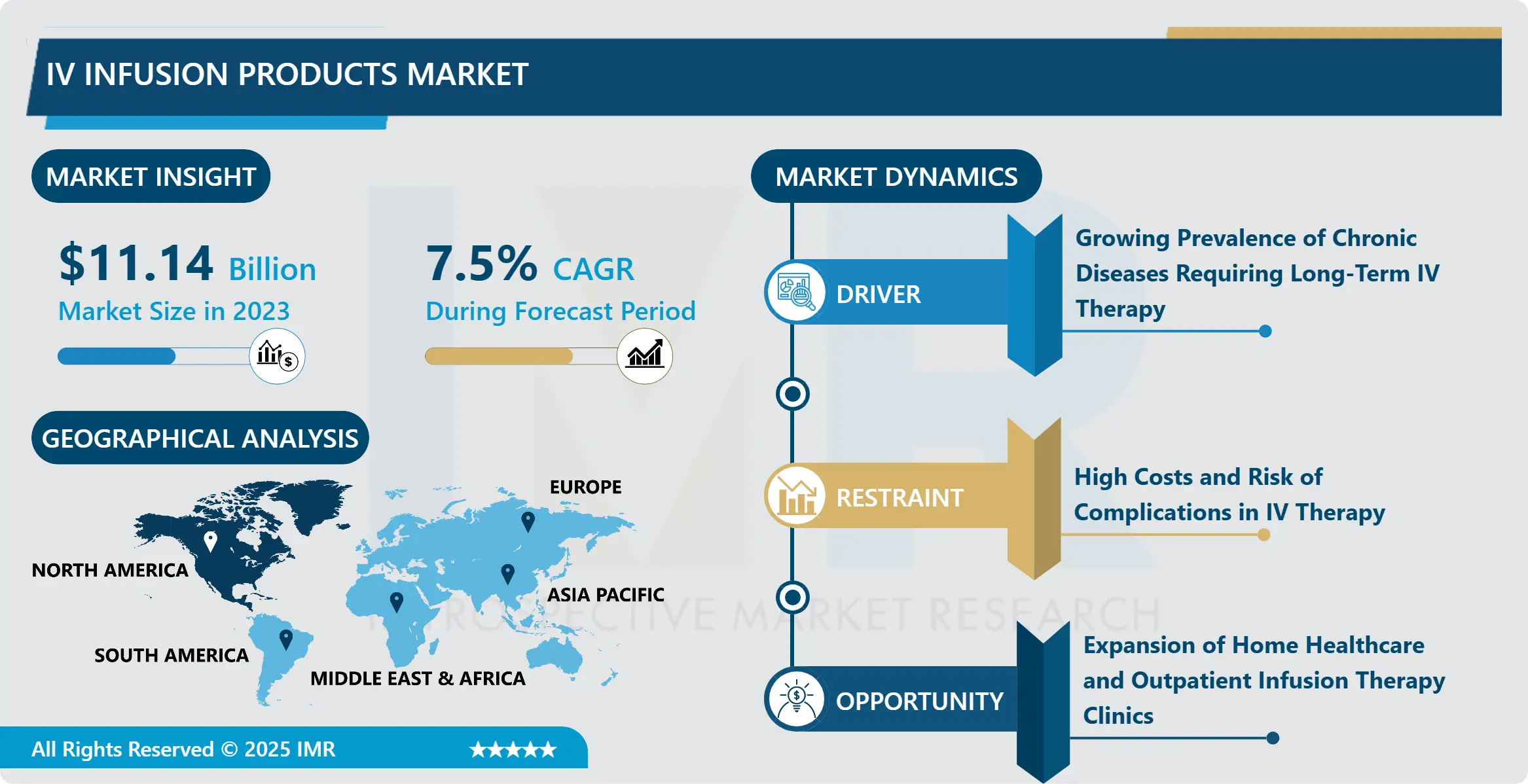 IV Infusion Products Market Trend Analysis:
Increasing Adoption of Smart Infusion Pumps
-
The IV Infusion Products Market has witnessed certain trends, one of them being the evolution towards the smart infusion pumps. This appears to promote patient safety because it allows the devices to be used to determine the doses to be dispensed. The smart infusion pumps contain dose error reduction software which alert the healthcare providers of errors in real time thus reducing adverse drug events. Besides, majority of the latest intelligent infusion pumps can be interface with Hospital information systems, thereby enabling collection and analysis of data for improved management of health care. Appropriate utilization of the pumps is going up gradually in the healthcare centers and clinics because the facilities are minimizing the patient care and safety in addition to enhancing fluidity in setting. The smart pumps will further be established to have better affordability and usability making the extension of the healthcare domain even larger with increased use.
Expanding Home Healthcare and Infusion Therapy Clinics
-
Home healthcare and the increasing count of the clinics providing infusion therapy is underlining the prospect of the IV Infusion Products Market. Because patients are seeking treatments that avoid the healthcare setting because of costs and preferences for a more comfortable setting, there is a growing need for IV infusion products that are portable and simple to use. Patients who would benefit from home-based infusion therapies include those with long-term or chronic conditions including those receiving nutrition support, antibiotics, or hydration therapy. There are also increasing opportunities in infusion therapy clinics which provide certain therapies in the outpatient department and take fewer burdens from the hospitals. Such changes in the mode of deliverance of healthcare make way for companies in the IV Infusion Products Market to explore new growth opportunities to create new products tailored to home and outpatient use.
IV Infusion Products Market Segment Analysis:
IV Infusion Products Market is Segmented on the basis of Service, Component, End User, and Region
By Service Energy Booster segment is expected to dominate the market during the forecast period
-
Out of the identified segments, the energy booster segment is expected to hold the largest share in the IV Infusion Products Market in the forthcoming years the increasing trend toward wellness and recovery therapies that provide instant energy boost. Energy booster infusions which is a combination of vitamins, amino acids and electrolytes have nowadays gone popular among athletes, business executives as well as people who would wish to enhance their energy and body’s capacity to absorb fluids more efficiently. Insoluble fibres These infusions produce rapid and efficient outcomes due to gate direct delivery system of nutrients into the blood streams without going through the digestive system. Given the fact that more and more wellness centres and clinics started including IV therapy in their list of offerings, energy booster infusions are becoming popular, targeting a wide audience who wants to enhance their well-being and improve their health. Since consumers now opt for products that help them avoid developing illnesses, the energy booster is predicted to record high growth rates.
By Component, Medicated segment expected to held the largest share
-
The medicated segment is likely to lead the IV Infusion Products Market, as IV medication forms a part of treatment for many diseases. Ranging from antibiotics/chemotherapy to pain management and anesthesia, medicated infusions are standard component in hospital and clinical Practices. Used in intensive care cases, IV medication delivery has the advantage of immediate or first order kinetics. In addition, the increase in long term diseases that need constant use of medicines like diabetics, cancer among others; gives a market for medicated IV products. Subsegmentation of medicated infusion pumps by technology indicates that enhanced features for dosing accuracy, safety enhancements, and other features add to this segment’s market dominance because healthcare practitioners seek to provide safe, reliable medication delivery for patients.
IV Infusion Products Market Regional Insights:
North America is Expected to Dominate the Market Over the Forecast period
-
North America is expected to hold the largest share in the IV Infusion Products Market during the given period because of the region’s developed healthcare system, high healthcare expenditure, and a raised usage of innovative technologies. The United States has been leading the growth of the IV infusion products within the hospital outpatient clinic and home healthcare sectors because of the increasing cases of chronic diseases and a growing elderly population. Having high health care standards, comparably strict regulation, and motivating medical cost coverage, North America’s market seamlessly guarantees the IV infusion patient care equipment is the latest, accurate, and efficient to protect both patients and providers.
- In addition, advance in outpatient and domiciliary care especially in North America is expected to boost the demand for portable and easy to use IV Infusion products for home care treatments. The COVID-19 pandemic has only amplified people’s demand for home-based care and therefore the advancement of products that are developed to be patient-portable. They also note that the area is dedicated to research and development, many organizations that develop new techniques in infusion technology including smart pumps, wireless monitoring techniques that enhance patient experience and minimize medical mistakes. Considering these factors, North America is anticipated to continue to dominate the IV Infusion Products Market in the international platform.
Active Key Players in the IV Infusion Products Market:
-
Abbott Laboratories (USA)
- B. Braun Melsungen AG (Germany)
- Baxter International Inc. (USA)
- Becton, Dickinson and Company (USA)
- ICU Medical, Inc. (USA)
- JMS Co., Ltd. (Japan)
- Medtronic plc (Ireland)
- Nipro Corporation (Japan)
- Pfizer Inc. (USA)
- Poly Medicure Limited (India)
- Smiths Medical (USA)
- Terumo Corporation (Japan)
- Teleflex Incorporated (USA)
- Vygon SA (France)
- Zyno Medical LLC (USA)
- Other Active Players
|
IV Infusion Products Market |
|||
|
Base Year: |
2023 |
Forecast Period: |
2024-2032 |
|
Historical Data: |
2017 to 2023 |
Market Size in 2023: |
USD 11.14 Billion |
|
Forecast Period 2024-32 CAGR: |
7.5 % |
Market Size in 2032: |
USD 21.36 Billion |
|
Segments Covered: |
By Service |
|
|
|
By Component |
|
||
|
By End User |
|
||
|
By Region |
|
||
|
Key Market Drivers: |
|
||
|
Key Market Restraints: |
|
||
|
Key Opportunities: |
|
||
|
Companies Covered in the report: |
|
||
Chapter 1: Introduction
1.1 Scope and Coverage
Chapter 2:Executive Summary
Chapter 3: Market Landscape
3.1 Market Dynamics
3.1.1 Drivers
3.1.2 Restraints
3.1.3 Opportunities
3.1.4 Challenges
3.2 Market Trend Analysis
3.3 PESTLE Analysis
3.4 Porter's Five Forces Analysis
3.5 Industry Value Chain Analysis
3.6 Ecosystem
3.7 Regulatory Landscape
3.8 Price Trend Analysis
3.9 Patent Analysis
3.10 Technology Evolution
3.11 Investment Pockets
3.12 Import-Export Analysis
Chapter 4: IV Infusion Products Market by Service
4.1 IV Infusion Products Market Snapshot and Growth Engine
4.2 IV Infusion Products Market Overview
4.3 Immune Boosters
4.3.1 Introduction and Market Overview
4.3.2 Historic and Forecasted Market Size in Value USD and Volume Units (2017-2032F)
4.3.3 Key Market Trends, Growth Factors and Opportunities
4.3.4 Immune Boosters: Geographic Segmentation Analysis
4.4 Energy Boosters
4.4.1 Introduction and Market Overview
4.4.2 Historic and Forecasted Market Size in Value USD and Volume Units (2017-2032F)
4.4.3 Key Market Trends, Growth Factors and Opportunities
4.4.4 Energy Boosters: Geographic Segmentation Analysis
4.5 Skin Care
4.5.1 Introduction and Market Overview
4.5.2 Historic and Forecasted Market Size in Value USD and Volume Units (2017-2032F)
4.5.3 Key Market Trends, Growth Factors and Opportunities
4.5.4 Skin Care: Geographic Segmentation Analysis
4.6 Migraine Other
4.6.1 Introduction and Market Overview
4.6.2 Historic and Forecasted Market Size in Value USD and Volume Units (2017-2032F)
4.6.3 Key Market Trends, Growth Factors and Opportunities
4.6.4 Migraine Other: Geographic Segmentation Analysis
Chapter 5: IV Infusion Products Market by Components
5.1 IV Infusion Products Market Snapshot and Growth Engine
5.2 IV Infusion Products Market Overview
5.3 Medicated
5.3.1 Introduction and Market Overview
5.3.2 Historic and Forecasted Market Size in Value USD and Volume Units (2017-2032F)
5.3.3 Key Market Trends, Growth Factors and Opportunities
5.3.4 Medicated: Geographic Segmentation Analysis
5.4 Non-medicated
5.4.1 Introduction and Market Overview
5.4.2 Historic and Forecasted Market Size in Value USD and Volume Units (2017-2032F)
5.4.3 Key Market Trends, Growth Factors and Opportunities
5.4.4 Non-medicated: Geographic Segmentation Analysis
Chapter 6: IV Infusion Products Market by End User
6.1 IV Infusion Products Market Snapshot and Growth Engine
6.2 IV Infusion Products Market Overview
6.3 Hospitals and Clinics
6.3.1 Introduction and Market Overview
6.3.2 Historic and Forecasted Market Size in Value USD and Volume Units (2017-2032F)
6.3.3 Key Market Trends, Growth Factors and Opportunities
6.3.4 Hospitals and Clinics: Geographic Segmentation Analysis
6.4 wellness centres and Spas
6.4.1 Introduction and Market Overview
6.4.2 Historic and Forecasted Market Size in Value USD and Volume Units (2017-2032F)
6.4.3 Key Market Trends, Growth Factors and Opportunities
6.4.4 wellness centres and Spas: Geographic Segmentation Analysis
6.5 Home health care and others
6.5.1 Introduction and Market Overview
6.5.2 Historic and Forecasted Market Size in Value USD and Volume Units (2017-2032F)
6.5.3 Key Market Trends, Growth Factors and Opportunities
6.5.4 Home health care and others: Geographic Segmentation Analysis
Chapter 7: Company Profiles and Competitive Analysis
7.1 Competitive Landscape
7.1.1 Competitive Benchmarking
7.1.2 IV Infusion Products Market Share by Manufacturer (2023)
7.1.3 Industry BCG Matrix
7.1.4 Heat Map Analysis
7.1.5 Mergers and Acquisitions
7.2 ABBOTT LABORATORIES (USA)
7.2.1 Company Overview
7.2.2 Key Executives
7.2.3 Company Snapshot
7.2.4 Role of the Company in the Market
7.2.5 Sustainability and Social Responsibility
7.2.6 Operating Business Segments
7.2.7 Product Portfolio
7.2.8 Business Performance
7.2.9 Key Strategic Moves and Recent Developments
7.2.10 SWOT Analysis
7.3 B. BRAUN MELSUNGEN AG (GERMANY)
7.4 BAXTER INTERNATIONAL INC. (USA)
7.5 BECTON
7.6 DICKINSON AND COMPANY (USA)
7.7 ICU MEDICAL INC. (USA)
7.8 JMS CO. LTD. (JAPAN)
7.9 MEDTRONIC PLC (IRELAND)
7.10 NIPRO CORPORATION (JAPAN)
7.11 PFIZER INC. (USA)
7.12 POLY MEDICURE LIMITED (INDIA)
7.13 SMITHS MEDICAL (USA)
7.14 TERUMO CORPORATION (JAPAN)
7.15 TELEFLEX INCORPORATED (USA)
7.16 VYGON SA (FRANCE)
7.17 ZYNO MEDICAL LLC (USA)
7.18 OTHER ACTIVE PLAYERS
Chapter 8: Global IV Infusion Products Market By Region
8.1 Overview
8.2. North America IV Infusion Products Market
8.2.1 Key Market Trends, Growth Factors and Opportunities
8.2.2 Top Key Companies
8.2.3 Historic and Forecasted Market Size by Segments
8.2.4 Historic and Forecasted Market Size By Service
8.2.4.1 Immune Boosters
8.2.4.2 Energy Boosters
8.2.4.3 Skin Care
8.2.4.4 Migraine Other
8.2.5 Historic and Forecasted Market Size By Components
8.2.5.1 Medicated
8.2.5.2 Non-medicated
8.2.6 Historic and Forecasted Market Size By End User
8.2.6.1 Hospitals and Clinics
8.2.6.2 wellness centres and Spas
8.2.6.3 Home health care and others
8.2.7 Historic and Forecast Market Size by Country
8.2.7.1 US
8.2.7.2 Canada
8.2.7.3 Mexico
8.3. Eastern Europe IV Infusion Products Market
8.3.1 Key Market Trends, Growth Factors and Opportunities
8.3.2 Top Key Companies
8.3.3 Historic and Forecasted Market Size by Segments
8.3.4 Historic and Forecasted Market Size By Service
8.3.4.1 Immune Boosters
8.3.4.2 Energy Boosters
8.3.4.3 Skin Care
8.3.4.4 Migraine Other
8.3.5 Historic and Forecasted Market Size By Components
8.3.5.1 Medicated
8.3.5.2 Non-medicated
8.3.6 Historic and Forecasted Market Size By End User
8.3.6.1 Hospitals and Clinics
8.3.6.2 wellness centres and Spas
8.3.6.3 Home health care and others
8.3.7 Historic and Forecast Market Size by Country
8.3.7.1 Russia
8.3.7.2 Bulgaria
8.3.7.3 The Czech Republic
8.3.7.4 Hungary
8.3.7.5 Poland
8.3.7.6 Romania
8.3.7.7 Rest of Eastern Europe
8.4. Western Europe IV Infusion Products Market
8.4.1 Key Market Trends, Growth Factors and Opportunities
8.4.2 Top Key Companies
8.4.3 Historic and Forecasted Market Size by Segments
8.4.4 Historic and Forecasted Market Size By Service
8.4.4.1 Immune Boosters
8.4.4.2 Energy Boosters
8.4.4.3 Skin Care
8.4.4.4 Migraine Other
8.4.5 Historic and Forecasted Market Size By Components
8.4.5.1 Medicated
8.4.5.2 Non-medicated
8.4.6 Historic and Forecasted Market Size By End User
8.4.6.1 Hospitals and Clinics
8.4.6.2 wellness centres and Spas
8.4.6.3 Home health care and others
8.4.7 Historic and Forecast Market Size by Country
8.4.7.1 Germany
8.4.7.2 UK
8.4.7.3 France
8.4.7.4 The Netherlands
8.4.7.5 Italy
8.4.7.6 Spain
8.4.7.7 Rest of Western Europe
8.5. Asia Pacific IV Infusion Products Market
8.5.1 Key Market Trends, Growth Factors and Opportunities
8.5.2 Top Key Companies
8.5.3 Historic and Forecasted Market Size by Segments
8.5.4 Historic and Forecasted Market Size By Service
8.5.4.1 Immune Boosters
8.5.4.2 Energy Boosters
8.5.4.3 Skin Care
8.5.4.4 Migraine Other
8.5.5 Historic and Forecasted Market Size By Components
8.5.5.1 Medicated
8.5.5.2 Non-medicated
8.5.6 Historic and Forecasted Market Size By End User
8.5.6.1 Hospitals and Clinics
8.5.6.2 wellness centres and Spas
8.5.6.3 Home health care and others
8.5.7 Historic and Forecast Market Size by Country
8.5.7.1 China
8.5.7.2 India
8.5.7.3 Japan
8.5.7.4 South Korea
8.5.7.5 Malaysia
8.5.7.6 Thailand
8.5.7.7 Vietnam
8.5.7.8 The Philippines
8.5.7.9 Australia
8.5.7.10 New Zealand
8.5.7.11 Rest of APAC
8.6. Middle East & Africa IV Infusion Products Market
8.6.1 Key Market Trends, Growth Factors and Opportunities
8.6.2 Top Key Companies
8.6.3 Historic and Forecasted Market Size by Segments
8.6.4 Historic and Forecasted Market Size By Service
8.6.4.1 Immune Boosters
8.6.4.2 Energy Boosters
8.6.4.3 Skin Care
8.6.4.4 Migraine Other
8.6.5 Historic and Forecasted Market Size By Components
8.6.5.1 Medicated
8.6.5.2 Non-medicated
8.6.6 Historic and Forecasted Market Size By End User
8.6.6.1 Hospitals and Clinics
8.6.6.2 wellness centres and Spas
8.6.6.3 Home health care and others
8.6.7 Historic and Forecast Market Size by Country
8.6.7.1 Turkiye
8.6.7.2 Bahrain
8.6.7.3 Kuwait
8.6.7.4 Saudi Arabia
8.6.7.5 Qatar
8.6.7.6 UAE
8.6.7.7 Israel
8.6.7.8 South Africa
8.7. South America IV Infusion Products Market
8.7.1 Key Market Trends, Growth Factors and Opportunities
8.7.2 Top Key Companies
8.7.3 Historic and Forecasted Market Size by Segments
8.7.4 Historic and Forecasted Market Size By Service
8.7.4.1 Immune Boosters
8.7.4.2 Energy Boosters
8.7.4.3 Skin Care
8.7.4.4 Migraine Other
8.7.5 Historic and Forecasted Market Size By Components
8.7.5.1 Medicated
8.7.5.2 Non-medicated
8.7.6 Historic and Forecasted Market Size By End User
8.7.6.1 Hospitals and Clinics
8.7.6.2 wellness centres and Spas
8.7.6.3 Home health care and others
8.7.7 Historic and Forecast Market Size by Country
8.7.7.1 Brazil
8.7.7.2 Argentina
8.7.7.3 Rest of SA
Chapter 9 Analyst Viewpoint and Conclusion
9.1 Recommendations and Concluding Analysis
9.2 Potential Market Strategies
Chapter 10 Research Methodology
10.1 Research Process
10.2 Primary Research
10.3 Secondary Research
|
IV Infusion Products Market |
|||
|
Base Year: |
2023 |
Forecast Period: |
2024-2032 |
|
Historical Data: |
2017 to 2023 |
Market Size in 2023: |
USD 11.14 Billion |
|
Forecast Period 2024-32 CAGR: |
7.5 % |
Market Size in 2032: |
USD 21.36 Billion |
|
Segments Covered: |
By Service |
|
|
|
By Component |
|
||
|
By End User |
|
||
|
By Region |
|
||
|
Key Market Drivers: |
|
||
|
Key Market Restraints: |
|
||
|
Key Opportunities: |
|
||
|
Companies Covered in the report: |
|
||


