




Intravenous Solutions Market Synopsis:
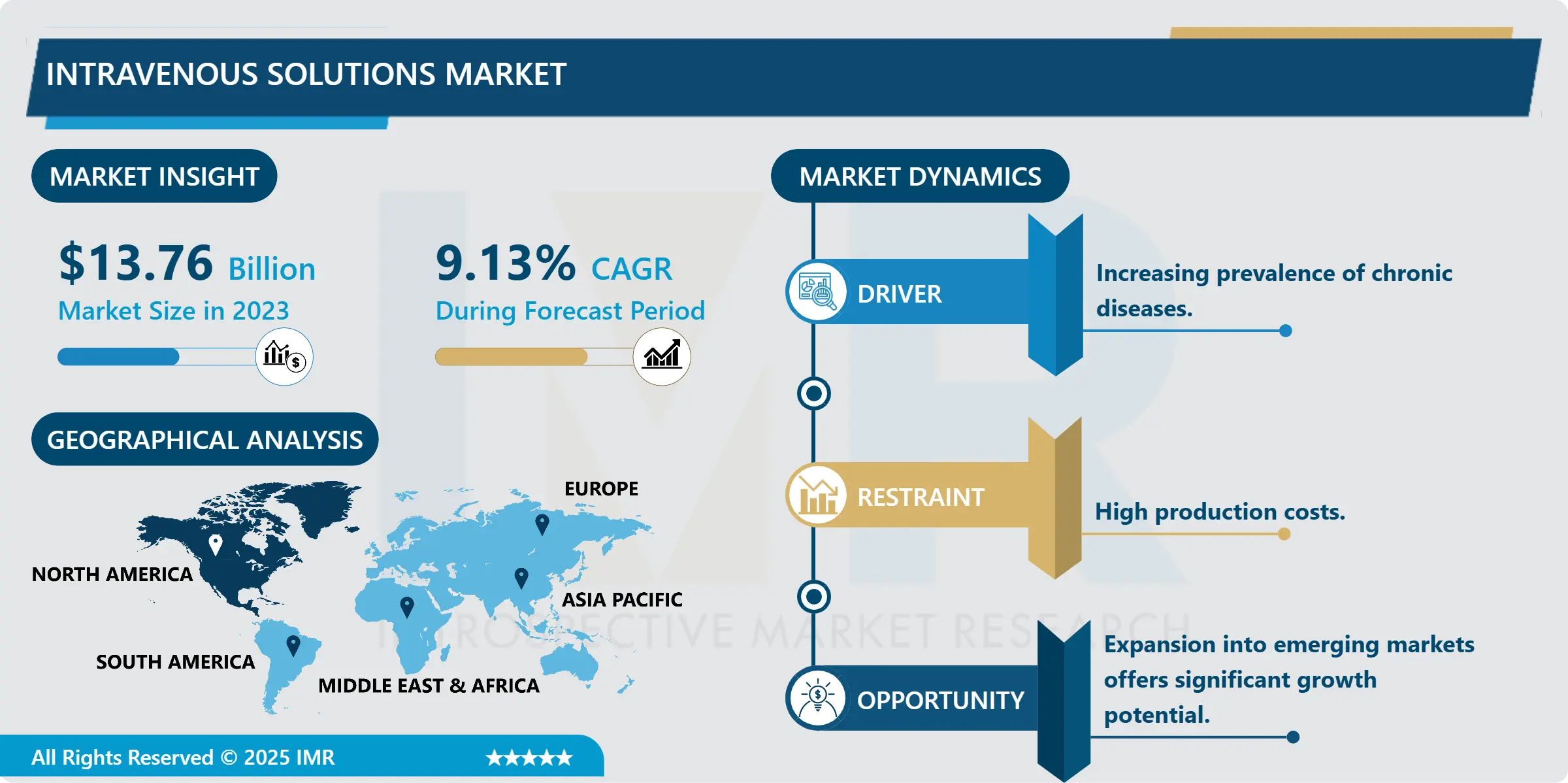
Intravenous Solutions Market Size Was Valued at USD 13.76 Billion in 2023, and is Projected to Reach USD 30.20 Billion by 2032, Growing at a CAGR of 9.13% From 2024-2032.
The IV solutions market refers to a broad category of sterile solutions that get delivered directly into a patient’s system through the bloodstream by intravenous therapy. These solutions are important in numerous areas of medicine trapped in such as hydration, nutrition and drug delivery. They may contain electrolytes, vitamins and other products depending on the patient requirements hence convenient to use in hospitals, outpatient clinics and emergency medical services. Technological developments in this field, a rise in cases of chronic diseases, introduction of modern technologies, and a growing old population put pressure on the need for an efficient and effective treatment of the diseases.
A growing importance of patient care and improvements in healthcare facilities has led to tremendous development of the intravenous solutions market. Because of the increasing need for surgeries, critical care and management of chronic illness patients the demand for IV solutions has grown. Features of this market include saline solutions, dextrose solutions, as well as other specialized nutritional products. Diabetes, cancer, Gastrointestinal disorders are on the rise, this also triggers the need for IV therapy to be performed. More so, the COVID-19 pandemic has also helped to create more awareness in intravenous therapies in addition to helping to spur innovations and deliver more capacities in production.
As healthcare systems grow, so too does the market for intravenous solutions and it is changing in response to new expectations of patient needs. Higher research spending is also associated with new formulations and protein delivery systems through which these products are now coming in the market and regulatory authorities are also committed to making sure that they are safe to use. In addition, increasing adoption of telehealth and home care models is refocusing the industry on seeking out new kinds of distribution channels and adding IV therapies that increase accessibility across the industry, driving growth and better patient outcomes.
Intravenous Solutions Market Trend Analysis:
The Rise of Specialty IV Solutions
-
One key trend that is being seen in the intravenous solutions market is increase in the tendency of getting specialty IV solutions. While these formulations can be used separately in particular clinical uses tailored formulations are developed to suit different medical condition and the patient’s nutritive needs for instance; Total nutrient intake for those who cannot eat orally; or certain electrolyte replenishments for critically ill patients. Due to the shift in focus towards the individual; there has been more attention paid to creating IV solutions that are more specific to ensuring that the treatment is improved and that the patients recovery time is reduced. Specialty IV solutions are also growing popular in health care facilities as caregivers try to get the most out of their treatment intervention.
- Furthermore, the rising demand for specialty IV solutions is being boosted by technological factors like better formulation methods, and higher-value delivery systems.. Features related to administration of IV fluids and drugs, including advanced technology smart infusion pumps, and monitoring systems assist in preparing improved treatments and delivery. This change improves the safety of patients and contributes to the phenomenon of individualized medicine, revolting the market of intravenous solution and satisfying the needs of patients and medical professionals.
Expansion into Emerging Markets
-
Intravenous solutions have displayed good prospects for growth, especially in the developing world.. It could be argued that, as facilities for healthcare continue to develop and as more patients get access to healthcare services, a demand for IV solutions is expected. Healthcare industries in the Asia-Pacific, Latin American and African nations are witnessing a rise in investments for delivering a better healthcare services with more, stress on innovate therapies. It gives the manufacturers and the suppliers an opportunity for diversification and market pain where the need for healthcare is rising in those regions.
- Some of the strategies can include developing partnership with the local health care stakeholders to ease the entry into the market, as well as gain better perception and understanding of the needs of the local market. In this way companies can maximize IV solutions performance to address certain healthcare needs in emerging markets while at the same time bringing positive change to patients in underserved regions. These emerging markets will become important for continuous growth of the intravenous solutions in the upcoming future as global healthcare sector is changing.
Intravenous Solutions Market Segment Analysis:
Intravenous Solutions Market is Segmented on the basis of Type, Composition, End User, and Region
By Type, Total segment is expected to dominate the market during the forecast period
-
By application, total parenteral nutrition (TPN) segment is expected to hold the largest share of the intravenous solutions market during the period due to increasing number of patients who cannot meet their nutritional requirements orally. TPN is most especially needed by people who have GI diseases, surgical patients, and cancer patients. Therefore, given the growing incidence of such conditions on the global platform, the need for TPN solutions will only go up. Furthermore, improvements in formulation technology coupled with increasing focus on individualised therapy increases the security of TPN with improved efficiency making TPN the most popular among health care providers. This is because the geriatric population grows every year and needs specific nutritional support, therefore strengthening TPN’s position as the leading segment of intravenous solution products.
By Application, Carbohydrates segment expected to held the largest share
-
It is projected that carbohydrates segment shall dominate the intravenous solutions market because of the sentient need of energy in patients. The indications include total parenteral nutrition, where in this case carbohydrates mainly in the form of dextrose infusions are necessary in managing and regulating cellular metabolism, and glycemic control especially in patients who cannot intake food normally. The rise in sick population experiencing diseases like diabetes that requires accurate carbohydrate control also enhances the consumption rate of the carbohydrate containing IV solutions. Furthermore, carbohydrate requirements in total parenteral nutrition (TPN) for intensified patients or for patients that underwent certain surgery also underlines carbohydrates’ necessity. Since healthcare providers gauge a need for the best and appropriate source of nutrition and energy, the carbohydrates segment holds the potentiality of sustaining the leadership position in the market.
Intravenous Solutions Market Regional Insights:
North America is Expected to Dominate the Market Over the Forecast period
-
In 2023, North America continues to dominate the intravenous solutions market, accounting for approximately 45% of the total market share. This substantial share can be attributed to a well-established healthcare infrastructure, high prevalence of chronic diseases, and increasing healthcare expenditure. The presence of key players in the region, along with ongoing advancements in IV therapy technologies, further solidifies North America’s position as the leading market. Moreover, the rising geriatric population and the growing trend of outpatient and home healthcare services are expected to bolster demand for intravenous solutions in this region.
Active Key Players in the Intravenous Solutions Market:
-
Amgen Inc. (USA)
- B. Braun Melsungen AG (Germany)
- Baxter International Inc. (USA)
- Epredia, LLC (USA)
- Fresenius Kabi AG (Germany)
- Grifols S.A. (Spain)
- Halyard Health, Inc. (USA)
- Hospira, Inc. (USA)
- ICU Medical, Inc. (USA)
- Otsuka Pharmaceutical Co., Ltd. (Japan)
- Pfizer Inc. (USA)
- Smiths Medical (USA)
- Terumo Corporation (Japan)
- Vifor Pharma AG (Switzerland)
- Zynex Inc. (USA)
- Other Active Players
|
Global Intravenous Solutions Market |
|||
|
Base Year: |
2023 |
Forecast Period: |
2024-2032 |
|
Historical Data: |
2017 to 2023 |
Market Size in 2023: |
USD 13.76 Billion |
|
Forecast Period 2024-32 CAGR: |
9.13 % |
Market Size in 2032: |
USD 30.20 Billion |
|
Segments Covered: |
By Type |
|
|
|
By Composition |
|
||
|
By Region |
|
||
|
Key Market Drivers: |
|
||
|
Key Market Restraints: |
|
||
|
Key Opportunities: |
|
||
|
Companies Covered in the report: |
|
||
Chapter 1: Introduction
1.1 Scope and Coverage
Chapter 2:Executive Summary
Chapter 3: Market Landscape
3.1 Market Dynamics
3.1.1 Drivers
3.1.2 Restraints
3.1.3 Opportunities
3.1.4 Challenges
3.2 Market Trend Analysis
3.3 PESTLE Analysis
3.4 Porter's Five Forces Analysis
3.5 Industry Value Chain Analysis
3.6 Ecosystem
3.7 Regulatory Landscape
3.8 Price Trend Analysis
3.9 Patent Analysis
3.10 Technology Evolution
3.11 Investment Pockets
3.12 Import-Export Analysis
Chapter 4: Intravenous Solutions Market by Type
4.1 Intravenous Solutions Market Snapshot and Growth Engine
4.2 Intravenous Solutions Market Overview
4.3 Total
4.3.1 Introduction and Market Overview
4.3.2 Historic and Forecasted Market Size in Value USD and Volume Units (2017-2032F)
4.3.3 Key Market Trends, Growth Factors and Opportunities
4.3.4 Total: Geographic Segmentation Analysis
4.4 Peripheral Parenteral Nutrition
4.4.1 Introduction and Market Overview
4.4.2 Historic and Forecasted Market Size in Value USD and Volume Units (2017-2032F)
4.4.3 Key Market Trends, Growth Factors and Opportunities
4.4.4 Peripheral Parenteral Nutrition: Geographic Segmentation Analysis
Chapter 5: Intravenous Solutions Market by Composition
5.1 Intravenous Solutions Market Snapshot and Growth Engine
5.2 Intravenous Solutions Market Overview
5.3 Carbohydrates
5.3.1 Introduction and Market Overview
5.3.2 Historic and Forecasted Market Size in Value USD and Volume Units (2017-2032F)
5.3.3 Key Market Trends, Growth Factors and Opportunities
5.3.4 Carbohydrates: Geographic Segmentation Analysis
5.4 Vitamins & Minerals
5.4.1 Introduction and Market Overview
5.4.2 Historic and Forecasted Market Size in Value USD and Volume Units (2017-2032F)
5.4.3 Key Market Trends, Growth Factors and Opportunities
5.4.4 Vitamins & Minerals: Geographic Segmentation Analysis
5.5 Single-dose Amino Acids
5.5.1 Introduction and Market Overview
5.5.2 Historic and Forecasted Market Size in Value USD and Volume Units (2017-2032F)
5.5.3 Key Market Trends, Growth Factors and Opportunities
5.5.4 Single-dose Amino Acids: Geographic Segmentation Analysis
5.6 Parenteral Lipid Emulsion
5.6.1 Introduction and Market Overview
5.6.2 Historic and Forecasted Market Size in Value USD and Volume Units (2017-2032F)
5.6.3 Key Market Trends, Growth Factors and Opportunities
5.6.4 Parenteral Lipid Emulsion: Geographic Segmentation Analysis
Chapter 6: Company Profiles and Competitive Analysis
6.1 Competitive Landscape
6.1.1 Competitive Benchmarking
6.1.2 Intravenous Solutions Market Share by Manufacturer (2023)
6.1.3 Industry BCG Matrix
6.1.4 Heat Map Analysis
6.1.5 Mergers and Acquisitions
6.2 BAXTER INTERNATIONAL INC. (USA)
6.2.1 Company Overview
6.2.2 Key Executives
6.2.3 Company Snapshot
6.2.4 Role of the Company in the Market
6.2.5 Sustainability and Social Responsibility
6.2.6 Operating Business Segments
6.2.7 Product Portfolio
6.2.8 Business Performance
6.2.9 Key Strategic Moves and Recent Developments
6.2.10 SWOT Analysis
6.3 B. BRAUN MELSUNGEN AG (GERMANY)
6.4 FRESENIUS KABI AG (GERMANY)
6.5 PFIZER INC. (USA)
6.6 OTHER ACTIVE PLAYERS
Chapter 7: Global Intravenous Solutions Market By Region
7.1 Overview
7.2. North America Intravenous Solutions Market
7.2.1 Key Market Trends, Growth Factors and Opportunities
7.2.2 Top Key Companies
7.2.3 Historic and Forecasted Market Size by Segments
7.2.4 Historic and Forecasted Market Size By Type
7.2.4.1 Total
7.2.4.2 Peripheral Parenteral Nutrition
7.2.5 Historic and Forecasted Market Size By Composition
7.2.5.1 Carbohydrates
7.2.5.2 Vitamins & Minerals
7.2.5.3 Single-dose Amino Acids
7.2.5.4 Parenteral Lipid Emulsion
7.2.6 Historic and Forecast Market Size by Country
7.2.6.1 US
7.2.6.2 Canada
7.2.6.3 Mexico
7.3. Eastern Europe Intravenous Solutions Market
7.3.1 Key Market Trends, Growth Factors and Opportunities
7.3.2 Top Key Companies
7.3.3 Historic and Forecasted Market Size by Segments
7.3.4 Historic and Forecasted Market Size By Type
7.3.4.1 Total
7.3.4.2 Peripheral Parenteral Nutrition
7.3.5 Historic and Forecasted Market Size By Composition
7.3.5.1 Carbohydrates
7.3.5.2 Vitamins & Minerals
7.3.5.3 Single-dose Amino Acids
7.3.5.4 Parenteral Lipid Emulsion
7.3.6 Historic and Forecast Market Size by Country
7.3.6.1 Russia
7.3.6.2 Bulgaria
7.3.6.3 The Czech Republic
7.3.6.4 Hungary
7.3.6.5 Poland
7.3.6.6 Romania
7.3.6.7 Rest of Eastern Europe
7.4. Western Europe Intravenous Solutions Market
7.4.1 Key Market Trends, Growth Factors and Opportunities
7.4.2 Top Key Companies
7.4.3 Historic and Forecasted Market Size by Segments
7.4.4 Historic and Forecasted Market Size By Type
7.4.4.1 Total
7.4.4.2 Peripheral Parenteral Nutrition
7.4.5 Historic and Forecasted Market Size By Composition
7.4.5.1 Carbohydrates
7.4.5.2 Vitamins & Minerals
7.4.5.3 Single-dose Amino Acids
7.4.5.4 Parenteral Lipid Emulsion
7.4.6 Historic and Forecast Market Size by Country
7.4.6.1 Germany
7.4.6.2 UK
7.4.6.3 France
7.4.6.4 The Netherlands
7.4.6.5 Italy
7.4.6.6 Spain
7.4.6.7 Rest of Western Europe
7.5. Asia Pacific Intravenous Solutions Market
7.5.1 Key Market Trends, Growth Factors and Opportunities
7.5.2 Top Key Companies
7.5.3 Historic and Forecasted Market Size by Segments
7.5.4 Historic and Forecasted Market Size By Type
7.5.4.1 Total
7.5.4.2 Peripheral Parenteral Nutrition
7.5.5 Historic and Forecasted Market Size By Composition
7.5.5.1 Carbohydrates
7.5.5.2 Vitamins & Minerals
7.5.5.3 Single-dose Amino Acids
7.5.5.4 Parenteral Lipid Emulsion
7.5.6 Historic and Forecast Market Size by Country
7.5.6.1 China
7.5.6.2 India
7.5.6.3 Japan
7.5.6.4 South Korea
7.5.6.5 Malaysia
7.5.6.6 Thailand
7.5.6.7 Vietnam
7.5.6.8 The Philippines
7.5.6.9 Australia
7.5.6.10 New Zealand
7.5.6.11 Rest of APAC
7.6. Middle East & Africa Intravenous Solutions Market
7.6.1 Key Market Trends, Growth Factors and Opportunities
7.6.2 Top Key Companies
7.6.3 Historic and Forecasted Market Size by Segments
7.6.4 Historic and Forecasted Market Size By Type
7.6.4.1 Total
7.6.4.2 Peripheral Parenteral Nutrition
7.6.5 Historic and Forecasted Market Size By Composition
7.6.5.1 Carbohydrates
7.6.5.2 Vitamins & Minerals
7.6.5.3 Single-dose Amino Acids
7.6.5.4 Parenteral Lipid Emulsion
7.6.6 Historic and Forecast Market Size by Country
7.6.6.1 Turkiye
7.6.6.2 Bahrain
7.6.6.3 Kuwait
7.6.6.4 Saudi Arabia
7.6.6.5 Qatar
7.6.6.6 UAE
7.6.6.7 Israel
7.6.6.8 South Africa
7.7. South America Intravenous Solutions Market
7.7.1 Key Market Trends, Growth Factors and Opportunities
7.7.2 Top Key Companies
7.7.3 Historic and Forecasted Market Size by Segments
7.7.4 Historic and Forecasted Market Size By Type
7.7.4.1 Total
7.7.4.2 Peripheral Parenteral Nutrition
7.7.5 Historic and Forecasted Market Size By Composition
7.7.5.1 Carbohydrates
7.7.5.2 Vitamins & Minerals
7.7.5.3 Single-dose Amino Acids
7.7.5.4 Parenteral Lipid Emulsion
7.7.6 Historic and Forecast Market Size by Country
7.7.6.1 Brazil
7.7.6.2 Argentina
7.7.6.3 Rest of SA
Chapter 8 Analyst Viewpoint and Conclusion
8.1 Recommendations and Concluding Analysis
8.2 Potential Market Strategies
Chapter 9 Research Methodology
9.1 Research Process
9.2 Primary Research
9.3 Secondary Research
|
Global Intravenous Solutions Market |
|||
|
Base Year: |
2023 |
Forecast Period: |
2024-2032 |
|
Historical Data: |
2017 to 2023 |
Market Size in 2023: |
USD 13.76 Billion |
|
Forecast Period 2024-32 CAGR: |
9.13 % |
Market Size in 2032: |
USD 30.20 Billion |
|
Segments Covered: |
By Type |
|
|
|
By Composition |
|
||
|
By Region |
|
||
|
Key Market Drivers: |
|
||
|
Key Market Restraints: |
|
||
|
Key Opportunities: |
|
||
|
Companies Covered in the report: |
|
||


