




In Vitro Toxicity Testing Market Synopsis:
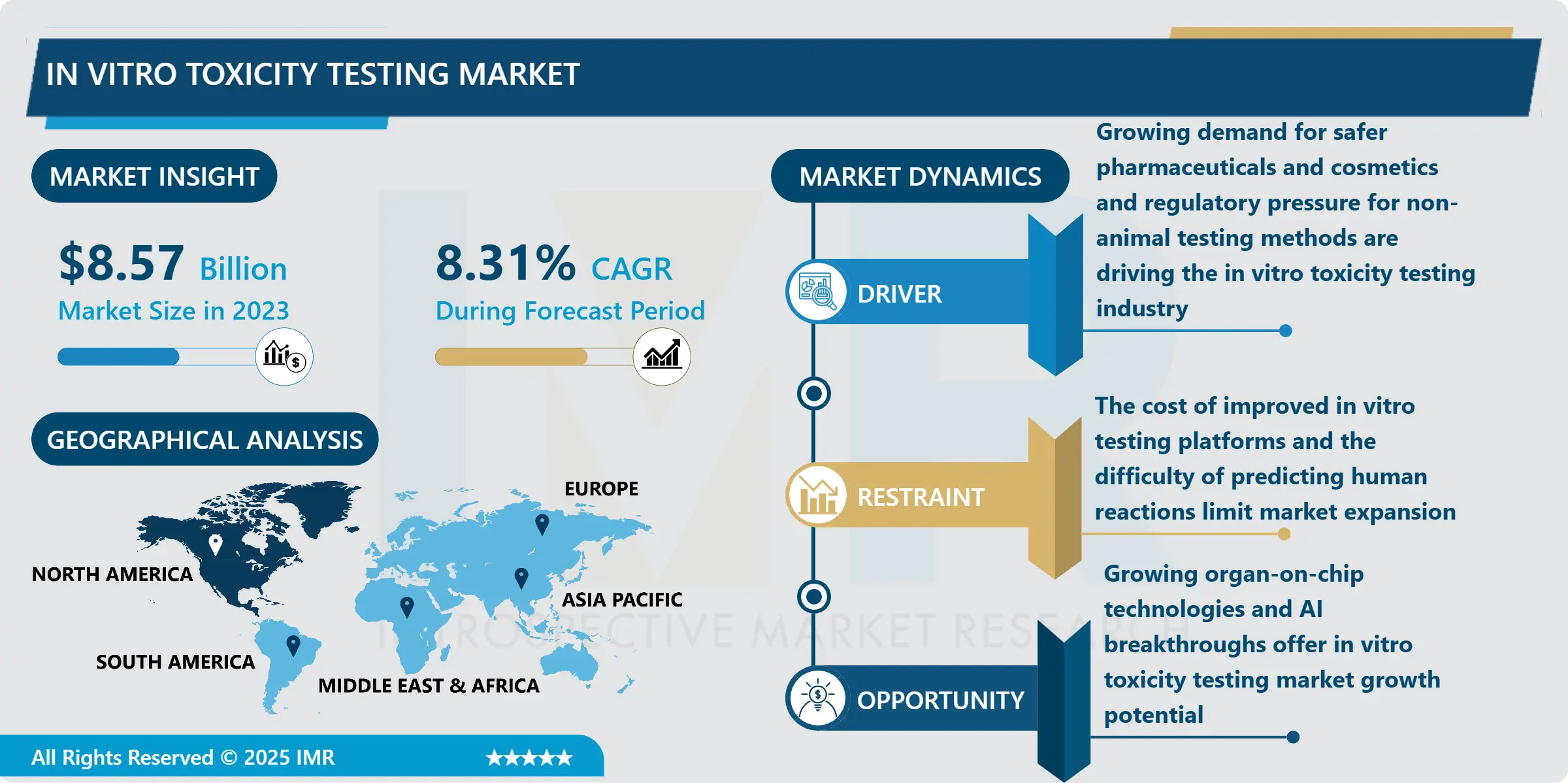
In Vitro Toxicity Testing Market Size Was Valued at USD 8.57 Billion in 2023, and is Projected to Reach USD 17.58 Billion by 2032, Growing at a CAGR of 8.31% From 2024-2032
The in vitro toxicity testing market refers to the use of laboratory-based tests to assess the toxicity of substances such as chemicals, pharmaceuticals, and environmental agents without using live animals. This market has gained substantial traction due to the increasing demand for alternative testing methods that are more ethical, cost-effective, and in compliance with regulatory guidelines. In vitro testing is increasingly adopted by the pharmaceutical, cosmetics, and chemical industries to evaluate the safety and effectiveness of their products before they are introduced to the market.
A key driver of the in vitro toxicity testing market is the growing shift toward regulatory frameworks that emphasize the reduction of animal testing. International regulations such as the REACH (Registration, Evaluation, Authorization, and Restriction of Chemicals) and other safety assessment guidelines require industries to adopt non-animal testing methods. In vitro tests allow more accurate and efficient predictions of the safety profile of chemicals and drugs, enhancing the reliability of product development.
Additionally, technological advancements in cell-based assays, microfluidic devices, and organ-on-a-chip models are significantly contributing to the expansion of the in vitro toxicity testing market. These innovations enable more accurate, high-throughput testing with lower costs, faster results, and greater predictability for human responses. As demand for these advanced testing methods continues to grow across various sectors, the in vitro toxicity testing market is poised for sustained expansion over the coming years.
In Vitro Toxicity Testing Market Trend Analysis:
Increasing Adoption of 3D Cell Cultures and Organ-on-a-Chip Models
- One of the significant trends driving the in vitro toxicity testing market is the growing use of 3D cell cultures and organ-on-a-chip models. These technologies mimic the in vivo environment more accurately than traditional 2D cell cultures, allowing for a better understanding of the potential toxic effects of substances on human tissues. 3D cell cultures and organ-on-a-chip platforms enable more realistic toxicological assessments, making them increasingly popular in drug development and safety testing. As these technologies continue to evolve, they offer higher predictive value and can reduce the need for animal testing, further aligning with regulatory and ethical standards.
Integration of Artificial Intelligence (AI) and Machine Learning for Toxicity Prediction
- Another emerging trend in the in vitro toxicity testing market is the integration of artificial intelligence (AI) and machine learning (ML) for predicting toxicity outcomes. AI and ML algorithms can analyze large datasets from in vitro tests, improving the speed and accuracy of toxicity assessments. These technologies help identify patterns and predict the toxicological effects of chemicals and pharmaceuticals based on molecular structures, offering more efficient risk assessments. The use of AI and ML not only accelerates the testing process but also supports the development of more robust predictive models, contributing to safer product development in industries such as pharmaceuticals, cosmetics, and chemicals.
In Vitro Toxicity Testing Market Segment Analysis:
In Vitro Toxicity Testing Market Segmented on the basis of Product and Service, Toxicology End Point and Test, Technology, Method, Industry, Distribution Channel, and Region
By Product and Service, Consumables segment is expected to dominate the market during the forecast period
- The in vitro toxicity testing market is segmented by product and service into consumables, services, assays, equipment, and software. Consumables include reagents, culture media, and laboratory supplies, which are essential for conducting toxicity tests. Services comprise the testing and consultancy services offered by contract research organizations (CROs) and other providers. Assays are standardized tests used to assess the toxic effects of substances on cell cultures, while equipment includes specialized instruments like automated cell culture systems, toxicity testing kits, and analytical tools. Software plays a crucial role in data analysis, providing computational models and databases to enhance the prediction and interpretation of toxicity results. Each of these segments contributes to the market's growth, driven by advancements in testing methodologies, increased demand for safer products, and regulatory changes promoting alternatives to animal testing.
By Distribution Channel, Direct Tender segment expected to held the largest share
- In the In Vitro Toxicity Testing Market, the distribution channels primarily include direct tender, retail sales, and others. Direct tender involves the sale of testing services and products directly to research institutions, pharmaceutical companies, and regulatory bodies, often through contractual agreements. This channel ensures a steady and targeted supply for large-scale studies and drug development programs. Retail sales cater to smaller, individual clients such as laboratories and clinics, providing off-the-shelf toxicology test kits and devices. In addition, other distribution channels encompass online sales, partnerships with distributors, and collaborations with contract research organizations (CROs), expanding the reach of in vitro toxicity testing solutions across various sectors including cosmetics, chemicals, and biotechnology. These diverse distribution channels enable companies to tap into different segments of the market and respond to specific customer needs.
In Vitro Toxicity Testing Market Regional Insights:
North America is Expected to Dominate the Market Over the Forecast period
- North America is expected to dominate the in vitro toxicity testing market over the forecast period, driven by the increasing demand for advanced testing methods in the pharmaceutical, biotechnology, and chemical industries. The region's robust healthcare infrastructure, high levels of research and development activities, and regulatory support for alternative testing methods are key factors contributing to its market leadership. Additionally, the rising adoption of advanced technologies such as 3D cell cultures, organ-on-a-chip models, and AI-driven predictive tools is further boosting market growth in North America. The presence of major players and government initiatives promoting the reduction of animal testing also strengthens the region’s position in the global market.
Active Key Players in the In Vitro Toxicity Testing Market:
- Charles River Laboratories (USA),
- Covance (USA),
- Thermo Fisher Scientific (USA),
- Eurofins Scientific (Luxembourg),
- SGS SA (Switzerland),
- Merck KGaA (Germany),
- Cyprotex (UK),
- Promega Corporation (USA),
- Gentronix Limited (UK),
- BioReliance Corporation (USA)
- Other Active Players
|
Global In Vitro Toxicity Testing Market |
|||
|
Base Year: |
2023 |
Forecast Period: |
2024-2032 |
|
Historical Data: |
2017 to 2023 |
Market Size in 2023: |
USD 8.57 Billion |
|
Forecast Period 2024-32 CAGR: |
8.31% |
Market Size in 2032: |
USD 17.58 Billion |
|
Segments Covered: |
By Product and Service |
|
|
|
Toxicology End Point and Test |
|
||
|
Technology |
|
||
|
Method |
|
||
|
Industry |
|
||
|
Distribution Channel |
|
||
|
By Region |
|
||
|
Key Market Drivers: |
|
||
|
Key Market Restraints: |
|
||
|
Key Opportunities: |
|
||
|
Companies Covered in the report: |
|
||
Chapter 1: Introduction
1.1 Scope and Coverage
Chapter 2:Executive Summary
Chapter 3: Market Landscape
3.1 Market Dynamics
3.1.1 Drivers
3.1.2 Restraints
3.1.3 Opportunities
3.1.4 Challenges
3.2 Market Trend Analysis
3.3 PESTLE Analysis
3.4 Porter's Five Forces Analysis
3.5 Industry Value Chain Analysis
3.6 Ecosystem
3.7 Regulatory Landscape
3.8 Price Trend Analysis
3.9 Patent Analysis
3.10 Technology Evolution
3.11 Investment Pockets
3.12 Import-Export Analysis
Chapter 4: In Vitro Toxicity Testing Market by Product and Service
4.1 In Vitro Toxicity Testing Market Snapshot and Growth Engine
4.2 In Vitro Toxicity Testing Market Overview
4.3 Consumables
4.3.1 Introduction and Market Overview
4.3.2 Historic and Forecasted Market Size in Value USD and Volume Units (2017-2032F)
4.3.3 Key Market Trends, Growth Factors and Opportunities
4.3.4 Consumables: Geographic Segmentation Analysis
4.4 Services
4.4.1 Introduction and Market Overview
4.4.2 Historic and Forecasted Market Size in Value USD and Volume Units (2017-2032F)
4.4.3 Key Market Trends, Growth Factors and Opportunities
4.4.4 Services: Geographic Segmentation Analysis
4.5 Assays
4.5.1 Introduction and Market Overview
4.5.2 Historic and Forecasted Market Size in Value USD and Volume Units (2017-2032F)
4.5.3 Key Market Trends, Growth Factors and Opportunities
4.5.4 Assays: Geographic Segmentation Analysis
4.6 Equipments
4.6.1 Introduction and Market Overview
4.6.2 Historic and Forecasted Market Size in Value USD and Volume Units (2017-2032F)
4.6.3 Key Market Trends, Growth Factors and Opportunities
4.6.4 Equipments: Geographic Segmentation Analysis
4.7 and Software
4.7.1 Introduction and Market Overview
4.7.2 Historic and Forecasted Market Size in Value USD and Volume Units (2017-2032F)
4.7.3 Key Market Trends, Growth Factors and Opportunities
4.7.4 and Software: Geographic Segmentation Analysis
Chapter 5: In Vitro Toxicity Testing Market by Toxicology End Point and Test
5.1 In Vitro Toxicity Testing Market Snapshot and Growth Engine
5.2 In Vitro Toxicity Testing Market Overview
5.3 ADME (Absorption
5.3.1 Introduction and Market Overview
5.3.2 Historic and Forecasted Market Size in Value USD and Volume Units (2017-2032F)
5.3.3 Key Market Trends, Growth Factors and Opportunities
5.3.4 ADME (Absorption: Geographic Segmentation Analysis
5.4 Distribution
5.4.1 Introduction and Market Overview
5.4.2 Historic and Forecasted Market Size in Value USD and Volume Units (2017-2032F)
5.4.3 Key Market Trends, Growth Factors and Opportunities
5.4.4 Distribution: Geographic Segmentation Analysis
5.5 Metabolism
5.5.1 Introduction and Market Overview
5.5.2 Historic and Forecasted Market Size in Value USD and Volume Units (2017-2032F)
5.5.3 Key Market Trends, Growth Factors and Opportunities
5.5.4 Metabolism: Geographic Segmentation Analysis
5.6 & Excretion) Testing
5.6.1 Introduction and Market Overview
5.6.2 Historic and Forecasted Market Size in Value USD and Volume Units (2017-2032F)
5.6.3 Key Market Trends, Growth Factors and Opportunities
5.6.4 & Excretion) Testing: Geographic Segmentation Analysis
5.7 Cytotoxicity Testing
5.7.1 Introduction and Market Overview
5.7.2 Historic and Forecasted Market Size in Value USD and Volume Units (2017-2032F)
5.7.3 Key Market Trends, Growth Factors and Opportunities
5.7.4 Cytotoxicity Testing: Geographic Segmentation Analysis
5.8 Genotoxicity Testing
5.8.1 Introduction and Market Overview
5.8.2 Historic and Forecasted Market Size in Value USD and Volume Units (2017-2032F)
5.8.3 Key Market Trends, Growth Factors and Opportunities
5.8.4 Genotoxicity Testing: Geographic Segmentation Analysis
5.9 Dermal Toxicity Testing
5.9.1 Introduction and Market Overview
5.9.2 Historic and Forecasted Market Size in Value USD and Volume Units (2017-2032F)
5.9.3 Key Market Trends, Growth Factors and Opportunities
5.9.4 Dermal Toxicity Testing: Geographic Segmentation Analysis
5.10 Ocular Toxicity Testing
5.10.1 Introduction and Market Overview
5.10.2 Historic and Forecasted Market Size in Value USD and Volume Units (2017-2032F)
5.10.3 Key Market Trends, Growth Factors and Opportunities
5.10.4 Ocular Toxicity Testing: Geographic Segmentation Analysis
5.11 Organ Toxicity Testing
5.11.1 Introduction and Market Overview
5.11.2 Historic and Forecasted Market Size in Value USD and Volume Units (2017-2032F)
5.11.3 Key Market Trends, Growth Factors and Opportunities
5.11.4 Organ Toxicity Testing: Geographic Segmentation Analysis
5.12 Skin Irritation
5.12.1 Introduction and Market Overview
5.12.2 Historic and Forecasted Market Size in Value USD and Volume Units (2017-2032F)
5.12.3 Key Market Trends, Growth Factors and Opportunities
5.12.4 Skin Irritation: Geographic Segmentation Analysis
5.13 Corrosion
5.13.1 Introduction and Market Overview
5.13.2 Historic and Forecasted Market Size in Value USD and Volume Units (2017-2032F)
5.13.3 Key Market Trends, Growth Factors and Opportunities
5.13.4 Corrosion: Geographic Segmentation Analysis
5.14 & Sensitization Testing
5.14.1 Introduction and Market Overview
5.14.2 Historic and Forecasted Market Size in Value USD and Volume Units (2017-2032F)
5.14.3 Key Market Trends, Growth Factors and Opportunities
5.14.4 & Sensitization Testing: Geographic Segmentation Analysis
5.15 Phototoxicity Testing
5.15.1 Introduction and Market Overview
5.15.2 Historic and Forecasted Market Size in Value USD and Volume Units (2017-2032F)
5.15.3 Key Market Trends, Growth Factors and Opportunities
5.15.4 Phototoxicity Testing: Geographic Segmentation Analysis
5.16 and Other Toxicity Endpoints & Tests
5.16.1 Introduction and Market Overview
5.16.2 Historic and Forecasted Market Size in Value USD and Volume Units (2017-2032F)
5.16.3 Key Market Trends, Growth Factors and Opportunities
5.16.4 and Other Toxicity Endpoints & Tests: Geographic Segmentation Analysis
Chapter 6: In Vitro Toxicity Testing Market by Technology
6.1 In Vitro Toxicity Testing Market Snapshot and Growth Engine
6.2 In Vitro Toxicity Testing Market Overview
6.3 Cell Culture Technologies
6.3.1 Introduction and Market Overview
6.3.2 Historic and Forecasted Market Size in Value USD and Volume Units (2017-2032F)
6.3.3 Key Market Trends, Growth Factors and Opportunities
6.3.4 Cell Culture Technologies: Geographic Segmentation Analysis
6.4 High-Throughput Technologies
6.4.1 Introduction and Market Overview
6.4.2 Historic and Forecasted Market Size in Value USD and Volume Units (2017-2032F)
6.4.3 Key Market Trends, Growth Factors and Opportunities
6.4.4 High-Throughput Technologies: Geographic Segmentation Analysis
6.5 Molecular Imaging
6.5.1 Introduction and Market Overview
6.5.2 Historic and Forecasted Market Size in Value USD and Volume Units (2017-2032F)
6.5.3 Key Market Trends, Growth Factors and Opportunities
6.5.4 Molecular Imaging: Geographic Segmentation Analysis
6.6 and Omics Technology
6.6.1 Introduction and Market Overview
6.6.2 Historic and Forecasted Market Size in Value USD and Volume Units (2017-2032F)
6.6.3 Key Market Trends, Growth Factors and Opportunities
6.6.4 and Omics Technology: Geographic Segmentation Analysis
Chapter 7: In Vitro Toxicity Testing Market by Method
7.1 In Vitro Toxicity Testing Market Snapshot and Growth Engine
7.2 In Vitro Toxicity Testing Market Overview
7.3 Cellular Assays
7.3.1 Introduction and Market Overview
7.3.2 Historic and Forecasted Market Size in Value USD and Volume Units (2017-2032F)
7.3.3 Key Market Trends, Growth Factors and Opportunities
7.3.4 Cellular Assays: Geographic Segmentation Analysis
7.4 Biochemical Assays
7.4.1 Introduction and Market Overview
7.4.2 Historic and Forecasted Market Size in Value USD and Volume Units (2017-2032F)
7.4.3 Key Market Trends, Growth Factors and Opportunities
7.4.4 Biochemical Assays: Geographic Segmentation Analysis
7.5 Ex-Vivo Models
7.5.1 Introduction and Market Overview
7.5.2 Historic and Forecasted Market Size in Value USD and Volume Units (2017-2032F)
7.5.3 Key Market Trends, Growth Factors and Opportunities
7.5.4 Ex-Vivo Models: Geographic Segmentation Analysis
7.6 and In Silico Models
7.6.1 Introduction and Market Overview
7.6.2 Historic and Forecasted Market Size in Value USD and Volume Units (2017-2032F)
7.6.3 Key Market Trends, Growth Factors and Opportunities
7.6.4 and In Silico Models: Geographic Segmentation Analysis
Chapter 8: In Vitro Toxicity Testing Market by Industry
8.1 In Vitro Toxicity Testing Market Snapshot and Growth Engine
8.2 In Vitro Toxicity Testing Market Overview
8.3 Pharmaceutical & Biopharmaceutical Companies
8.3.1 Introduction and Market Overview
8.3.2 Historic and Forecasted Market Size in Value USD and Volume Units (2017-2032F)
8.3.3 Key Market Trends, Growth Factors and Opportunities
8.3.4 Pharmaceutical & Biopharmaceutical Companies: Geographic Segmentation Analysis
8.4 Diagnostics
8.4.1 Introduction and Market Overview
8.4.2 Historic and Forecasted Market Size in Value USD and Volume Units (2017-2032F)
8.4.3 Key Market Trends, Growth Factors and Opportunities
8.4.4 Diagnostics: Geographic Segmentation Analysis
8.5 Food
8.5.1 Introduction and Market Overview
8.5.2 Historic and Forecasted Market Size in Value USD and Volume Units (2017-2032F)
8.5.3 Key Market Trends, Growth Factors and Opportunities
8.5.4 Food: Geographic Segmentation Analysis
8.6 Chemicals
8.6.1 Introduction and Market Overview
8.6.2 Historic and Forecasted Market Size in Value USD and Volume Units (2017-2032F)
8.6.3 Key Market Trends, Growth Factors and Opportunities
8.6.4 Chemicals: Geographic Segmentation Analysis
8.7 Cosmetics & Household Products
8.7.1 Introduction and Market Overview
8.7.2 Historic and Forecasted Market Size in Value USD and Volume Units (2017-2032F)
8.7.3 Key Market Trends, Growth Factors and Opportunities
8.7.4 Cosmetics & Household Products: Geographic Segmentation Analysis
Chapter 9: In Vitro Toxicity Testing Market by Distribution Channel
9.1 In Vitro Toxicity Testing Market Snapshot and Growth Engine
9.2 In Vitro Toxicity Testing Market Overview
9.3 Direct Tender
9.3.1 Introduction and Market Overview
9.3.2 Historic and Forecasted Market Size in Value USD and Volume Units (2017-2032F)
9.3.3 Key Market Trends, Growth Factors and Opportunities
9.3.4 Direct Tender: Geographic Segmentation Analysis
9.4 Retail Sales
9.4.1 Introduction and Market Overview
9.4.2 Historic and Forecasted Market Size in Value USD and Volume Units (2017-2032F)
9.4.3 Key Market Trends, Growth Factors and Opportunities
9.4.4 Retail Sales: Geographic Segmentation Analysis
9.5 and Others
9.5.1 Introduction and Market Overview
9.5.2 Historic and Forecasted Market Size in Value USD and Volume Units (2017-2032F)
9.5.3 Key Market Trends, Growth Factors and Opportunities
9.5.4 and Others: Geographic Segmentation Analysis
Chapter 10: Company Profiles and Competitive Analysis
10.1 Competitive Landscape
10.1.1 Competitive Benchmarking
10.1.2 In Vitro Toxicity Testing Market Share by Manufacturer (2023)
10.1.3 Industry BCG Matrix
10.1.4 Heat Map Analysis
10.1.5 Mergers and Acquisitions
10.2 CHARLES RIVER LABORATORIES (USA)
10.2.1 Company Overview
10.2.2 Key Executives
10.2.3 Company Snapshot
10.2.4 Role of the Company in the Market
10.2.5 Sustainability and Social Responsibility
10.2.6 Operating Business Segments
10.2.7 Product Portfolio
10.2.8 Business Performance
10.2.9 Key Strategic Moves and Recent Developments
10.2.10 SWOT Analysis
10.3 COVANCE (USA)
10.4 THERMO FISHER SCIENTIFIC (USA)
10.5 EUROFINS SCIENTIFIC (LUXEMBOURG)
10.6 SGS SA (SWITZERLAND)
10.7 MERCK KGAA (GERMANY)
10.8 CYPROTEX (UK)
10.9 PROMEGA CORPORATION (USA)
10.10 GENTRONIX LIMITED (UK)
10.11 BIORELIANCE CORPORATION (USA)
10.12 OTHER ACTIVE PLAYERS
Chapter 11: Global In Vitro Toxicity Testing Market By Region
11.1 Overview
11.2. North America In Vitro Toxicity Testing Market
11.2.1 Key Market Trends, Growth Factors and Opportunities
11.2.2 Top Key Companies
11.2.3 Historic and Forecasted Market Size by Segments
11.2.4 Historic and Forecasted Market Size By Product and Service
11.2.4.1 Consumables
11.2.4.2 Services
11.2.4.3 Assays
11.2.4.4 Equipments
11.2.4.5 and Software
11.2.5 Historic and Forecasted Market Size By Toxicology End Point and Test
11.2.5.1 ADME (Absorption
11.2.5.2 Distribution
11.2.5.3 Metabolism
11.2.5.4 & Excretion) Testing
11.2.5.5 Cytotoxicity Testing
11.2.5.6 Genotoxicity Testing
11.2.5.7 Dermal Toxicity Testing
11.2.5.8 Ocular Toxicity Testing
11.2.5.9 Organ Toxicity Testing
11.2.5.10 Skin Irritation
11.2.5.11 Corrosion
11.2.5.12 & Sensitization Testing
11.2.5.13 Phototoxicity Testing
11.2.5.14 and Other Toxicity Endpoints & Tests
11.2.6 Historic and Forecasted Market Size By Technology
11.2.6.1 Cell Culture Technologies
11.2.6.2 High-Throughput Technologies
11.2.6.3 Molecular Imaging
11.2.6.4 and Omics Technology
11.2.7 Historic and Forecasted Market Size By Method
11.2.7.1 Cellular Assays
11.2.7.2 Biochemical Assays
11.2.7.3 Ex-Vivo Models
11.2.7.4 and In Silico Models
11.2.8 Historic and Forecasted Market Size By Industry
11.2.8.1 Pharmaceutical & Biopharmaceutical Companies
11.2.8.2 Diagnostics
11.2.8.3 Food
11.2.8.4 Chemicals
11.2.8.5 Cosmetics & Household Products
11.2.9 Historic and Forecasted Market Size By Distribution Channel
11.2.9.1 Direct Tender
11.2.9.2 Retail Sales
11.2.9.3 and Others
11.2.10 Historic and Forecast Market Size by Country
11.2.10.1 US
11.2.10.2 Canada
11.2.10.3 Mexico
11.3. Eastern Europe In Vitro Toxicity Testing Market
11.3.1 Key Market Trends, Growth Factors and Opportunities
11.3.2 Top Key Companies
11.3.3 Historic and Forecasted Market Size by Segments
11.3.4 Historic and Forecasted Market Size By Product and Service
11.3.4.1 Consumables
11.3.4.2 Services
11.3.4.3 Assays
11.3.4.4 Equipments
11.3.4.5 and Software
11.3.5 Historic and Forecasted Market Size By Toxicology End Point and Test
11.3.5.1 ADME (Absorption
11.3.5.2 Distribution
11.3.5.3 Metabolism
11.3.5.4 & Excretion) Testing
11.3.5.5 Cytotoxicity Testing
11.3.5.6 Genotoxicity Testing
11.3.5.7 Dermal Toxicity Testing
11.3.5.8 Ocular Toxicity Testing
11.3.5.9 Organ Toxicity Testing
11.3.5.10 Skin Irritation
11.3.5.11 Corrosion
11.3.5.12 & Sensitization Testing
11.3.5.13 Phototoxicity Testing
11.3.5.14 and Other Toxicity Endpoints & Tests
11.3.6 Historic and Forecasted Market Size By Technology
11.3.6.1 Cell Culture Technologies
11.3.6.2 High-Throughput Technologies
11.3.6.3 Molecular Imaging
11.3.6.4 and Omics Technology
11.3.7 Historic and Forecasted Market Size By Method
11.3.7.1 Cellular Assays
11.3.7.2 Biochemical Assays
11.3.7.3 Ex-Vivo Models
11.3.7.4 and In Silico Models
11.3.8 Historic and Forecasted Market Size By Industry
11.3.8.1 Pharmaceutical & Biopharmaceutical Companies
11.3.8.2 Diagnostics
11.3.8.3 Food
11.3.8.4 Chemicals
11.3.8.5 Cosmetics & Household Products
11.3.9 Historic and Forecasted Market Size By Distribution Channel
11.3.9.1 Direct Tender
11.3.9.2 Retail Sales
11.3.9.3 and Others
11.3.10 Historic and Forecast Market Size by Country
11.3.10.1 Russia
11.3.10.2 Bulgaria
11.3.10.3 The Czech Republic
11.3.10.4 Hungary
11.3.10.5 Poland
11.3.10.6 Romania
11.3.10.7 Rest of Eastern Europe
11.4. Western Europe In Vitro Toxicity Testing Market
11.4.1 Key Market Trends, Growth Factors and Opportunities
11.4.2 Top Key Companies
11.4.3 Historic and Forecasted Market Size by Segments
11.4.4 Historic and Forecasted Market Size By Product and Service
11.4.4.1 Consumables
11.4.4.2 Services
11.4.4.3 Assays
11.4.4.4 Equipments
11.4.4.5 and Software
11.4.5 Historic and Forecasted Market Size By Toxicology End Point and Test
11.4.5.1 ADME (Absorption
11.4.5.2 Distribution
11.4.5.3 Metabolism
11.4.5.4 & Excretion) Testing
11.4.5.5 Cytotoxicity Testing
11.4.5.6 Genotoxicity Testing
11.4.5.7 Dermal Toxicity Testing
11.4.5.8 Ocular Toxicity Testing
11.4.5.9 Organ Toxicity Testing
11.4.5.10 Skin Irritation
11.4.5.11 Corrosion
11.4.5.12 & Sensitization Testing
11.4.5.13 Phototoxicity Testing
11.4.5.14 and Other Toxicity Endpoints & Tests
11.4.6 Historic and Forecasted Market Size By Technology
11.4.6.1 Cell Culture Technologies
11.4.6.2 High-Throughput Technologies
11.4.6.3 Molecular Imaging
11.4.6.4 and Omics Technology
11.4.7 Historic and Forecasted Market Size By Method
11.4.7.1 Cellular Assays
11.4.7.2 Biochemical Assays
11.4.7.3 Ex-Vivo Models
11.4.7.4 and In Silico Models
11.4.8 Historic and Forecasted Market Size By Industry
11.4.8.1 Pharmaceutical & Biopharmaceutical Companies
11.4.8.2 Diagnostics
11.4.8.3 Food
11.4.8.4 Chemicals
11.4.8.5 Cosmetics & Household Products
11.4.9 Historic and Forecasted Market Size By Distribution Channel
11.4.9.1 Direct Tender
11.4.9.2 Retail Sales
11.4.9.3 and Others
11.4.10 Historic and Forecast Market Size by Country
11.4.10.1 Germany
11.4.10.2 UK
11.4.10.3 France
11.4.10.4 The Netherlands
11.4.10.5 Italy
11.4.10.6 Spain
11.4.10.7 Rest of Western Europe
11.5. Asia Pacific In Vitro Toxicity Testing Market
11.5.1 Key Market Trends, Growth Factors and Opportunities
11.5.2 Top Key Companies
11.5.3 Historic and Forecasted Market Size by Segments
11.5.4 Historic and Forecasted Market Size By Product and Service
11.5.4.1 Consumables
11.5.4.2 Services
11.5.4.3 Assays
11.5.4.4 Equipments
11.5.4.5 and Software
11.5.5 Historic and Forecasted Market Size By Toxicology End Point and Test
11.5.5.1 ADME (Absorption
11.5.5.2 Distribution
11.5.5.3 Metabolism
11.5.5.4 & Excretion) Testing
11.5.5.5 Cytotoxicity Testing
11.5.5.6 Genotoxicity Testing
11.5.5.7 Dermal Toxicity Testing
11.5.5.8 Ocular Toxicity Testing
11.5.5.9 Organ Toxicity Testing
11.5.5.10 Skin Irritation
11.5.5.11 Corrosion
11.5.5.12 & Sensitization Testing
11.5.5.13 Phototoxicity Testing
11.5.5.14 and Other Toxicity Endpoints & Tests
11.5.6 Historic and Forecasted Market Size By Technology
11.5.6.1 Cell Culture Technologies
11.5.6.2 High-Throughput Technologies
11.5.6.3 Molecular Imaging
11.5.6.4 and Omics Technology
11.5.7 Historic and Forecasted Market Size By Method
11.5.7.1 Cellular Assays
11.5.7.2 Biochemical Assays
11.5.7.3 Ex-Vivo Models
11.5.7.4 and In Silico Models
11.5.8 Historic and Forecasted Market Size By Industry
11.5.8.1 Pharmaceutical & Biopharmaceutical Companies
11.5.8.2 Diagnostics
11.5.8.3 Food
11.5.8.4 Chemicals
11.5.8.5 Cosmetics & Household Products
11.5.9 Historic and Forecasted Market Size By Distribution Channel
11.5.9.1 Direct Tender
11.5.9.2 Retail Sales
11.5.9.3 and Others
11.5.10 Historic and Forecast Market Size by Country
11.5.10.1 China
11.5.10.2 India
11.5.10.3 Japan
11.5.10.4 South Korea
11.5.10.5 Malaysia
11.5.10.6 Thailand
11.5.10.7 Vietnam
11.5.10.8 The Philippines
11.5.10.9 Australia
11.5.10.10 New Zealand
11.5.10.11 Rest of APAC
11.6. Middle East & Africa In Vitro Toxicity Testing Market
11.6.1 Key Market Trends, Growth Factors and Opportunities
11.6.2 Top Key Companies
11.6.3 Historic and Forecasted Market Size by Segments
11.6.4 Historic and Forecasted Market Size By Product and Service
11.6.4.1 Consumables
11.6.4.2 Services
11.6.4.3 Assays
11.6.4.4 Equipments
11.6.4.5 and Software
11.6.5 Historic and Forecasted Market Size By Toxicology End Point and Test
11.6.5.1 ADME (Absorption
11.6.5.2 Distribution
11.6.5.3 Metabolism
11.6.5.4 & Excretion) Testing
11.6.5.5 Cytotoxicity Testing
11.6.5.6 Genotoxicity Testing
11.6.5.7 Dermal Toxicity Testing
11.6.5.8 Ocular Toxicity Testing
11.6.5.9 Organ Toxicity Testing
11.6.5.10 Skin Irritation
11.6.5.11 Corrosion
11.6.5.12 & Sensitization Testing
11.6.5.13 Phototoxicity Testing
11.6.5.14 and Other Toxicity Endpoints & Tests
11.6.6 Historic and Forecasted Market Size By Technology
11.6.6.1 Cell Culture Technologies
11.6.6.2 High-Throughput Technologies
11.6.6.3 Molecular Imaging
11.6.6.4 and Omics Technology
11.6.7 Historic and Forecasted Market Size By Method
11.6.7.1 Cellular Assays
11.6.7.2 Biochemical Assays
11.6.7.3 Ex-Vivo Models
11.6.7.4 and In Silico Models
11.6.8 Historic and Forecasted Market Size By Industry
11.6.8.1 Pharmaceutical & Biopharmaceutical Companies
11.6.8.2 Diagnostics
11.6.8.3 Food
11.6.8.4 Chemicals
11.6.8.5 Cosmetics & Household Products
11.6.9 Historic and Forecasted Market Size By Distribution Channel
11.6.9.1 Direct Tender
11.6.9.2 Retail Sales
11.6.9.3 and Others
11.6.10 Historic and Forecast Market Size by Country
11.6.10.1 Turkiye
11.6.10.2 Bahrain
11.6.10.3 Kuwait
11.6.10.4 Saudi Arabia
11.6.10.5 Qatar
11.6.10.6 UAE
11.6.10.7 Israel
11.6.10.8 South Africa
11.7. South America In Vitro Toxicity Testing Market
11.7.1 Key Market Trends, Growth Factors and Opportunities
11.7.2 Top Key Companies
11.7.3 Historic and Forecasted Market Size by Segments
11.7.4 Historic and Forecasted Market Size By Product and Service
11.7.4.1 Consumables
11.7.4.2 Services
11.7.4.3 Assays
11.7.4.4 Equipments
11.7.4.5 and Software
11.7.5 Historic and Forecasted Market Size By Toxicology End Point and Test
11.7.5.1 ADME (Absorption
11.7.5.2 Distribution
11.7.5.3 Metabolism
11.7.5.4 & Excretion) Testing
11.7.5.5 Cytotoxicity Testing
11.7.5.6 Genotoxicity Testing
11.7.5.7 Dermal Toxicity Testing
11.7.5.8 Ocular Toxicity Testing
11.7.5.9 Organ Toxicity Testing
11.7.5.10 Skin Irritation
11.7.5.11 Corrosion
11.7.5.12 & Sensitization Testing
11.7.5.13 Phototoxicity Testing
11.7.5.14 and Other Toxicity Endpoints & Tests
11.7.6 Historic and Forecasted Market Size By Technology
11.7.6.1 Cell Culture Technologies
11.7.6.2 High-Throughput Technologies
11.7.6.3 Molecular Imaging
11.7.6.4 and Omics Technology
11.7.7 Historic and Forecasted Market Size By Method
11.7.7.1 Cellular Assays
11.7.7.2 Biochemical Assays
11.7.7.3 Ex-Vivo Models
11.7.7.4 and In Silico Models
11.7.8 Historic and Forecasted Market Size By Industry
11.7.8.1 Pharmaceutical & Biopharmaceutical Companies
11.7.8.2 Diagnostics
11.7.8.3 Food
11.7.8.4 Chemicals
11.7.8.5 Cosmetics & Household Products
11.7.9 Historic and Forecasted Market Size By Distribution Channel
11.7.9.1 Direct Tender
11.7.9.2 Retail Sales
11.7.9.3 and Others
11.7.10 Historic and Forecast Market Size by Country
11.7.10.1 Brazil
11.7.10.2 Argentina
11.7.10.3 Rest of SA
Chapter 12 Analyst Viewpoint and Conclusion
12.1 Recommendations and Concluding Analysis
12.2 Potential Market Strategies
Chapter 13 Research Methodology
13.1 Research Process
13.2 Primary Research
13.3 Secondary Research
|
Global In Vitro Toxicity Testing Market |
|||
|
Base Year: |
2023 |
Forecast Period: |
2024-2032 |
|
Historical Data: |
2017 to 2023 |
Market Size in 2023: |
USD 8.57 Billion |
|
Forecast Period 2024-32 CAGR: |
8.31% |
Market Size in 2032: |
USD 17.58 Billion |
|
Segments Covered: |
By Product and Service |
|
|
|
Toxicology End Point and Test |
|
||
|
Technology |
|
||
|
Method |
|
||
|
Industry |
|
||
|
Distribution Channel |
|
||
|
By Region |
|
||
|
Key Market Drivers: |
|
||
|
Key Market Restraints: |
|
||
|
Key Opportunities: |
|
||
|
Companies Covered in the report: |
|
||


