Enteral Nutrition Market Synopsis:
Enteral Nutrition Market Size Was Valued at USD 7.4 Billion in 2023, and is Projected to Reach USD 12.08 Billion by 2032, Growing at a CAGR of 5.6 % From 2024-2032.
The enteral nutrition market involves products and solutions designed to deliver nutrients directly into the gastrointestinal tract for patients unable to consume food orally. It includes formulas, feeding tubes, and accessories used in hospitals, long-term care, and home settings to manage chronic conditions, malnutrition, or recovery from surgery or illness.
The Enteral Nutrition Market was positive throughout the world and expected to grow enormously due to older people's life span, chronic diseases, and improved enteral formulations. The growth has been prevalent in the hospital market for enteral nutrition particularly in the intensive care unit ICUs, for diverse critically ill clients. Other arrangements that are rapidly growing include home-based care solutions which are preferred by healthcare givers and families because they are cheaper and comfortable.
The other important factor is the increasing interest that has been displayed in developing own nutrition plans. Companies are introducing enteral nutrition products with a focus on certain diseases, diabetes, kidney or immune system disorders. This differentiation improves the patient experience and is supported by constant input from healthcare professionals which is increasing the growth of this market. Further, the application of advanced delivery devices adds enhanced capabilities for usage and product availability of those devices.
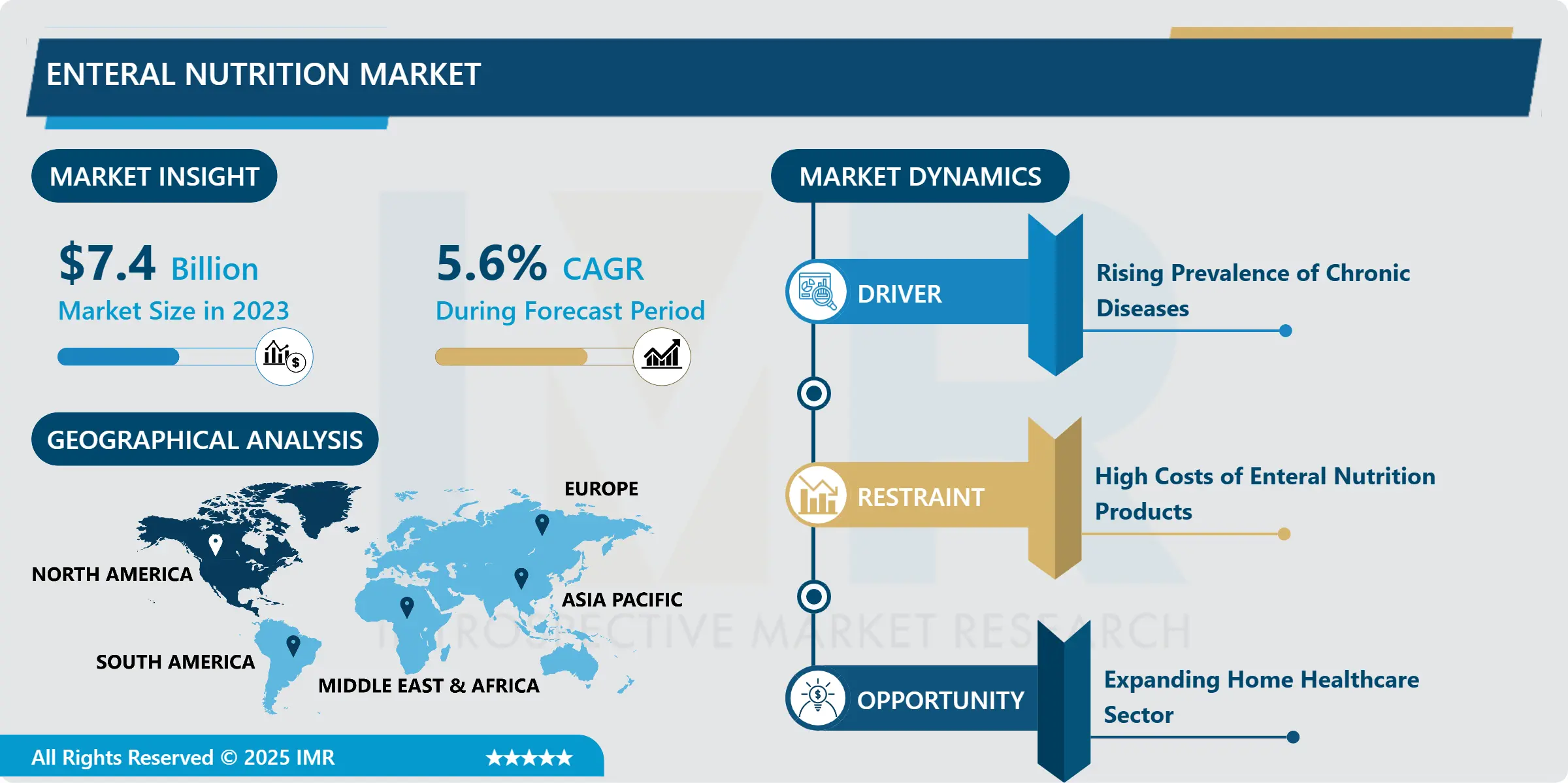
Enteral Nutrition Market Trend Analysis:
Increasing Adoption of Disease-Specific Formulations
-
The increasing adoption of disease-specific formulations. These specialized nutritional products are tailored to meet the unique dietary and metabolic needs of patients with conditions such as diabetes, cancer, renal disorders, and gastrointestinal diseases. As healthcare providers prioritize personalized treatment strategies, demand for condition-targeted enteral nutrition continues to grow. This trend is further supported by advancements in clinical research and product innovation, enabling manufacturers to offer highly specialized and effective solutions.
- Rising awareness among clinicians regarding the therapeutic benefits of disease-specific nutrition is encouraging wider adoption across hospitals, long-term care facilities, and home healthcare settings. This shift toward targeted nutritional therapy significantly enhances patient outcomes and drives market expansion.
Rising Demand for Home-Based Enteral Nutrition
-
Rising demand for home-based enteral nutrition presents a significant opportunity for market growth. Patients and caregivers increasingly prefer home care due to its cost-effectiveness, comfort, and reduced risk of hospital-acquired infections. This shift is supported by technological advancements, including user-friendly feeding devices and portable pumps, facilitating easier administration at home.
- Favorable reimbursement policies and government initiatives further encourage this trend. The growing geriatric population and prevalence of chronic diseases necessitate long-term nutritional support, making home enteral nutrition a practical solution. Additionally, the integration of telehealth services enables remote monitoring, enhancing patient outcomes. Collectively, these factors drive the expansion of the enteral nutrition market, highlighting the strategic importance of home-based care solutions.
Enteral Nutrition Market Segment Analysis:
The enteral Nutrition Market is Segmented on the basis of Product Type, Nutrition, End User, and Region
By Product Type, Enteral Nutrition segment is expected to dominate the market during the forecast period
-
The enteral nutrition segment is expected to dominate the clinical nutrition market during the forecast period due to its growing application across acute and chronic care settings. This dominance is driven by rising incidences of conditions such as cancer, gastrointestinal disorders, and neurological impairments, which require consistent nutritional support.
- The segment benefits from increasing clinical awareness, improved product availability, and advancements in enteral feeding technologies that enhance patient safety and ease of administration. Moreover, cost-effectiveness compared to parenteral nutrition and a growing preference for non-invasive nutritional therapies are further propelling segment growth. As healthcare systems globally focus on reducing inpatient costs and supporting long-term care at home, the enteral nutrition segment is well-positioned to sustain strong demand and market leadership.
By Nutrition Type, the Protein segment expected to hold the largest share
-
The protein segment is expected to hold the largest share of the enteral nutrition market during the forecast period, driven by the critical role of protein in patient recovery and health maintenance. High-protein formulations are increasingly prescribed for patients with chronic illnesses, post-surgical needs, and age-related muscle loss.
- As clinical guidelines emphasize the importance of protein-enriched nutrition to support immune function, tissue repair, and muscle preservation, demand for specialized protein-based enteral products continues to grow. Additionally, advancements in protein formulation such as hydrolyzed and peptide-based proteins—are enhancing digestibility and absorption, particularly for patients with compromised gastrointestinal function. With a rising geriatric population and growing prevalence of protein-energy malnutrition
Enteral Nutrition Market Regional Insights:
North America is Expected to Dominate the Market Over the Forecast period
-
This leadership is due to the relatively greater development of healthcare in the region together with a comparatively faster uptake of clinical nutrition products due to enhanced awareness of the efficacy of nutritional therapy. Among the regions, the United States of America has been contributing a lot, due the increasing geriatric population and the increase in incidence of chronic diseases including cancer and diabetes.
- Canada also occupies an important place in the North American market due to its subjects being the home-based care solutions and the government projects which support the improvement of the access to the healthcare services. In order to expand the capabilities of their product offerings, key market players in the region remain focused on increasing their R&D investment, thereby driving the market. The relatively elevated per capita disposable income in the region, coupled with insurance-friendly policies in the North American region make the market a promising breeding ground for enteral nutrition solutions.
Active Key Players in the Enteral Nutrition Market
- Abbott Laboratories (United States)
- Ajinomoto Co., Inc. (Japan)
- B. Braun Melsungen AG (Germany)
- Baxter International Inc. (United States)
- Boston Scientific Corporation (United States)
- Danone S.A. (France)
- Fresenius Kabi AG (Germany)
- Hormel Foods Corporation (United States)
- ICU Medical Inc. (United States)
- Medline Industries (United States)
- Mead Johnson Nutrition Company (United States)
- Nestlé Health Science (Switzerland)
- Nutricia Advanced Medical Nutrition (Netherlands)
- Reckitt Benckiser Group PLC (United Kingdom)
- Vitasoy International Holdings (China)
- Other Active Players
|
Global Enteral Nutrition Market |
|||
|
Base Year: |
2023 |
Forecast Period: |
2024-2032 |
|
Historical Data: |
2017 to 2023 |
Market Size in 2023: |
USD 7.4 Billion |
|
Forecast Period 2024-32 CAGR: |
5.6% |
Market Size in 2032: |
USD 12.08 Billion |
|
Segments Covered: |
By Product Type |
|
|
|
By Nutrition Type |
|
||
|
By End User |
|
||
|
By Region |
|
||
|
Key Market Drivers: |
|
||
|
Key Market Restraints: |
|
||
|
Key Opportunities: |
|
||
|
Companies Covered in the report: |
|
||
Chapter 1: Introduction
1.1 Scope and Coverage
Chapter 2:Executive Summary
Chapter 3: Market Landscape
3.1 Market Dynamics
3.1.1 Drivers
3.1.2 Restraints
3.1.3 Opportunities
3.1.4 Challenges
3.2 Market Trend Analysis
3.3 PESTLE Analysis
3.4 Porter's Five Forces Analysis
3.5 Industry Value Chain Analysis
3.6 Ecosystem
3.7 Regulatory Landscape
3.8 Price Trend Analysis
3.9 Patent Analysis
3.10 Technology Evolution
3.11 Investment Pockets
3.12 Import-Export Analysis
Chapter 4: Enteral Nutrition Market by Product Type
4.1 Enteral Nutrition Market Snapshot and Growth Engine
4.2 Enteral Nutrition Market Overview
4.3 Standard Enteral Nutrition Enteral Nutrition for Chronic illnesses
4.3.1 Introduction and Market Overview
4.3.2 Historic and Forecasted Market Size in Value USD and Volume Units (2017-2032F)
4.3.3 Key Market Trends, Growth Factors and Opportunities
4.3.4 Standard Enteral Nutrition Enteral Nutrition for Chronic illnesses: Geographic Segmentation Analysis
Chapter 5: Enteral Nutrition Market by Nutrition Type
5.1 Enteral Nutrition Market Snapshot and Growth Engine
5.2 Enteral Nutrition Market Overview
5.3 Proteins Carbohydrates Multi-vitamins and Antioxidants Amino Acid Fibers Minerals Others
5.3.1 Introduction and Market Overview
5.3.2 Historic and Forecasted Market Size in Value USD and Volume Units (2017-2032F)
5.3.3 Key Market Trends, Growth Factors and Opportunities
5.3.4 Proteins Carbohydrates Multi-vitamins and Antioxidants Amino Acid Fibers Minerals Others: Geographic Segmentation Analysis
Chapter 6: Enteral Nutrition Market by End User
6.1 Enteral Nutrition Market Snapshot and Growth Engine
6.2 Enteral Nutrition Market Overview
6.3 Hospitals Home Care Settings Retirement Homes Others
6.3.1 Introduction and Market Overview
6.3.2 Historic and Forecasted Market Size in Value USD and Volume Units (2017-2032F)
6.3.3 Key Market Trends, Growth Factors and Opportunities
6.3.4 Hospitals Home Care Settings Retirement Homes Others: Geographic Segmentation Analysis
Chapter 7: Company Profiles and Competitive Analysis
7.1 Competitive Landscape
7.1.1 Competitive Benchmarking
7.1.2 Enteral Nutrition Market Share by Manufacturer (2023)
7.1.3 Industry BCG Matrix
7.1.4 Heat Map Analysis
7.1.5 Mergers and Acquisitions
7.2 ABBOTT LABORATORIES (UNITED STATES)
7.2.1 Company Overview
7.2.2 Key Executives
7.2.3 Company Snapshot
7.2.4 Role of the Company in the Market
7.2.5 Sustainability and Social Responsibility
7.2.6 Operating Business Segments
7.2.7 Product Portfolio
7.2.8 Business Performance
7.2.9 Key Strategic Moves and Recent Developments
7.2.10 SWOT Analysis
7.3 AJINOMOTO CO. INC. (JAPAN)
7.4 B. BRAUN MELSUNGEN AG (GERMANY)
7.5 BAXTER INTERNATIONAL INC. (UNITED STATES)
7.6 BOSTON SCIENTIFIC CORPORATION (UNITED STATES)
7.7 DANONE S.A. (FRANCE)
7.8 FRESENIUS KABI AG (GERMANY)
7.9 HORMEL FOODS CORPORATION (UNITED STATES)
7.10 ICU MEDICAL INC. (UNITED STATES)
7.11 MEDLINE INDUSTRIES (UNITED STATES)
7.12 MEAD JOHNSON NUTRITION COMPANY (UNITED STATES)
7.13 NESTLÉ HEALTH SCIENCE (SWITZERLAND)
7.14 NUTRICIA ADVANCED MEDICAL NUTRITION (NETHERLANDS)
7.15 RECKITT BENCKISER GROUP PLC (UNITED KINGDOM)
7.16 VITASOY INTERNATIONAL HOLDINGS (CHINA)
7.17 OTHER ACTIVE PLAYERS
Chapter 8: Global Enteral Nutrition Market By Region
8.1 Overview
8.2. North America Enteral Nutrition Market
8.2.1 Key Market Trends, Growth Factors and Opportunities
8.2.2 Top Key Companies
8.2.3 Historic and Forecasted Market Size by Segments
8.2.4 Historic and Forecasted Market Size By Product Type
8.2.4.1 Standard Enteral Nutrition Enteral Nutrition for Chronic illnesses
8.2.5 Historic and Forecasted Market Size By Nutrition Type
8.2.5.1 Proteins Carbohydrates Multi-vitamins and Antioxidants Amino Acid Fibers Minerals Others
8.2.6 Historic and Forecasted Market Size By End User
8.2.6.1 Hospitals Home Care Settings Retirement Homes Others
8.2.7 Historic and Forecast Market Size by Country
8.2.7.1 US
8.2.7.2 Canada
8.2.7.3 Mexico
8.3. Eastern Europe Enteral Nutrition Market
8.3.1 Key Market Trends, Growth Factors and Opportunities
8.3.2 Top Key Companies
8.3.3 Historic and Forecasted Market Size by Segments
8.3.4 Historic and Forecasted Market Size By Product Type
8.3.4.1 Standard Enteral Nutrition Enteral Nutrition for Chronic illnesses
8.3.5 Historic and Forecasted Market Size By Nutrition Type
8.3.5.1 Proteins Carbohydrates Multi-vitamins and Antioxidants Amino Acid Fibers Minerals Others
8.3.6 Historic and Forecasted Market Size By End User
8.3.6.1 Hospitals Home Care Settings Retirement Homes Others
8.3.7 Historic and Forecast Market Size by Country
8.3.7.1 Russia
8.3.7.2 Bulgaria
8.3.7.3 The Czech Republic
8.3.7.4 Hungary
8.3.7.5 Poland
8.3.7.6 Romania
8.3.7.7 Rest of Eastern Europe
8.4. Western Europe Enteral Nutrition Market
8.4.1 Key Market Trends, Growth Factors and Opportunities
8.4.2 Top Key Companies
8.4.3 Historic and Forecasted Market Size by Segments
8.4.4 Historic and Forecasted Market Size By Product Type
8.4.4.1 Standard Enteral Nutrition Enteral Nutrition for Chronic illnesses
8.4.5 Historic and Forecasted Market Size By Nutrition Type
8.4.5.1 Proteins Carbohydrates Multi-vitamins and Antioxidants Amino Acid Fibers Minerals Others
8.4.6 Historic and Forecasted Market Size By End User
8.4.6.1 Hospitals Home Care Settings Retirement Homes Others
8.4.7 Historic and Forecast Market Size by Country
8.4.7.1 Germany
8.4.7.2 UK
8.4.7.3 France
8.4.7.4 The Netherlands
8.4.7.5 Italy
8.4.7.6 Spain
8.4.7.7 Rest of Western Europe
8.5. Asia Pacific Enteral Nutrition Market
8.5.1 Key Market Trends, Growth Factors and Opportunities
8.5.2 Top Key Companies
8.5.3 Historic and Forecasted Market Size by Segments
8.5.4 Historic and Forecasted Market Size By Product Type
8.5.4.1 Standard Enteral Nutrition Enteral Nutrition for Chronic illnesses
8.5.5 Historic and Forecasted Market Size By Nutrition Type
8.5.5.1 Proteins Carbohydrates Multi-vitamins and Antioxidants Amino Acid Fibers Minerals Others
8.5.6 Historic and Forecasted Market Size By End User
8.5.6.1 Hospitals Home Care Settings Retirement Homes Others
8.5.7 Historic and Forecast Market Size by Country
8.5.7.1 China
8.5.7.2 India
8.5.7.3 Japan
8.5.7.4 South Korea
8.5.7.5 Malaysia
8.5.7.6 Thailand
8.5.7.7 Vietnam
8.5.7.8 The Philippines
8.5.7.9 Australia
8.5.7.10 New Zealand
8.5.7.11 Rest of APAC
8.6. Middle East & Africa Enteral Nutrition Market
8.6.1 Key Market Trends, Growth Factors and Opportunities
8.6.2 Top Key Companies
8.6.3 Historic and Forecasted Market Size by Segments
8.6.4 Historic and Forecasted Market Size By Product Type
8.6.4.1 Standard Enteral Nutrition Enteral Nutrition for Chronic illnesses
8.6.5 Historic and Forecasted Market Size By Nutrition Type
8.6.5.1 Proteins Carbohydrates Multi-vitamins and Antioxidants Amino Acid Fibers Minerals Others
8.6.6 Historic and Forecasted Market Size By End User
8.6.6.1 Hospitals Home Care Settings Retirement Homes Others
8.6.7 Historic and Forecast Market Size by Country
8.6.7.1 Turkiye
8.6.7.2 Bahrain
8.6.7.3 Kuwait
8.6.7.4 Saudi Arabia
8.6.7.5 Qatar
8.6.7.6 UAE
8.6.7.7 Israel
8.6.7.8 South Africa
8.7. South America Enteral Nutrition Market
8.7.1 Key Market Trends, Growth Factors and Opportunities
8.7.2 Top Key Companies
8.7.3 Historic and Forecasted Market Size by Segments
8.7.4 Historic and Forecasted Market Size By Product Type
8.7.4.1 Standard Enteral Nutrition Enteral Nutrition for Chronic illnesses
8.7.5 Historic and Forecasted Market Size By Nutrition Type
8.7.5.1 Proteins Carbohydrates Multi-vitamins and Antioxidants Amino Acid Fibers Minerals Others
8.7.6 Historic and Forecasted Market Size By End User
8.7.6.1 Hospitals Home Care Settings Retirement Homes Others
8.7.7 Historic and Forecast Market Size by Country
8.7.7.1 Brazil
8.7.7.2 Argentina
8.7.7.3 Rest of SA
Chapter 9 Analyst Viewpoint and Conclusion
9.1 Recommendations and Concluding Analysis
9.2 Potential Market Strategies
Chapter 10 Research Methodology
10.1 Research Process
10.2 Primary Research
10.3 Secondary Research
|
Global Enteral Nutrition Market |
|||
|
Base Year: |
2023 |
Forecast Period: |
2024-2032 |
|
Historical Data: |
2017 to 2023 |
Market Size in 2023: |
USD 7.4 Billion |
|
Forecast Period 2024-32 CAGR: |
5.6% |
Market Size in 2032: |
USD 12.08 Billion |
|
Segments Covered: |
By Product Type |
|
|
|
By Nutrition Type |
|
||
|
By End User |
|
||
|
By Region |
|
||
|
Key Market Drivers: |
|
||
|
Key Market Restraints: |
|
||
|
Key Opportunities: |
|
||
|
Companies Covered in the report: |
|
||