




Air Cushion Vehicle Market Synopsis:
Air Cushion Vehicle Market Was Valued at USD 142.24 million in 2023 and is Projected to Reach USD 257.79 million by 2032, Growing at a CAGR of 6.83% from 2024 to 2032
An Air Cushion Vehicle (ACV) is a unique Shipping Concept designed for use on a cushion of air formed by big fans where it can travel on roads, across the sea and even on ice. The car employs a flexible skirt to confine as much air as possible under the vehicle so as to reduce the contact between the vehicle and the ground and allow smooth, low frictional movement on the same. ACVs are used in military, search & rescue, commercial transportation, and leisure refer to because of their mobility capabilities in challenging terrains and conditions. The air cushion technology has specific advantages associated with amphibious and all-terrain operating conditions.
The market for air cushion vehicles (ACV) has exhibited consistent growth over the years due to growing requirement for useful transportation system across diverse sectors. Hovercrafts and other ACV classes of vehicles rely on air cushions for support to be used on land, water, icing and other types of surfaces. This undeniably is a remarkable feature which makes them very useful in military, defense, logistic, search and rescue amongst other fields. Besides, demand for amphibious vehicle operation and enhancements in disaster relief requirement are other forces that are driving the market. Lifestyle factors and the growth of more progressive mobility solutions that help to minimize traffic and negative effects on the environment can also be considered as a factor that is helping the market’s growth.
Trends in the air cushion vehicle manufacturing market involve technological innovations instrumental in the enhancements of the efficiency, performance rates and capabilities of the air cushion vehicles. With R and D directing time and attention toward improving the fuel efficiency, lowering noise levels, and the overall performance of machines, the ACV marketplace will only continue to grow. Further, military and defense also have a big share in using ACVs with logistic benefit in rugged areas. However, drawbacks such as high cost of production, operational legislation requirements, and the need for appropriate structures to operate these motors in the commercial market may limit their use. Nevertheless, the market is expected to grow further in the future because of higher demands across end-use industries and advancements in the vehicle structure and their functionality.
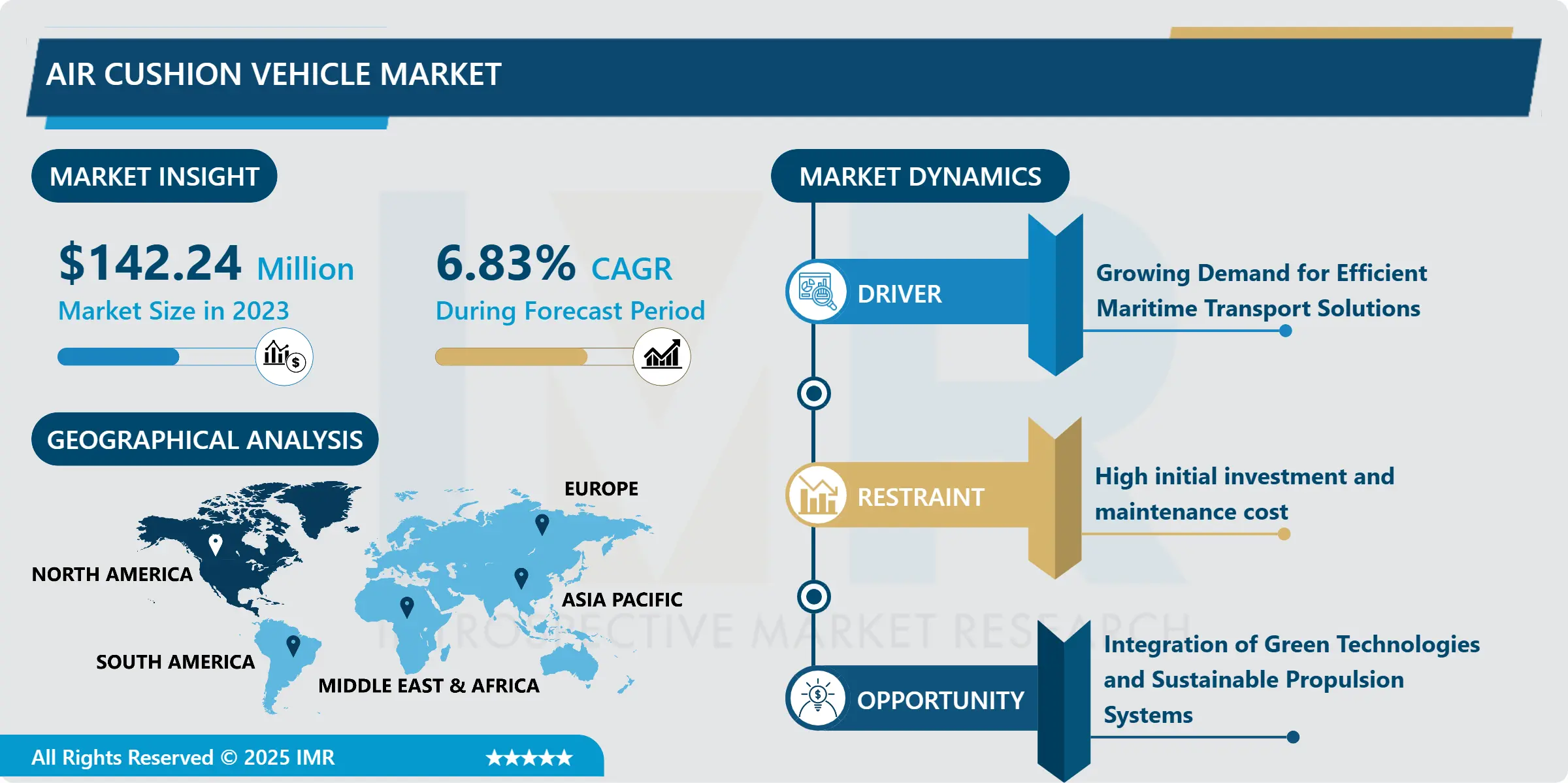
Air Cushion Vehicle Market Trend Analysis:
Integration of Electric Propulsion Systems in Air Cushion Vehicles
-
One trend that is conspicuous in the Air Cushion Vehicle (ACV) market is the use of electronics in the propulsion system. This course is consistent with the global trend towards environment friendly provided transport system with efficiently reduced carbon emissions. Electric ACVs are used mostly due to the environmental aspects since they are environment friendly as compared to traditional ACVs. The fact that they do not require the use of fossil fuel makes them ideal solutions to increasing environmental problems. Air-cushion vehicles that are electrically powered are now being weighed for use in city as well as intercity transport since there is growing need for environmentally friendly technologies.
- Electric ACVs are increasingly becoming popular because they move using air cushions instead of wheels and can be used on land, water and even ice. It also increases their mobility and develops potential means to be used in various fields of human activity. These vehicles are becoming particularly desirable in fields like tourism, military usage, or freight transport in which it is necessary for vehicles to maneuver various surface types. Forecasting into the future with developments in the field of electric propulsion, ACVs are expected to have great potential as part of eco-friendly public transport, and is flexible to provide high reliability solutions for many uses.
Development of Sustainable and Versatile Air Cushion Vehicles
-
The most important growth scope in the Air Cushion Vehicle (ACV) market is the creation of the upgraded and environment-friendly power transmission systems. This has seen industries and governments around the world focus on transportation alternatives that will respect the already changing global environmental concerns. Originated and designed to run on many surfaces like water, ice and other rough terrains inpUnlike conventional vehicles that require asphalt paved road networks and infrastructure services to function, ACVs are seamless multi-utility options. The use of innovative technologies such as hybrid/electric power in ACVs would afford manufacturers an opportunity to decrease overall emissions from the machines, benefiting both urban and distant operations. They also dovetail with calls for higher use of clean energy, which situates ACVs as progressive in present transportation networks.
- Furthermore, freedom of movement uses and transport in flood prone or difficult terrains gives acvs wider market appeal. Due to the change of climate that leads to occurrence of severe natural conditions, ACVs may be very useful during disasters and natural disasters. Given their special characteristics, they can be indispensable in transporting humanitarian supplies or evacuating people where conventional automotive solutions cannot perform. This aspect not only relates to sustainable transport but also to important humanitarian needs thus ensuring insistent demand for such autos in municipal and individual ownerships.
Air Cushion Vehicle Market Segment Analysis:
Air Cushion Vehicle Market is Segmented on the basis of By Type, Application, and Region.
By Type, Amphibious Air-cushion Vehicles segment is expected to dominate the market during the forecast period
-
That is why the amphibious air-cushion vehicles are designed to move across water and land as a float or a regular car without any difficulty. Suspended by a force produced by fans, these vehicles move above the ground confronting any conditions from marshy lands to snowy fields, and even shallow water, in which conventional means of transport cannot traverse. Especially for important tasks, such as the military and rescuers. These vehicles play an important role especially in calamity response and disaster operations, particularly in flooded areas, wherein ordinary vehicles find it hard to penetrate because of water logs, obstacles and rough terrains.
- Light vehicles such as the amphibious air-cushion vehicles are prospecting under the generalized growth stimulated by the technology and materials. Contemporary designs are aiming at decreasing mass, increasing the utilization rate of fuels and increasing service life, for these automobiles to prove to be more dependable and economical. Since industries are focusing on developing new mobility solutions, such vehicles have become versatile and can be used for both commercial and recreational purposes apart from many applications in defense and emergency services. Thus, their growing application, further research and development mainly driven by propulsion systems and environment friendly designs also lead to a persisting demand in all segments.
By Application, Recreational segment expected to held the largest share
-
The recreational classes are embracing air cushion vehicles more and more with adventure and tourism promotion outfits being common users of the vehicles. These animals have a remarkable baloncesto and aquabatics quality, which makes them preferred animals for recreation in coastal and lakeside regions as well as other regions of scenic beauty. Such vehicles are typically small scale, intended for single ride or with a limited number of persons inside, and are very easy to operate enabling their user to achieve high speeds thus giving an thrilling experience without so much training. They also provide vital added advantages to the tourism operators in developing variety of appealing adventure packages in their line of services.
- The directed interest in water sporting activities and adventure tourism is thus spurring much innovation in civil-recreational hovercrafts. Companies are also now striving to popularize affordability and sustainability of their goods; this is why manufacturers are developing cars that are environmentally friendly and are running on electricity. Not only do these new devices meet the demand for eco-friendly guests, but they also allow operators to manage their business in compliance with strict environmental standards on delicate degraded lands. The trend towards demanding and novel experiences continues to emerge and air-cushion vehicles look to be more and more call for adaptation in adventure tourism.
Air Cushion Vehicle Market Regional Insights:
North America is Expected to Dominate the Market Over the Forecast period
-
In North America, Air Cushion Vehicle (ACV) industry benefits from its important application to military and rescue mission. The United States controls the regional market, fueled by intense state support to upgrade the military industry and guarantee internal safety. ACV is popular due to its amphibious capabilities as a vehicle proving to be very useful for military and quick disaster response in flooded or hard to reach regions. The United States of Department of Defense has continued to be one of the most important buyers of advanced ACV technologies, which helps in improving and enhancing the strategies of defense coupled with operation efficiency.
- Canada also has significant contribution in the overall demand of ACV for crossing icy areas and marshy areas and especially in the northern part of this country. This use of ACVs for military and civilian purposes has therefore been pressurizing development of the equipment. Moreover, with the growing involvement of the private sector in leisure and tourism – including coastal exploration and recreational services – the market has enjoyed additional growth. Both sectors’ adoption demonstrates North America as a critical driver of the global ACV market growth.
Active Key Players in the Air Cushion Vehicle Market
- Aerohod, ALMAZ,
- China Hovercraft Ltd,
- Christy Hovercraft,
- Griffon Hoverwork,
- Hoverstream
- Hovertechnics,
- Jedy Hovercraft,
- Mariah Hovercraft,
- MercierJones,
- Neoteric Hovercraft,
- The British Hovercraft Company,
- Vanair Hovercraft,
- Viper Hovercraft,
- Other Active Players.
Key Industry Developments in the Air Cushion Vehicle Market:
-
In September 2023, Griffon Hoverwork is a leading manufacturer of hovercraft, specializing in the design, production, and maintenance of these innovative vehicles. introduced its latest Landing Craft Air Cushion, named The Wyvern. This new class of hovercraft offers swift and versatile transportation for military forces worldwide, useful for responding to conflicts, natural disasters, or emergencies.
|
Global Air Cushion Vehicle Market |
|||
|
Base Year: |
2023 |
Forecast Period: |
2024-2032 |
|
Historical Data: |
2017 to 2023 |
Market Size in 2023: |
USD 142.24 Million |
|
Forecast Period 2024-32 CAGR: |
6.83% |
Market Size in 2032: |
USD 257.79 Million |
|
Segments Covered: |
By Type |
|
|
|
By Application |
|
||
|
By Region |
|
||
|
Key Market Drivers: |
|
||
|
Key Market Restraints: |
|
||
|
Key Opportunities: |
|
||
|
Companies Covered in the report: |
|
||
Chapter 1: Introduction
1.1 Scope and Coverage
Chapter 2:Executive Summary
Chapter 3: Market Landscape
3.1 Market Dynamics
3.1.1 Drivers
3.1.2 Restraints
3.1.3 Opportunities
3.1.4 Challenges
3.2 Market Trend Analysis
3.3 PESTLE Analysis
3.4 Porter's Five Forces Analysis
3.5 Industry Value Chain Analysis
3.6 Ecosystem
3.7 Regulatory Landscape
3.8 Price Trend Analysis
3.9 Patent Analysis
3.10 Technology Evolution
3.11 Investment Pockets
3.12 Import-Export Analysis
Chapter 4: Air Cushion Vehicle Market by Type
4.1 Air Cushion Vehicle Market Snapshot and Growth Engine
4.2 Air Cushion Vehicle Market Overview
4.3 Amphibious Air-cushion Vehicles and Sidewall Air-cushion Vehicles
4.3.1 Introduction and Market Overview
4.3.2 Historic and Forecasted Market Size in Value USD and Volume Units (2017-2032F)
4.3.3 Key Market Trends, Growth Factors and Opportunities
4.3.4 Amphibious Air-cushion Vehicles and Sidewall Air-cushion Vehicles: Geographic Segmentation Analysis
Chapter 5: Air Cushion Vehicle Market by Application
5.1 Air Cushion Vehicle Market Snapshot and Growth Engine
5.2 Air Cushion Vehicle Market Overview
5.3 Recreational
5.3.1 Introduction and Market Overview
5.3.2 Historic and Forecasted Market Size in Value USD and Volume Units (2017-2032F)
5.3.3 Key Market Trends, Growth Factors and Opportunities
5.3.4 Recreational: Geographic Segmentation Analysis
5.4 Rescue
5.4.1 Introduction and Market Overview
5.4.2 Historic and Forecasted Market Size in Value USD and Volume Units (2017-2032F)
5.4.3 Key Market Trends, Growth Factors and Opportunities
5.4.4 Rescue: Geographic Segmentation Analysis
5.5 Commercial
5.5.1 Introduction and Market Overview
5.5.2 Historic and Forecasted Market Size in Value USD and Volume Units (2017-2032F)
5.5.3 Key Market Trends, Growth Factors and Opportunities
5.5.4 Commercial: Geographic Segmentation Analysis
5.6 and Military
5.6.1 Introduction and Market Overview
5.6.2 Historic and Forecasted Market Size in Value USD and Volume Units (2017-2032F)
5.6.3 Key Market Trends, Growth Factors and Opportunities
5.6.4 and Military: Geographic Segmentation Analysis
Chapter 6: Company Profiles and Competitive Analysis
6.1 Competitive Landscape
6.1.1 Competitive Benchmarking
6.1.2 Air Cushion Vehicle Market Share by Manufacturer (2023)
6.1.3 Industry BCG Matrix
6.1.4 Heat Map Analysis
6.1.5 Mergers and Acquisitions
6.2 AEROHOD
6.2.1 Company Overview
6.2.2 Key Executives
6.2.3 Company Snapshot
6.2.4 Role of the Company in the Market
6.2.5 Sustainability and Social Responsibility
6.2.6 Operating Business Segments
6.2.7 Product Portfolio
6.2.8 Business Performance
6.2.9 Key Strategic Moves and Recent Developments
6.2.10 SWOT Analysis
6.3 ALMAZ
6.4 GRIFFON HOVERWORK
6.5 CHRISTY HOVERCRAFT
6.6 CHINA HOVERCRAFT LTD
6.7 NEOTERIC HOVERCRAFT
6.8 THE BRITISH HOVERCRAFT COMPANY
6.9 JEDY HOVERCRAFT
6.10 HOVERTECHNICS
6.11 VIPER HOVERCRAFT
6.12 MARIAH HOVERCRAFT
6.13 VANAIR HOVERCRAFT
6.14 MERCIERJONES
6.15 AND HOVERSTREAM
6.16 OTHER ACTIVE PLAYERS
Chapter 7: Global Air Cushion Vehicle Market By Region
7.1 Overview
7.2. North America Air Cushion Vehicle Market
7.2.1 Key Market Trends, Growth Factors and Opportunities
7.2.2 Top Key Companies
7.2.3 Historic and Forecasted Market Size by Segments
7.2.4 Historic and Forecasted Market Size By Type
7.2.4.1 Amphibious Air-cushion Vehicles and Sidewall Air-cushion Vehicles
7.2.5 Historic and Forecasted Market Size By Application
7.2.5.1 Recreational
7.2.5.2 Rescue
7.2.5.3 Commercial
7.2.5.4 and Military
7.2.6 Historic and Forecast Market Size by Country
7.2.6.1 US
7.2.6.2 Canada
7.2.6.3 Mexico
7.3. Eastern Europe Air Cushion Vehicle Market
7.3.1 Key Market Trends, Growth Factors and Opportunities
7.3.2 Top Key Companies
7.3.3 Historic and Forecasted Market Size by Segments
7.3.4 Historic and Forecasted Market Size By Type
7.3.4.1 Amphibious Air-cushion Vehicles and Sidewall Air-cushion Vehicles
7.3.5 Historic and Forecasted Market Size By Application
7.3.5.1 Recreational
7.3.5.2 Rescue
7.3.5.3 Commercial
7.3.5.4 and Military
7.3.6 Historic and Forecast Market Size by Country
7.3.6.1 Russia
7.3.6.2 Bulgaria
7.3.6.3 The Czech Republic
7.3.6.4 Hungary
7.3.6.5 Poland
7.3.6.6 Romania
7.3.6.7 Rest of Eastern Europe
7.4. Western Europe Air Cushion Vehicle Market
7.4.1 Key Market Trends, Growth Factors and Opportunities
7.4.2 Top Key Companies
7.4.3 Historic and Forecasted Market Size by Segments
7.4.4 Historic and Forecasted Market Size By Type
7.4.4.1 Amphibious Air-cushion Vehicles and Sidewall Air-cushion Vehicles
7.4.5 Historic and Forecasted Market Size By Application
7.4.5.1 Recreational
7.4.5.2 Rescue
7.4.5.3 Commercial
7.4.5.4 and Military
7.4.6 Historic and Forecast Market Size by Country
7.4.6.1 Germany
7.4.6.2 UK
7.4.6.3 France
7.4.6.4 The Netherlands
7.4.6.5 Italy
7.4.6.6 Spain
7.4.6.7 Rest of Western Europe
7.5. Asia Pacific Air Cushion Vehicle Market
7.5.1 Key Market Trends, Growth Factors and Opportunities
7.5.2 Top Key Companies
7.5.3 Historic and Forecasted Market Size by Segments
7.5.4 Historic and Forecasted Market Size By Type
7.5.4.1 Amphibious Air-cushion Vehicles and Sidewall Air-cushion Vehicles
7.5.5 Historic and Forecasted Market Size By Application
7.5.5.1 Recreational
7.5.5.2 Rescue
7.5.5.3 Commercial
7.5.5.4 and Military
7.5.6 Historic and Forecast Market Size by Country
7.5.6.1 China
7.5.6.2 India
7.5.6.3 Japan
7.5.6.4 South Korea
7.5.6.5 Malaysia
7.5.6.6 Thailand
7.5.6.7 Vietnam
7.5.6.8 The Philippines
7.5.6.9 Australia
7.5.6.10 New Zealand
7.5.6.11 Rest of APAC
7.6. Middle East & Africa Air Cushion Vehicle Market
7.6.1 Key Market Trends, Growth Factors and Opportunities
7.6.2 Top Key Companies
7.6.3 Historic and Forecasted Market Size by Segments
7.6.4 Historic and Forecasted Market Size By Type
7.6.4.1 Amphibious Air-cushion Vehicles and Sidewall Air-cushion Vehicles
7.6.5 Historic and Forecasted Market Size By Application
7.6.5.1 Recreational
7.6.5.2 Rescue
7.6.5.3 Commercial
7.6.5.4 and Military
7.6.6 Historic and Forecast Market Size by Country
7.6.6.1 Turkiye
7.6.6.2 Bahrain
7.6.6.3 Kuwait
7.6.6.4 Saudi Arabia
7.6.6.5 Qatar
7.6.6.6 UAE
7.6.6.7 Israel
7.6.6.8 South Africa
7.7. South America Air Cushion Vehicle Market
7.7.1 Key Market Trends, Growth Factors and Opportunities
7.7.2 Top Key Companies
7.7.3 Historic and Forecasted Market Size by Segments
7.7.4 Historic and Forecasted Market Size By Type
7.7.4.1 Amphibious Air-cushion Vehicles and Sidewall Air-cushion Vehicles
7.7.5 Historic and Forecasted Market Size By Application
7.7.5.1 Recreational
7.7.5.2 Rescue
7.7.5.3 Commercial
7.7.5.4 and Military
7.7.6 Historic and Forecast Market Size by Country
7.7.6.1 Brazil
7.7.6.2 Argentina
7.7.6.3 Rest of SA
Chapter 8 Analyst Viewpoint and Conclusion
8.1 Recommendations and Concluding Analysis
8.2 Potential Market Strategies
Chapter 9 Research Methodology
9.1 Research Process
9.2 Primary Research
9.3 Secondary Research
|
Global Air Cushion Vehicle Market |
|||
|
Base Year: |
2023 |
Forecast Period: |
2024-2032 |
|
Historical Data: |
2017 to 2023 |
Market Size in 2023: |
USD 142.24 Million |
|
Forecast Period 2024-32 CAGR: |
6.83% |
Market Size in 2032: |
USD 257.79 Million |
|
Segments Covered: |
By Type |
|
|
|
By Application |
|
||
|
By Region |
|
||
|
Key Market Drivers: |
|
||
|
Key Market Restraints: |
|
||
|
Key Opportunities: |
|
||
|
Companies Covered in the report: |
|
||


