




Acne Therapeutics Market Synopsis:
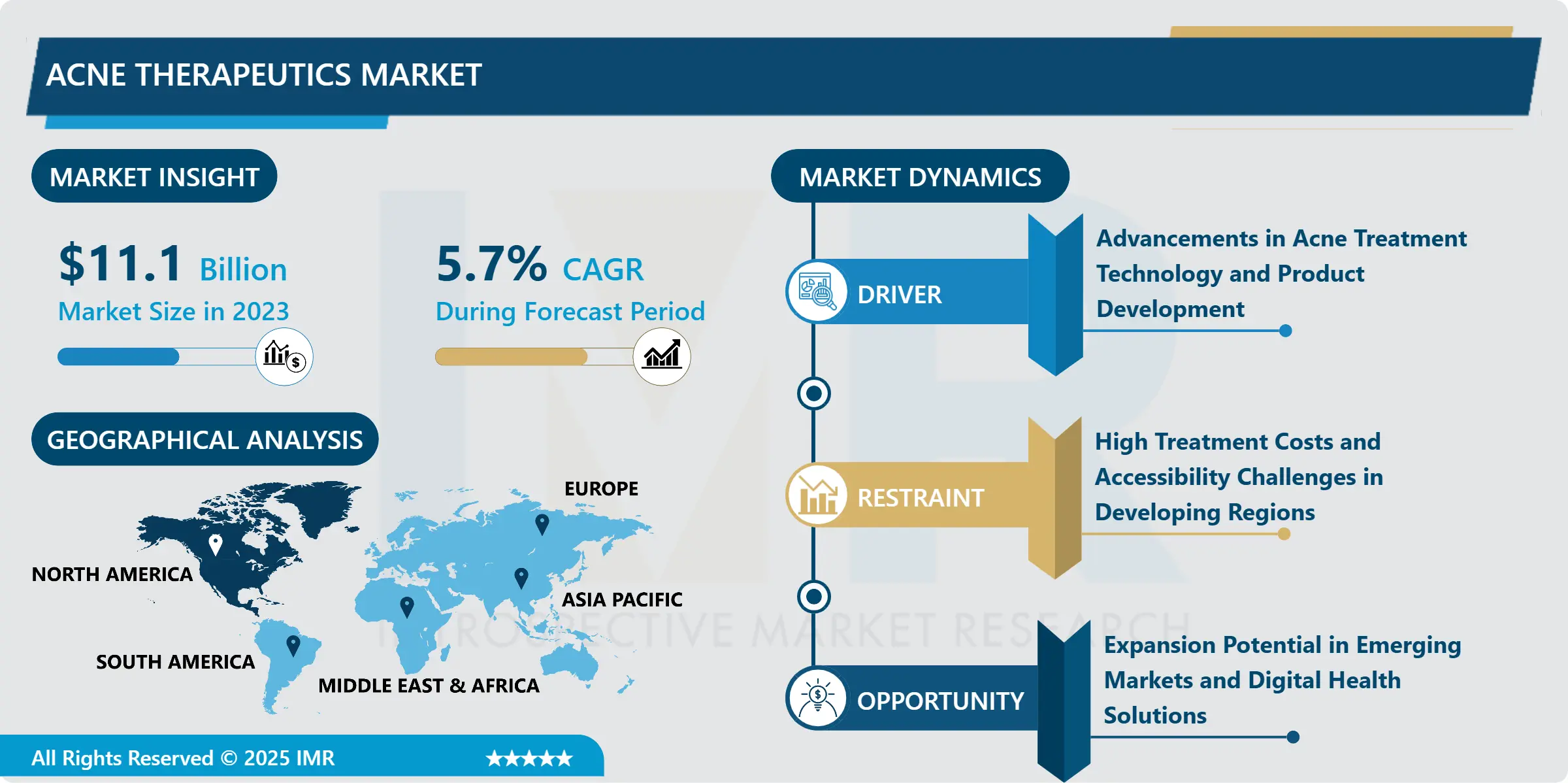
Acne Therapeutics Market Size Was Valued at USD 11.10 Billion in 2023, and is Projected to Reach USD 18.28 Billion by 2032, Growing at a CAGR of 5.70% From 2024-2032.
Acne Therapeutics Market Therefore Acne Therapeutics Market means the industry deals in treatment of acne vulgaris, which is a skin ailment which includes formation of pimple, black head and cysts. This market category consists of topical therapies (creams and gels), oral therapies (antibiotics and retinoids), and sophisticated procedures including light therapy and chemical peeling to curb breakouts and treat acne
Recent trends on acne spread, especially to teenagers and young adults have been one of the key factors that have enhance market growth. Through dietetic changes, stress, and environmental pollution being among the causes of acne formation, the need for treatment has increasingly emerged. Also, the increase in the rate of skin diseases and focusing awareness of skincare and acne treatment in the society and official positions for people makes them go for a medical checkup and proper methods.
There are certain factors that are driving the growth of the acne therapeutics market and these are technological Innovations and new products novelty. New products, including multi-drug administration and new specific-segment drugs that afford fewer side effects at relatively improved effectiveness, appeal to consumers. In addition, more over the counter products and a growing variety of prescribed medicines give patients more choice, which in turn will increase the market demand.
Acne Therapeutics Market Trend Analysis:
Use natural and organic products
-
One other feature of the development of acne therapeutics market is the trend to use natural and organic products. Another trend differentiating between ordinary cosmetics is the presence of side effects, which also influences the activity of acne care products increased popularity of plant-based or natural additives. This shift is as a result of increasing consciousness of environmentally friendly beauty products with more force from the young generation.
- Another prominent trend is Digital dermatology and telemedicine platforms that offers, consumers online consultation and a customized acne treatment plan. It is on the rise because it can conveniently, privately and easily access an expert’s advice, which may recommend treatment without the need for going to a clinic.
Increased disposable income
-
With increased disposable income, better health care facilities, and changing lifestyle there is a huge market potential in the emerging economies. There is a vast young population in regions such as Asia-Pacific and Latin America, which, along with increasing urbanization and shifts in lifestyle have led to a situation where acne has become a novel, untouched market for companies in the pharma industry as well as cosmetic brands.
- Also, dynamic progress in pharmacotherapy and appropriate engineering and innovative methods in diagnostic make it possible to develop further new treatments more appropriate to the skin type and the severity of acne. More research is being done towards establishing the causes of acne and coming up with customized treatments that target this problem hence establishing companies that deal with these areas stands to benefit from market that is expanding in as a result of increasing numbers of acne victims.
Acne Therapeutics Market Segment Analysis:
Acne Therapeutics Market is Segmented on the basis of Product Type, Drug Class, Treatment Type, End User, and Region.
By Product Type, Topical Products segment is expected to dominate the market during the forecast period
-
Cross-sectional segmentation of the acne therapeutics market can also be made based on the product type: topical products, oral products, and combination products. The topical treatments, spreading creams, gels and lotions, are applied on the skin and are often employed to treat ordinary to moderate acne. Oral medications are administered for severe forms of acne, antibiotics, and retinoids act topically as they treat acne internally. Topical therapies combined with oral therapies refer to the treatment regimen in which both topically and orally administered products are used to treat acne, which tends to work out well in treating acne than using a single treatment regimen. Retinoid type products are useful when mild acne is not responding to, or does not need, topical treatments, while azelaic acid and all of the antibiotics may be used for moderate or severe acne, as is specific to the individual patient.
By Drug Class, Retinoids segment expected to held the largest share
-
With regards to drug class, the acne therapeutics market is divided into retinoids, antibiotics, benzoyl peroxide, salicylic acid, hormonal agents and other drug classes. Retinoids are a class of compounds that are incorporated into severe forms of acne because of their abilities to unblock the pores and ease inflammation. Anti-inflammatory drugs or antibiotics like tetracycline class of drugs are commonly used to treat bacteria. Benzoyl peroxide is an OTC topical agent which has antibacterial activity against acne causing bacteria and prevent formation of comedones. Salicylic acid is an exfoliant and a skin cell shedding agent, it can be used for the treatment of milder forms of acne. Hormonal agents as part of treatment usually for female clients are agents that help control hormones that cause acne. Other drug classes may include products in the form of alpha hydroxyacids or sulfur-based products that have different treatment strategies suitable for particular forms of acne.
Acne Therapeutics Market Regional Insights:
North America is Expected to Dominate the Market Over the Forecast period
-
North America has the largest market share in the acne therapeutics market, and the trend is similar in several countries, especially the United States. The region also signifies the good healthcare facility, higher disposable income, and access to a sophisticated dermatological treatment, making the acne therapeutic highly receptive. In addition, it is backed up by efforts from key players in the pharma and biotechnology industries that consistently develop new treatments for acne furthermore the market.
- Another reason is the increasing consumer interest in acne treatments that are both efficient and have fewer side effects in North America. Hence, they are worried how they can increase the regional market share of their acne therapeutics, and the common strategies adopted include the following.
Active Key Players in the Acne Therapeutics Market
- AbbVie (USA)
- Almirall (Spain)
- Bayer AG (Germany)
- Galderma (Switzerland)
- Johnson & Johnson (USA)
- Leo Pharma (Denmark)
- Mylan N.V. (USA)
- Novartis (Switzerland)
- Pfizer (USA)
- Zydus Cadila (India)
- Other Active Players.
|
Global Acne Therapeutics Market |
|||
|
Base Year: |
2023 |
Forecast Period: |
2024-2032 |
|
Historical Data: |
2017 to 2023 |
Market Size in 2023: |
USD 11.10 Billion |
|
Forecast Period 2024-32 CAGR: |
5.70% |
Market Size in 2032: |
USD 18.28 Billion |
|
Segments Covered: |
By Product Type |
|
|
|
By Drug Class |
|
||
|
By Treatment Type |
|
||
|
By End User |
|
||
|
By Region |
|
||
|
Key Market Drivers: |
|
||
|
Key Market Restraints: |
|
||
|
Key Opportunities: |
|
||
|
Companies Covered in the report: |
|
||
Chapter 1: Introduction
1.1 Scope and Coverage
Chapter 2:Executive Summary
Chapter 3: Market Landscape
3.1 Market Dynamics
3.1.1 Drivers
3.1.2 Restraints
3.1.3 Opportunities
3.1.4 Challenges
3.2 Market Trend Analysis
3.3 PESTLE Analysis
3.4 Porter's Five Forces Analysis
3.5 Industry Value Chain Analysis
3.6 Ecosystem
3.7 Regulatory Landscape
3.8 Price Trend Analysis
3.9 Patent Analysis
3.10 Technology Evolution
3.11 Investment Pockets
3.12 Import-Export Analysis
Chapter 4: Acne Therapeutics Market by Product Type
4.1 Acne Therapeutics Market Snapshot and Growth Engine
4.2 Acne Therapeutics Market Overview
4.3 Topical Products
4.3.1 Introduction and Market Overview
4.3.2 Historic and Forecasted Market Size in Value USD and Volume Units (2017-2032F)
4.3.3 Key Market Trends, Growth Factors and Opportunities
4.3.4 Topical Products: Geographic Segmentation Analysis
4.4 Oral Medications
4.4.1 Introduction and Market Overview
4.4.2 Historic and Forecasted Market Size in Value USD and Volume Units (2017-2032F)
4.4.3 Key Market Trends, Growth Factors and Opportunities
4.4.4 Oral Medications: Geographic Segmentation Analysis
4.5 Combination Therapies
4.5.1 Introduction and Market Overview
4.5.2 Historic and Forecasted Market Size in Value USD and Volume Units (2017-2032F)
4.5.3 Key Market Trends, Growth Factors and Opportunities
4.5.4 Combination Therapies: Geographic Segmentation Analysis
Chapter 5: Acne Therapeutics Market by Drug Class
5.1 Acne Therapeutics Market Snapshot and Growth Engine
5.2 Acne Therapeutics Market Overview
5.3 Retinoids
5.3.1 Introduction and Market Overview
5.3.2 Historic and Forecasted Market Size in Value USD and Volume Units (2017-2032F)
5.3.3 Key Market Trends, Growth Factors and Opportunities
5.3.4 Retinoids: Geographic Segmentation Analysis
5.4 Antibiotics
5.4.1 Introduction and Market Overview
5.4.2 Historic and Forecasted Market Size in Value USD and Volume Units (2017-2032F)
5.4.3 Key Market Trends, Growth Factors and Opportunities
5.4.4 Antibiotics: Geographic Segmentation Analysis
5.5 Benzoyl Peroxide
5.5.1 Introduction and Market Overview
5.5.2 Historic and Forecasted Market Size in Value USD and Volume Units (2017-2032F)
5.5.3 Key Market Trends, Growth Factors and Opportunities
5.5.4 Benzoyl Peroxide: Geographic Segmentation Analysis
5.6 Salicylic Acid
5.6.1 Introduction and Market Overview
5.6.2 Historic and Forecasted Market Size in Value USD and Volume Units (2017-2032F)
5.6.3 Key Market Trends, Growth Factors and Opportunities
5.6.4 Salicylic Acid: Geographic Segmentation Analysis
5.7 Hormonal Agents
5.7.1 Introduction and Market Overview
5.7.2 Historic and Forecasted Market Size in Value USD and Volume Units (2017-2032F)
5.7.3 Key Market Trends, Growth Factors and Opportunities
5.7.4 Hormonal Agents: Geographic Segmentation Analysis
5.8 Other Drug Classes
5.8.1 Introduction and Market Overview
5.8.2 Historic and Forecasted Market Size in Value USD and Volume Units (2017-2032F)
5.8.3 Key Market Trends, Growth Factors and Opportunities
5.8.4 Other Drug Classes: Geographic Segmentation Analysis
5.9
5.9.1 Introduction and Market Overview
5.9.2 Historic and Forecasted Market Size in Value USD and Volume Units (2017-2032F)
5.9.3 Key Market Trends, Growth Factors and Opportunities
5.9.4 : Geographic Segmentation Analysis
Chapter 6: Acne Therapeutics Market by Treatment
6.1 Acne Therapeutics Market Snapshot and Growth Engine
6.2 Acne Therapeutics Market Overview
6.3 Type
6.3.1 Introduction and Market Overview
6.3.2 Historic and Forecasted Market Size in Value USD and Volume Units (2017-2032F)
6.3.3 Key Market Trends, Growth Factors and Opportunities
6.3.4 Type: Geographic Segmentation Analysis
Chapter 7: Acne Therapeutics Market by End User
7.1 Acne Therapeutics Market Snapshot and Growth Engine
7.2 Acne Therapeutics Market Overview
7.3 Hospitals
7.3.1 Introduction and Market Overview
7.3.2 Historic and Forecasted Market Size in Value USD and Volume Units (2017-2032F)
7.3.3 Key Market Trends, Growth Factors and Opportunities
7.3.4 Hospitals: Geographic Segmentation Analysis
7.4 Clinics
7.4.1 Introduction and Market Overview
7.4.2 Historic and Forecasted Market Size in Value USD and Volume Units (2017-2032F)
7.4.3 Key Market Trends, Growth Factors and Opportunities
7.4.4 Clinics: Geographic Segmentation Analysis
7.5 Homecare Settings
7.5.1 Introduction and Market Overview
7.5.2 Historic and Forecasted Market Size in Value USD and Volume Units (2017-2032F)
7.5.3 Key Market Trends, Growth Factors and Opportunities
7.5.4 Homecare Settings: Geographic Segmentation Analysis
Chapter 8: Company Profiles and Competitive Analysis
8.1 Competitive Landscape
8.1.1 Competitive Benchmarking
8.1.2 Acne Therapeutics Market Share by Manufacturer (2023)
8.1.3 Industry BCG Matrix
8.1.4 Heat Map Analysis
8.1.5 Mergers and Acquisitions
8.2 GALDERMA (SWITZERLAND)
8.2.1 Company Overview
8.2.2 Key Executives
8.2.3 Company Snapshot
8.2.4 Role of the Company in the Market
8.2.5 Sustainability and Social Responsibility
8.2.6 Operating Business Segments
8.2.7 Product Portfolio
8.2.8 Business Performance
8.2.9 Key Strategic Moves and Recent Developments
8.2.10 SWOT Analysis
8.3 JOHNSON & JOHNSON (USA)
8.4 ABBVIE (USA)
8.5 PFIZER (USA)
8.6 BAYER AG (GERMANY)
8.7 MYLAN N.V. (USA)
8.8 LEO PHARMA (DENMARK)
8.9 ALMIRALL (SPAIN)
8.10 NOVARTIS (SWITZERLAND)
8.11 ZYDUS CADILA (INDIA)
8.12 OTHER ACTIVE PLAYERS
Chapter 9: Global Acne Therapeutics Market By Region
9.1 Overview
9.2. North America Acne Therapeutics Market
9.2.1 Key Market Trends, Growth Factors and Opportunities
9.2.2 Top Key Companies
9.2.3 Historic and Forecasted Market Size by Segments
9.2.4 Historic and Forecasted Market Size By Product Type
9.2.4.1 Topical Products
9.2.4.2 Oral Medications
9.2.4.3 Combination Therapies
9.2.5 Historic and Forecasted Market Size By Drug Class
9.2.5.1 Retinoids
9.2.5.2 Antibiotics
9.2.5.3 Benzoyl Peroxide
9.2.5.4 Salicylic Acid
9.2.5.5 Hormonal Agents
9.2.5.6 Other Drug Classes
9.2.5.7
9.2.6 Historic and Forecasted Market Size By Treatment
9.2.6.1 Type
9.2.7 Historic and Forecasted Market Size By End User
9.2.7.1 Hospitals
9.2.7.2 Clinics
9.2.7.3 Homecare Settings
9.2.8 Historic and Forecast Market Size by Country
9.2.8.1 US
9.2.8.2 Canada
9.2.8.3 Mexico
9.3. Eastern Europe Acne Therapeutics Market
9.3.1 Key Market Trends, Growth Factors and Opportunities
9.3.2 Top Key Companies
9.3.3 Historic and Forecasted Market Size by Segments
9.3.4 Historic and Forecasted Market Size By Product Type
9.3.4.1 Topical Products
9.3.4.2 Oral Medications
9.3.4.3 Combination Therapies
9.3.5 Historic and Forecasted Market Size By Drug Class
9.3.5.1 Retinoids
9.3.5.2 Antibiotics
9.3.5.3 Benzoyl Peroxide
9.3.5.4 Salicylic Acid
9.3.5.5 Hormonal Agents
9.3.5.6 Other Drug Classes
9.3.5.7
9.3.6 Historic and Forecasted Market Size By Treatment
9.3.6.1 Type
9.3.7 Historic and Forecasted Market Size By End User
9.3.7.1 Hospitals
9.3.7.2 Clinics
9.3.7.3 Homecare Settings
9.3.8 Historic and Forecast Market Size by Country
9.3.8.1 Russia
9.3.8.2 Bulgaria
9.3.8.3 The Czech Republic
9.3.8.4 Hungary
9.3.8.5 Poland
9.3.8.6 Romania
9.3.8.7 Rest of Eastern Europe
9.4. Western Europe Acne Therapeutics Market
9.4.1 Key Market Trends, Growth Factors and Opportunities
9.4.2 Top Key Companies
9.4.3 Historic and Forecasted Market Size by Segments
9.4.4 Historic and Forecasted Market Size By Product Type
9.4.4.1 Topical Products
9.4.4.2 Oral Medications
9.4.4.3 Combination Therapies
9.4.5 Historic and Forecasted Market Size By Drug Class
9.4.5.1 Retinoids
9.4.5.2 Antibiotics
9.4.5.3 Benzoyl Peroxide
9.4.5.4 Salicylic Acid
9.4.5.5 Hormonal Agents
9.4.5.6 Other Drug Classes
9.4.5.7
9.4.6 Historic and Forecasted Market Size By Treatment
9.4.6.1 Type
9.4.7 Historic and Forecasted Market Size By End User
9.4.7.1 Hospitals
9.4.7.2 Clinics
9.4.7.3 Homecare Settings
9.4.8 Historic and Forecast Market Size by Country
9.4.8.1 Germany
9.4.8.2 UK
9.4.8.3 France
9.4.8.4 The Netherlands
9.4.8.5 Italy
9.4.8.6 Spain
9.4.8.7 Rest of Western Europe
9.5. Asia Pacific Acne Therapeutics Market
9.5.1 Key Market Trends, Growth Factors and Opportunities
9.5.2 Top Key Companies
9.5.3 Historic and Forecasted Market Size by Segments
9.5.4 Historic and Forecasted Market Size By Product Type
9.5.4.1 Topical Products
9.5.4.2 Oral Medications
9.5.4.3 Combination Therapies
9.5.5 Historic and Forecasted Market Size By Drug Class
9.5.5.1 Retinoids
9.5.5.2 Antibiotics
9.5.5.3 Benzoyl Peroxide
9.5.5.4 Salicylic Acid
9.5.5.5 Hormonal Agents
9.5.5.6 Other Drug Classes
9.5.5.7
9.5.6 Historic and Forecasted Market Size By Treatment
9.5.6.1 Type
9.5.7 Historic and Forecasted Market Size By End User
9.5.7.1 Hospitals
9.5.7.2 Clinics
9.5.7.3 Homecare Settings
9.5.8 Historic and Forecast Market Size by Country
9.5.8.1 China
9.5.8.2 India
9.5.8.3 Japan
9.5.8.4 South Korea
9.5.8.5 Malaysia
9.5.8.6 Thailand
9.5.8.7 Vietnam
9.5.8.8 The Philippines
9.5.8.9 Australia
9.5.8.10 New Zealand
9.5.8.11 Rest of APAC
9.6. Middle East & Africa Acne Therapeutics Market
9.6.1 Key Market Trends, Growth Factors and Opportunities
9.6.2 Top Key Companies
9.6.3 Historic and Forecasted Market Size by Segments
9.6.4 Historic and Forecasted Market Size By Product Type
9.6.4.1 Topical Products
9.6.4.2 Oral Medications
9.6.4.3 Combination Therapies
9.6.5 Historic and Forecasted Market Size By Drug Class
9.6.5.1 Retinoids
9.6.5.2 Antibiotics
9.6.5.3 Benzoyl Peroxide
9.6.5.4 Salicylic Acid
9.6.5.5 Hormonal Agents
9.6.5.6 Other Drug Classes
9.6.5.7
9.6.6 Historic and Forecasted Market Size By Treatment
9.6.6.1 Type
9.6.7 Historic and Forecasted Market Size By End User
9.6.7.1 Hospitals
9.6.7.2 Clinics
9.6.7.3 Homecare Settings
9.6.8 Historic and Forecast Market Size by Country
9.6.8.1 Turkiye
9.6.8.2 Bahrain
9.6.8.3 Kuwait
9.6.8.4 Saudi Arabia
9.6.8.5 Qatar
9.6.8.6 UAE
9.6.8.7 Israel
9.6.8.8 South Africa
9.7. South America Acne Therapeutics Market
9.7.1 Key Market Trends, Growth Factors and Opportunities
9.7.2 Top Key Companies
9.7.3 Historic and Forecasted Market Size by Segments
9.7.4 Historic and Forecasted Market Size By Product Type
9.7.4.1 Topical Products
9.7.4.2 Oral Medications
9.7.4.3 Combination Therapies
9.7.5 Historic and Forecasted Market Size By Drug Class
9.7.5.1 Retinoids
9.7.5.2 Antibiotics
9.7.5.3 Benzoyl Peroxide
9.7.5.4 Salicylic Acid
9.7.5.5 Hormonal Agents
9.7.5.6 Other Drug Classes
9.7.5.7
9.7.6 Historic and Forecasted Market Size By Treatment
9.7.6.1 Type
9.7.7 Historic and Forecasted Market Size By End User
9.7.7.1 Hospitals
9.7.7.2 Clinics
9.7.7.3 Homecare Settings
9.7.8 Historic and Forecast Market Size by Country
9.7.8.1 Brazil
9.7.8.2 Argentina
9.7.8.3 Rest of SA
Chapter 10 Analyst Viewpoint and Conclusion
10.1 Recommendations and Concluding Analysis
10.2 Potential Market Strategies
Chapter 11 Research Methodology
11.1 Research Process
11.2 Primary Research
11.3 Secondary Research
|
Global Acne Therapeutics Market |
|||
|
Base Year: |
2023 |
Forecast Period: |
2024-2032 |
|
Historical Data: |
2017 to 2023 |
Market Size in 2023: |
USD 11.10 Billion |
|
Forecast Period 2024-32 CAGR: |
5.70% |
Market Size in 2032: |
USD 18.28 Billion |
|
Segments Covered: |
By Product Type |
|
|
|
By Drug Class |
|
||
|
By Treatment Type |
|
||
|
By End User |
|
||
|
By Region |
|
||
|
Key Market Drivers: |
|
||
|
Key Market Restraints: |
|
||
|
Key Opportunities: |
|
||
|
Companies Covered in the report: |
|
||


